Internetworking Internetworking Address Resolution Protocol - - PDF document

internetworking internetworking
SMART_READER_LITE
LIVE PREVIEW

Internetworking Internetworking Address Resolution Protocol - - PDF document

Internet Protocol Suite: Transport Internet Protocol Suite: Transport TCP: Transmission Control Protocol Byte stream transfer Internet Protocol Suite Internet Protocol Suite Reliable, connection-oriented service Point-to-point


slide-1
SLIDE 1

Application Layer 1

Internet Protocol Suite Internet Protocol Suite

Srinidhi Varadarajan

Internet Protocol Suite: Transport Internet Protocol Suite: Transport

  • TCP: Transmission Control Protocol
  • Byte stream transfer
  • Reliable, connection-oriented service
  • Point-to-point (one-to-one) service only
  • UDP: User Datagram Protocol
  • Unreliable (“best effort”) datagram service
  • Point-to-point, multicast (one-to-many), and
  • broadcast (one-to-all)

Internet Protocol Suite: Network Internet Protocol Suite: Network

z IP: Internet Protocol – Unreliable service – Performs routing – Supported by routing protocols,

  • e.g. RIP, IS-IS,
  • OSPF, IGP, and BGP

z ICMP: Internet Control Message Protocol – Used by IP (primarily) to exchange error and control messages with other nodes z IGMP: Internet Group Management

Protocol

– Used for controlling multicast (one-to-many transmission) for UDP datagrams

Internet Protocol Suite: Data Link Internet Protocol Suite: Data Link

z ARP: Address Resolution Protocol – Translates from an IP (network) address to a network interface (hardware) address, e.g. IP address-to-Ethernet address or IP address-to- FDDI address z RARP: Reverse Address Resolution

Protocol

– Translates from a network interface (hardware) address to an IP (network) address

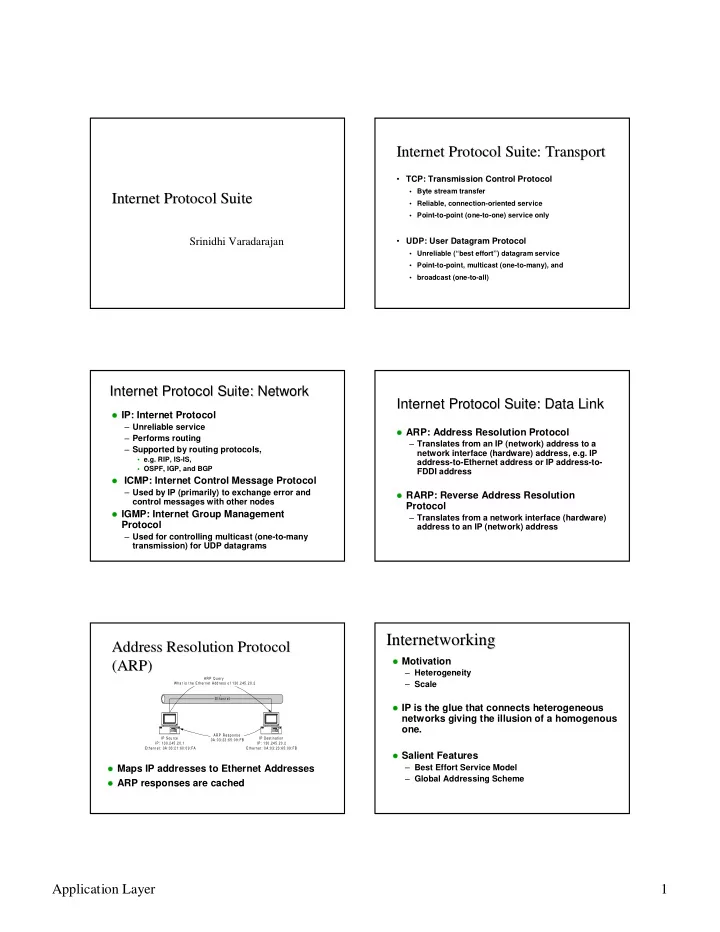
Ethernet IP Source IP: 130.245.20.1 Ethernet: 0A:03:21:60:09:FA IP Destination IP: 130.245.20.2 Ethernet: 0A:03:23:65:09:FB ARP Query What is the Ethernet Address of 130.245.20.2 ARP Response 0A:03:23:65:09:FB

Address Resolution Protocol Address Resolution Protocol (ARP) (ARP)

z Maps IP addresses to Ethernet Addresses z ARP responses are cached

Internetworking Internetworking

z Motivation – Heterogeneity – Scale z IP is the glue that connects heterogeneous

networks giving the illusion of a homogenous

  • ne.

z Salient Features – Best Effort Service Model – Global Addressing Scheme

slide-2
SLIDE 2

Application Layer 2

Internet Protocol: IP Internet Protocol: IP

z The Internet Protocol (IP) delivers

datagrams across networks through routers

z IP provides unreliable datagram service – Datagrams (packets) may or may not be delivered – Datagrams may arrive at destination out of

  • rder

– Datagrams may be arbitrarily delayed z Datagram service is not demanding on the

underlying network, thus allowing just about any network to join the Internet

Internet Protocol: IP Internet Protocol: IP

z Two transport services are commonly

built on top of IP

– Transmission Control Protocol (TCP) – User Datagram Protocol (UDP) – Other transport protocols may also use IP, e.g. the Real Time Transport Protocol (RTP, RTSP) z IP functions: – Route datagrams through the Internet – Provide Internet-wide addressing – Fragment datagrams, as needed for underlying network z Currently version: IPv4. IPv6 is “next

generation” IP

Global IP Addresses Global IP Addresses

z Properties – globally unique – hierarchical: network + host z Dot Notation – 10.3.2.4 – 128.96.33.81 – 192.12.69.77

Network Host 7 24 A: Network Host 14 16 1 B: Network Host 21 8 1 1 C:

Internet Addressing Internet Addressing

z Example: IP address for abc.xyz.net – 10000000 10101101 01011100 01100000 – 128.173.92.96 – netmask: 255.255.0.0 – network: 128.173.0.0 – hostid: 92.96

Internet Addressing Internet Addressing

z Special addresses used for broadcasting – Directed broadcast: network (or subnet) plus hostid that is all 1’s – Limited broadcast: all 1’s (network and hostid) z Example: broadcasting for abc.xyz.net – Directed broadcast (using subnet): 128.173.255.255 – Limited broadcast: 255.255.255.255 z The Address Resolution Protocol (ARP)

provides a translation between an IP address and an appropriate local network address (e.g. Ethernet physical address)

IP IP Datagrams Datagrams

z IP datagrams include – Header, minimum size of 20 bytes – Data z Data size – Less than or equal to minimum transport unit (MTU) of the underlying network z Fragmentation – Packets may need to be fragmented at intermediate nodes if packet is too big for an intermediate network

  • Path MTU less than link MTU at sender

– Receiver reassembles fragments to form entire IP packet

slide-3
SLIDE 3

Application Layer 3

IP IP Datagram Datagram Format Format

Version HLen TOS Length Ident Flags Offset TTL Protocol Checksum SourceAddr DestinationAddr Options (variable) Pad (variable)

4 8 16 19 31

Data

IP Header Fields IP Header Fields

z Identification: unique datagram identifier z Total Length: length of this datagram +

header, in bytes

– Hosts are required to accept datagrams up to 576 bytes – Many applications (e.g. NFS) accept up to 8,192 bytes – Datagram may be fragmented z Internet Header Length: length of header

in 32-bit words

IP Header Fields IP Header Fields

z Fragment Offset: offset of fragment in this

datagram in 8-byte units

z Flags: indicate – If this is last fragment, and – If datagram should not be fragmented z Time To Live: maximum number of routers

through which the datagram may pass

– Decremented at each router – Used to prevent looping in the network – Also used to limit scope of multicast datagrams

IP Header Fields IP Header Fields

z Protocol: identifies higher level protocol

that provided data

z Version: IP version identifier (currently 4) z Type of Service: – Precedence field (ignored) – Type of service (TOS) -- maximize throughput, minimize delay, maximize reliability, minimize cost (no guarantees, though) z Header Checksum: checksum over header

(protects addresses, lengths, etc.)

– 16-bit one’s complement sum

IP Header Fields IP Header Fields

z Source IP Address: full address of source

node

z Destination IP Address: full address of

destination node

z Options (rarely used, may not be

supported by routers):

– Security and handling restrictions – Record route – Loose source routing – Strict source routing