Interprocedural Analysis Last time Interprocedural analysis Today - - PDF document

interprocedural analysis
SMART_READER_LITE
LIVE PREVIEW

Interprocedural Analysis Last time Interprocedural analysis Today - - PDF document

Interprocedural Analysis Last time Interprocedural analysis Today Interprocedural alias analysis Interprocedural optimization CS553 Lecture Interprocedural Analysis and Optimization 2 Improving the Efficiency of the Iterative


slide-1
SLIDE 1

1

CS553 Lecture Interprocedural Analysis and Optimization 2

Interprocedural Analysis

Last time

– Interprocedural analysis

Today

– Interprocedural alias analysis – Interprocedural optimization

CS553 Lecture Interprocedural Analysis and Optimization 3

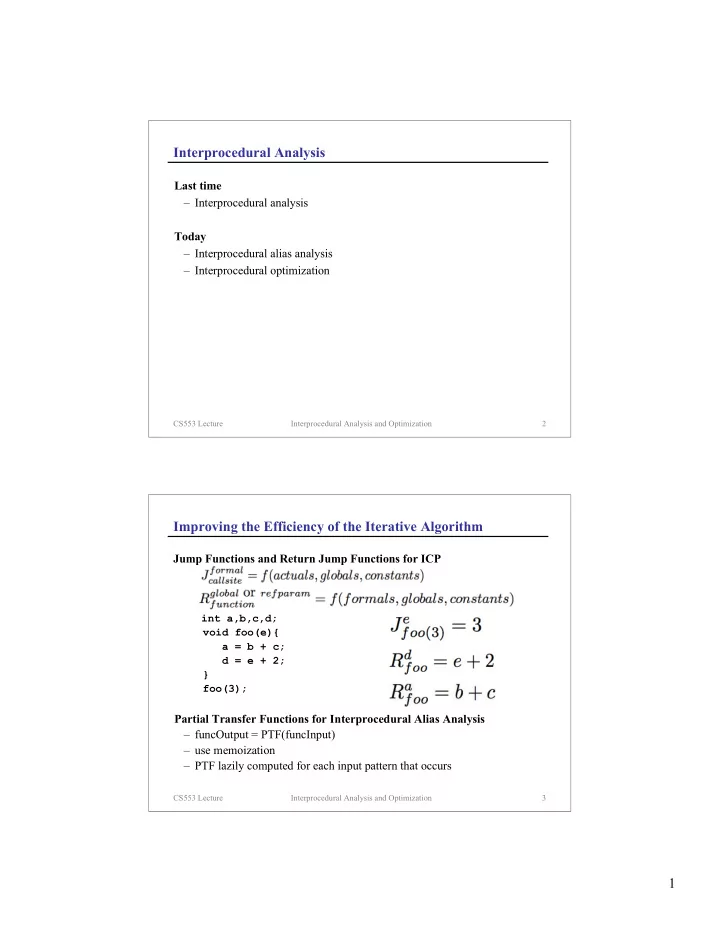
Jump Functions and Return Jump Functions for ICP

int a,b,c,d; void foo(e){ a = b + c; d = e + 2; } foo(3);

Partial Transfer Functions for Interprocedural Alias Analysis

– funcOutput = PTF(funcInput) – use memoization – PTF lazily computed for each input pattern that occurs

Improving the Efficiency of the Iterative Algorithm

slide-2
SLIDE 2

2

CS553 Lecture Interprocedural Analysis and Optimization 4

Partial Transfer Function [Wilson et. al. 95]

Example [http://www.cs.princeton.edu/~jqwu/Memory/survey.html]

main() { int *a,*b,c,d; a = &c; b = &d; S0 foo(&a, &b); for (i = 0; i<2; i++) { S1 bar(&a,&a); S2 bar(&b,&b); S3 bar(&a,&b); S4 bar(&b,&a); } } void bar(int **i, int **j) { foo(i,j); } void foo(int **x, int **y){ int *temp = *x; *x = *y; *y = temp; }

CS553 Lecture Interprocedural Analysis and Optimization 5

Characterizing Interprocedural Analysis

Definiteness

– May (possible) versus must (definite)

Flow sensitivity

– Sensitive (consider control flow) – Requires iterative data-flow analysis or similar technique – More accurate than flow-insensitive – Insensitive (ignore control flow) – Can compute in linear time – May information only

Context sensitivity

– Sensitive (polyvariant analysis) – Re-analyze callee for each caller – Variations based on how much of the call path is maintained – Insensitive (monovariant analysis) – Perform one analysis independent of callers

slide-3
SLIDE 3

3

CS553 Lecture Interprocedural Analysis and Optimization 6

Emami 1994

Overview

– Compute L and R locations to implement flow-sensitive data-flow analysis – Uses invocation graph for full context-sensitivity – Can be exponential in program size – Handles function pointers

Characterization of Emami

– Whole program – Flow-sensitive – Context-sensitive – May and must analysis – Alias representation: points-to – Heap modeling: one heap variable – Aggregate modeling: fields and first array element

CS553 Lecture Interprocedural Analysis and Optimization 7

Choi 1993

Overview

– Iterates over call graph with callsite labeled edges – Iterates over Sparse Evaluation Graph for each procedure

Characterization of Choi

– Whole program – Flow-sensitive – Context-sensitive (one-level) – May analysis – Alias representation: compact pairs (similar to points-to) – Heap modeling: k names for each malloc stmt – Aggregate modeling: fields?

slide-4
SLIDE 4

4

CS553 Lecture Interprocedural Analysis and Optimization 8

Burke 1995

Overview

– Iterates over call graph with callsite labeled edges – Iterates over Sparse Evaluation Graph for each procedure – Use kill information before propagating on call graph – Handles function pointers

Characterization of Burke

– Whole program – Flow-insensitive (kill info is propagated along call edges) – Context-sensitive – May analysis – Alias representation: compact pairs (similar to points-to) – Heap modeling: k names for each malloc stmt? – Aggregate modeling: fields?

CS553 Lecture Interprocedural Analysis and Optimization 9

Alias/Pointer Analysis Summary

slide-5
SLIDE 5

5

CS553 Lecture Interprocedural Analysis and Optimization 10

Interprocedural Analysis vs. Interprocedural Optimization

Interprocedural analysis

– Gather information across multiple procedures (typically across the entire program) – Can use this information to improve intraprocedural analyses and

  • ptimization (e.g., CSE)

Interprocedural optimizations

– Optimizations that involve multiple procedures e.g., Inlining, procedure cloning, interprocedural register allocation – Optimizations that use interprocedural analysis

CS553 Lecture Interprocedural Analysis and Optimization 11

Alternative to Interprocedural Analysis: Inlining

Idea

– Replace call with procedure body

Pros

– Reduces call overhead – Exposes calling context to procedure body – Exposes side effects of procedure to caller – Simple!

Cons

– Code bloat (decrease efficacy of caches, branch predictor, etc) – Can’t always statically determine callee (e.g., in OO languages) – Library source is usually unavailable – Can’t always inline (recursion)

slide-6
SLIDE 6

6

CS553 Lecture Interprocedural Analysis and Optimization 12

Inlining Policies

The hard question

– How do we decide which calls to inline?

Many possible heuristics

– Only inline small functions – Let the programmer decide using an inline directive – Use a code expansion budget [Ayers, et al ’97] – Use profiling or instrumentation to identify hot paths—inline along the hot paths [Chang, et al ’92] – JIT compilers do this – Use inlining trials for object oriented languages [Dean & Chambers ’94] – Keep a database of functions, their parameter types, and the benefit of inlining – Keeps track of indirect benefit of inlining – Effective in an incrementally compiled language Oblivious to callsite

CS553 Lecture Interprocedural Analysis and Optimization 13

Inlining versus Interprocedural Analysis

How effective is inlining?

– Richardson & Ganapathi [1989] compared it to interprocedural analysis – Context – Pascal on RISC processors – Used interprocedural USE, MOD, ALIASES information

Results

– Interprecedural analysis resulted in small benefit (<2%) – Simple link-time inlining provided more benefit (10%)

slide-7
SLIDE 7

7

CS553 Lecture Interprocedural Analysis and Optimization 14

Alternative to Interprocedural Analysis: Cloning

Procedure Cloning/Specialization

– Create a customized version of procedure for particular call sites – Compromise between inlining and interprocedural optimization

Pros

– Less code bloat than inlining – Recursion is not an issue (as compared to inlining) – Better caller/callee optimization potential (versus interprocedural analysis)

Cons

– Still some code bloat (versus interprocedural analysis) – May have to do interprocedural analysis anyway – e.g. Interprocedural constant propagation can guide cloning

CS553 Lecture Interprocedural Analysis and Optimization 15

Procedure Cloning

Abstract implementation

– Given a set of call sites to procedure p e.g., {c1,c2,c3,c4,c5,c6} – Partition them into equivalence classes of “similar” call sites e.g., {{c1,c4},{c2,c3},{c6}} – Meaning of “similar” depends on the intended benefit e.g., For constant propagation, partition according to constant valued actual parameters

Important question

– How do we partition the call sites?

slide-8
SLIDE 8

8

CS553 Lecture Interprocedural Analysis and Optimization 16

Evaluation

Why don’t many compilers use interprocedural analysis?

– Benefits on optimization have not been well explored – Common view: not beneficial for most scalar optimizations – It’s expensive and complex – Separate compilation + interprocedural analysis requires recompilation analysis [Burke and Torczon’93] – Can’t analyze library code

When is it useful?

– Pointer analysis – Parallelization – Constant propagation – Object oriented class analysis – Error checking

CS553 Lecture Interprocedural Analysis and Optimization 17

Trends

Questions

– Is interprocedural analysis really useful? – Is it worth doing anything beyond inlining?

Trends

– Cost of procedures is growing – More of them and they’re smaller (OO languages) – Modern machines demand precise information (memory op aliasing) – Cost of inlining is growing – Code bloat degrades efficacy of many modern structures – Procedures are being used more extensively – Programs are becoming larger – Cost of interprocedural analysis is shrinking – Faster machines – Better methods

slide-9
SLIDE 9

9

CS553 Lecture Interprocedural Analysis and Optimization 18

Trends (cont)

Trends

– Call graph construction is complicated by modern languages – Dynamic binding of methods – Dynamically loaded code

Summary

– Interprocedural analysis (and cloning) are becoming more important

CS553 Lecture Interprocedural Analysis and Optimization 19

Historical Note: Interprocedural Alias Analysis

Until recently

– Interprocedural alias analysis was mostly concerned with detecting aliasing formal parameters and globals (in call-by-var context) – Perhaps the general (i.e., C) problem was viewed as hopeless

Recently (c. 2003-2004)

– Pointer analysis using Binary Decision Diagrams (BDDs) – http://www.sable.mcgill.ca/bdd/BDD – http://bddbddb.sourceforge.net/ – Approach to handle context-sensitivity in an efficient manner

slide-10
SLIDE 10

10

CS553 Lecture Interprocedural Analysis and Optimization 20

Concepts

Partial transfer functions for context-sensitive alias analysis Different kinds of context-sensitivity Comparison of alias analysis algorithms in terms of context and flow

sensitivity

Alternatives to interprocedural analysis

– Inlining – Procedure cloning

CS553 Lecture Interprocedural Analysis and Optimization 21

Next Time

Reading

– Ch 16 in Muchnick, focus on 16.3.11

Next lecture

– Register allocation