Intro to the Internet of Things Marco Zennaro, PhD T/ICT4D - - PowerPoint PPT Presentation

intro to the internet of things
SMART_READER_LITE
LIVE PREVIEW

Intro to the Internet of Things Marco Zennaro, PhD T/ICT4D - - PowerPoint PPT Presentation

Intro to the Internet of Things Marco Zennaro, PhD T/ICT4D Laboratory The Abdus Salam International Centre for Theoretical Physics Vision History of IoT The first telemetry system was rolled out in Chicago way back in 1912. It is said to


slide-1
SLIDE 1

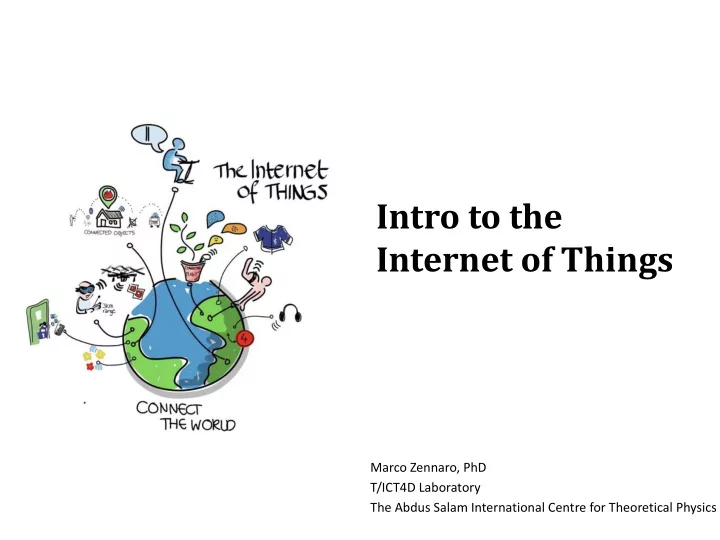
Intro to the Internet of Things

Marco Zennaro, PhD T/ICT4D Laboratory The Abdus Salam International Centre for Theoretical Physics
slide-2
SLIDE 2

Vision

slide-3
SLIDE 3

History of IoT

  • The first telemetry system was rolled out in Chicago way

back in 1912. It is said to have used telephone lines to monitor data from power plants.

  • Telemetry expanded to weather monitoring in the 1930s,

when a device known as a radiosonde became widely used to monitor weather conditions from balloons.

  • In 1957 the Soviet Union launched Sputnik, and with it the

Space Race. This has been the entry of aerospace telemetry that created the basis of our global satellite communications today.

slide-4
SLIDE 4

History of IoT

  • Broad adoption of M2M technology began in the 1980s

with wired connections for SCADA (supervisory control and data acquisition) on the factory floor and in home and business security systems.

  • In the 1990s, M2M began moving toward wireless
  • technologies. ADEMCO built their own private radio

network to address intrusion and smoke detection because budding cellular connectivity was too expensive.

  • In 1995, Siemens introduced the first cellular module built

for M2M.

slide-5
SLIDE 5

History of IoT

slide-6
SLIDE 6

Why IoT now?

  • Ubiquitous Connectivity
  • Widespread Adoption of IP
  • Computing Economics
  • Miniaturization
  • Advances in Data Analytics
  • Rise of Cloud Computing
slide-7
SLIDE 7

RPi Zero: $5

slide-8
SLIDE 8

IoT Definition

slide-9
SLIDE 9

ITU Definition

  • Recommendation ITU-T Y.2060 provides an
  • verview of the Internet of Things (IoT). It

clarifies the concept and scope of the IoT, identifies the fundamental characteristics and high-level requirements of the IoT and describes the IoT reference model.

  • Date: 2012-06-15
slide-10
SLIDE 10

ITU Definition

“The IoT can be viewed as a global infrastructure for the information society, enabling advanced services by interconnecting (physical and virtual) things based on existing and evolving interoperable information and communication technologies (ICT).”

Source: Recommendation ITU-T Y.2060

slide-11
SLIDE 11

Things

Things are

  • bjects
  • f

the physical world (physical things) or of the information world (virtual world) which are capable of being identified and integrated into communication

  • networks. Things have associated information,

which can be static and dynamic.

Source: Recommendation ITU-T Y.2060

slide-12
SLIDE 12

Things

  • Physical things exist in the physical world and are

capable of being sensed, actuated and

  • connected. Examples of physical things include

the surrounding environment, industrial robots, goods and electrical equipment.

  • Virtual things exist in the information world and

are capable of being stored, processed and

  • accessed. Examples of virtual things include

multimedia content and application software.

Source: Recommendation ITU-T Y.2060

slide-13
SLIDE 13

ITU Definition

Source: Recommendation ITU-T Y.2060

slide-14
SLIDE 14

Any-Time/Place/Thing

Source: Recommendation ITU-T Y.2060

slide-15
SLIDE 15

Predictions

slide-16
SLIDE 16

ITU Definition

A device is a piece of equipment with the mandatory capabilities of communication and

  • ptional capabilities of sensing, actuation, data

capture, data storage and data processing. The devices collect various kinds of information and provide it to the information and communication networks for further processing. Some devices also execute operations based on information received from the information and communication networks.

Source: Recommendation ITU-T Y.2060

slide-17
SLIDE 17

Type of Devices

Source: Recommendation ITU-T Y.2060

slide-18
SLIDE 18

Fundamental characteristics

  • Interconnectivity: With regard to the IoT, anything can be

interconnected with the global information and communication infrastructure.

  • Heterogeneity: The devices in the IoT are heterogeneous as

based on different hardware platforms and networks. They can interact with other devices or service platforms through different networks.

  • Dynamic changes: The state of devices change dynamically,

e.g., sleeping and waking up, connected and/or disconnected as well as the context of devices including location and speed. Moreover, the number of devices can change dynamically.

Source: Recommendation ITU-T Y.2060

slide-19
SLIDE 19

Fundamental characteristics

  • Enormous scale: The number of devices that

need to be managed and that communicate with each other will be at least an order of magnitude larger than the devices connected to the current Internet. The ratio of communication triggered by devices as compared to communication triggered by humans will noticeably shift towards device- triggered communication.

Source: Recommendation ITU-T Y.2060

slide-20
SLIDE 20

High-level requirements

  • Identification-based connectivity: The IoT needs to support that

the connectivity between a thing and the IoT is established based

  • n the thing's identifier. Also, this includes that possibly

heterogeneous identifiers of the different things are processed in a unified way.

  • Interoperability: Interoperability needs to be ensured among

heterogeneous and distributed systems for provision and consumption of a variety of information and services.

  • Autonomic networking: Autonomic networking (including self-

management, self-configuring, self-healing, self-optimizing and self- protecting techniques and/or mechanisms) needs to be supported in the networking control functions of the IoT, in order to adapt to different application domains, different communication environments and large numbers and types of devices.

Source: Recommendation ITU-T Y.2060

slide-21
SLIDE 21

High-level requirements

  • Location-based capabilities: Location-based capabilities need to be

supported in the IoT.

  • Security: In the IoT, every 'thing' is connected which results in

significant security threats, such as threats towards confidentiality, authenticity and integrity of both data and services. A critical example of security requirements is the need to integrate different security policies and techniques related to the variety of devices and user networks in the IoT.

  • Privacy protection: Privacy protection needs to be supported in the
  • IoT. Many things have their owners and users. Sensed data of things

may contain private information concerning their owners or users. The IoT needs to support privacy protection during data transmission, aggregation, storage, mining and processing.

Source: Recommendation ITU-T Y.2060

slide-22
SLIDE 22

High-level requirements

  • Plug and play: Plug and play capability needs to be

supported in the IoT in order to enable on-the-fly generation, composition or the acquiring of semantic- based configurations for seamless integration and cooperation of interconnected things with applications, and responsiveness to application requirements.

  • Manageability: Manageability needs to be supported

in the IoT in order to ensure normal network

  • perations. IoT applications usually work automatically

without the participation of people, but their whole

  • peration process should be manageable by the

relevant parties.

Source: Recommendation ITU-T Y.2060

slide-23
SLIDE 23

IoT reference model

Source: Recommendation ITU-T Y.2060

slide-24
SLIDE 24

Predictions

Source: Cisco IBSG, April 2011

slide-25
SLIDE 25

Predictions

slide-26
SLIDE 26

Predictions

Source: http://www.postscapes.com/what-exactly-is-the-internet-of-things-infographic/

slide-27
SLIDE 27

Internet of Fewer Things

http://spectrum.ieee.org/telecom/internet/the-internet-of-fewer-things

slide-28
SLIDE 28

Internet of Fewer Things

http://spectrum.ieee.org/telecom/internet/the-internet-of-fewer-things

slide-29
SLIDE 29

Predictions

slide-30
SLIDE 30

2011

slide-31
SLIDE 31

2016

slide-32
SLIDE 32

Interest: Google Trends

slide-33
SLIDE 33

Interest: #iot on Twitter

slide-34
SLIDE 34

ITU Definition

slide-35
SLIDE 35

Sensor Nodes

  • Main components of a WSN node
  • Controller
  • Communication device(s)
  • Sensors/actuators
  • Memory
  • Power supply
slide-36
SLIDE 36

Sensor Nodes

Memory Controller Sensor(s)/ actuator(s) Communication device Power supply

slide-37
SLIDE 37

Sensor Nodes

Memory Controller Sensor(s)/ actuator(s) Communication device Power supply

slide-38
SLIDE 38

Network Connectivity

Key aspects when considering network connectivity:

  • Range - are you deploying to a single office floor or

an entire city?

  • Data Rate - how much bandwidth do you require?

How often does your data change?

  • Power - is your sensor running on mains or battery?
  • Frequency - have you considered channel blocking

and signal interference?

  • Security - will your sensors be supporting mission

critical applications?

slide-39
SLIDE 39

Network Connectivity

Source: http://www.postscapes.com/what-exactly-is-the-internet-of-things-infographic/

slide-40
SLIDE 40

Network Connectivity

slide-41
SLIDE 41

IPv6

Smart Objects will add tens of billions of additional devices There is no scope for IPv4 to support Smart Object Networks IPv6 is the only viable way forward Solution to address exhaustion Stateless Auto-configuration thanks to Neighbor Discovery Protocol Each embedded node can be individually addressed/accessed

slide-42
SLIDE 42

Connectivity Landscape

From https://publisher.opensensors.io/connectivity

slide-43
SLIDE 43

Connectivity Landscape

slide-44
SLIDE 44

Sensors

Source: http://www.postscapes.com/what-exactly-is-the-internet-of-things-infographic/

slide-45
SLIDE 45

Sensors

slide-46
SLIDE 46

Applications

slide-47
SLIDE 47

Applications

slide-48
SLIDE 48

Predictions

slide-49
SLIDE 49
slide-50
SLIDE 50

Predictions

slide-51
SLIDE 51

Predictions

slide-52
SLIDE 52

Applications

slide-53
SLIDE 53
slide-54
SLIDE 54

Predictions

slide-55
SLIDE 55

IoT Landscape

slide-56
SLIDE 56

Web of Things

  • Is one vision of the IoT
  • Inspired by the World Wide Web
  • Objects connect through the Web
  • Objects use Web protocols (&

technologies & tools)

  • Adoption of the RESTful architecture
slide-57
SLIDE 57

WSN

  • Multihop
  • Autonomous

– Low-Power – Low-Throughput – No Maintenance

  • Fault-tolerant
  • Data-collect
  • Gateways

Traditionally:

slide-58
SLIDE 58

WSN

Multihop Data Collection Common Destination

slide-59
SLIDE 59

WSN

  • µC

– 8-16kB RAM, 48-128kB Flash – A few MHz

  • 802.15.4 radio
  • a few sensors
  • GPIO
  • Some external flash (1-8 Mbit)
  • Batteries
  • Cheap
slide-60
SLIDE 60

WSN

  • Now becoming a subset of IoT

WSN

Bidirectionnal Data Patterns

response

Full end-to-end IPv6

IPv6 IPv6

slide-61
SLIDE 61

WSN

  • Multihop
  • Autonomous

– Low-Power – Low-Throughput – No Maintenance

  • Fault-tolerant
  • Data-collect
  • Gateways

Traditionally:

slide-62
SLIDE 62

Thank You