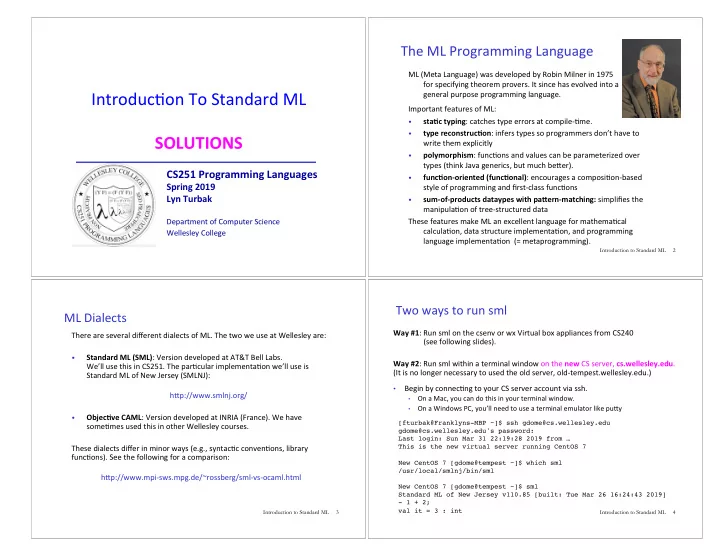
Introduc)on To Standard ML general purpose programming language. - - PowerPoint PPT Presentation

introduc on to standard ml
SMART_READER_LITE
LIVE PREVIEW

Introduc)on To Standard ML general purpose programming language. - - PowerPoint PPT Presentation

The ML Programming Language ML (Meta Language) was developed by Robin Milner in 1975 for specifying theorem provers. It since has evolved into a Introduc)on To Standard ML general purpose programming language. Important features of ML: sta?c


slide-1
SLIDE 1

Introduc)on To Standard ML SOLUTIONS

CS251 Programming Languages

Spring 2019 Lyn Turbak

Department of Computer Science Wellesley College

The ML Programming Language

ML (Meta Language) was developed by Robin Milner in 1975 for specifying theorem provers. It since has evolved into a general purpose programming language. Important features of ML:

  • sta?c typing: catches type errors at compile-)me.
  • type reconstruc?on: infers types so programmers don’t have to

write them explicitly

  • polymorphism: func)ons and values can be parameterized over

types (think Java generics, but much beRer).

  • func?on-oriented (func?onal): encourages a composi)on-based

style of programming and first-class func)ons

  • sum-of-products dataypes with paIern-matching: simplifies the

manipula)on of tree-structured data These features make ML an excellent language for mathema)cal calcula)on, data structure implementa)on, and programming language implementa)on (= metaprogramming).

Introduction to Standard ML 2

ML Dialects

There are several different dialects of ML. The two we use at Wellesley are:

  • Standard ML (SML): Version developed at AT&T Bell Labs.

We’ll use this in CS251. The par)cular implementa)on we’ll use is Standard ML of New Jersey (SMLNJ): hRp://www.smlnj.org/

  • Objec?ve CAML: Version developed at INRIA (France). We have

some)mes used this in other Wellesley courses. These dialects differ in minor ways (e.g., syntac)c conven)ons, library func)ons). See the following for a comparison: hRp://www.mpi-sws.mpg.de/~rossberg/sml-vs-ocaml.html

Introduction to Standard ML 3

Two ways to run sml

Way #1: Run sml on the csenv or wx Virtual box appliances from CS240 (see following slides). Way #2: Run sml within a terminal window on the new CS server, cs.wellesley.edu. (It is no longer necessary to used the old server, old-tempest.wellesley.edu.)

  • Begin by connec)ng to your CS server account via ssh.
  • On a Mac, you can do this in your terminal window.
  • On a Windows PC, you’ll need to use a terminal emulator like puRy

[fturbak@Franklyns-MBP ~]$ ssh gdome@cs.wellesley.edu gdome@cs.wellesley.edu's password: Last login: Sun Mar 31 22:19:28 2019 from … This is the new virtual server running CentOS 7 New CentOS 7 [gdome@tempest ~]$ which sml /usr/local/smlnj/bin/sml New CentOS 7 [gdome@tempest ~]$ sml Standard ML of New Jersey v110.85 [built: Tue Mar 26 16:24:43 2019]

  • 1 + 2;

val it = 3 : int

Introduction to Standard ML 4

slide-2
SLIDE 2

Two ways to run sml

Way #1: Run sml on the csenv or wx Virtual box appliances from CS240 (see following slides). Way #2: Run sml within a terminal window the new CS server, cs.wellesley.edu. (It is no longer necessary to used the old server, old-tempest.wellesley.edu.)

  • Begin by connec)ng to your CS server account via ssh.
  • On a Mac, you can do this in your terminal window.
  • On a Windows PC, you’ll need to use a terminal emulator like puRy

[fturbak@Franklyns-MBP ~]$ ssh gdome@cs.wellesley.edu gdome@cs.wellesley.edu's password: Last login: Sun Mar 31 22:19:28 2019 from … This is the new virtual server running CentOS 7 New CentOS 7 [gdome@tempest ~]$ which sml /usr/local/smlnj/bin/sml New CentOS 7 [gdome@tempest ~]$ sml Standard ML of New Jersey v110.85 [built: Tue Mar 26 16:24:43 2019]

  • 1 + 2;

val it = 3 : int

Introduction to Standard ML 5

SML and csenv/wx

We will use SML inside the csenv Virtual Machine appliance. Details on how to install csenv and install SML within csenv are available on the CS251 schedule page. For ini)al examples, it’s easiest to run SML in a terminal window, as shown above. But we’ll soon see (slides 19-21) running it in Emacs is much beRer!

Introduction to Standard ML 6

[wx@wx ~] sml Standard ML of New Jersey v110.78 [built: Wed Jan 14 12:52:09 2015]

  • 1 + 2;

val it = 3 : int

  • 3+4;

val it = 7 : int

  • 5+6

= ; val it = 11 : int

  • 7

= + = 8; val it = 15 : int

Learning SML by Interac)ve Examples

Try out these examples. (Note: many answers are missing in these slides so you can predict them. See the solu;on slides for answers.)

Introduction to Standard ML 7

Naming Values Solu)ons

  • val a = 2 + 3;

val a = 5 : int

  • a * a;

val it = 25 : int

  • it + a;

val it = 30 : int

Introduction to Standard ML 8

slide-3
SLIDE 3

Nega)ve Quirks

  • 2 - 5;

val it = ~3 : int

  • -17;

stdIn:60.1 Error: expression or pattern begins with infix identifier "-" stdIn:60.1-60.4 Error: operator and operand don't agree [literal]

  • perator domain: 'Z * 'Z
  • perand: int

in expression:

  • 17
  • ~17;

val it = ~17 : int

  • 3 * ~1;

val it = ~3 : int

Introduction to Standard ML 9

Division Quirks

  • 7 / 2;

stdIn:1.1-1.6 Error: operator and operand don't agree [literal]

  • perator domain: real * real
  • perand: int * int

in expression: 7 / 2

  • 7.0 / 2.0;

val it = 3.5 : real

  • 7 div 2; (* integer division *)

val it = 3 : int

(* For a description of all top-level operators, see: http://www.standardml.org/Basis/top-level-chapter.html *)

Introduction to Standard ML 10

Simple Func)ons Solu)ons

  • val inc = fn x => x + 1;

val inc = fn : int -> int (* SML figures out type! *)

  • inc a;

val it = 6 : int

  • fun dbl y = y * 2;

(* Syntactic sugar for val dbl = fn y => y * 2 *) val dbl = fn : int -> int

  • dbl 5;

val it = 10 : int

  • (fn x => x * 3) 10; (* Dont need to name function

to use it *) val it = 30 : int

Introduction to Standard ML 11

  • dbl(5); (* parens are optional here *)

val it = 10 : int

  • (dbl 5); (* parens are optional here *)

val it = 10 : int

  • inc (dbl 5); (* parens for argument subexpressions are required! *)

val it = 11 : int

  • (inc dbl) 5;

stdIn:1.2-2.2 Error: operator and operand don't agree [tycon mismatch]

  • perator domain: int
  • perand: int -> int

in expression: inc dbl

  • inc dbl 5; (* default left associativity for application *)

stdIn:22.1-22.10 Error: operator and operand don't agree [tycon mismatch]

  • perator domain: int
  • perand: int -> int

in expression: inc dbl

When Parentheses MaRer

Introduction to Standard ML 12

slide-4
SLIDE 4
  • 1 = 1;

val it = true : bool

  • 1 > 2;

val it = false : bool

  • (1 = 1) andalso (1 > 2);

val it = false : bool

  • (1 = 1) orelse (1 = 2);

val it = true : bool

  • (3 = 4) andalso (5 = (6 div 0)); (* short-circuit evaluation *)

val it = false : bool

  • fun isEven n = (n mod 2) = 0;

val isEven = fn : int -> bool (* SML figures out type! *)

  • isEven 17;

val it = false : bool

  • isEven 6;

val it = true : bool

Booleans Solu)ons

Introduction to Standard ML 13

Condi)onals Solu)ons

  • fun f n = if n > 10 then 2 * n else n * n;

val f = fn : int -> int

  • f 20;

val it = 40 : int

  • f 5;

val it = 25 : int

Introduction to Standard ML 14

Recursion Solu)ons

  • fun fact n =

= if n = 0 then = 1 = else = n * (fact (n - 1)); (* fun names have recursive scope *) val fact = fn : int -> int (* simpler than Java definition b/c no explicit types! *)

  • fact 5;

val it = 120 : int

  • fact 12;

val it = 479001600 : int

  • fact 13;

uncaught exception Overflow [overflow] raised at: <file stdIn> (* SML ints have limited size L *)

Introduction to Standard ML 15

Easier to Put Your Code in a File

(* This is the contents of the file ~cs251/download/sml/mydefns.sml ‘ (* By the way, comments nest properly in SML! *) It defines integers a and b and functions named sq, hyp, and fact *) val a = 2 + 3 val b = 2 * a fun sq n = n * n (* squaring function *) (* calculate hypotenuse of right triangle with sides a and b *) fun hyp a b = Math.sqrt(Real.fromInt(sq a + sq b)) fun fact n = (* a recursive factorial function *) if n = 0 then 1 else n * (fact (n - 1))

  • File is a sequence of value/func)on defini)ons.
  • Defini)ons are not followed by semi-colons in files!
  • There are no con?nua?on characters (equal signs) for mul)ple-line defini)ons.
  • Introduction to Standard ML

16

slide-5
SLIDE 5

Using Code From a File

  • Posix.FileSys.getcwd(); (* current working directory *)

val it = "/students/gdome" : string

  • Posix.FileSys.chdir("/students/gdome/cs251/sml");

(* change working directory *) val it = () : unit

  • Posix.FileSys.getcwd();

val it = "/students/gdome/cs251/sml" : string

  • use "mydefns.sml"; (* load defns from file as if *)

[opening mydefns.sml] (* they were typed manually *) val a = 5 : int val b = 10 : int val sq = fn : int -> int val hyp = fn : int -> int -> real val fact = fn : int -> intval it = () : unit

  • fact a

val it = 120 : int

Introduction to Standard ML 17

Another File Example

  • use "test-fact.sml";

[opening test-fact.sml] val fact_3 = 6 : int val fact_a = 120 : int val it = () : unit

(* This is the contents of the file test-fact.sml *) val fact_3 = fact 3 val fact_a = fact a

Introduction to Standard ML 18

Nested File Uses

  • use "load-fact.sml";

[opening load-fact.sml] [opening mydefns.sml] val a = 5 : int val b = 10 : int val sq = fn : int -> int val hyp = fn : int -> int -> real val fact = fn : int -> intval [opening test-fact.sml] val fact_3 = 6 : int val fact_a = 120 : int val it = () : unit val it = () : unit

(* The contents of the file load-fact.sml *) use "mydefns.sml"; (* semi-colons are required here *) use “test-fact.sml";

Introduction to Standard ML 19

Use Emacs within csenv/wx for all your SML edi)ng/tes)ng

Introduction to Standard ML 20

*sml* interpreter buffer. Evaluate SML expressions here. Create this via M-x sml or C-c C-b or C-c C-s (see next slide). Emacs editor buffer in SML mode. Edit your SML code here. Launch Emacs by clicking on the icon, or executing emacs & (to create a new Emacs window) or emacs –nw (to run Emacs directly in the shell..)

slide-6
SLIDE 6

Learn Emacs!

Introduction to Standard ML 21

  • For an overview of Emacs, see https://www.gnu.org/software/emacs/tour/
  • Run the interactive Emacs tutorial:
  • Launch Emacs
  • Type Ctrl-h followed by t
  • Refer to the Gnu Emacs Reference Card

Use Emacs SML commands to start *sml* interpreter buffer and send editor buffer contents to it

Introduction to Standard ML 22

SML>Process>Switch to SML repl (or C-c C-s) moves the cursor to the

*sml* interpreter buffer (crea)ng it if it does not exist. This is just like the SML interpreter buffer in a terminal window, but it’s in an Emacs buffer.

SML>Process>Send buffer (or C-c C-b) sends the contents of the

SML editor buffer to the *sml* buffer (crea)ng it if it does not exist). This is much more convenient than use for loading the contents of a file into the *sml* buffer.

How to exit SML interpreter?

[wx@wx ~] sml Standard ML of New Jersey v110.78 [built: Wed Jan 14 12:52:09 2015]

  • 1 + 2;

val it = 3 : int

  • [gdome@tempest ~]

Introduction to Standard ML 23

Type Control-d at the SML prompt

Your turn: fib Solu)ons

(define (fib n) (if (< n 2) n (+ (fib (- n 1)) (fib (- n 2)))))

Introduction to Standard ML 24

In an Emacs buffer, translate the following recursive Racket func)on into SML, and then test your SML fib func)on in the *sml* interpreter buffer. fun fib n = if n < 2 then 1 else fib(n-1) + fib(n-2) [opening /tmp/emacs-region12173z61] val fib = fn : int -> int val it = () : unit

  • fib 10;

val it = 55 : int

slide-7
SLIDE 7
  • "foobar";

val it = "foobar" : string

  • "foo" ^ "bar" ^ "baz";

val it = "foobarbaz" : string

  • print ("baz" ^ "quux");

bazquuxval it = () : unit (* printout followed by value *)

  • print ("baz" ^ "quux\n"); (* parens are essential here! *)

bazquux val it = () : unit

  • print "baz" ^ "quux\n";

stdIn:1.1-1.23 Error: operator and operand don't agree [tycon mismatch]

  • perator domain: string * string
  • perand: unit * string

in expression: print "baz" ^ "quux\n"

Strings Solu)ons

Introduction to Standard ML 25

Other String Opera)ons Solu)ons

  • String.size ("foo" ^ "bar");

val it = 6 : int

  • String.substring ("abcdefg", 2, 3); (* string, start index, len *)

val it = "cde" : string ("bar" < "foo", "bar" <= "foo", "bar" = "foo", "bar" > "foo"); val it = (true,true,false,false) : bool * bool * bool * bool

  • (String.compare("bar", "foo"), String.compare("foo", "foo"),

= String.compare("foo", "bar")); val it = (LESS,EQUAL,GREATER) : order * order * order

  • String.size;

val it = fn : string -> int

  • String.substring;

val it = fn : string * int * int -> string

  • String.compare;

val it = fn : string * string -> order (* An API for all SMLNJ String operations can be found at: http://www.standardml.org/Basis/string.html *)

Introduction to Standard ML 26

Characters Solu)ons

  • #"a";

val it = #"a" : char

  • String.sub ("foobar",0);

val it = #"f" : char

  • String.sub ("foobar",5);

val it = #"r" : char

  • String.sub ("foobar",6);

uncaught exception Subscript [subscript out of bounds] raised at: stdIn:17.1-17.11

  • String.str #"a"; (* convert a char to a string *)

val it = "a" : string

  • (String.str (String.sub ("ABCD",2))) ^ "S"

= ^ (Int.toString (112 + 123)); val it = "CS235" : string

  • (1+2, 3=4, "foo" ^ "bar", String.sub("baz",2));

val it = (3,false,"foobar,#"z ) : int * bool * string * char

Introduction to Standard ML 27

Tuples Solu)ons

  • val tpl = (1 + 2, 3 < 4, 5 * 6, 7 = 8);

val tpl = (3,true,30,false) : int * bool * int * bool

  • #1 tpl;

val it = 3: int

  • #2 tpl;

val it = true : bool (* In practice, *always* use pattern matching with tuples (see later slides) rather than #1, #2, etc. *)

  • ((#1 tpl) + (#3 tpl), (#2 tpl) orelse (#4 tpl));

val it = (33,true) : int * bool

Introduction to Standard ML 28

slide-8
SLIDE 8

PaRern-matching Tuple Func)on Arguments Solu)ons

  • fun swap (x,y) = (y, x);

val swap = fn : 'a * 'b -> 'b * 'a (* infers polymorphic type! 'a and 'b stand for any two types. *)

  • swap (1+2, 3=4);

val it = (false,3) : bool * int

  • swap (swap (1+2, 3=4));

val it = (3,false) : int * bool

  • swap ((1+2, 3=4), ("foo" ^ "bar", String.sub("baz",2)));

val it = (("foobar",#"z"),(3,false)) : (string * char) * (int * bool)

Introduction to Standard ML 29

  • fun avg1 (x, y) = (x + y) div 2; (* Approach 1: use pairs *)

val avg1 = fn : int * int -> int

  • avg1 (10,20);

val it = 15 : int

  • fun avg2 x = (fn y => (x + y) div 2); (* Approach 2: currying *)

val avg2 = fn : int -> int -> int

  • avg2 10 20;

val it = 15 : int

  • fun avg3 x y = (x + y) div 2; (* Syntactic sugar for currying *)

val avg3 = fn : int -> int -> int

  • avg3 10 20;

val it = 15 : int

  • app5 (avg3 15);

val it = 10 : int

  • app5 (fn i => avg1(15,i));

val it = 10 : int

How to Pass Mul)ple Arguments

Introduction to Standard ML 30

Func)ons as Arguments Solu)ons

  • fun app5 f = f 5;

val app5 = fn : (int -> 'a) -> 'a (* infers polymorphic type! 'a stands for “any type” *)

  • app5 (fn x => x + 1);

val it = 6 : int

  • app5 (fn n => n > 0);

val it = true : bool

  • fun dbl y = 2*y;

val dbl = fn : int -> int

  • app5 dbl;

val it = 10 : int Well see later that func)ons can also be returned as results from other func)ons and stored in data structures, so func)ons are first-class in SML just as in Racket.

Introduction to Standard ML 31

(define (sum-between lo hi) (if (> lo hi) 0 ; fixed from earlier slides (+ lo (sum-between (+ lo 1) hi)))) (sum-between 3 7) (define (app-3-5 f) (f 3 5)) (define (make-linear a b) (lambda (x) (+ (* a x) b))) ((app-3-5 make-linear) 10)

Your turn: translate these from Racket to SML Solu)ons

Introduction to Standard ML 32

(* .sml file editor buffer *) fun sumBetween lo hi = (* can't use - in names! *) if lo > hi then else lo + sumBetween (lo + 1) hi (* parens matter! *) fun app_3_5 f = f 3 5 fun makeLinear a b x = fn x => a*x + b (* *sml* interpreter buffer *) sumBetween = fn : int -> int -> int val app_3_5 = fn : (int -> int -> 'a) -> 'a val makeLinear = fn : int -> int -> int -> int val it = () : unit

  • sumBetween 3 7;

val it = 25 : int

  • ((app_3_5 makeLinear) 10);

val it = 35 : int

slide-9
SLIDE 9

Func)on Composi)on Solu)ons

  • val inc x = x + 1;

val inc = fn : int -> int

  • fun dbl y = y * 2;

val dbl = fn : int -> int

  • (inc o dbl) 10; (* SML builtin infix function composition *)

val it = 21 : int

  • (dbl o inc) 10;

val it = 22 : int

  • fun id x = x; (* we can define our own identity fcn *)

val id = fn : 'a -> 'a (* polymorphic type; compare to Javas public static <T> T id (T x) {return x;} *)

  • (inc o id) 10;

val it = 11 : int

  • (id o dbl) 10;

val it = 20 : int

  • (inc o inc o inc o inc) 10;

val it = 14 : int

Introduction to Standard ML 33

  • use ("step.sml");

[opening step.sml] val step = fn : int * int -> int * int val stepUntil = fn : (int * int) * int -> int * int val it = () : unit

  • step (1,2);

val it = (3,2) : int * int

  • step (step (1,2));

val it = (5,6) : int * int

  • let val (x,y) = step (step (1,2)) in x*y end;

val it = 30 : int

  • stepUntil ((1,2), 100);

val it = (371,13530) : int * int

Itera)ng via Tail Recursion Solu)ons

(* This is the contents of the file step.sml *) fun step (a,b) = (a+b, a*b) fun stepUntil ((a,b), limit) = (* no looping constructs in ML; *) if a >= limit then (* use tail recursion instead! *) (a,b) else stepUntil (step(a,b), limit) Introduction to Standard ML 34

Adding print statements

(* This is the contents of the file step-more.sml *) fun printPair (a,b) = print ("(" ^ (Int.toString a) ^ "," ^ (Int.toString b) ^ ")\n") fun stepUntilPrint ((a,b), limit) = if a >= limit then (a,b) else (printPair (a,b); (* here, semicolon sequences expressions *) stepUntilPrint (step(a,b), limit))

  • use ("step-more.sml");

[opening step-more.sml] val printPair = fn : int * int -> unit val stepUntilPrint = fn : (int * int) * int -> int * int val it = () : unit

  • stepUntilPrint ((1,2),100);

(1,2) (3,2) (5,6) (11,30) (41,330) val it = (371,13530) : int * int Introduction to Standard ML 35

  • val a = 2 + 3;

val a = 5 : int

  • val b = a * 2;

val b = 10 : int

  • fun adda x = x + a; (* adda adds 5 *)

val adda = fn : int -> int

  • adda 7;

val it = 12 : int

  • adda b;

val it = 15 : int

  • val a = 42; (* this is a different a from the previous one *)

val a = 42 : int

  • b; (* ML values are immutable; nothing can change bs value *)

val it = 10 : int

  • adda 7;

val it = 12 : int (* still uses the a where adda was defined *)

Gotcha! Scope of Top-Level Names

Introduction to Standard ML 36

slide-10
SLIDE 10

Gotcha! Mutually Recursive Func)on Scope

(* This version of stepUntil DOES NOT WORK because it can only ``see’’ names declared *above* it, and the step function is defined *below* it *) fun stepUntil ((a,b), limit) = (* no looping constructs in ML; *) if a >= limit then (* use tail recursion instead! *) (a,b) else stepUntil (step(a,b), limit) fun step (a,b) = (a+b, a*b)

Introduction to Standard ML 37

(* This version of stepUntil DOES WORK because it uses keyword and in place of fun to define mutually recursive functions. *) fun stepUntil ((a,b), limit) = (* no looping constructs in ML; *) if a >= limit then (* use tail recursion instead! *) (a,b) else stepUntil (step(a,b), limit) and step (a,b) = (a+b, a*b) (* Note keyword fun replaced by and *)

Your turn: translate fib-iter to SML

Introduction to Standard ML 38

(define (fib-iter n) (fib-tail n 0 0 1)) (define (fib-tail n i fib_i fib_i_plus_1) (if (= i n) fib_i (fib-tail n (+ i 1) fib_i_plus_1 (+ fib_i fib_i_plus_1)))) fun fib_iter n = fib_tail n 0 0 1 (* curried args *) and fib_tail n i fib_i fib_i_plus_1 = (* use and, not fun! *) if i = n then fib_i else fib_tail n (i + 1) fib_i_plus_1 (fib_i + fib_i_plus_1)

Local Naming via let

let-bound names are only visible in the body of the let.

Introduction to Standard ML 39

let is used to define local names. Any such names shadow exis)ng defini)ons from the surrounding scope.

let val a = 27 (* 1st let binding *) val b = 3 (* 2nd binding *) fun fact x = x + 2 (* 3rd binding *) in fact (a div b) (* let body after in keyword *) end; (* end terminates the let *) val it = 11 : int

  • fact (a div b);

(* these are global names: * fact is factorial function. * a is 42 * b is 10 *) val it = 24 : int

PaRern Matching with Tuples

val tpl = (1 + 2, 3 < 4, 5 * 6, 7 = 8) (* val tpl = (3,true,30,false) : int * bool * int * bool *) (* It is *very bad* SML style to use #1, #2, etc. to extract the components of a tuple. *) val tpl2 = ((#1 tpl) + (#3 tpl), (#2 tpl) orelse (#4 tpl)); (* val tpl2 = (33,true) : int * bool *) (* Instead can deconstruct tuples via pattern matching. *Always* do this rather than using #1, #2 etc. *) val tpl3 = let val (i1, b1, i2, b2) = tpl in (i1 + i2, b1 orelse b2) end (* val tpl3 = (33,true) : int * bool *)

Introduction to Standard ML 40

slide-11
SLIDE 11

Local Func)ons in SML

fun fib_iter n = let fun fib_tail i fib_i fib_i_plus_1 = if i = n then (* "sees" n from outer definition *) fib_i else fib_tail (i+1) fib_i_plus_1 (fib_i+fib_i_plus_1) in fib_tail 0 0 1 end

Introduction to Standard ML 41

Func)ons locally defined with let are omen used in SML to improve program organiza)on and name hiding, aspecially with tail recursive func)ons. For example: