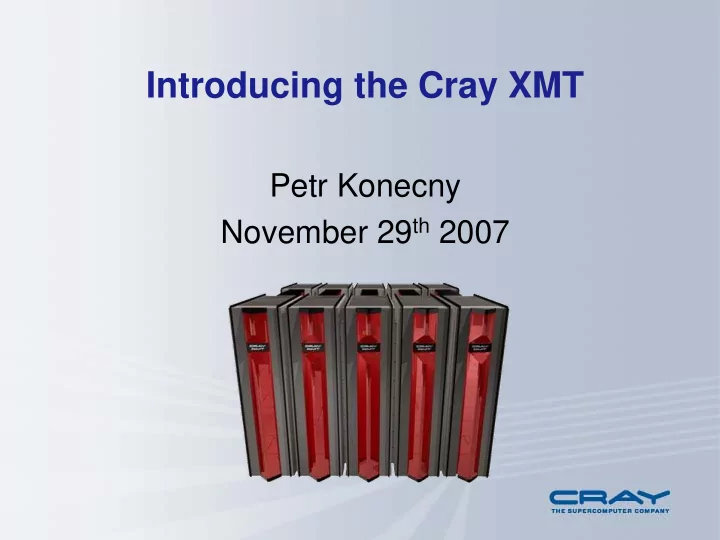
Introducing the Cray XMT Petr Konecny November 29 th 2007 Agenda - - PowerPoint PPT Presentation

introducing the cray xmt
SMART_READER_LITE
LIVE PREVIEW

Introducing the Cray XMT Petr Konecny November 29 th 2007 Agenda - - PowerPoint PPT Presentation

Introducing the Cray XMT Petr Konecny November 29 th 2007 Agenda Shared memory programming model Benefits/challenges/solutions Origins of the Cray XMT Cray XMT system architecture Cray XT infrastructure Cray Threadstorm


slide-1
SLIDE 1

Introducing the Cray XMT

Petr Konecny November 29th 2007

slide-2
SLIDE 2

November 07 Slide 2

Agenda

Shared memory programming model

  • Benefits/challenges/solutions

Origins of the Cray XMT Cray XMT system architecture

  • Cray XT infrastructure
  • Cray Threadstorm processor

Basic programming environment features Examples

  • HPCC Random Access
  • Breadth first search

Rules of thumb Summary

slide-3
SLIDE 3

November 07 Slide 3

Shared memory model

Benefits

  • Uniform memory access
  • Memory is distributed across all nodes
  • No (need for) explicit message passing
  • Productivity advantage over MPI

Challenges

  • Latency: time for a single operation
  • Network bandwidth limits performance
  • Legacy MPI codes
slide-4
SLIDE 4

November 07 Slide 4

Addressing shared memory challenges

Latency

  • Little’s law:

Parallelism is necessary ! Concurrency = Bandwidth * Latency e.g.: 800 MB/s, 2μs latency => 200 concurrent 64-bit word ops

  • Need a lot of concurrency to maximize bandwidth

Concurrency per thread (ILP, vector, SSE) => SPMD Many threads (MTA, XMT) => MPMD

Network Bandwidth

  • Provision lots of bandwidth

~1 GB/s per processor, ~5 GB/s per router on XMT

  • Efficient for small messages
  • Software controlled caching (registers, nearby memory)

Eliminates cache coherency traffic Reduces network bandwidth

slide-5
SLIDE 5

November 07 Slide 5

Origins of the Cray XMT

Multithreaded Architecture (MTA) Shared memory programming model Thread level parallelism Lightweight synchronization Cray XT Infrastructure Scalable I/O, HSS, Support Network efficient for small messages Cray XMT (a.k.a. Eldorado) Upgrade Opteron to Threadstorm

slide-6
SLIDE 6

November 07 Slide 6

Cray XMT System Architecture

MTK Linux Compute Service & IO RAID Controllers Network

PCI-X 10 GigE Fiber Channel PCI-X

Service Partition

  • Linux OS
  • Specialized Linux nodes

Login PEs IO Server PEs Network Server PEs FS Metadata Server PEs Database Server PEs

Compute Partition

MTK (BSD)

slide-7
SLIDE 7

November 07 Slide 7

Cray XMT Speeds and feeds

Threadstorm ASIC 140M memory op/s 500M memory op/s 500M instructions/s 500M memory op/s 66M cache lines/s 110M→30M memory op/s (1→ 4K processors); bisection bandwidth impact 4,8 or 16 GB DDR DRAM

slide-8
SLIDE 8

November 07 Slide 8

Cray Threadstorm architecture

Streams (128 per processor)

  • Registers, program counter, other state

Protection domain (16 per processor)

  • Provides address space
  • Each running stream belongs to exactly one protection domain

Functional units

  • Memory
  • Arithmetic
  • Control

Memory buffer (cache)

  • Only store data of the DIMMs attached to the processor
  • Never cache remote data (no coherency traffic)
  • All requests go through the buffer
  • 128 KB, 4-way associative, 64 byte cache lines
slide-9
SLIDE 9

November 07 Slide 9

XMT Programming Environment supports multithreading

Flat distributed shared memory! Rely on the parallelizing compilers

  • They do great with loop level parallelism

Many computations need to be restructured

  • To expose parallelism
  • For thread safety

Light-weight threading

  • Full/empty bit on every word

writeef/readfe/readff/writeff

  • Compact thread state
  • Low thread overhead
  • Low synchronization overhead
  • Futures (see LISP)

Performance tools

  • Apprentice2 – parse compiler annotations, visualize runtime behavior
slide-10
SLIDE 10

November 07 Slide 10

HPCC Random Access

Update a large table based on a random number generator NEXTRND returns next value of RNG

unsigned rnd = 1; for(i=0; i<NUPDATE; i++) { rnd = NEXTRND(rnd); Table[rnd&(size-1)] ^= rnd; }

HPCC_starts(k) returns k-th value of RNG

for(i=0; i<NUPDATE; i++) { unsigned rnd = HPCC_starts(i); Table[rnd&(size-1)] ^= rnd; }

Compiler can automatically parallelize this loop It generates readfe/writeef for atomicity

slide-11
SLIDE 11

November 07 Slide 11

HPCC Random Access - tuning

HPCC_starts is expensive Restructure loop to amortize cost

for(i=0; i<NUPDATE; i+=bigstep) { unsigned v = HPCC_starts(i); for(j=0;j<bigstep;j++) { v = NEXTRND(v); Table[(v&(size-1)] ^= v; } }

The compiler parallelizes outer loop across all processors Apprentice2 reports

  • Five instructions per update (includes NEXTRND)
  • Two (synchronized) memory operations per update
slide-12
SLIDE 12

November 07 Slide 12

HPCC Random Access - performance

Performance analysis

  • Each update requires a read from and a write to a DIMM
  • Peak of 66 M cachelines/s/processor =>
  • Peak of 33 M updates/s/processor

Single processor performance

  • Measured 20.9 M updates/s

On 64 CPU preproduction system

  • Measured 1.28 Gup/s

95% scaling efficiency from 1P to 64P

slide-13
SLIDE 13

November 07 Slide 13

Breadth first search

Algorithm to find shortest path tree in unweighted graph

Parent[*] = null Enqueue(source) Parent[source] = source While queue not empty: For all u already in queue: Dequeue(u) For all neighbors v of u: If Parent[v] is null: Parent[v] = u Enqueue(v)

slide-14
SLIDE 14

November 07 Slide 14

Breadth first search

An algorithm to find shortest path tree in unweighted graph

parent[*] = null ← parallel enqueue(source) parent[source] = source while queue not empty: ← serial for all u already in queue: ← parallel dequeue(u) for all neighbors v of u:← possibly parallel if Parent[v] is null: ← atomic (readfe) parent[v] = u ← writeef enqueue(v)

slide-15
SLIDE 15

November 07 Slide 15

Breadth first search - queue

Each vertex can be enqueued at most once Use an array of size |V| with head and tail pointers

  • ldtail

= tail;

  • ldhead

= head; head = tail; #pragma mta assert parallel for(int i = oldhead; i<oldtail; i++) { Node u = Queue[i]; … }

slide-16
SLIDE 16

November 07 Slide 16

Breadth first search – tuning and performance

Tune on sparse Erdös-Rényi graphs Reduce overhead of queue operations Eliminate contention for queue tail pointer Performance counters show:

  • 2 memory operations/edge
  • 8.45 memory operations/vertex

32p system

  • 1 billion nodes/10 billion edges: ~17s

128p system

  • 4 billion nodes/40 billion edges: ~20s
slide-17
SLIDE 17

November 07 Slide 17

Performance – rules of thumb

Instructions are cheap compared to memory ops

Most workloads will be limited by bandwidth

Keep enough memory operations in flight at all times

Load balancing Minimize synchronization

Use moderately cache friendly algorithms

Cache hits are not necessary to hide latency Cache can improve effective bandwidth

~40% cache hit rate for distributed memory ~80% cache hit rate for nearby memory

Reduce cache footprint Be careful about speculative loads (bandwidth is scarce)

Think of XMT as a lot of processors running at 1 MHz

slide-18
SLIDE 18

November 07 Slide 18

Traits of strong Cray XMT applications

  • 1. Use lots of memory
  • Cray XMT supports terabytes
  • 2. Lots of parallelism
  • Amdahl’s law
  • Parallelizing compiler
  • 3. Fine granularity of memory access
  • Network is efficient for all (including short) packets
  • 4. Data hard to partition
  • Uniform shared memory alleviates the need to partition
  • 5. Difficult load balancing
  • Uniform shared memory enables work migration
slide-19
SLIDE 19

November 07 Slide 19

Summary

Shared memory programming is good for productivity Cray XMT adds value for an important class of problems

  • Terabytes of memory
  • Irregular access with small granularity
  • Lots of parallelism exploitable by programming environment

Working on scaling the system

slide-20
SLIDE 20

November 07 Slide 20

struct Tree { Tree *llink; Tree *rlink; int data; }; int search_tree(Tree *root, int target) { int sum = 0; if (root) { sum = (root->data == target ? 1 : 0); sum += search_tree(root->rlink, target); sum += search_tree(root->llink, target); } return sum; } struct Tree { Tree *llink; Tree *rlink; int data; }; int search_tree(Tree *root, int target) { int sum = 0; if (root) { future int left$; future left$(root, target) { return search_tree(root->llink, target); } sum = (root->data == target ? 1 : 0); sum += search_tree(root->rlink, target); sum += left$; } return sum; }

Future example: Tree search

Declare a future variable. All loads are readff(). All stores are writeff(). Create a continuation based on the future variable left$. Set left$ to empty. Return the result in the future variable left$. Set left$ to full. Wait for left$ to be full before adding it to the sum.