Introduction Against phonetic realism as the source of root - - PowerPoint PPT Presentation

introduction against phonetic realism as the source of
SMART_READER_LITE
LIVE PREVIEW

Introduction Against phonetic realism as the source of root - - PowerPoint PPT Presentation

Introduction Against phonetic realism as the source of root co-occurrence restrictions Laryngeal co-occurrence restrictions are widely attested within AMP 2016, University of Southern California roots. (e.g. It & Mester 1986, MacEachern


slide-1
SLIDE 1

Against phonetic realism as the source of root co-occurrence restrictions

AMP 2016, University of Southern California Ryan Bennett1, Kevin Tang1, and Juan Ajsivinac Sian2

ryan.bennett@yale.edu & kevin.tang@yale.edu https://campuspress.yale.edu/ryanbennett/ & http://tang-kevin.github.io/

1Yale University 2Independent scholar

October 21st–23rd, 2016

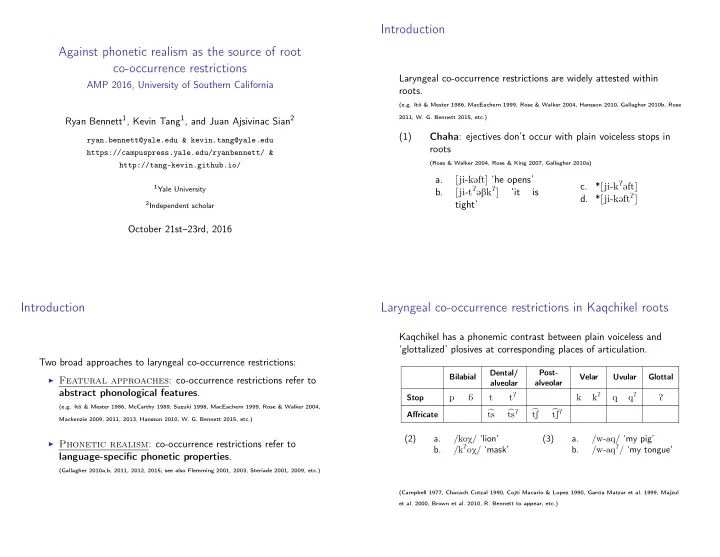
Introduction

Laryngeal co-occurrence restrictions are widely attested within roots.

(e.g. Itô & Mester 1986, MacEachern 1999, Rose & Walker 2004, Hansson 2010, Gallagher 2010b, Rose 2011, W. G. Bennett 2015, etc.)

(1) Chaha: ejectives don’t occur with plain voiceless stops in roots

(Rose & Walker 2004, Rose & King 2007, Gallagher 2010a)

a. [ji-k@ft] ‘he opens’ b. [ji-tP@BkP] ‘it is tight’

  • c. *[ji-kP@ft]
  • d. *[ji-k@ftP]

Introduction

Two broad approaches to laryngeal co-occurrence restrictions:

▶ Featural approaches: co-occurrence restrictions refer to

abstract phonological features.

(e.g. Itô & Mester 1986, McCarthy 1989, Suzuki 1998, MacEachern 1999, Rose & Walker 2004, Mackenzie 2009, 2011, 2013, Hansson 2010, W. G. Bennett 2015, etc.)

▶ Phonetic realism: co-occurrence restrictions refer to

language-specific phonetic properties.

(Gallagher 2010a,b, 2011, 2012, 2015; see also Flemming 2001, 2003, Steriade 2001, 2009, etc.)

Laryngeal co-occurrence restrictions in Kaqchikel roots

Kaqchikel has a phonemic contrast between plain voiceless and ‘glottalized’ plosives at corresponding places of articulation.

Bilabial Dental/ alveolar Post- alveolar Velar Uvular Glottal Stop

p á t tP k kP q qP P

Affricate

> ts > tsP > tS > tSP (2) a. /koX/ ‘lion’ b. /kPoX/ ‘mask’ (3) a. /w-aq/ ‘my pig’ b. /w-aqP/ ‘my tongue’

(Campbell 1977, Chacach Cutzal 1990, Cojtí Macario & Lopez 1990, García Matzar et al. 1999, Majzul et al. 2000, Brown et al. 2010, R. Bennett to appear, etc.)

slide-2
SLIDE 2

Laryngeal co-occurrence restrictions in Kaqchikel roots

Multiple ejectives are not allowed in a /CVC/ root, unless they are identical (Edmonson 1988: 60-72, R. Bennett to appear, and references there) */TP

1VTP 2/, 1 ̸= 2

(4) a. /tPotP/ ‘snail’ b. /kPekP/ ‘stingy’ c. /qPaqP/ ‘fire’ d. /> tSPi> tSP/ ‘metal’ (5)

  • a. */qPotP/
  • b. */kPeqP/
  • c. */qPa>

tSP/ etc. Plain stops are unrestricted.

Laryngeal co-occurrence restrictions in Kaqchikel roots

The labial implosive /á/ and glottal stop /P/ are exempt from this restriction, and freely combine with ejectives in /CVC/ roots. (6) /á/ exempt a. /á@> tsP/ ‘thread’ b. /kPiá/ ‘pacaya (fruit of the Chamaedorea palm)’ c. /-áiqP/ ‘to swallow’ (7) /P/ exempt a. /> tsPiP/ ‘dog’ b. /ikP/ ‘moon’ (surface [PikP]) c. /-qPuP/ ‘blanket’

Phonetic realism

Analytical problem: [constricted glottis] alone does not pick out the correct natural classes for Kaqchikel.

▶ /TP/ are [cg]. ▶ /á P/ are [cg] too.

Phonetic realism

Phonetic realism: Root co-occurrence constraints are sensitive to specific dimensions of auditory similarity (Gallagher 2010b, 2011, 2012, 2015).

slide-3
SLIDE 3

Phonetic realism

Auditory similiarity is expressed with acoustically-defined phonological features. Features relevant for ejectives:

▶ Burst intensity: [loud burst] ▶ Release duration: [long VOT] ▶ Phonation: [creak]

These are redundant features: not independently contrastive, but predictable phonetic properties of ejectives.

Phonetic realism

The acoustic properties of ejectives vary widely across languages.

▶ Consequence: the featural representation of ejectives must

also vary across languages.

(Gallagher 2010b: 38) ▶ Cochabamba Quechua: /TP/ = [loud burst, long

VOT]

▶ Hausa: /TP/ = [creak] (Lindau 1984, Kingston 1984, 2005, Ladefoged & Maddieson 1996, Warner 1996, Clements & Osu 2002, Wright et al. 2002, Bird 2002, Fallon 2002, Ham 2004, Shosted 2009, Gallagher 2010b, Percival 2015, R. Bennett to appear, etc.)

Phonetic realism

Claim: laryngeal co-occurrence restrictions are stated over these redundant, language-specific auditory properties.

(Gallagher 2010a,b, 2011, 2012, 2015; Flemming 2001, 2003, 2004, 2005; Steriade 1999, 2001, 2009 etc.)

(8) OCP[loud burst]: Roots cannot contain two instances of a stop specified (redundantly) as [loud burst].

(Gallagher 2011)

This is phonetic realism: Language-specific phonetics determine language-specific phonotactic patterning.

Phonetic realism

Prediction Segment classes in laryngeal co-occurrence restrictions should correspond to phonetic classes defined by acoustic/auditory similarity.

slide-4
SLIDE 4

Results

Phonetic realism: some auditory feature should be unique to ejectives (the restricted class). Finding: no acoustic property is unique to ejectives.

▶ Burst intensity and VOT: /T/ ≈ /TP/ ▶ Phonation: /á/ ≈ /TP/

(Note: our presentation is informal/visual, but all of our descriptive claims are backed-up by statistical clustering techniques and mixed-effects regressions.)

Results

Ejectives across languages:

Stiff Slack Burst intensity Loud Weak Release duration Long Short Phonation Modal/tense Creaky

(Lindau 1984, Kingston 1984, 2005, Wright et al. 2002, Shosted 2009, etc.)

Observation: ejectives appear to be slack in Kaqchikel.

▶ Release properties (burst, VOT) much like plain counterparts. ▶ Creakiness distinguishes ejectives from plain counterparts.

Slack ejective [kP] in Kaqchikel

kan tzij k’a ri /kan > tsiX kPa Ri/ ‘(but it was) truly like that’ (speaker 8)

[loud burst]

n=4118 n=919

45 50 55 60 65 70 75 80 85

Unrestricted Restricted (Tˀ)

Peak intensity (dB)

Peak intensity (first 25ms after release)

Peak intensity during burst (first 25ms of VOT interval)

(Blumstein & Stevens 1979, Stevens 2000: 455)

slide-5
SLIDE 5

[loud burst]

/p ɓ/ /t tˀ/ /ts tsˀ/ /tʃ tʃˀ/ /k kˀ/ /q qˀ/

n=304 n=326 n=867 n=15 n=214 n=121 n=679 n=69 n=1014 n=562 n=714 n=152

45 50 55 60 65 70 75 80 85

Peak intensity (dB)

Peak intensity (first 25ms after release)

Peak intensity during burst (first 25ms of VOT interval)

(Blumstein & Stevens 1979, Stevens 2000: 455)

[long vot]

n=4172 n=919

10 20 30 40 50 60 70 80 90 100 110 120

Unrestricted Restricted (Tˀ)

VOT (ms)

VOT values

VOT (release noise) duration

[long vot]

/p ɓ/ /t tˀ/ /ts tsˀ/ /tʃ tʃˀ/ /k kˀ/ /q qˀ/

n=322 n=328 n=886 n=16 n=214 n=121 n=681 n=69 n=1028 n=560 n=713 n=153

10 20 30 40 50 60 70 80 90 100 110 120

VOT (ms)

VOT values

VOT (release noise) duration

[long vot]

VOT does not reliably separate plain and ejective stops (except /k kP/).

slide-6
SLIDE 6

[long vot]

None of the Kaqchikel ejectives merit the label [long VOT].

(See also Keating 1984, Cho & Ladefoged 1999, Holt et al. 2004.)

▶ Mean VOTs for /TP/: 24-46ms

VOT values in Cochabamba Quechua (Gallagher 2011)

[creak]

A standard measure of voice quality is H1-H2:

▶ Relative amplitude of f0 (H1) and the second harmonic (H2). ▶ Low H1-H2 ≈ more creak.

(Gordon & Ladefoged 2001; see also Gerratt & Kreiman 2001, DiCanio 2009, 2014, Garellek 2013, Keating et al. 2015, and references there)

[creak]

Phonation fails to distinguish /á/ from /TP/.

▶ All glottalized consonants induce creaky phonation on adjacent

vowels.

▶ Plain stops do not induce creaky phonation. ▶ (n = 4267 distinct stop-adjacent vowels)

[creak]: VC transition

/p ɓ/ /t tˀ/ /ts tsˀ/ /tʃ tʃˀ/ /k kˀ/ /q qˀ/

n=120 n=221 n=427 n=11 n=146 n=62 n=296 n=37 n=424 n=153 n=388 n=51

  • 12
  • 8
  • 4

4 8 12 16 20 24

H1*-H2*

Creak in [VC] transition (last 1/3 of vowel)

Creakiness (H1*-H2*) during last 1/

3 of vowel in VC transition

slide-7
SLIDE 7

Interim summary

The acoustic features [loud burst, long VOT, creak] fail to define phonotactically appropriate natural classes.

▶ [loud burst, long VOT]: /T/ ≈ /TP/ (neither qualify) ▶ [creak]: /á/ ≈ /TP/

Conclusion: laryngeal co-occcurrence restrictions in Kaqchikel cannot be stated over auditorily-defined features.

Formal analysis

Proposal: assume a different representational status for [constricted glottis] in /TP/ vs. /á P/ Assumption: stops have sub-segmental phonological structure.

(Kingston 1984, 1990, Keating 1990, Steriade 1993, 1994, Gafos 2002, etc.)

Formal analysis

Stop Release { sg cg } Closure { voice cg }

(after Keating 1990, Steriade 1993, 1994)

Formal analysis

Implosives and /P/ Stop Release Closure [cg] Ejectives Stop Release [cg] Closure

(after Keating 1990, Steriade 1993, 1994)

slide-8
SLIDE 8

The restriction, restated

(9) OCP[cg-rel]Root Assign one violation for every /CVC/ root containing two instances of Release-linked [constricted glottis].

(NB: the permissibility of co-occurring identical ejectives requires further mechanisms; McCarthy 1979, 1989, Gallagher & Coon 2009, Gallagher 2010a, 2014, etc.)

Formal analysis

Predicted long-distance dissimilations:

▶ OCP[voi]: Voiced obstruents (✓, Japanese, Itô & Mester 1986) ▶ OCP[cg]: Ejectives, implosives and /P/ (✓, Bolivian Aymara,

Landerman 1994)

▶ OCP[sg]: Aspirated stops and /h H/ (✓, Sanskrit, Grassmann 1863)

Stop Release { sg cg } Closure { voice cg }

Formal analysis

Predicted long-distance dissimilations:

▶ OCP[cg-rel]: Ejectives, but not implosives or /P/ (✓, Kaqchikel) ▶ OCP[sg-rel]: Aspirated stops, but not [h] (✓, Ofo, De Reuse 1981) ▶ OCP[F-rel]: Ejectives, aspirated stops (✓, Quechua, Parker & Weber

1996)

▶ OCP[F-clo]: Voiced stops and implosives: (✓, Hausa, Parsons 1970)

Stop Release { sg cg } Closure { voice cg }

Formal analysis

Unexpected long-distance dissimilations:

▶ Ejectives/aspirated stops and voiced stops (unattested) ▶ Aspirated stops and implosives (unattested)

Stop Release { sg cg } Closure { voice cg }

(MacEachern 1997, 1999, Rose & Walker 2004, Hansson 2010, Gallagher 2010a,b, 2011, 2015, Mackenzie 2009, 2011, 2013, W. G. Bennett 2013, 2015)

slide-9
SLIDE 9

Conclusion

With respect to root-level laryngeal co-occurrence restrictions in Mayan:

▶ Phonetic realism is too strict: phonotactic classes do not line

up with acoustic classes in Kaqchikel (and probably other Mayan languages).

▶ A more promising tact: OCP constraints stated over abstract

(but articulatorily-grounded) features in sub-segmental structure.

Conclusion

The distinction between ejectives and implosives is crucial for phonotactic patterning in Kaqchikel.

▶ The realization of the glottalized labial as implosive /á/ (rather

than ejective /pP/) is predictable from its place of articulation.

▶ ∴ predictable, redundant, and non-contrastive properties must

be phonologically ‘active’ for the purposes of phonotactic restrictions.

(E.g. Vaux 1996, Steriade 2001, Flemming 2003, Gallagher 2011; cf. Hall 2007, Dresher 2009, and others.)

References

References available on request.

Slide download

Slides available for download at http://tang-kevin.github.io/Files/Slides/Bennett_Tang_AMP.pdf