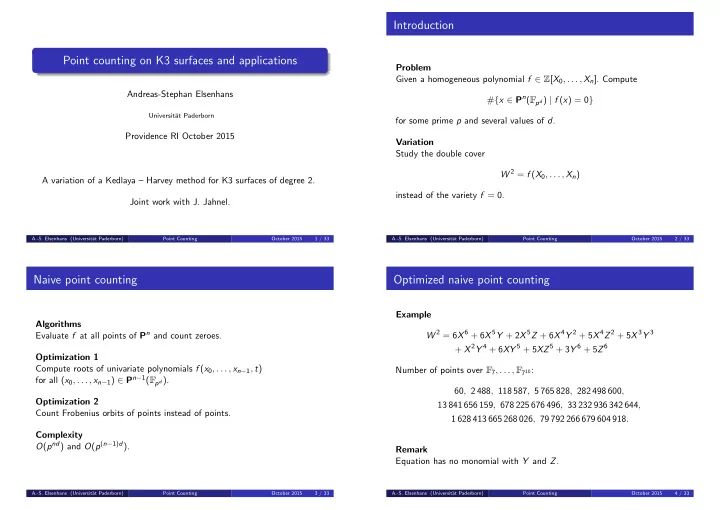

SLIDE 1
Point counting on K3 surfaces and applications
Andreas-Stephan Elsenhans
Universit¨ at Paderborn
Providence RI October 2015 A variation of a Kedlaya – Harvey method for K3 surfaces of degree 2. Joint work with J. Jahnel.
A.-S. Elsenhans (Universit¨ at Paderborn) Point Counting October 2015 1 / 33
Introduction
Problem Given a homogeneous polynomial f ∈ ❩[X0, . . . , Xn]. Compute #{x ∈ Pn(❋
pd) | f (x) = 0}
for some prime p and several values of d. Variation Study the double cover W 2 = f (X0, . . . , Xn) instead of the variety f = 0.
A.-S. Elsenhans (Universit¨ at Paderborn) Point Counting October 2015 2 / 33
Naive point counting
Algorithms Evaluate f at all points of Pn and count zeroes. Optimization 1 Compute roots of univariate polynomials f (x0, . . . , xn−1, t) for all (x0, . . . , xn−1) ∈ Pn−1(❋
pd).
Optimization 2 Count Frobenius orbits of points instead of points. Complexity O(pnd) and O(p(n−1)d).
A.-S. Elsenhans (Universit¨ at Paderborn) Point Counting October 2015 3 / 33
Optimized naive point counting
Example W 2 = 6X 6 + 6X 5Y + 2X 5Z + 6X 4Y 2 + 5X 4Z 2 + 5X 3Y 3 + X 2Y 4 + 6XY 5 + 5XZ 5 + 3Y 6 + 5Z 6 Number of points over ❋
7, . . . , ❋ 710:
60, 2 488, 118 587, 5 765 828, 282 498 600, 13 841 656 159, 678 225 676 496, 33 232 936 342 644, 1 628 413 665 268 026, 79 792 266 679 604 918. Remark Equation has no monomial with Y and Z.
A.-S. Elsenhans (Universit¨ at Paderborn) Point Counting October 2015 4 / 33