Introduction to Data-flow analysis Last Time Implementing a Mark - - PDF document

introduction to data flow analysis
SMART_READER_LITE
LIVE PREVIEW

Introduction to Data-flow analysis Last Time Implementing a Mark - - PDF document

Introduction to Data-flow analysis Last Time Implementing a Mark and Sweep GC Today Control flow graphs Liveness analysis Register allocation CS553 Lecture Introduction to Data-flow Analysis 1 Data-flow


slide-1
SLIDE 1

CS553 Lecture Introduction to Data-flow Analysis 1

Introduction to Data-flow analysis

Last Time

– Implementing a Mark and Sweep GC

Today

– Control flow graphs – Liveness analysis – Register allocation

CS553 Lecture Introduction to Data-flow Analysis 2

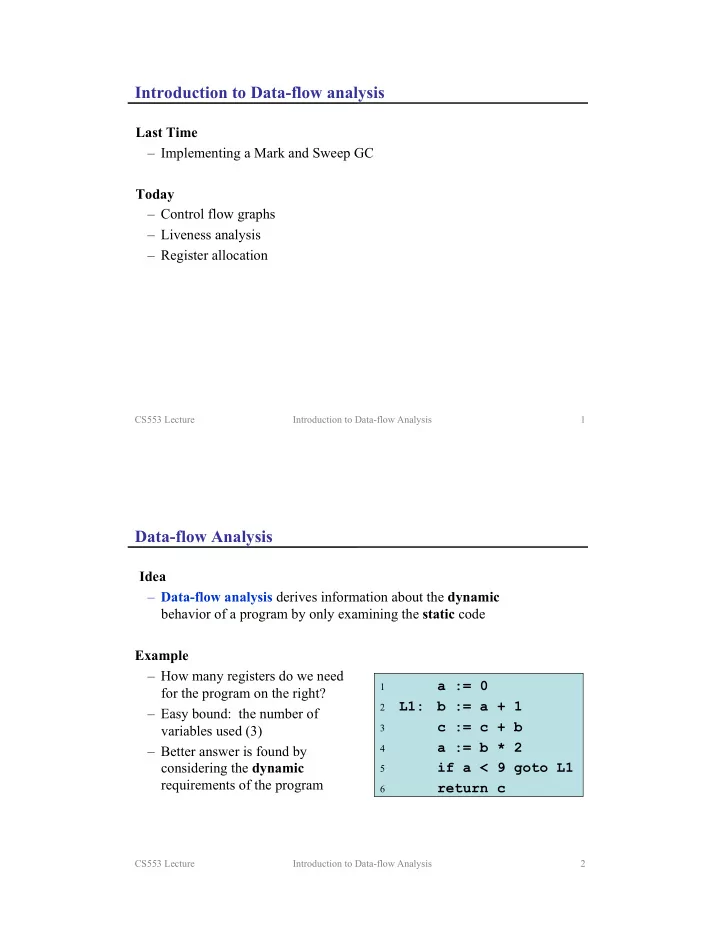
Data-flow Analysis

Idea

– Data-flow analysis derives information about the dynamic behavior of a program by only examining the static code

1

a := 0

2 L1: b := a + 1 3

c := c + b

4

a := b * 2

5

if a < 9 goto L1

6

return c Example – How many registers do we need for the program on the right? – Easy bound: the number of variables used (3) – Better answer is found by considering the dynamic requirements of the program

slide-2
SLIDE 2

CS553 Lecture Introduction to Data-flow Analysis 3

Liveness Analysis

Definition

–A variable is live at a particular point in the program if its value at that point will be used in the future (dead, otherwise). To compute liveness at a given point, we need to look into the future

Motivation: Register Allocation

–A program contains an unbounded number of variables –Must execute on a machine with a bounded number of registers –Two variables can use the same register if they are never in use at the same time (i.e, never simultaneously live). Register allocation uses liveness information

CS553 Lecture Introduction to Data-flow Analysis 4

Control Flow Graphs (CFGs)

Definition

–A CFG is a graph whose nodes represent program statements and whose directed edges represent control flow

Example

1

a := 0

2 L1: b := a + 1 3

c := c + b

4

a := b * 2

5

if a < 9 goto L1

6

return c return c a = 0 b = a + 1 a<9

1 2 6 5 3 4 a = b * 2

c = c + b

Yes No

slide-3
SLIDE 3

CS553 Lecture Introduction to Data-flow Analysis 5

Terminology

Flow Graph Terms

– A CFG node has out-edges that lead to successor nodes and in-edges that come from predecessor nodes – pred[n] is the set of all predecessors of node n succ[n] is the set of all successors of node n

Examples

– Out-edges of node 5: – succ[5] = – pred[5] = – pred[2] = return c a = 0 b = a + 1 a<9

1 2 6 5 3 4 a = b * 2

c = c + b (56) and (52) {2,6} {1,5} {4}

Yes No CS553 Lecture Introduction to Data-flow Analysis 6

Liveness by Example

What is the live range of b?

– Variable b is read in statement 4, so b is live on the (3 4) edge – Since statement 3 does not assign into b, b is also live on the (23) edge – Statement 2 assigns b, so any value of b on the (12) and (52) edges are not needed, so b is dead along these edges

b’s live range is (234)

return c a = 0 b = a + 1 a<9

1 2 6 5 3 4 a = b * 2

c = c + b

Yes No

slide-4
SLIDE 4

CS553 Lecture Introduction to Data-flow Analysis 7

Liveness by Example (cont)

Live range of a

– a is live from (12) and again from (452) – a is dead from (234)

Live range of b

– b is live from (234)

Live range of c

– c is live from (entry123452, 56) return c a = 0 b = a + 1 a<9

1 2 6 5 3 4 a = b * 2

c = c + b

Yes No

  • Variables a and b are never simultaneously live, so they can share a register

CS553 Lecture Introduction to Data-flow Analysis 8

Uses and Defs

Def (or definition)

– An assignment of a value to a variable – def_node[v] = set of CFG nodes that define variable v – def[n] = set of variables that are defined at node n

Use

– A read of a variable’s value – use_node[v] = set of CFG nodes that use variable v – use[n] = set of variables that are used at node n

More precise definition of liveness

– A variable v is live on a CFG edge if

a = 0 a < 9? def_node[v] use_node[v] v live

(1) a directed path from that edge to a use of v (node in use_node[v]), and

(2) that path does not go through any def of v (no nodes in def_node[v])

slide-5
SLIDE 5

CS553 Lecture Introduction to Data-flow Analysis 9

a := b * 2

5

c := c + b

The Flow of Liveness

Data-flow

– Liveness of variables is a property that flows through the edges of the CFG

Direction of Flow

– Liveness flows backwards through the CFG, because the behavior at future nodes determines liveness at a given node – Consider a – Consider b – Later, we’ll see other properties that flow forward a < 9? b := a + 1

Yes No 3 1

a := 0

4 6

return c

2 CS553 Lecture Introduction to Data-flow Analysis 10

Liveness at Nodes

edges a = 0

Two More Definitions

– A variable is live-out at a node if it is live on any of that node’s out-edges – A variable is live-in at a node if it is live on any of that node’s in-edges

We have liveness on edges

– How do we talk about liveness at nodes? just after computation just before computation

n live-out

  • ut-edges

n live-in in-edges

program points

slide-6
SLIDE 6

CS553 Lecture Introduction to Data-flow Analysis 11

Data-flow equations

  • in[n] = use[n] (out[n] – def[n])
  • ut[n] =

in[s]

s succ[n]

(1) (3) (2)

Rules for computing liveness (1) Generate liveness:

If a variable is in use[n], it is live-in at node n

n live-in use live-in n live-out

(3) Push liveness across nodes:

If a variable is live-out at node n and not in def[n]

  • then the variable is also live-in at n

live-out n live-in pred[n] live-out live-out

(2) Push liveness across edges:

If a variable is live-in at a node n

  • then it is live-out at all nodes in pred[n]

Computing Liveness

CS553 Lecture Introduction to Data-flow Analysis 12

Solving the Data-flow Equations

Algorithm This is iterative data-flow analysis (for liveness analysis)

for each node n in CFG in[n] = ; out[n] = repeat for each node n in CFG in’[n] = in[n]

  • ut’[n] = out[n]

in[n] = use[n] (out[n] – def[n])

  • ut[n] = in[s]

until in’[n]=in[n] and out’[n]=out[n] for all n

s succ[n]

initialize solutions solve data-flow equations test for convergence save current results

slide-7
SLIDE 7

CS553 Lecture Introduction to Data-flow Analysis 13

3 bc c 5 a 2 a b 1 a node # use def in out in out in out in out in out in out in out 4 b a 6 c 1st 2nd 3rd 4th 5th 6th 7th c a b a a bc a c a bc bc b b a a ac a c ac bc bc b b a ac ac ac c ac bc bc b b ac ac ac c ac c ac bc bc b bc ac ac ac c ac c ac bc bc bc bc ac ac ac c ac c ac bc bc bc bc ac ac ac

Data-flow Equations for Liveness in[n] = use[n] (out[n] – def[n])

  • ut[n] = in[s]

s succ[n] Yes No 2 b := a + 1 3 c := c + b 1

a := 0

4 a := b * 2 5

a < 9?

6

return c

Example Liveness Analysis in the MiniJava compiler

Currently …

– Parse into AST – Allocate space on stack for locals and parameters and space in heap for member variables – Use stack for expression evaluation – Generate MIPS code from AST

To perform data-flow analysis …

– Need intermediate representation like 3-address code – Use temporaries for parameters, locals, and expression results – Indicate uses and defs of temporaries in each 3-address code instruction – Create a control-flow graph with each 3-address code instruction as a node

CS553 Lecture Introduction to Data-flow Analysis 14

slide-8
SLIDE 8

CS553 Lecture Register Allocation I 15

Register Allocation

  • Problem

– Assign an unbounded number of symbolic registers to a fixed number of architectural registers – Simultaneously live data must be assigned to different architectural registers

  • Goal

– Minimize overhead of accessing data – Memory operations (loads & stores) – Register moves

CS553 Lecture Register Allocation I 16

Scope of Register Allocation

  • Expression
  • Local
  • Loop
  • Global
  • Interprocedural
slide-9
SLIDE 9

CS553 Lecture Register Allocation I 17

Granularity of Allocation

  • What is allocated to registers?

– Variables – Live ranges/Webs (i.e., du-chains with common uses) – Values (i.e., definitions; same as variables with SSA)

s1: x := 5 s2: y := x s3: x := y+1 s4: ... x ... s5: x := 3 s6: ... x ...

Variables: 2 (x & y) Live Ranges/Web: 3 (s1s2,s4; s2 s3; s3,s5 s6) Values: 4 (s1, s2, s3, s5, (s3,s5)) Each allocation unit is given a symbolic register name (e.g., t1, t2, etc.)

b1 b4 b2 b3

What are the tradeoffs?

CS553 Lecture Register Allocation I 18

t2 t1 t3 Global Register Allocation by Graph Coloring

Idea [Cocke 71], First allocator [Chaitin 81]

  • 1. Construct interference graph G=(N,E)

–Represents notion of “simultaneously live” –Nodes are units of allocation (e.g., variables, live ranges, values) – edge (n1,n2) E if n1 and n2 are simultaneously live –Symmetric (not reflexive nor transitive)

  • 2. Find k-coloring of G (for k registers)

–Adjacent nodes can’t have same color

  • 3. Allocate the same register to all allocation units of the same color

–Adjacent nodes must be allocated to distinct registers

slide-10
SLIDE 10

CS553 Lecture Register Allocation I 19

Interference Graph Example (Variables)

a := ... b := ... c := ... ... a ... d := ... ... d ... a := ... ... c ... a := ... ... d ... ... d ... e := ... ... a ... ... e ... ... b ... c := ...

a d b c e

CS553 Lecture Register Allocation I 20

Computing the Interference Graph

  • Use results of live variable analysis

for each symbolic-register/temporary ti do for each symbolic-register/temporary tj (j < i) do for each def {definitions of ti} do if (tj is live out at def) then E E (ti,tj)

  • Options

– treat all instructions the same – treat MOVE instructions special – which is better?

slide-11
SLIDE 11

CS553 Lecture Register Allocation I 21

Allocating Registers Using the Interference Graph

  • K-coloring

– Color graph nodes using up to k colors – Adjacent nodes must have different colors

  • Allocating to k registers finding a k-coloring of the interference

graph – Adjacent nodes must be allocated to distinct registers

  • But. . .

– Optimal graph coloring is NP-complete – Optimal register allocation is NP-complete, too (must approximate) – What if we can’t k-color a graph? (must spill)

CS553 Lecture Register Allocation I 22

Register Allocation: Spilling

  • If we can’t find a k-coloring of the interference graph

– Spill variables (nodes) until the graph is colorable

  • Choosing variables to spill

– Choose arbitrarily or – Choose least frequently accessed variables – Break ties by choosing nodes with the most conflicts in the interference graph – Yes, these are heuristics!

slide-12
SLIDE 12

CS553 Lecture Register Allocation I 23

a d b c f e Spilling (Original CFG and Interference Graph)

a := ... b := ... c := ... ... a ... d := ... ... c ... f := ... ... d ... ... d ... e := ... ... f ... ... e ... ... b ... c := ... ... d ... f := ...

CS553 Lecture Register Allocation I 24

a d b1 c f e Spilling (After spilling b )

a := ... b1 := ... M[fp+4] := b1 c := ... ... a ... d := ... ... c ... f := ... ... d ... ... d ... e := ... ... f ... ... e ... b2 = M[fp+4] ... b2 ... c := ... ... d ... f := ...

b2

slide-13
SLIDE 13

CS553 Lecture Register Allocation I 25

Simple Greedy Algorithm for Register Allocation

for each n N do { select n in decreasing order of weight } if n can be colored then do it { reserve a register for n } else Remove n (and its edges) from graph { allocate n to stack (spill) }

a d c f e

a := ... r1 := ... M[fp+4] := r1 c := ... ... a ... d := ... ... d ... e := ... ... f ... ... e ... r2 = M[fp+4] ... r2 ...

(After spilling b )

CS553 Lecture Register Allocation I 26

Weighted order: a b c d f e

Example a d b c f e

  • Attempt to 3-color this graph ( , , )

What if you use a different order?

slide-14
SLIDE 14

CS553 Lecture Register Allocation I 27

a b Example

Weighted order: a b c

  • Attempt to 2-color this graph ( , )

c

CS553 Lecture Introduction to Data-flow Analysis 28

Concepts

Liveness

– Used in register allocation – Generating liveness – Flow and direction – Data-flow equations and analysis

Control flow graphs Register allocation

– scope of allocation – granularity: what is being allocated to a register – order that allocation units are visited in matters in all heuristic algorithms

Global approach: greedy coloring

slide-15
SLIDE 15

CS553 Lecture Introduction to Data-flow Analysis 29

Next Time

Reading

– Ch. 8.4, 9.2-9.25, intro to data-flow analysis – Ch 8.8 and Briggs paper, register allocation

Lecture

– Improvements to graph coloring register allocators – Register allocation across procedure calls

Suggested Exercises

– See schedule on website