Introduction to Onsite The introduction to septic systems program - - PDF document

introduction to onsite
SMART_READER_LITE
LIVE PREVIEW

Introduction to Onsite The introduction to septic systems program - - PDF document

6/7/2012 Introduction Introduction to Onsite The introduction to septic systems program covers: Wastewater Treatment Systems Function of a septic system Septic Systems Evaluation of septic tank operation Determining if a


slide-1
SLIDE 1

6/7/2012 1

Introduction to Onsite Wastewater Treatment Systems – Septic Systems

Ryan Gerlich

Extension Program Specialist Department of Biological & Agricultural Engineering Texas AgriLife Extension Service

Introduction

The introduction to septic systems program covers:

  • Function of a septic system
  • Evaluation of septic tank operation
  • Determining if a septic tank should be

pumped.

  • How to live with a septic system

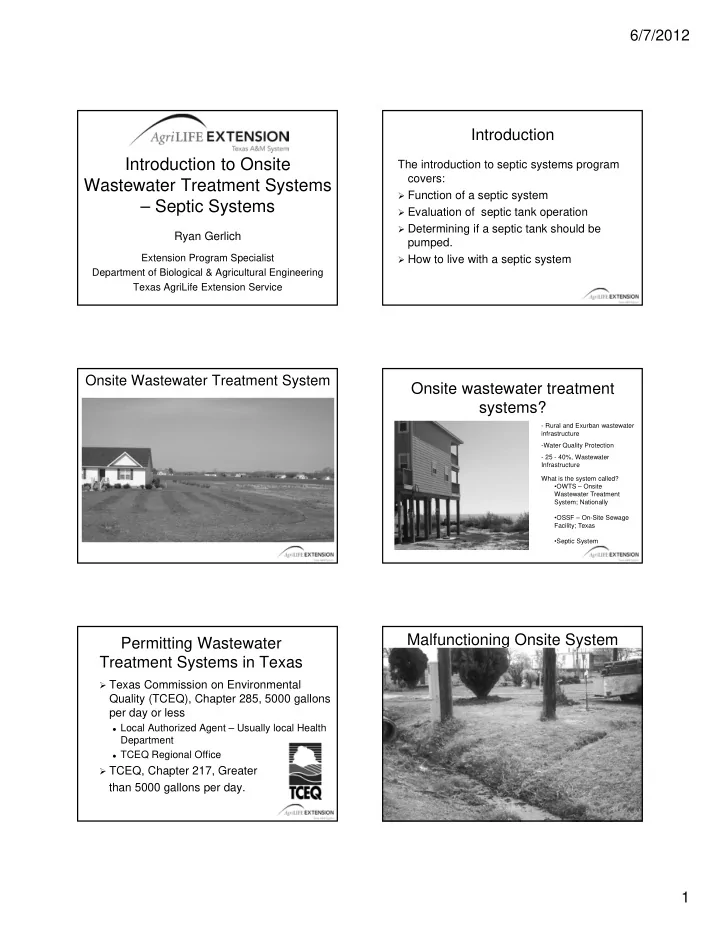
Onsite Wastewater Treatment System

Onsite wastewater treatment systems?

  • Rural and Exurban wastewater

infrastructure

  • Water Quality Protection
  • 25 - 40%, Wastewater

Infrastructure What is the system called?

  • OWTS – Onsite

Wastewater Treatment System; Nationally

  • OSSF – On-Site Sewage

Facility; Texas

  • Septic System

Permitting Wastewater Treatment Systems in Texas

  • Texas Commission on Environmental

Quality (TCEQ), Chapter 285, 5000 gallons per day or less

 Local Authorized Agent – Usually local Health

Department

 TCEQ Regional Office

  • TCEQ, Chapter 217, Greater

than 5000 gallons per day.

Malfunctioning Onsite System

slide-2
SLIDE 2

6/7/2012 2

Malfunction

  • Malfunctioning OSSF – An on-site

sewage facility that is causing a nuisance

  • r is not operating in compliance with the

285 OSSF regulations.

Nuisance

  • sewage, human excreta, or other organic

waste discharged or exposed in a manner that makes it a potential instrument or medium in the transmission of disease to or between persons

  • an overflow from a septic tank or similar

device, including surface discharge from or groundwater contamination by a component of an on-site sewage facility; or

  • a blatant discharge from an OSSF.

Evolution of wastewater treatment goals

  • From outdoor plumbing to water reuse
  • We need to review the history to

understand the present

Outdoor plumbing: the pit privy

  • Goal: designated place
  • No carrier needed to

convey waste

  • Waste applied directly to

the soil

  • Public health concerns

addressed

  • Management: relocate

Indoor plumbing

  • Convenience
  • Water carrier to

convey waste out of facility

  • ‘Collection system’
  • Public health and

pathogens

  • Management:

keep pipe flowing

Disposal

  • Goal: limit human

contact

  • Keep wastewater below

ground

  • Disposal options
  • Public health

 “Disposing” of pathogens  Treatment?

  • Environment:

groundwater contamination

  • Management:

install, flush and forget

slide-3
SLIDE 3

6/7/2012 3

Septic tank and soil treatment area

  • Changing goal:

 Disposal: effluent goes away versus treatment  Dispersal: TREATMENT is essential to good systems

  • Address both public health AND environmental concerns
  • Management:

 Disposal: often none at all;  Dispersal: System management is critical

Groundwater

Well Aerobic soil

Goal: TREATMENT AND DISPERSAL

  • Changes in goals means:

 Siting requirements  Technological advancements  Choice of components and systems  System O&M  Management program

Decentralized Approach

What is an Onsite Wastewater Treatment System?

1.

Wastewater Source

2.

Collection and Storage

3.

Pretreatment components

4.

Final Treatment and Dispersal components

Wastewater source

  • Facility type

 Domestic  Commercial  Industrial

  • User

 Owner/family  Employees

Collection

  • Piping from facility

with cleanout

 Blackwater  Graywater

slide-4
SLIDE 4

6/7/2012 4

Collection options

  • Holding tanks
  • Composting toilets
  • Incinerating toilets

Pretreatment

  • Septic tanks
  • Aerobic treatment

units

  • Media filters
  • Constructed wetlands
  • Disinfection

Final Treatment and Dispersal Components

 Trench and bed

distribution

 Evapotranspiration

beds

 Low pressure

distribution trench

 Drip field  Spray field

How do we make the wastewater system work?

  • Evaluate the wastewater

source

  • Evaluate site

 Wastewater treatment  Wastewater acceptance

  • Choose a final treatment

and dispersal component

  • Choose the appropriate

pretreatment system

  • Operation and

Maintenance

Minimum required separation distances

Choices of distribution for various soil types

slide-5
SLIDE 5

6/7/2012 5

What is a conventional septic system?

Conventional Septic Tank System What is a Septic Tank?

  • Water tight containers

 Concrete  Plastic/ Fiberglass

  • Gravity separation/

detention time

 Typically 2-3 days  Heavy sinks  Lighter floats

  • Calm conditions
  • Screen assisted
  • Anaerobic digestion

RISERS INLET TEE OUTLET TEE W/ EFFLUENT SCREEN LIDS SLUDGE CLEAR LAYER SCUM

What is a Grease Tank?

  • Baffles extend lower in the tank to help

retain grease and oil

  • Typically not needed in most residential

systems

  • Necessary for restaurants

Gravity Trench Biomat

slide-6
SLIDE 6

6/7/2012 6

Wastewater distribution method

  • Gravity

 Sequential  Parallel

  • Manifolds
  • Beds
  • Pressure dosed

trench

  • Pressure distribution

in the Field

Distribution media

  • Rock
  • Chambers
  • Gravelless pipe
  • Synthetic media

Gravity Distribution Gravel-less Pipe Distribution Leaching Chambers

Low-Pressure Distribution System

slide-7
SLIDE 7

6/7/2012 7

Mound Distribution Field

Role of vegetative cover in treatment system

  • A healthy cover crop is essential for the

system to function properly. Plants will:

 Take up nutrients  Take up water  Stabilize the soil

and prevent erosion

 Provide food and

habitat for beneficial soil organisms

What is an aerobic treatment unit?

Aerobic Treatment Unit System

Aerobic vs. Anaerobic Processes (???)

  • Aerobic

 Aerobic bacteria require O2 to live and grow  Aerobic treatment processes require O2 to proceed  Common condition in soil treatment, media filters,

ATUs

  • Anaerobic

 Anaerobic bacteria grow in absence of free oxygen,O2  Anaerobic treatment processes do not use oxygen, but

consumption of items, breaks oxygen bonds Ex. SO4, NO3

 Common condition in septic tanks, processing tanks,

and usually any saturated environment

Aerobic Treatment Unit System

  • Trash Tank

 Small septic tank  1 day retention time  Physical separation  Anaerobic digestion

slide-8
SLIDE 8

6/7/2012 8

Aerobic tank

  • Aerobic Microbes

 Require Oxygen to live and grow  Consume waste and bacteria

  • Configurations

Suspended growth: Attached growth:

Aerobic Treatment Unit System

  • Air supply

 Compressor / Aerator  Diffusers  Oxygen transfer to wastewater  Mixing of food and organisms

  • Clarifier

 Process were the microbes,

cell waste and biomass settle

  • ut of the water.

Aerobic Treatment Unit System

  • Disinfection

 Disinfection, not sterilization  Chlorinator

  • NOT SWIMMING POOL TABLETS!

 UV light

  • Distribution

 Pump tank  Spray field

Water Quality – Spray Field

  • High potential for human

contact with water

  • Secondary- Quality Effluent
  • Remove 85-98% of solids

and organic matter

  • Remove pathogens?
  • Soil for Final Treatment
  • This is NOT drinking water!!

No Playing in Sprinklers!! Spray Field

  • Low angle spray head

 < 15 degrees

  • Clear area around

spray head – 10 feet in the direction of spray from the head

  • Vegetation growing

for water and nutrient removal

  • Reseed dead

vegetation

Feeding the System

Conventional and Aerobic Systems

slide-9
SLIDE 9

6/7/2012 9

SEWAGE COMPOSITION

  • Water carrying

waste – Hydraulic Loading

  • Organic Loading

 BOD

TSS

  • Pathogens
  • Nutrients

 Phosphorus

Nitrogen

  • Chemicals

Fats, oils and grease

Constituent State at room temperature Comments Fats Solid Non-toxic to the system, origin – animals, will separate in water Oils Liquid Non-toxic to the system, origin – plants, trouble separating in water Grease Solid Residual material on appliances; solid material on pans/equipment; petroleum products; moisturizers; bath oils; tanning oils; toxic to the wastewater system Room temperature assumes 74 degrees F A degreaser will move all components through a system

In-Home Businesses/Hobbies

  • Add stronger waste
  • Add chemicals
  • Increase flow
  • Examples of Businesses:

 Home photography

developing lab

 Barber shops  Day care  Bakery  Dog grooming  Taxidermy  Artist

Prescription Drugs and Antibiotics

  • Can kill microbes living

in system

 Won’t discriminate against

  • rganisms living in the

system

  • Additional treatment

components may be necessary

  • Increase maintenance

Septic System Additives

  • Not been proven to be

beneficial to system performance

  • Not recommended
  • Break up particles that

are settled at the bottom and make them suspended

  • Potential solids loading to

downstream components

Kitchen

  • 20% of daily flow
  • Dishwasher
  • Garbage Disposal
slide-10
SLIDE 10

6/7/2012 10

Dishwasher

  • Adds surges of

wastewater

 Hydraulically

  • verload system

 Homeowner should

space out loads

  • Organic load

 Clean/scrape

dishes

Garbage Disposal

  • Increases scum by 20%
  • System should be pumped 1-2 years sooner

than without a garbage disposal

  • Increases Organic Loading

 Smaller particles will take longer to settle  Organic matter had not been digested,

so it will take longer to break down

 Potential for fats and oils

  • More water is used to wash out sink

Laundry 20%

  • Use should be spread
  • ut
  • Liquid soap is

recommended

 Use less  Remove risk of fillers

in powders

Bathroom Fixtures 60%

  • Garden tubs

 Use large volumes of water  Add hydraulic surges  How often it is used?

  • Multi-head showers
  • No every-use shower

cleaner

Bath and body oils

  • Increases Fats, Oils and Grease
  • If usage is great, may need more maintenance

Bathroom

  • Only urine, feces, soap, toilet

paper and limited amounts of cleaner should be going down drain

  • No feminine products,

prophylactics, cigarette butts, etc

  • No every-flush toilet bowl

sanitizers

Septic Safe?

slide-11
SLIDE 11

6/7/2012 11

Toilet Paper

  • Number of rolls used

per week

  • Results in faster

sludge build up

  • Treated toilet paper

(with lotions) prevents paper from settling

  • Wet wipe disposal is

discouraged

Cleaning Products

  • Cumulative effects on system performance
  • Look at Labels!
  • DANGER; Means the chemical will kill the

bacteria, and its use should be minimized

  • r eliminated
  • WARNING; Means limited use should

have a minimal impact on the system.

  • CAUTION: Typically means the product

will have little effect.

Drain Cleaner

  • Toxic drain cleaners

can impact ability to properly treat wastewater

  • Affect bacteria activity

Operation & Maintenance of Septic Systems

Gases and Chemicals of Concern

  • Hydrogen Sulfide
  • Sulfuric Acid (converted from H2S)
  • Chlorine Gas
  • CO(X)’s

 Carbon Dioxide  Carbon Monoxide

  • Methane

Common Biological Hazards around the Site

  • Kids
  • Dogs
  • Cats
  • Insects
  • Snakes
  • Vegetation
slide-12
SLIDE 12

6/7/2012 12

Conditions at the tank

Odors?

Tank material Septic tank configurations Tank access

Access Location:

 Inlet  Outlet  Center

Current operating condition

Liquid level in respect to

  • utlet (inches):

 At  Above  Below

In:_______

Above At Below

Septic tank pumping recommended?

  • Should be

pumped when total solids reach 25-33% of tank capacity.

  • If ‘A’ is less

than 3”

  • If ‘B’ is less

than 12” If recommended, did it happen?

slide-13
SLIDE 13

6/7/2012 13

SCUM LAYER CLEAR LAYER SLUDGE LAYER

Is It full?

  • Measure solids in the tank
  • 60” deep
  • 6” of Scum
  • 18” of Sludge

[18”+ 6”] ÷ 60” x 100 = 40 % Layers?

Septic tank pumping recommended? Baffles

  • Inlet baffle in place
  • Outlet baffle in place
  • Compartment baffle in place

Baffles

  • Concrete
  • Plastic
  • Fiberglass
slide-14
SLIDE 14

6/7/2012 14

Baffles - tees

Effluent screens

Effluent screen cleaning

  • Screen is washed off directly

into the septic tank

  • This is being done at the inlet

end of the tank to protect against cleanings going directly

  • ut the outlet
  • Some units have protection

against outflow or an extra screen that that operates during cleaning.

Tank structural condition

  • Watertight (no visual leaks)
  • Rebar exposed
  • Root intrusion
  • Corrosion or spalling

present

  • Cracks
  • Flex

Vegetation

  • Trees in

distribution field

  • Excessive

vegetation

  • Uneven

vegetation

  • Poor vegetation

Why perform maintenance?

  • Keep systems

functioning properly

  • Maintain effluent

quality

  • Early detection of

problems

  • Public health
  • Environmental

Protection

  • System reliability
  • User satisfaction
slide-15
SLIDE 15

6/7/2012 15

Public health

  • Wastewater can contain disease causing

Pathogens

 Bacteria  Viruses  Parasites  Protozoa

Hepatitis A Virus Ascaris lumbricoides (roundworm)

Environmental protection

Treat contaminants before they reach surface water

  • r groundwater

 Nutrients

  • Phosphorus
  • Nitrogen

 Organic loading  Pathogens

  • Fecal coliforms
  • E-coli

EPA water quality programs

  • Onsite wastewater

treatment systems

 Non-point source of

pollution

  • Total Maximum Daily

Loads

  • Coastal Zone

Management Program

System reliability

Performance of all system components must be functional to achieve full treatment

  • Components require

maintenance

  • Service/maintenance

should extend life of components

Thank you

Ryan Gerlich

Office # 979-458-4185 ragerlich@ag.tamu.edu http://ossf.tamu.edu/