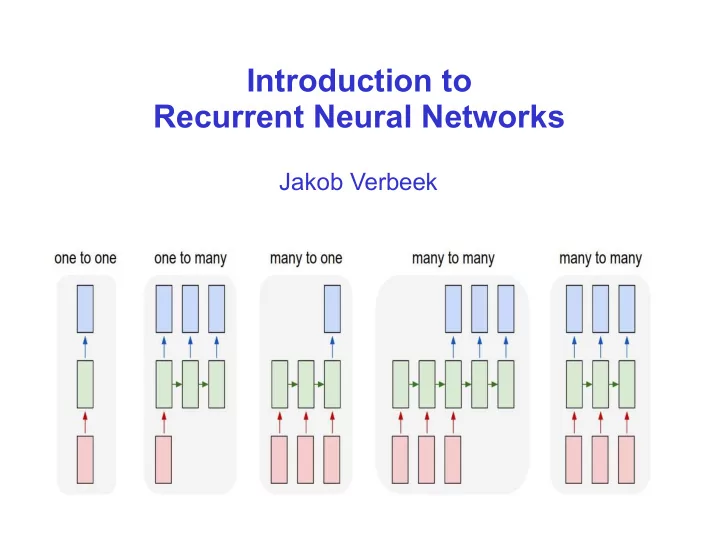
Introduction to Recurrent Neural Networks Jakob Verbeek Modeling - - PowerPoint PPT Presentation
Introduction to Recurrent Neural Networks Jakob Verbeek Modeling sequential data with Recurrent Neural Networks Compact schematic drawing of standard multi-layer perceptron (MLP) output hidden input Modeling sequential data So far we
Modeling sequential data with Recurrent Neural Networks
Compact schematic drawing of standard multi-layer perceptron (MLP)
input
- utput
hidden
Modeling sequential data
So far we considered “one-to-one” prediction tasks
►
Classification: one image to one class label, which digit is displayed 0...9
►
Regression: one image to one scalar, how old is this person?
Many prediction problems have a sequential nature to them
►
Either in input, in output, or both
►
Both may vary in length from one example to another
Modeling sequential data
One-to-many prediction
Image captioning
►
Input: an image
►
Output: natural language description, variable length sequence of words
Modeling sequential data
Text classification
►
Input: a sentence
►
Output: user rating
Modeling sequential data
Machine translation of text from one language to another
►
Sequences of different length on input and output
Modeling sequential data
Part of speech tagging
►
For each word in sentence predict PoS label (verb, noun, adjective, etc.)
Temporal segmentation of video
►
Predict action label for every video frame
Temporal segmentation of audio
►
Predict phoneme labels over time
Modeling sequential data
Possible to use a k-order autoregressive model over output sequences
►
Limits memory to only k time steps in the past
Not applicable when input sequence is not aligned with output sequence
►
Many-to-one tasks, unaligned many-to-many
Recurrent neural networks
Recurrent computation of hidden units from one time step to the next
►
Hidden state accumulates information on entire sequence, since the field
- f view spans entire sequence processed so far
►
Time-invariant function makes it applicable to arbitrarily long sequences
Similar ideas used in
►
Hidden Markov models for arbitrarily long sequences
►
Parameter sharing across space in convolutional neural networks
But has limited field of view: parallel instead of sequential processing
Recurrent neural networks
Basic example for many-to-many prediction
►
Hidden state linear function of current input and previous hidden state, followed by point-wise non-linearity
►
Output is linear function of current hidden state, followed by point-wise non-linearity zt=ϕ( A xt+B zt−1)
yt=ψ(C zt) xt yt zt
Recurrent neural network diagrams
Two graphical representations are used “Unfolded” flow diagram Recurrent flow diagram
Unfolded representation shows that we still have an acyclic directed graph
►
Size of the graph (horizontally) is variable, given by sequence length
►
Weights are shared across horizontal replications
Gradient computation via back-propagation as before
►
Referred to as “back-propagation through time” (Pearlmutter, 1989) xt yt zt xt yt zt A B C zt=ϕ (A xt+B zt−1) yt=ψ(C zt)
Recurrent neural network diagrams
Deterministic feed-forward network from inputs to outputs
Predictive model over output sequence is obtained by defining a distribution
- ver outputs given y
►
For example: probability of a word given via softmax of word score
Training loss: sum of losses over output variables
►
Independent prediction of elements in output given input sequence p(wt=k∣x1:t)= exp ytk
∑v=1
V
exp ytv xt yt zt zt=ϕ( A xt+B zt−1) yt=ψ(C zt) wt L=−∑t=1
T
ln p(wt∣x1:t)
More topologies: “deep” recurrent networks
Instead of a recurrence across a single hidden layer, consider a recurrence across a multi-layer architecture x
t
h
t
z
t
y
t
x
t
h
t
z
t
y
t
x
t
h
t
z
t
y
t
x
t
h
t
z
t
y
t
More topologies: multi-dimensional recurrent networks
Instead of a recurrence across a single (time) axis, consider a recurrence across a multi-dimensional grid
For example: axis aligned directed edges
►
Each node receives input from predecessors, one for each dimension x
3,1
x
3,3
x
3,2
x
2,1
x
2,3
x
2,2
x
1,1
x
1,3
x
1,2
x
3,1
x
3,3
x
3,2
x
2,1
x
2,3
x
2,2
x
1,1
x
1,3
x
1,2
More topologies: bidirectional recurrent neural networks
Standard RNN only uses left-context for many-to-many prediction
Use two separate recurrences, one in each direction
►
Aggregate output from both directions for prediction at each time step
Only possible on a given input sequence of arbitrary length
►
Not on output sequence, since it needs to be predicted/generated
More topologies: output feedback loops
So far the element in the output sequence at time t was independently drawn given the state at time t
►
State at time t depends on the entire input sequence up to time t
►
No dependence on the output sequence produced so far
Problematic when there are strong regularities in output, eg character or words sequences in natural language xt yt zt p(w1:T∣x1:T)=∏t=1
T
p(wt∣x1:t)
More topologies: output feedback loops
To introduce dependence on output sequence, we add a feedback loop from the output to the hidden state
Without output-feedback, the state evolution is a deterministic non-linear dynamical system
With output feedback, the state evolution becomes a stochastic non-linear dynamical system
►
Caused by the stochastic output, which flows back into the state update xt yt zt p( y1:T∣x1:T)=∏t=1
T
p( yt∣x1:t, y1:t−1)
How do we generate data from an RNN ?
xt yt zt
RNN gives a distribution over output sequences
Sampling: sequentially sample one element at a time
►
Compute state from current input and previous state and output
►
Compute distribution on current output symbol
►
Sample output symbol
Compute maximum likelihood sequence?
►
Not feasible with feedback since output symbol impacts state
Marginal distribution on n-th symbol
►
Not feasible: marginalize over exponential nr. of sequences
Marginal probability of a symbol appearing anywhere in seq.
►
Not feasible: average over all marginals
Approximate maximum likelihood sequences
Exhaustive maximum likelihood search exponential in sequence length
Use Beam Search, computational cost linear in
►
Beam size K, vocabulary size V, (maximum) sequence length T
ϵ a a ϵ a b ϵ a b ϵ a b ϵ a b ϵ a b ϵ a b ϵ a b ϵ a b λ ϵ a b T = 3 T = 2 T = 1
current hypotheses proposed extensions current hypotheses proposed extensions current hypotheses proposed extensions empty string
Ensembles of networks to improve prediction
Averaging predictions of several networks can improve results
►
Trained from different initialization and using different mini-batches
►
Possibly including networks with different architectures, but not per se
►
For CNNs see eg [Krizhevsky & Hinton, 2012] [Simomyan & Zisserman, 2014]
For RNN sequence prediction
►
Train RNNs independently
►
“Run” RNNs in parallel for prediction, updating states with common seq.
►
Average distribution over next symbol
►
Sample or beam-search based on av. distribution
A B ? A B ?
How to train an RNN without output feedback?
xt yt zt
Compute full state sequence given the input (deterministic given input)
Compute loss at each time step w.r.t. ground truth output sequence
Backpropagation (“through time”) to compute gradients w.r.t. loss
How to train an RNN with output feedback?
xt yt zt
Compute state sequence given input and ground-truth output, deterministic due to known and fixed output
Loss at each time step wrt ground truth output seq, backprop through time
Note discrepancy between train and test
►
Train: predict next symbol from ground-truth sequence so far
►
Test: predict next symbol from generated sequence so far
Might deviate from observed ground-truth sequences
Scheduled sampling for RNN training
Compensate discrepancy between train and test procedure by training from generated sequence [Bengio et al. NIPS, 2015]
►
Learn to recover from partially incorrect sequences
Directly training from sampled sequences does not work well in practice
►
At the start randomly initialized model generates random sequences
►
Instead, start by training from ground-truth sequence, and progressively increase probability to sample generated symbol in the sequence
Scheduled sampling for RNN training
Evaluation image captioning
►
Image in, sentence out
►
Higher scores are better
Scheduled sampling improves baseline, also in ensemble case
Uniform Scheduled Sampling: sample uniform instead of using model
►
Already improves over baseline, but not as much as using model
Always sampling gives very poor results, as expected
Limitations recurrent networks
Recurrent net can be unrolled as deep network with shared parameters
►
As deep as the number of time steps of the RNN
►
Very deep for very long sequences
Gradients of “deep” layers (far from input) computed via chainrule as product
- f Jacobians between layers (time-steps)
►
Product of Jacobians tend to either “explode” to inf. or “vanish” to zero
►
Similar effect observed in non-recurrent networks
Approaches to address this issue
►
Non-recurrent case: add skip connections from earlier layers towards
- utput: Residual networks, dense networks
►
Introduction of “gates” that shield a hidden unit from input and/or output for several layers, effectively shortening the depth for that unit
Long short-term memory (LSTM) cells
LSTM consist of hidden state h and a “memory cell” c
Gates are used to modulate the state updates [Hochreiter & Schmidhuber, Neural Computation, 1997]
Long short-term memory (LSTM) cells
Introduced by Hochreiter & Schmidhuber (Neural Computation, 1997)
LSTM defines a dynamical system on hidden state h and a “memory cell” c
Involves a number of additional processing elements
►
Cell update: can forget previous cell state, can ignore input
Long short-term memory (LSTM) cells
Introduced by Hochreiter & Schmidhuber (Neural Computation, 1997)
LSTM defines a dynamical system on hidden state h and a “memory cell” c
Involves a number of additional processing elements
►
Forget gate f: “remember” or “forget” previous cell state c
Long short-term memory (LSTM) cells
Introduced by Hochreiter & Schmidhuber (Neural Computation, 1997)
LSTM defines a dynamical system on hidden state h and a “memory cell” c
Involves a number of additional processing elements
►
Input gate i: controls flow of input to cell state
►
Input modulator , maps input and previous state to cell state update ~ C
Long short-term memory (LSTM) cells
Introduced by Hochreiter & Schmidhuber (Neural Computation, 1997)
LSTM defines a dynamical system on hidden state h and a “memory cell” c
Involves a number of additional processing elements
►
Output gate o, controls flow of cell state to output
►
Output vector also passed to next time step of LSTM unit
Gated Recurrent Unit (GRU) cells
GRU is simplified gated RNN as compared to LSTM [Cho et al., Empirical Methods in Natural Language Processing, 2014]
Two gates, single state signal
►
Forget gate: z
►
Read gate: r
Examples of character-level LSTM language model
Training data: all Paul Graham essays, about 1 million characters
Random sample from the trained model: "The surprised in investors weren't going to raise money. I'm not the company with the time there are all interesting quickly, don't have to get off the same
- programmers. There's a super-angel round fundraising, why do you can do. If
you have a different physical investment are become in people who reduced in a startup with the way to argument the acquirer could see them just that you're also the founders will part of users' affords that and an alternation to the idea. [2] Don't work at first member to see the way kids will seem in advance of a bad successful startup. And if you have to act the big company too."
Learns to spell words, as well as long range grammatical dependencies
[examples taken from Andrej Karpathy]
Examples of character-level LSTM language model
Training data: all of Shakespeak (4.4 MB)
Random sample from the trained model:
PANDARUS: Alas, I think he shall be come approached and the day When little srain would be attain'd into being never fed, And who is but a chain and subjects of his death, I should not sleep. Second Senator: They are away this miseries, produced upon my soul, Breaking and strongly should be buried, when I perish The earth and thoughts of many states. DUKE VINCENTIO: Well, your wit is in the care of side and that. Second Lord: They would be ruled after this chamber, and my fair nues begun out of the fact, to be conveyed, Whose noble souls I'll have the heart of the wars. Clown: Come, sir, I will make did behold your worship. VIOLA: I'll drink it.
Specific style structure is also captured by the model
Examples of character-level LSTM language model
Training data: linux source code (474 MB)
Very long range dependencies on bracket structure
/* * Increment the size file of the new incorrect UI_FILTER group information * of the size generatively. */ static int indicate_policy(void) { int error; if (fd == MARN_EPT) { /* * The kernel blank will coeld it to userspace. */ if (ss->segment < mem_total) unblock_graph_and_set_blocked(); else ret = 1; goto bail; } segaddr = in_SB(in.addr); selector = seg / 16; setup_works = true; for (i = 0; i < blocks; i++) { seq = buf[i++]; bpf = bd->bd.next + i * search; if (fd) { current = blocked; } } rw->name = "Getjbbregs"; bprm_self_clearl(&iv->version); regs->new = blocks[(BPF_STATS << info->historidac)] | PFMR_CLOBATHINC_SECONDS << 12; return segtable; }
Case study: image captioning
Given image generate descriptive english sentence
Image captioning with encoder-decoder system
Encoder: CNN takes image and maps it into a vector
For example, fully connected layer of VGG16 network
►
CNN pre-trained on ImageNet classification task (>1 million images)
Image captioning with encoder-decoder system
Decoder: RNN takes CNN image vector to initialize RNN state
Typical configuration:
►
Single layer of 512 GRUs
►
Output feedback to ensure coherent sentence
Image captioning with encoder-decoder system
Example output (Vinyals et al., CVPR 2015)
Encoder-decoder machine translation
Translation of a sentence into another language
►
Input and output of different length
Encoder-decoder machine translation
Read source sentence with encoder RNN (Sutskever et al., NIPS 2014)
►
Can use bidirectional RNN since input sequence is given
Generate target sentence with decoder RNN
►
Uses a different set of parameters
►
Uses output feedback to ensure output coherency
Meaning of source sentence encoded in the RNN state vector passed between encoder and decoder
►
For the captioning model, a CNN is used as an image encoder
encoder decoder
Encoder-decoder machine translation
F i g u r e : K y u n g h y u n C h
-
Encoder learns a word embedding matrix E
Columns contain word vector embedding
si=Ewi
Decoder learns word embedding matrix G for
- utput feedback
zi+1=ϕ(W zi+Gui)
Decoder learns word embedding matrix F for word probabilities via softmax normalization
pi=σ(F zi)
Encoder-decoder machine translation
Trained from “aligned” corpus of matching source-target sentences
Encoder and decoder can be learned on multiple language pairs in parallel
►
(English to French) and (Dutch to French) use same decoder
►
(English to French) and (English to Dutch) use same encoder
Generalizes to translation between new language pairs for which no aligned training corpus was available
english french french english dutch english dutch english dutch english english dutch french french
Encoder-decoder machine translation
PCA projection of LSTM encoder state after reading a sentence
►
Word order important for meaning, captured in encoder state vector
e n c
- d
e r d e c
- d
e r
Attention mechanisms in RNNs
Encoder-decoder based models compress the entire input into a single vector
►
Difficult to store all details as the sentences grow longer
Sequential nature of RNN updates makes that start of sentence is less well encoded into the RNN state
►
Using bi-directional RNN helps, but not in the middle of the sentence...
Attention mechanisms in RNNs
Let decoder attend to part of the input for each state update
►
Selectively: based on current state and input representation
►
Should work for input sequences of variable size
Sub-network takes state and input encoding, computes attention weights
►
Soft-max over candidate positions in the input
Feed weighted sum of inputs to the state update aij=σ(zi,h j) zi+1=ϕ(zi,ci,ui) ci=∑j=1
T
aijh j
[Bahdanau et al., ICLR’15]
Attention mechanisms in RNNs
Example correspondences identified by attention mechanism
►
Trained from sentence-level supervision, no word correspondences
Attention mechanisms in image captioning
Without attention image content encoded into vector output of CNN
►
Decoder cannot “look back” at image
Attention can be used to focus decoder model on parts of input [Xu et al, ICML’15]
Attention mechanisms in image captioning
What are the image “parts” that we should be looking at?
[Pedersoli et al, ICCV’17]
Activation grid: the locations in a convolutional CNN layer
Object proposals: plausible object locations predicted by external method
Spatial transformer: regress deformation of default boxes at locations in activation grid
Attention mechanisms in image captioning
Examples of generated sentences together with the attention regions
►
Region width proportional to attention weight [Pedersoli et al., ICCV’17]
Further reading
“Pattern Recognition and Machine Learning” Chris Bishop. Springer, 2006.
“Supervised Sequence Labelling with Recurrent Neural Networks” Alex Graves, 2012 (free online)