Introduction Willie Jacobsz Good morning ladies and gentlemen. - - PDF document

introduction willie jacobsz good morning ladies and
SMART_READER_LITE
LIVE PREVIEW

Introduction Willie Jacobsz Good morning ladies and gentlemen. - - PDF document

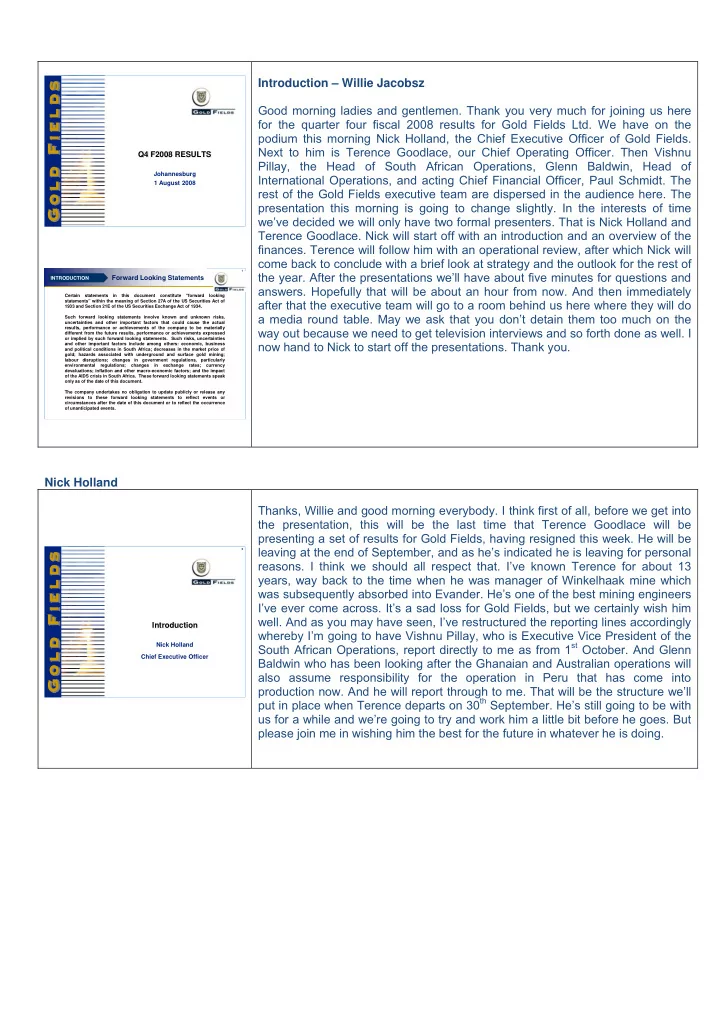
Introduction Willie Jacobsz Good morning ladies and gentlemen. Thank you very much for joining us here for the quarter four fiscal 2008 results for Gold Fields Ltd. We have on the podium this morning Nick Holland, the Chief Executive Officer


slide-1
SLIDE 1

Q4 F2008 RESULTS

Johannesburg 1 August 2008

2

INTRODUCTION

Forward Looking Statements

Certain statements in this document constitute “forward looking statements” within the meaning of Section 27A of the US Securities Act of 1933 and Section 21E of the US Securities Exchange Act of 1934. Such forward looking statements involve known and unknown risks, uncertainties and other important factors that could cause the actual results, performance or achievements of the company to be materially different from the future results, performance or achievements expressed

  • r implied by such forward looking statements. Such risks, uncertainties

and other important factors include among others: economic, business and political conditions in South Africa; decreases in the market price of gold; hazards associated with underground and surface gold mining; labour disruptions; changes in government regulations, particularly environmental regulations; changes in exchange rates; currency devaluations; inflation and other macro-economic factors; and the impact

  • f the AIDS crisis in South Africa. These forward looking statements speak
  • nly as of the date of this document.

The company undertakes no obligation to update publicly or release any revisions to these forward looking statements to reflect events

  • r

circumstances after the date of this document or to reflect the occurrence

  • f unanticipated events.

1

Introduction – Willie Jacobsz Good morning ladies and gentlemen. Thank you very much for joining us here for the quarter four fiscal 2008 results for Gold Fields Ltd. We have on the podium this morning Nick Holland, the Chief Executive Officer of Gold Fields. Next to him is Terence Goodlace, our Chief Operating Officer. Then Vishnu Pillay, the Head of South African Operations, Glenn Baldwin, Head of International Operations, and acting Chief Financial Officer, Paul Schmidt. The rest of the Gold Fields executive team are dispersed in the audience here. The presentation this morning is going to change slightly. In the interests of time we’ve decided we will only have two formal presenters. That is Nick Holland and Terence Goodlace. Nick will start off with an introduction and an overview of the

  • finances. Terence will follow him with an operational review, after which Nick will

come back to conclude with a brief look at strategy and the outlook for the rest of the year. After the presentations we’ll have about five minutes for questions and

  • answers. Hopefully that will be about an hour from now. And then immediately

after that the executive team will go to a room behind us here where they will do a media round table. May we ask that you don’t detain them too much on the way out because we need to get television interviews and so forth done as well. I now hand to Nick to start off the presentations. Thank you. Nick Holland

Introduction

Nick Holland Chief Executive Officer

2

Thanks, Willie and good morning everybody. I think first of all, before we get into the presentation, this will be the last time that Terence Goodlace will be presenting a set of results for Gold Fields, having resigned this week. He will be leaving at the end of September, and as he’s indicated he is leaving for personal

  • reasons. I think we should all respect that. I’ve known Terence for about 13

years, way back to the time when he was manager of Winkelhaak mine which was subsequently absorbed into Evander. He’s one of the best mining engineers I’ve ever come across. It’s a sad loss for Gold Fields, but we certainly wish him

  • well. And as you may have seen, I’ve restructured the reporting lines accordingly

whereby I’m going to have Vishnu Pillay, who is Executive Vice President of the South African Operations, report directly to me as from 1st October. And Glenn Baldwin who has been looking after the Ghanaian and Australian operations will also assume responsibility for the operation in Peru that has come into production now. And he will report through to me. That will be the structure we’ll put in place when Terence departs on 30th September. He’s still going to be with us for a while and we’re going to try and work him a little bit before he goes. But please join me in wishing him the best for the future in whatever he is doing.

slide-2
SLIDE 2

4

Securing the Future Operational Excellence Growing Gold Fields

INTRODUCTION

Strategy To Release Value STEP CHANGE IN SAFETY AND DELIVER PROJECTS

Notional Cash Expenditure Free Cash Flow Margin Growth UNHEDGED Aggressive International Growth Few, Large, High Quality Assets Smaller Projects For Exceptional Returns Leverage Existing Positions Rule of Five’s to Rule of Two’s SAFETY

Strategy Presented 9 May 2008

3

Right, I’ve been in this job for 90 days or three months, which ever way you want to look at it. And the last time I got up, which was just after I’d taken over on 9th May, I said to you that our strategy was largely unchanged in terms of its major composition, i.e. securing the future, operational excellence and growing Gold

  • Fields. But we were heavily focused on what we call notional cash expenditure

(NCE), which is the all-in cost of production, operating costs plus capital, and that I was going to be measuring our performance based on that. That in turn drives free cash flow. And let me tell you something. One of the other things I’ve done since I got into office is speak to as many fund managers around the globe as possible. That’s on the east and west coast of the US, in London. And the thing that comes through clearly time and again is that it’s not reserves in the ground that counts, it’s not ounces of production that counts – it is cash flow. Obviously you’ve got to have those things to have cash flow, but just having those things is not going to add value in the minds of the investors. So we’re going to measuring ourselves on all-in costs because this industry hasn’t been making much cash flow. And you’ll see this time and again when we report. That will be the parameter.

slide-3
SLIDE 3

5

DELIVERING WHAT WE PROMISED

DELIVERING OUR PROJECTS

CERRO CORONA Rock in the mills Shipment of concentrate in Q1 F2009 TARKWA EXPANSION CIL Project completion and ramp-up Q2 F2009 ST IVES New underground mines commissioned Ramp-up underway 15% production increase by Dec quarter SOUTH AFRICA Power supply stable but tight Safety audit commenced – Du Pont appointed Pillar mining already reduced Production recovering SOUTH DEEP PROJECT Restructuring at an advanced stage 2nd outlet repairs underway below 95 level Market presentation, late August BEATRIX Quality mining issues resolved Strong recovery INTRODUCTION

Strategy To Release Value

4

What I also said to you was in the short-term there were two main areas that I was concerned about, particularly after the South Deep accident. Number one was to radically improve our safety in the group, and secondly it was to deliver

  • ur projects. Let’s go through how we’re doing in terms of that and what the

implications are. If we look first on delivering on our projects - at Cerro Corona I’m pleased to be able to tell you that as we speak the mills are turning over. We’re getting rock through the mills. Some of you may have been on the visit last month to see the

  • peration. I’m very pleased you managed to do that, and you will get an

appreciation for the scale of that operation and what we’re doing. We expect the first shipments of concentrates in the first quarter of 2009, but the first production

  • f the concentrates themselves by around about the 12th August. So holding

thumbs that everything works well. We tested the mills extensively before we put rock through them, so it looks as though we’re on our way. That will have a steep ramp-up and I’d like us to get to 375 000 ounces of gold equivalent a year by

  • December. So that’s on its way.

The Tarkwa expansion, as we said earlier that should be completed by around

  • October. And what that does is double the size of the mill and enables us to take

the heap leach material that would otherwise go to the pads, put that into the mill, improve the recoveries and get an extra 80,000 ounces a year of gold. That should come into production by around the end of October, and will be fully commissioned and producing what it should do by the end of the year as well. In South Africa one of the things I wanted to do before I spoke to you today was to get hold of the Chief Executive of Eskom, and I managed to speak to him yesterday on his travels. I said one of the things I’m going to be asked by the market is power. And in fact on the TV interviews this morning from London everyone was just asking what’s happening with power - are you running your

  • perations? And Jacob was able to tell me as far as he is concerned power

supplies are stable but tight. And you’d expect them to be tight because we’re in winter where usage goes up to 40 gigawatts. But I think the maintenance has

  • improved. He is much more comfortable about maintenance and also the coal

supplies look better. Let’s bear in mind that since the power crisis back in January we’ve had stable supplies of power for six months. So I think credit to them for turning this around and starting to get more stability into the grid. Okay, so that’s the other thing. We’ve commissioned Du Pont and started the audit, and I expect that to be completed around about September or October. Remember that’s the group-wide initiative to review all of our safety practises and procedures, and we expect to learn a lot from that. Pillar mining has already been reduced. A lot of people have said to us, you’ve talked about pulling out of pillar mining because it’s risky. You shouldn’t be sending people in there. You know what? We’ve already done it. We’ve pulled back pillar mining by 25% at Driefontein already. That’s inherent in these numbers. And by 50% at Kloof. Now, that pillar mining review as I said to you last time is not over. What we indicated is that Terence and I will complete that exercise by the end of August with our operations and decide if there are any further cutbacks to be done. But we’ve done a lot of it already. Our production in South Africa is recovering. It was a poor quarter in March, we all understand that. But I’m pleased to be able to report that the production in South Africa got back up by 6% this quarter. We’ve got a long way to go, but it’s starting to move in the right direction. At South Deep the other pleasing thing is that the restructuring that we’ve spoken about… bear in mind when we stopped mining the VCR, given that that was depleted above 95 level, we were over-complemented by about 850 people. We’ve come to a solution with the workforce on that, and all but around 200 people we have a deal with, and the rest I think we’ll sort out in the next few

  • days. So I would expect we’ll have all of those people off the operation within

three weeks, and then South Deep will be restructured and will be a fully mechanised operation. Terence will talk more about that in the last part of his

  • presentation. And at Beatrix the other thing that worried us last quarter was that

the production had slipped significantly. And with the mine call factor improving we’ve seen a strong recovery from Beatrix. So well done to the team, and we

slide-4
SLIDE 4

look forward to getting more of that. So I think we’ve made good progress on getting our projects up and running and we’re well positioned for all these to deliver by the end of the year.

6

STEP CHANGE IN SAFETY

Driefontein Secondary Support South Deep Rehabilitation of 95 2 & 3 West ramps Kloof Main Shaft Steel Work Repairs Pillar Mining Review Du Pont Safety Audit Training and Culture “WE WILL NOT MINE IF WE CANNOT MINE SAFELY”

INTRODUCTION

Strategy To Release Value

5

Now, the second part of what I said to you was safety. I made a statement to you and I said to you we will not mine if we cannot mine safely. And everyone said what the hell does that mean. Well, let me tell you what it means. It means what it says, and we’ve already taken significant action in that regard. One, you’ve heard about pillar mining. That has already been cut back 25% at Driefontein and 50% at Kloof. Secondary support in Gold Fields has been a problem for years, and we’ve taken the view that we cannot continue with this. At Driefontein we need to start getting our secondary support caught up. And regrettably what that means is that next quarter Driefontein’s production is going to be reduced by about 400kg as we tackle some of the secondary support of the higher grade

  • areas. That fortunately is only a one quarter impact, and by the September

quarter I expect us to be over the worst of that and back up to production of around 6.8 tonnes a quarter. South Deep, we did mention before that the primary support had failed in the two west and 95 three west ramps, and we had to cut back production there. And that meant we had to drop production by about 250kg a month. That work will now be completed by the end of August, so next quarter production will be 200kg lower than what it is now, but thereafter when we get back into the December quarter we’ll be in better shape for that mine to start delivering and getting back to where it is. Pillar mining I have discussed. At Kloof, the one thing that has become evident is that as part of our whole heightened safety awareness programme I’ve asked everybody to go and look at all of our infrastructure across all of our operations. Not just the ropes given the South Deep accident, but all of the infrastructure. And the team has done a comprehensive review across all of the operations, and what we’ve identified in this period is that the Kloof main shaft steelwork is in urgent need of rehabilitation. And the area that’s really affected is below 17 level. Terence will talk more about that in detail, but simply put we had to stop that shaft and do this work, and that’s going to take about six months. Now, unfortunately that is one of the main shafts that we hoist about 60% of our gold

  • through. We’re putting contingency plans in place to deal with that, but I’ve made

the decision that we have to stop that shaft and fix this. And I’ve really used this quarter to identify all of the issues that are affecting us. Let’s fix these issues and move on. I don’t want to delay these kinds of issues, and that’s why I’ve taken this hard decision, but the right decision that we have to stop that shaft. So that’s around about six months of work to fix that, and it’s going to mean we’re going to lose about 500kg a month for those six months. You might well say why wasn’t this identified before? Again, what I’m saying to you is I’ve been in this job 90 days, we’ve heightened the whole safety awareness across

  • perations and this has been identified as an issue. So I think it’s important that

we deal with it and move on. Training and culture continues, and Terence will talk more about the initiatives we’re doing on training and the number of people we’re putting through our various initiatives. I’ve personally gone out to the

  • perations and spoken to 50,000 people about safety. I don’t think that has been

done in Gold Fields before by a Chief Executive, so I think that gives you an idea about how important this is for Gold Fields.

slide-5
SLIDE 5

7

Q4 2008 Q3 2008 Gold Produced1

000oz

865 827 Exchange rate

ZAR/US$

7.77 7.45 Revenue

A$/oz

949 1,008

US$/oz

895 921

R/kg

223,568 220,612

Rm

6,452 6,109 Operating costs, net

Rm

3,731 3,543 Operating costs

R/ton

306 283

SA ug R/t

886 974 Operating profit

Rm

2,721 2,566 Operating margin

%

42 42 Total cash costs

R/kg

125,359 122,920

US$/oz

502 513 Notional cash expenditure2 (NCE)

R/kg

217,065 201,181

US$/oz

869 843 Q4 F2008 FINANCIAL REVIEW Salient Features

1 Attributable 2 NCE = Operating cost + Capex 6

I think looking at the numbers for the quarter you can see that our production was up about 5% to 865,000 ounces. And that’s on the back of the improvement in South Africa, as I mentioned. The international operations were fairly stable quarter on quarter. The net effect of the gold price going slightly but the Rand weakening means that in Rand per kilogram terms our price is similar to the previous quarter, and therefore our revenue was up and our operating profit was up to R2.7 billion. Operating costs were up about 5%. That’s on the back of the additional volumes in South Africa, as the volumes we did this quarter were higher than last quarter, given the power crisis,- continued inflationary pressures, particularly in Ghana, where diesel and fuel in particular has impacted us, and also some translation issues. But Terence will go through some more detail with

  • you. So operating profit was up.

Cash costs, as we mentioned in our guidance, were pretty stale quarter on quarter, and in Dollar terms slightly down to $502. And you can see notional cash expenditure. I’m reporting that for the first time. You’re going to be seeing this in future. And that’s all capital expenditure. Some people will argue you should only take maintenance capital expenditure. Frankly I think that’s misleading because in the long term all of it’s sustaining capital to keep your

  • perations going. And that’s $869, and you look at the gold price and say that’s

$895 per ounce. And you say, hang on a minute guys, you’re not making any

  • cash. Correct, we’re not making any cash. That’s because we’re reinvesting all
  • f the cash flow into the growth projects. And in particular over the last quarter

about $88 million or $100 per ounce was invested into Cerro Corona, which goes into that line. And you’ll see in the second half of next fiscal year how that NCE will come down as that project comes in. This is what we’re measuring because at the end of the day the all-in costs don’t lie. Whether you capitalise stuff, whether you expense it, it’s all in here

8

Q4 2008 Q3 2008

Operating profit Rm 2,721 2,566 Amortisation & depreciation Rm 778 714 Net operating profit Rm 1,943 1,852 Interest paid, net Rm (46) (88) Foreign exchange (loss)/gain Rm (7) 38 Gain on financial instruments Rm 2 262 Other expenses Rm (76) (32) Exploration Rm (107) (58) Profit before tax & exceptional items Rm 1,709 1,975 Exceptional items Rm (95) (42) Mining & income tax Rm (664) (567) Net profit Rm 950 1,366 Net profit attributable to ordinary shareholders Rm 843 1,248 SA cps 129 191 Net profit excluding gains and losses on foreign exchange, financial instruments, exceptional items and discontinued

  • perations (Core earnings)

Rm 911 1,009 SA cps 140 155

Q4 F2008 FINANCIAL REVIEW Income Statement

7

Okay, working further down through the income statement, amortisation is up from R714 million to R778 million. That’s on the back of the increased

  • production. You can see the interest paid is around R45 million. That’s lower

than normal because of some year end adjustments where we capitalised some

  • interest. But going forward you can work on about R80 million to R100 million a

quarter given our current debt level. Exploration is double last quarter, and that’s really a function of timing. Often we find that we account for this as it occurs. We don’t always accrue for the invoices exactly on a quarter by quarter basis, and some of it’s also just timing of the work. Other expenses is up principally because of re-basing how we measure Gold Fields’ share incentive scheme against the index of the peer group, and also some additional employee issues during the period. So I think that has pushed it up to a level that you can assume going forward. Exceptional items of R95 million is made up of restructuring costs at South Deep. We provided about R60 million there for the restructuring costs, getting the people off site. And then there are some small asset write-downs in Australia in respect of certain assets that we’re no longer going to use given the new reserves and resources, which we’ll take you through at the end of August. So net profit then was R843 million compared to R1.2 billion last quarter. And that decrease is mainly because of the significant write-back of mark to market losses last quarter on the Mvela structure. Remember last quarter we moved away from a variable number of shares to a fixed number of shares, and we avoided the mark to market adjustments going through the income statement. So that was a once-off benefit, just a book entry really. So you should really exclude

  • that. And if you look at the bottom line the core earnings dropped from R1 billion

to R900 million. And most of that reduction is because of year-end tax

  • adjustments. If you put those back we would have been flat, and that would have

better reflected what you see in the operating profit for the period. So 140c a share core earnings for the period.

slide-6
SLIDE 6

9

Q4 2008 Q3 2008 Cash flow from operations

Rm 2,568 3,039

Dividends

Rm

(425)

  • Capital expenditure - additions

Rm

(2,525) (2,086) Capital expenditure - disposals

Rm

7 3 Other investing activities

Rm

(701) (273) Net loans received/(repaid)

Rm

315 (253) Rights offer – Cerro Corona

Rm

768

  • Other financing activities

Rm

12 39 Net cash inflow

Rm

19 469 Currency translation adjustment

Rm

44 154 Cash at beginning of period

Rm

1,944 1,321 Cash at end of period

Rm

2,007 1,944 Q4 F2008 FINANCIAL REVIEW Cash Flow Statement

8

If we look at the cash flow from the period you can see R2.5 billion from

  • perations. Slightly lower than the last quarter, and that’s mainly because of a

large working capital release that we had in the March quarter that is not being repeated during this quarter. You can see dividends that we paid last quarter. Remember, we passed the dividend in March but caught it up in the last quarter. Capital at R2.5 billion is probably the highest we’ve had. It will be high for the next quarter and then it will start coming down. And as I say, most of that capital is the final stuff coming through on Cerro Corona. Other investing activities, almost all of that is increasing our stake in Sino Gold. That was the first deal that I’ve done where we increased our ownership up to 19.9%. That was a $90 million investment. And also at the same time we were able to reduce the exploration joint venture alliance from targets of five million ounces to three million ounces. So I think that’s something that gives some upside for the future. Rights offer at Cerro Corona, what that was, we had funded the project with debt historically and we needed to capitalise that debt and give the minorities an

  • pportunity to put their contribution in. And I must say the rights offer was 100%
  • subscribed. It’s interesting if you look at Cerro Corona, given that it is listed in

Peru, the market value of this asset if you look at the trading on the Lima stock exchange is over $2 billion. That’s what the market is valuing Cerro Corona at. So it’s quite interesting. Unfortunately I don’t see that coming through into the Gold Fields share price at this stage. So hopefully that will in due course. So cash at the end of the period was around R2 billion. Net debt was something in the order of around about R5 billion.

10

INTENSIVE CAPITAL INVESTMENT

F2008 F2007 Gold produced attributable

000’oz

3,638 3,972 Total cash costs

R/kg

111,315 86,623

US$/oz

476 374 Gold Price

R/kg

190,623 147,595

US$/oz

816 638 Operating profit

Rm

9,041 7,740 Operating margin

%

39 40 Net earnings

Rm

4,458 2,363

cps

683 414 Core earnings

Rm

2,930 2,298

cps

449 412 Capital expenditure

Rm

9,014 5,931 Notional cash expenditure (NCE)

$/oz

796 585

R/kg

186,088 135,666 F2008 FINANCIAL REVIEW

Salient Features

9

So the balance sheet is still in good shape. And briefly for the year, given this is the financial year end, you can see that our production for the year was 3.6 million ounces. That’s down from last year. The power crisis that hit us in the March quarter obviously had a major impact on our production, and we also had a reduction in Australia as well. So a contribution across the board, but the challenge for us now is to get that back up. You can see at the bottom there, capital expenditure, R9 billion for the year. Just to put that into context, if you look at a breakdown of that capital expenditure you can see that in Rand terms about R4.6 billion was spent on growth or long-term replacement.

11

F2008 Capital Expenditure:

R m US$m

  • Driefontein 9 shaft

267 37

  • Kloof KEA project

18 2

  • South Deep

785 108

  • Tarkwa CIL expansion

652 90

  • Cerro Corona

2,533 348

  • Uncle Harry’s

400 55 Total growth projects 4,655 640

  • Sustaining Capex

4,359 600 Total Capital Expenditure 9,014 1,240 Purchase of key investments:

  • Sino Gold

795 112

  • Conquest Mining

66 9 Total Purchase of Key Investments 861 121

INVESTING IN PROJECTS Investments

F2008 FINANCIAL REVIEW

10

More than 50% went into positioning Gold Fields for the future. We’ve never spent as much capital as that before, and that will obviously come down. And in addition, the purchase of our investments offshore, giving us options for the future, we spent another R800 million. So R5.5 billion or $760 million was reinvested during the year in growth projects and on strategic investments. So we are thinking about the future, for those who say we have no growth pipeline.

slide-7
SLIDE 7

12

A 4 MOZ P. A. PRODUCER AGAIN

Securing the Future Operational Excellence Growing Gold Fields Notional Cash Expenditure Free Cash Flow Margin Growth

UNHEDGED SAFETY

Q3 F09 TARGET

~4 moz annualised

@ NCE of ~US$725/oz

(@ R/US$ 8.00)

STRATEGY

Short Term Objectives

11 13

STRATEGY

Short Term Objectives PRODUCTION ~ 4MOZ BY Q3 F2009

Estimate Actual

‘000 ounces 215 192 120 49 199 56 107 118 40 Q4F09 Koz TARGET: 4 MOZ PA 200 400 600 800 1,000 1,200 Q1 Q2 Q3 Q4 Q1E Q2E Q3E Q4E F2008 F2009

Agnew St Ives Cerro Corona Damang Tarkwa South Deep Beatrix Kloof Driefontein Attributable 12

So where do we want to go to in the short term? I mentioned earlier we want to deliver our projects. I said we want to improve our safety. Notwithstanding those safety stoppages that I’ve mentioned at Kloof main shaft, Driefontein and South Deep, we still have a target of 4 million ounces at a total NCE of $725 per ounce. Previously I said to you that’s my target by the end of December. Regrettably with the Kloof situation I think we’re going to move that out a month or two. I’m hoping that Kloof will be able to get back by early January, but I’m not distracted from our target. And with the projects coming in at the same time and fixing up our assets locally I think we can do this and I don’t think it’s a stretch. Here is a profile for you. In quarter one 2009 you can see the drop there in our production. That’s about a 5% drop. That’s mainly on the back of the Kloof profile reducing from 200,000

  • unces per quarter to 125,000 ounces a quarter. Then you can see the next

quarter we start getting the build-up of Cerro Corona and some of Tarkwa coming in, and some of the new underground mines at St Ives coming in. And then we get back to one million ounces attributable by quarter three. I’ve put on the right there for the benefit of the analysts the sort of production profile you can expect for quarter four for each of the major operations. So that gives you an idea of how to model going forward. In looking at these I’ve consciously reviewed them and these aren’t shoot the lights out targets. These are targets that we should be able to get. The one thing I don’t want to do is over-promise and under-deliver. I want to put down stuff here that we can deliver for shareholders.

14

POSITIVE IMPACT OF GROWTH PROJECTS

100 200 300 400 500 600 700 800 900 1000 Q1F08 Q2F08 Q3F08 Q4F08 Q1F09E Q2F09E Q3F09E Q4F09E Group Cash Costs South Africa Ghana Australia Peru

STRATEGY

Short Term Objectives CASH COSTS

F2008 F2009 US$/oz

Estimate Actual

13

So a lot of this projection is just getting us back to where we should have been in any event. I think we can in fact do better. And then our cash costs you can see we’re going to have a steep rise in the next quarter. That’s on the back of the lower production at Kloof. As you know the fixed costs don’t go away in the short

  • term. The power increase of 20% in South Africa, the wage increase in South

Africa of 10%, and then it gradually comes back again as we bring in Corona, which will come in at about $300 per ounce cash costs compared to the portfolio

  • f $500. As we leverage back up, notwithstanding some of the inflationary

pressures that we’ve built in here, I’m hopeful we can get back to around $500 by the end of the year.

15 50 100 150 200 250 300 350 Q1F08 Q2F08 Q3F08 Q4F08 Q1F09E Q2F09E Q3F09E Q4F09E R’mil SA Ghana Australia Cerro Corona

STRONG CASH FLOW IN H2 F2009

Estimate Actual STRATEGY

Short Term Objectives CAPITAL

US$/oz F2008 F2009 14

There is the capital profile. As I mentioned, the next quarter, quarter one 2009, is still going to be a tough one as we finish up the remaining expenditure on the Corona and Tarkwa projects. Then you can see by the time we get into the second quarter it starts dropping down, and by quarter three you can see a further drop. That means we’re now starting to harvest our projects and generate cash flow from them.

slide-8
SLIDE 8

16

NCE US$725 – US$750 BY Q3 F2009

100 200 300 400 500 600 700 800 900 1000 Q1F08 Q2F08 Q3F08 Q4F08 Q1F09E Q2F09E Q3F09E Q4F09E Group Cash Costs Group NCE South Africa Ghana Australia Peru

STRATEGY

Short Term Objectives ALL IN COSTS (NCE)

NCE TARGET

F2008 F2009 US$/oz

Estimate Actual

15

And then you can see the NCE line. I’ve put the target in there of $725. That’s the red line. $725 per ounce. And you can see the green line is where we expect to go. Obviously it’s slightly up initially from where we were, given the lower production and still high capital, and then coming down as those projects deliver. That’s our quest for the short term. You might say $725 per ounce doesn’t sound very exciting, particularly when the gold price is $890 or something like that.

17 200 400 600 800 1,000 1,200 Barrick* Anglo* Newmont* GFI Harmony GoldCorp*

F2008 Mar Qtr 08 F2009 plan

Source: JP Morgan estimates *Cash Costs + all Capital Expenditure

*Financial Year-end December

STRATEGY

Short Term Objectives US$800/OZ A GOOD FLOOR PRICE NOTIONAL CASH EXPENDITURE* PEER GROUP JULY 2007 TO JUNE 2008

NCE - US$/oz 16

Well, let’s look where Gold Fields would be relative to the peer group. I must thank Steve Sheppard at JP Morgan for giving us these figures, because it’s always better to put an analyst’s figures up and not my figures. These are his figures that he has kindly provided to us, and you can see on an all-in basis – and this includes all capital expenditure – it shows the weighted all-in cost of the industry is around $780 per ounce. Now, a lot of people ask me, where do you think the gold price is going? And

  • ne of the things that gives me some comfort that I think the gold price is not

going to go back to $500 is that the all-in cost of production of the sector has risen significantly. And if we are still going to have a gold sector I think you’ll find gold should hold up at these prices. If I’m wrong and gold goes back down again, what’s going to happen? The exploration budgets are going to be slashed, capital is going to be slashed, rationalisation is going to take place and you may find that you have this bounce effect. Gold goes down and then it bounces way up, and it will overshoot on the upside. I don’t think that’s going to happen. I think gold has got a strong floor at $800. But I think it could certainly go a lot higher, and I wouldn’t be surprised to see gold at $1000 to $1200. What this tells you is that is Gold Fields can achieve what it has set out to do. We will be well-placed relative to the peer group. And if you look at the relative valuations compared to us if we achieve this I think it poses some interesting questions. I think with that I’m going to hand over to Terence.

slide-9
SLIDE 9

Terence Goodlace

Q4 F08 OPERATIONAL REVIEW

Terence Goodlace Chief Operating Officer

17

Thanks, Nick, and good morning ladies and gentlemen. Just to correct Nick, I recall when he came out I was actually the General Manager at Kinross. And all I knew about head office was that it was a helicopter that came to the operations

  • nce a quarter, had a go at you and left. And here was this redhead. I didn’t

even know what corporate finance was, and he was talking about ring fencing. So us miners who only know about mine call factors, stoping, volumes and grades had to learn about ring fencing. He taught us a bit about that, and a few years later we actually worked together on the ring fencing at Beatrix, when I decided at the merging of Gold Fields to try and do some corporate finance. I did that for two years but then Ian thought I probably wasn’t good at it, and he decided to pull me back to the operations. But to Gold Fields, thanks very much for the opportunity and the privilege. I really do appreciate it.

19

SAFE PRODUCTION = PROFITABLE PRODUCTION

Consistent delivery by existing assets

  • SHEC delivery
  • Volume, value, quality focus
  • Cost leadership
  • Utilities and energy strategies
  • Capital spend optimization

Securing the Future Operational Excellence Growing Gold Fields Notional Cash Expenditure Free Cash Flow Margin Growth

UNHEDGED SAFETY

Strategic Focus

Q408 OPERATIONAL REVIEW

18

Moving on to the presentation per se, there is a common operational focus throughout the group, and it is depicted on the slide. No matter where you are in the world and no matter what the mine type, you cannot get away with poor safety, health, environmental and community (SHEC) performance. You have to be the best at that. Volume, value, quality are essential in any mining operation. Cost leadership and the control of inputs and in-costs are absolutely critical, as is the security of supply. Utilities and energy have come to the fore as strategic items, and conversation is an absolute must. Capital spend needs to be

  • ptimised and controlled. But all of this has to happen through motivated people

who are healthy, and that’s another key focus area for the group. Each operation and region around the world for Gold Fields are driving at these themes as and when they require them under the mantra of safe production equals profitable production.

20

Safety Trends

Q408 OPERATIONAL REVIEW

“WE WILL NOT MINE IF WE CANNOT MINE SAFELY”

  • Performance recovering -
  • No LTI’s - Agnew, Damang, St Ives and Tarkwa
  • No fatalities – Beatrix and international ops
  • One million fatality free shifts – Beatrix, Kloof and

Driefontein

  • Du Pont and Full Compliance audits underway
  • Health and safety plans implemented
  • 14,311 employees trained during quarter
  • Pillar and secondary support review ongoing

455 425 410 382 356 320 260 50 100 150 200 250 300 350 400 450 500 F2002 F2003 F2004 F2005 F2006 F2007 F2008 DAYS LOST FREQUENCY RATE (per million hours worked) 10.00 10.44 9.15 7.12 7.99 6.49 6.91 6.39 6.08 5.50 3.97 2 4 6 8 10 12 F1998 F1999 F2000 F2001 F2002 F2003 F2004 F2005 F2006 F2007 F2008 SERIOUS INJURY FREQUENCY RATE (per million hours worked) 0.32 0.32 0.33 0.32 0.31 0.23 0.27 0.18 0.29 0.19 0.28 0.05 0.1 0.15 0.2 0.25 0.3 0.35 F1998F1999F2000F2001F2002F2003F2004F2005F2006F2007F2008 FATAL INJURY FREQUENCY RATE (per million hours worked) 19

Safety is absolutely critical as I said earlier, and we will continue to drive all of

  • ur initiatives in this regard. I must, however, congratulate the good

performances on some of our mines. We were LTI free at St Ives, Agnew, Tarkwa and Damang for the quarter. And as a matter of fact, Agnew has not had a single LTI for the last year, and Damang for the last six months. All of the international operations, as well as Beatrix, were fatal-free for the quarter, and Kloof achieved a million fatality-free shifts for the first time in two years. Since the end of the quarter we’ve also had Beatrix and Driefontein achieve a million fatality-free shifts. I have to say we’re striving to what was announced yesterday by AngloGold. If we can get to that level of performance then we will be happy. The DuPont audit is well underway, and we expect their report on the South African operations to be completed by October. And we will then move to the international operations with DuPont. We have over the last year spent a lot of time and effort and had our health and safety plans ratified at the board earlier this year. And these focus on short, medium and long-term actions that will affect

  • safety. In the short term it’s all about full compliance, it’s all about safe acts, it’s

all about safe conditions and it’s all about safe behaviours. In addition, our safety mobilisation programme which we commenced at Driefontein last year through the Masipepe programme has been expanded to the other mines. We have a programme in place now at Kloof called Sawubona

  • Kusasa. We have a programme at Beatrix called Kusileke. Those programmes

looked at what they need to do, and this quarter alone we put 14,300 people through those programmes. We will repeat, market and drive at these programmes until safety is at the top of everybody’s minds. We cannot and we will not relent. Over the last year we’ve reduced pillar mining activity as Nick has said, but just to put that into context, big reductions at Driefontein and Kloof, and then numbers were 24% and 51% respectively. If I equate that to what we have stopped on an annual basis, it’s around about 130,000 ounces per annum. So it’s 1.2 tonnes of gold per quarter, 4.8 tonnes per year. Those are in pillars that we are no longer mining, and we will not mine those until technology changes. We will also continue to drive our secondary support programmes, as it is critical to keep our access haulages open.

slide-10
SLIDE 10

21 Volume Value Quality Ounces

March F2008 827,400 Driefontein

  • =
  • 8,323

Kloof

  • =
  • 3,830

Beatrix

  • 36,520

South Deep

X

  • (15,110)

SA Operations 33,470 Tarkwa

X

  • 2,510

Damang

X

  • (1,830)

St Ives

X = =

(2,410) Agnew

  • 5,560

International Operations 3,830 June F2008 864,700

Attributable Production

Q408 OPERATIONAL REVIEW Reconciliation Q3 F08 to Q4 F2008

VOLUME, VALUE, QUALITY

20

Moving on to gold production, it is pleasing that the quarterly performance improved by 5% to 865,000 ounces on an attributable basis. The increase was driven primarily by South Africa with a 6% increase to 5500 ounces, an increase

  • f 33,500 ounces. Driefontein managed to restore volumes, but at slightly lower
  • grades. And in conjunction with a mine call factor of 89% resulted in production
  • f 217,000 ounces. Ten shaft was stopped for most of the quarter as a result of

the tragic event that we spoke about at the previous quarterlies, and it is unlikely that we will ever stope at that shaft again. Kloof increased underground volumes by 32% to 688,000 tonnes for the quarter. It had a lower yield of 7.5g that resulted in production of 179,000 ounces. The mine call factor was on plan at 85%, but it was 10% down on the previous quarter where we had some release from the gold and the effect of the Christmas break. Beatrix as Nick said showed a welcome return to the quality, and a sharp rise in the mine call factor to 94% from a low of 67% in the previous quarter. This, along with a 19% increase in volumes mined, lead to higher yields and a 45% increase in gold production to 119,000 ounces. South Deep volumes regressed as a result of the tragic accident on the 1st May 2008, the stopping of the VCR above 95 level, and the intentional stopping of the 95 two west and three west ramps for a three month support programme. Underground values at 7.4g per ton were more than planned, and although the mine achieved a mine call factor of more than 120%, the volume offset resulted in the mine producing 38,000 ounces. Tarkwa had a 2% increase in gold produced to 169,000 ounces, driven primarily by lower volumes. And this was largely as a result of four less milling and processing days. There was a welcome release of 9000 ounces from gold in process through the heap leach facilities. It was also pleasing to see that the CIL grades had increased to 1.58g per ton. Damang throughput also decreased by some 14% to one million tonnes for the quarter, and that was due to essential pebble crusher maintenance and also four less milling and processing days. In addition, relatively harder ores, which come from the Damang pit cutback, reduced mill throughput. However, this was offset by higher yields of 1.5g per ton, and the mine produced a creditable 50,000 ounces for the quarter. Moving to Australia, St Ives gold production decreased to 101,000 ounces, which was marginally down. And the prime driver for this was a reduction in the heap leach facilities where rock hardness affected recoveries adversely. Importantly, the new underground mines at St Ives were commissioned, and as they ramp up in the following quarters a higher proportion of relatively higher-grade ore will report to the Lefroy mill. Agnew performed in line with plan and produced 55,000

  • unces. Excellent volumes and values were realised from the productive Kim

Lode at the Waroonga complex.

slide-11
SLIDE 11

22

Net Operating Cost

Q408 OPERATIONAL REVIEW

COST LEADERSHIP – CONSUMPTION & PRICE

Reconciliation Q3 F08 to Q4 F2008 Rm

Q4F08 Q3F08 Variance South Africa 2,197 2,126 3.3%

  • Increases in stores
  • Increase in safety & production incentives
  • Increase in use of contracting services (surface screening

and mud loading) Ghana 810 751 7.8%

  • Increase in commodities (fuel, reagents, explosives)
  • Increase in maintenance contractors (MARC)
  • Increased mining, Damang pit cutback

Australia 724 666 8.7%

  • Foreign exchange translation

Group 3,731 3,543 5.3%

21 23

Net Operating Cost

Q408 OPERATIONAL REVIEW

COST LEADERSHIP – CONSUMPTION & PRICE

Reconciliation Q3 F08 to Q4 F2008 US$

Q4F08 Q3F08 Variance South Africa 282 283 0%

  • Increases in stores
  • Increase in safety & production incentives
  • Increase in use of contracting services (surface screening

and mud loading) Ghana 105 101 +4%

  • Increase in commodities (fuel, reagents, explosives)
  • Increase in maintenance contractors (MARC)
  • Increased mining, Damang pit cutback

Australia 95 90 5%

  • Foreign exchange translation

Group 482 474 2%

22

Moving on to costs, and Nick has given you some high-level reasons for what has happened with the costs, but overall if you look at the net operating cost in Rand terms it has increased from R3.5 billion to R3.7 billion, an increase of 5%. And this increase of 5% was driven primarily by the increase in volumes at the South African operations, and translation costs as a result of the slightly weaker

  • Rand. If you look at South Africa per se, the net operating costs increased by

3.3% to R2.2 billion, and that was driven primarily by an increase in volumes mined and processed, which lead to an increase in consumables and incentives

  • paid. There was also an increase in contracting services. Moving on to the

international operations, and here we will just look at the Dollar terms. The increase was some 4% for the quarter from $191 million to $199 million. Half of that emanated from Tarkwa, where there was an increase of $4 million, and that was a result of increases in commodities such as fuel, explosives, tyres and

  • ther maintenance costs. The balance of the costs was due to the 4% stronger

Australian Dollar as the costs in Australia were unchanged quarter on quarter at A$99 million.

24

Capital Expenditure

Q408 OPERATIONAL REVIEW US$m Sustaining & ORD** Growth Total#

Q408 Q109E Q209E Q408 Q109E Q209E Q408 Q109E* Q209E* Driefontein 30 25 32 9

  • 39

25 32 Kloof 31 31 38

  • 31

31 38 Beatrix 20 21 21

  • 20

21 21 South Deep

  • 28

31 32 28 31 32 South Africa 81 77 91 37 31 32

118 108 123

Tarkwa 38 59 70 31 9

  • 69

68 70 Damang 6 6 7

  • 6

6 7 Cerro Corona

  • 37

13 88 42

  • 88

79 13 St Ives 34 35 30

  • 34

35 30 Agnew 12 11 11

  • 12

11 11 International 90 148 131 119 51

  • 209

199 131

GROUP** 171 225 222 156 82 32

327 307 254

* The estimate for Q1 and Q2 F2009 is calculated at the June closing rate of R8.00 to the US$ ** Ore reserve development # Excludes Kloof Main Shaft repairs

CAPITAL EXPENDITURE DECLINING

23

Nick showed you a graph on capital expenditure, but we’ve provided you with a little bit more detail as far as capital is concerned. Capital expenditure for the group rose by R439 million to R2.5 billion or $327 million for the quarter. This was in line with the forecast that I gave you at the previous quarterlies. Growth projects constituted 45% of this expenditure, and that was primarily at Tarkwa where we spent $31 million, Cerro Corona where we spent $88 million, and at South Deep where we spent $28 million. Key to note is that overall expenditure is expected to reduce from $327 million to $307 million, ultimately to $254 million in the coming quarters, and all of that is being driven by what happens with the growth projects. The only one that stays in terms of growth projects right now is the South Deep project at some $30 million per quarter.

25

  • Capital - ~US$550million
  • Successful production ramp up and transition from

project to operation

  • Manage construction of tailings management facility

(Aguilas + Gordas) within cost estimates and schedule Key Issues

Q408 OPERATIONAL REVIEW

ROCK IN THE MILLS Cerro Corona Project

LOM = gold price US$800 /oz, Copper US$8,000/t; F2009: gold price US$920 /oz, Copper US$8,310/t

F2009E LOM Production eq koz 377 5,180

  • Gold produced
  • Gold equivalent
  • Copper

koz eq koz ‘000 tons 126 251 28 2,176 3,004 400 Cash costs US$/eqoz 286 295 Sustaining Capex US$m 113 313 NCE US$/eq oz 587 356

25 50 75 100 125 200 400 600 Q1F09E Q2F09E Q3F09E Q4F09E Cash Costs &NCE Gold Production Operating Costs NCE (US$/oz) koz 24

We’re all pretty excited about Cerro Corona as Nick said. We now have rock in the mill, and we’re obviously chasing everything through the full circuit and ultimately getting back to commissioning the tailings line. All of that is happening as we speak. I had an update last night. It’s going pretty well. There are no major issues in terms of the overall commissioning, and we will basically work through

  • ur punch list and get things up and running according to the dates that Nick has

provided you with. There is a sharp ramp-up to some 100,000 ounces per quarter, as you can see from the graph on the top left-hand side. And this will

  • bviously have benefits for the group in terms of notional cash expenditure as

well as cash costs. Key in all of this is the continued demobilisation of the contractors and everybody that is associated with the building of this mine, and the construction of the tailings management facility. For those of you who saw it, these are monstrous construction works and we really need to make sure that we keep ahead of the game as far as the construction is concerned. We’ve also provided you with a table. I’m not going to go through the detail, but the bottom line here is that for the coming year we’re looking at an NCE of something like $587 per ounce. And over life of mine we’re looking at something like $356 per

  • unce from this mine.
slide-12
SLIDE 12

26

  • Comprehensive exploration drilling program in progress
  • Completion of resource modelling for Phase 1
  • Completion of restructuring during Q1 F09
  • Focus on infrastructure development and ore reserve build-up above and below 95 level
  • Completion of the ventilation shaft, brattice wall and surface fans commissioning
  • Commission refrigeration plant on 94 Level by Q4
  • Ramp-up of mechanised destress mining

Key Focus Areas Q408 OPERATIONAL REVIEW

A MODERN MECHANISED MINE South Deep Project

25 27

Q408 OPERATIONAL REVIEW

A MODERN MECHANISED MINE South Deep Project

OLD MINE CURRENT MINE PHASE 1 PHASE 2 SV1 AREA Waterpan Fault Wrench Fault

Plan

VCR MBT MBB MIQ MIT MIB MAD MAC ED ECT ECMQ ECB ECBQ ECMC Foot-wall ECBAQ ECBA

W E Equivalent of type-section to right-hand side Strat column

UNCLE HARRY’S TWIN SHAFT 26

We finally, in my opinion, are turning the corner at South Deep, and setting this mine up as a modern, mechanised mine which can exploit the massive Elsberg reef package. Much still needs to be done, and now that the restructuring is almost complete we can now concentrate on the business at hand, and this comprises the exploration drilling. We have eight rigs in the field right now, and we are focussing on more geological information in phases one and two. We continue to do further modelling of the resource, and I believe our team has done an exceptional job in terms of that actual modelling. I’ve put a picture up on the top right-hand side. It looks a little bit like a lasagne, but if I look at what our geologists go through in modelling 17 surfaces, all with the associated geology, and we’ve complete all of this up to 95 level, it really provides us with a platform to do proper mine design and scheduling. And that’s the standard that we’ve always set for this mine. We need to focus on infrastructure development to complete the shaft and ore reserve development, and I’ll talk about that in a few slides’ time. And then we finally are in a position to commission a new surface fan and the up cast facility of the ventilation shaft. We’ve now completed the brattice wall for some 2500 metres of that ventilation shaft, and we’re in the final stages of opening up the airways at the bottom of that shaft, and ultimately starting some new surface fans.

28

Q408 OPERATIONAL REVIEW

South Deep Project

Underground LIB drilling programme on 95 & 110 levels

CONFIRMING DETAILED GEOLOGY TO SOUTH

27

Commissioning of the first refrigeration plant on 94 level has been pushed out somewhat, but we’re hoping to have it completed by year end. This year we’ll also see the commencement of a mechanised de-stress mining programme. I’d like to just point out a few things that I’m going to talk about with regards to South Deep. We’ve got north at the top of the page. If we move through you can see the blue area constitutes the old mine and the current mine. That’s the twin- shaft complex. That’s the phase one area. That’s the phase two area. I have also reflected the Waterpan fault. That is what stopped all of the VCR mining. You can see the stoping is abutted against that. We picked up during the seismic surveys done a couple of years back this thing known as the wrench fault, and I’d like to talk about that on the next slide. The focus is for us to move out to the east and go to what is known as the zero line. You have the zero line, the one, two, three and four lines. Ultimately we are focusing in that area in terms of development, as well as the ramp support that Nick spoke about a little earlier. Running down the middle of the page is this red line which constitutes the shore line and the commencement of the wedge out into the massive Elsberg package. This provides you with an idea of all of the packages that have been modelled in that lasagne that I showed you a little earlier.

slide-13
SLIDE 13

29

Q408 OPERATIONAL REVIEW

South Deep Project

1 2 3 4b 5 5 4a South Deep Ramp Support Area Metres Actual

1 325m 65% 2 250m 72% 4a 120m 100% 4b 146m 28% 5 260m 73%

STOP, THINK, FIX AND CONTINUE

28

Just to orientate you with regard to this slide, this is that wrench fault I showed you that runs across the ore body. And we are underway with a long incline borehole programme, which is being drilled from 95 level and 110 level. And what we in fact do is drill holes from the current workings, and this is down to the

  • south. These are some one kilometre to 1.5 kilometres in length, where we curve

the borehole down and up through the package. Ultimately what we’d like to do is go through that wrench fault because I know all of the geology has been thrown upwards on the southern side of that fault. This is extremely important for us in terms of mine design and scheduling because it does necessitate us looking at establishing a new mining front, and that will provide us impetus in terms of the build-up to four million tonnes per annum at this mine. This is a sketch of what actually happened in terms of the reef support of the decline and the stoppage of the 95 two west and three west massive mining areas in the

  • quarter. It provides you with an idea of the areas that we have approached and

the percentage completion. As Nick said a little earlier we should be back in there by the 24th August, and we should be able to restore production at the mine at some 540kg per month from August onwards. I do have to, however, commend the team for the effort that they’ve taken to identify this and then to get stuck in and come up with a recommendation and advance the project accordingly.

30

DEVELOPMENT ACCELERATED FROM OCTOBER 08

Fault Planes 39 L Accesses 41 L Accesses

50 100 150 200 250 300 350 400 Metres 93 O line 94 O line 95 O line 100 Spiral

  • Development below 95 Level delayed due to

Vent Raise Hole accident

  • Permission granted by DME (17 July ‘08) to take

control of Vent Raise Hole and lifting equipment

  • Have recommenced on 100-level

Development: Below 95 Level

  • Procurement of trackless equipment finalised
  • Delivery of equipment during Q1 and Q2 of

F2009

  • Access to the east via 93, 94 and

95 development

  • Spiral ramp down from 95-1W to accelerate

access to Phase 1 reserves Development: Above 95 Level

South Deep Project

100 200 300 400 500 600 700 Metres 100 Lev 105 Lev 110 Lev 110a Lev

Development Q408 OPERATIONAL REVIEW

29

Speaking about development, we’ve provided you with two graphs. One focuses

  • n the above 95 level development out to the east, and the other one is the

below 95 level development. As far as above 95 level development is concerned, again this will all be mechanised. It will be trackless. We have procured the equipment and deliveries are commencing now in this quarter and into the next

  • quarter. And ultimately we are going to build up to something like 350 metres a

month going out to the east and putting in a spiral decline which will access phase one reserves out to the east. As far as development below 95 level is concerned, and this again is focused on moving towards the ore body to the east, but also completing all of that infrastructure which is incomplete below 95

  • level. You know this was delayed as a result of the tragic accident. We do have

that vent raise hole back. We have commenced with the construction and decommissioning of the old winder there, and ultimately over the next 90 days we will be replacing that winder. We have put in another second means of egress and have recommenced some of the development on 100 level. But the focus is to get back up to 600 metres a month over the next couple of months.

31

  • A year of two halves
  • CIL project commissioning and ramp-up Q2F09
  • Construction and tie-ins critical
  • Logistics has been a challenge
  • Volume increases:
  • ore: 20Mt to 22Mt
  • waste: 110Mt to 130Mt

A WORLD CLASS MINE Tarkwa Gold Mine

50 100 150 200 250 200 400 600 800 1000 Gold Production (koz) Cash Costs & NCE Gold Production Cash costs Sustaining Capex NCE (US$/oz)

  • z

NCE = operating costs + plus capex

Key Issues CIL PLANT EXPANSION Actual Estimate Q408 OPERATIONAL REVIEW

30

Moving on to Tarkwa and the CIL plant expansion. Tarkwa in this coming year will have a year of two halves. The first half of the year will be consumed by completing the plant expansion and its associated tie-in to the existing plant with the subsequent build-up. The second half of the year is focused on increased waste stripping, ore mining and a gold production profile that takes us from the current base of 160,000 ounces per quarter to just below 200,000 ounces for the final quarter of the year. This increase will have a positive cash flow effect, with the NCE reducing from current levels to just on $700 per ounce.

slide-14
SLIDE 14

32

  • Reserve replacement challenging
  • Exploration and discovery will always be key
  • Leviathan established
  • Belleisle and Cave Rocks commissioned

Q408 OPERATIONAL REVIEW

NEW PROJECTS BUILDING UP St Ives Gold Mine

25 50 75 100 125 200 400 600 800 1000 1200 Cash Costs & NCE Gold Production Cash costs NCE (US$/oz)

  • z

Picture CAVE ROCKS AND BELLEISLE PROJECTS Actual Estimate Key Issues

NCE = operating costs + plus capex 31

The newly commissioned underground projects of Cave Rocks and Belleisle at St Ives will also benefit the group, with the net result of increased production of 115,000 ounces per quarter and a reduction of NCE to some $800 per ounce by financial year end. Greenstone belt mining and resourcing is always a challenge, but we know that St Ives is highly prospective and new discoveries could always be around the corner. We will continue to invest in near and on-mine exploration to find these new resources.

33

Q408 OPERATIONAL REVIEW

STOP, THINK, FIX AND CONTINUE Kloof Gold Mine

Main Shaft Repair Programme

2-3 PC 2-4 PC 2-5 PC 2-6 PC 2-7 PC 17 21 18 19 20 23 Belt 22 Bottom 1,600 288 1,536 1,664 586 873 1,166 1,458 1,737 1,810 1,874 1,938 1,989 2,043 ELEVATION BC LEVEL

  • Shaft commissioned in 1968
  • Shaft diameter is 9.9 m and depth 2043m
  • Design capacity 300 000 tons per month
  • All ore from 1SV, 2SV, 3SV and 4SV is hoisted to surface via Main Shaft
  • Shaft equipped with 3 pump columns, 2 air columns and 2 mud columns
  • 32 electrical feeders

Buntons Dividers Guides Focus area Critical area 32

Now finally moving on to Kloof. Kloof has presented us with a considerable challenge which requires a major logistics and shaft re-equipping exercise at main shaft as Nick spoke about a little earlier. This came about following many inspections, and ultimately reporting which lead to an investigation and a realisation that the shaft could not continue with its current duty. The shaft is a primary conduit for the mine in terms of hoisting, providing utilities and logistics. It is more than 40 years of age. It is 2000 metres in length. And just for reference I’ve put the Eiffel Tower at the bottom in the left hand corner. It’s probably some seven times the height of the Eiffel Tower. Shaft examinations have shown that there is serious deterioration in the steelwork over time, and we decided to bring in an expert to examine the shaft as I’ve indicated in the area below the 27 pump

  • station. The recommendation was quite simple, that we had to replace all of the

steelwork as Nick said a little earlier, below 17 level. If we look at what this entails, this is a ten metre diameter shaft. It’s a big shaft and it has a lot of

  • steelwork. On the right hand side I’ve included a shaft section, and really this

depicts the steelwork as it currently existed in the shaft. There are 455 of these bunting sets throughout the shaft, and we will have to replace something like 100

  • f those. And just to give you an idea of what it looks like, those are the four

members from an isometric view. I haven’t put it all the dividers. But that’s the style of steelwork that we would have to replace. This is a big job, and ultimately what makes me really proud is what the team has done over this last week to advance the logistics changes and do all of the planning that is required to in fact advance this project.

34

Q408 OPERATIONAL REVIEW

STOP, THINK, FIX AND CONTINUE Kloof Gold Mine

Main Shaft Repair Programme

  • Steel delivery: Maximum 4 weeks
  • No delays
  • No major work required between 2-6

and surface bank

  • Official start

4 August 2008

  • Hoisting at full speed

1 November 2008

  • Completion

17 December 2008

  • Handover

5 January 2009 Key Milestones Assumptions

33

This is the programme that we’ve set in place. It’s going to happen over something like six months. One of the first things we need to do is to move all of the people around to take people away from the main shaft, and that’s some 3000 people per day that we put down that shaft. We’re going to be moving them across to eight shaft, putting them down on eight shaft and bringing them back to below the main shaft and put them down the sub-vertical shafts to carry on with their workings, albeit at lower shift times. So the official start is on 4th August, and we ultimately are aiming at a handover on the 5th January. The project will not be without risk. Steel and manufacturing thereof is going to be absolutely critical, and we’re looking at a number of suppliers of steel and manufacturers. People and skills, we do have some very good crews on Kloof, but we’re looking at some of the other mines and other contracting firms. The other thing that could impact is the learning curve and the workflows in and about the shaft. And ultimately the integrity of the remainder of the shaft. Although if I look at it myself, not being a structural steel expert but having looked at many shafts over my career, it certainly looks pretty steady in the higher reaches of that shaft. The

  • ther key thing for us is the ability to reorganise the mine and all of the

subsequent logistic flows, but we’ve put considerable time, effort and thought into this. It is a work in progress, but we aim to mitigate all of those risks.

slide-15
SLIDE 15

35

Q408 OPERATIONAL REVIEW

PRODUCTION IMPACT FOR TWO QUARTERS Kloof Gold Mine

Main Shaft Repair Programme F2008 Qtr 4 F2009 Qtr 1 (Base Revised Plan) Comments and variances

Mining source kt g/t kg kt g/t kg Total ug 688 7.5 5,168 514 7.2 3,680 Tons -25%, Grade -4%, Au -29% Total surface 455 0.9 409 325 0.7 230 Tons -29%, Grade -22%,Au-44% Total mill 1,143 4.9 5,578 839 4.7 3,910 Tons -27%, Grade -4%, Au-30% Q1 F09 and Q2 F09: Tons - 27% Grade -4% Gold -30% 34

If you look at what this means, what we’ve put in this slide is what we produced in this current quarter. So if you look at the tonnage produced from underground, it’s something like 688,000. That will reduce to 514,000, a reduction of 25%. Grades around about the same and gold production down by 29%. From a surface operation perspective we will reduce somewhat. Most of the surface ore that we will treat here will be done across at South Deep, and we will replace the surface ore with underground tonnage by ramping up throughput at the number two plant at seven shaft which had ample capacity. So in total if we look at the next two quarters, and we haven’t completed our detailed planning for the second quarter, but it should be of the order of magnitude that we see below. So for quarters one and two we reduce tonnage by 27% and gold by 30% in those two quarters. But I have to say that safety is absolutely paramount as far as the shaft is concerned. It is 40 years of age. It has got itself into a position over the last 40 years where a busy shaft just has not been able to keep up with its maintenance, and ultimately we now have to fix it in totality. And with that considerable challenge I’d like to hand back to Nick. Nick Holland

37

AGAIN A 4 MOZ PRODUCER

Securing the Future Operational Excellence Growing Gold Fields Notional Cash Expenditure Free Cash Flow Margin Growth

UNHEDGED SAFETY

Q3 F09 TARGET

~4 moz annualised

@ NCE of ~US$725/oz

(@ R/US$ 8.00)

STRATEGY

Short Term Objectives

36

Thanks, Terence. Just to wrap up, let’s go back to our short-term objective. Despite everything you’ve heard about safety and cutback and infrastructure at Kloof main shaft, South Deep and Driefontein, it doesn’t detract us from our target of getting up to four million ounces. I want to be there by quarter three of fiscal 2009. That’s March next year. So we have to take the short-term pain, and I’m particularly pleased that we’ve been able to identify these issues earlier on. This is a cleanout if you like. We’ve also looked at all the infrastructure across the mines and we think this is the only real area we need to worry about. The

  • ngoing maintenance programmes will look after everything else. Obviously

we’re disappointed, but we believe we’ve got to tackle this head on and deal with it and get Gold Fields back to where it needs to be early next year.

38 1,000 2,000 3,000 4,000 5,000 F2007 F2008 F2009E

  • unces

Growing Gold Fields

STRATEGY

DIVERSIFICATION PROGRESSING

200 400 600 800 1,000 1,200 1,400 1,600 1,800 F2007 F2008 F2009E Rm

?

Attributable Production Operating Profit

Securing the Future Operational Excellence Growing Gold Fields Notional Cash Expenditure Free Cash Flow Margin Growth UNHEDGED SAFETY South African Operations International Operations

33% 67% 34% 66% 43% 57% 40% 38% 60% 62% 37

So that’s the short-term strategy, and the growth projects will increase the international production to about 43% of the total. And also the operating profit split, you can work out that’s certainly going to increase on the international side. So diversification is really starting to kick in here. I guess the question is where to from then. It’s all very well having a short-term strategy that we hope to deliver next year, but the question is where is Gold Fields going from here? And that’s where I come to the medium-term objective. And one of the things that has also struck me in the 90 days I’ve been in this job is that Gold Fields is largely seen as a SA-centric company with a couple of add-ons around the world. It’s not really seen as a global company, and that’s what we’re trying to create. And in

  • rder for us to create this global company we need to focus on splitting it into

different regions and building those regions up. And also shrinking the corporate

  • ffice, giving more autonomy to the regions, letting them also drive growth.

Because up until now we’ve been running these regions as just mines in the regions without really focussing on growth, and Johannesburg has been looking after growth. I think if we want to grow in South America you’ve got to create a team and structure in place there to facilitate growth. And they are far better placed than we’ll ever be in Johannesburg to identify and deliver growth

  • pportunities.

39

AGGRESSIVE GLOBAL GROWTH & DIVERSIFICATION

STRATEGY South America West Africa South Africa Australasia

  • Leverage existing footprint
  • Four entrepreneurial, incentivised regions
  • Small focused corporate office

Securing the Future Operational Excellence Growing Gold Fields Notional Cash Expenditure Free Cash Flow Margin Growth UNHEDGED

Medium Term Objective

SAFETY 38

So that’s why we’re looking at shrinking the corporate office. Vishnu and his team are already arranging to move closer to the mines, and we’ll be closing Parktown in due course and getting a much smaller office in place that can be really focussing on the strategy, the brains trust, and then a monitoring role. So giving more autonomy to the regions, letting them grow it.

slide-16
SLIDE 16

40

  • Driefontein, Kloof, Beatrix and South Deep
  • ~2.0 moz to ~2.3 moz p.a. base load
  • New regional office for South Africa, separate

from corporate office

  • Decentralised and more independent
  • South Deep, 50 year minelife
  • Growth & replacement ounces
  • Driefontein

21m pounds of Uranium in current tailings In feasibility stage 77m tons at 63g/t uranium content

  • West Wits historical tailings dams

28m pounds of contained Uranium In pre-feasibility stage 392 million tons at 74g/t uranium content 2 moz of gold

  • Decision within six months

Uranium Opportunity STRATEGY

TARGET: BASELOAD OF 2.0 TO 2.3 MOZ PER ANNUM Medium Term Objective

South Africa

Current Footprint

39

That way South Africa can become just another region as opposed to dominating the company. And make no mistake, a very important region, but let’s try and build some of the other areas. That’s really the focus going forward. If you look at South Africa, you’ve heard about South Deep. I think for the first time we’re getting our arms around it. We’re identifying the issues; the restructuring is almost complete. I think we’re on the right path now. This is still going to be a great mine for Gold Fields, make no mistake. I think there is a lot of upside on the other operations. I think we can do a lot better than some of the forecasts that I’ve given you, but I don’t want to put Vishnu under pressure. He also likes to under-promise and over-deliver, and good luck to him. Uranium, let’s not forget about uranium. We’ve got 400 million tonnes on surface stockpiles, of surface tailing of uranium that contains about 28 million pounds. We also have current horizons. So we’ve got to deal with both of those issues and take this into account, because we’re not getting any value for that in our share price. We’ve analysed this in some detail technically now for over a year, and what I’ve decided is that we’ve now got to see how we can commercialise this. Do we develop it on our own? Do we JV with other partners? Do we sell it? But we’ve got to get value in our share price, and I want to make a decision on that in the next six months tops. So I think South Africa will retain its base load of two to 2.3 million ounces. Over time as South Deep builds up it may replace some of the

  • lder shafts, the older western side of Driefontein, the older part of Kloof that

comes off and some of the older part of Beatrix. Some of those shafts should have already shut by now, so they will go at some point. But South Deep will replace that and keep us at those sorts of levels for 20 years at least. So that’s South Africa.

43

Australasia

  • St Ives and Agnew Gold Mines
  • Current production

~620koz p.a.

  • Production Post New UG Mines

~640koz p.a. St Ives’ growth offsets decline at Agnew

TARGET ~1 MOZ WITHIN 3 TO 4 YEARS Medium Term Objective

STRATEGY Find ~360koz p.a. Growth Opportunities

  • Agnew: Waroonga underground
  • Highly prospective conversion of 2 moz

resource, potentially 10-year mine life

  • St Ives: Highly prospective
  • 19.1% Stake in Conquest

Exploration JV

  • 19.9% Stake in Sino Gold

Exploration JV

  • Clancy JV

Current Footprint

42

If I look at South America the project is now kicking in. That’s 375,000 ounces. And that’s only phase one of Cerro Corona. Bear in mind there is another 100 million tonnes in resource, and the only reason it’s not a reserve is because we don’t have tailings facilities for it. So we’re looking at opportunities to see if we can bring that to account. And once the team has got Corona into production I want to get to a decision point on how we’re going to expand this mine during the course of next year. I don’t know if it’s going to be a 500,000 ounce producer, or 600,000. Let’s see. But importantly the existing project is the starter project and there are more things to come. We’ve got the joint venture with Buenaventura also, and that’s trying to identify additional satellite deposits that could be fed to the central mill, or even some stand-alone deposits. Also we have other

  • pportunities in southern Peru and also in Chile. So South America we want to

take to a million ounces as well. And these aren’t targets that I’m setting for five

  • r ten years. I’m impatient and I want us to move along as quickly as we can. If

we can generate the $800 million a year pre-tax that I spoke about earlier, that provides a very useful source of funding for this.

42

TARGET: ~1 MOZ WITHIN 3 TO 4 YEARS

West Africa

  • Tarkwa and Damang Gold Mines
  • Current production

~870koz p.a. managed (~620koz p.a. attributable)

  • Production Post CIL Expansion

~950koz p.a. managed (~675koz p.a. attributable)

  • Potential 10,000oz per quarter through

improved recoveries

  • Brown fields opportunities
  • Damang: Abosso Deeps
  • Tarkwa: Shallow underground
  • Regional consolidation opportunities
  • Greenfields exploration
  • Sankarani Project, Mali

Growth Opportunities STRATEGY

Medium Term Objective

Find ~325koz p.a. Current Footprint

41

West Africa, at the moment when the expansion comes in that will take us to 675,000 ounces attributable. We’re looking at high-pressure grinding rolls as an

  • pportunity for Gold Fields. We’re doing a pilot project at the moment, and that

could improve the recoveries on the heap leach by up to 10%. Bear in mind that the heap leach still produces about two thirds of the total gold at Tarkwa, and that could add about 10,000 ounces of additional gold per quarter. So that’s quite an exciting opportunity. We also have the Damang Abosso Deeps opportunity. That’s about a million ounce resource. We need to look at that. And there is also the possibility of shallow underground at Tarkwa. In the shorter term to medium term [unclear] looks like the best opportunity, so we’ll look at that in due course. And we’re also stepping up mine site exploration. You know the best place to find extra gold is currently where you are, so let’s not stray too far away from the current concession. Let’s look around that and I’m sure we’ll find it.

slide-17
SLIDE 17

43

Australasia

  • St Ives and Agnew Gold Mines
  • Current production

~620koz p.a.

  • Production Post New UG Mines

~640koz p.a. St Ives’ growth offsets decline at Agnew

TARGET ~1 MOZ WITHIN 3 TO 4 YEARS Medium Term Objective

STRATEGY Find ~360koz p.a. Growth Opportunities

  • Agnew: Waroonga underground
  • Highly prospective conversion of 2 moz

resource, potentially 10-year mine life

  • St Ives: Highly prospective
  • 19.1% Stake in Conquest

Exploration JV

  • 19.9% Stake in Sino Gold

Exploration JV

  • Clancy JV

Current Footprint

42

Australasia… bear in mind I didn’t say Australia. 640,000 ounces once the new mines get into production. Agnew is going to be reducing probably to about 40,000 ounces from the second half of next year, although I personally think they’ll maintain 50,000 ounces. Having just visited Australia, gone out to the mines, visited the people and seen their plans, I think Agnew has tremendous potential to convert almost all of its two million ounce resource to a reserve, and be a ten year mine. I think this place is going to be around for at least ten years. St Ives is also very prospective, and I think there are some interesting things coming down the road there too. Bear in mind in the 90 days I’ve been here we’ve taken our stake up in Conquest to 19.1%. That owns the Mount Carlton package in Queensland, which also has the Silver Hill deposit, which currently has about a million ounces of gold silver. That’s a very interesting play, and we’re looking at that carefully. And as I mentioned 19.9% in Sino Gold. And they will be a half a million ounce producer in about three years’ time, so that gives us

  • pportunities to participate in that as well. So it’s not as though we don’t have

plans to take this up.

45

STEADY AND PREDICTABLE PERFORMANCE

Q1 F2009 AND F2009

Guidance*

South Africa Q1 F2009: production down 13%, cash costs up 25% and NCE up 19% F2009: production down 12%, cash costs up 16% and NCE up 15% Australia Q1 F2009: production up 1%, cash costs up 6% and NCE up 4% F2009: production up 2%, cash costs up 20% and NCE up 24% Ghana Q1 F2009: production down 4%, cash costs up 20% and NCE up 11% F2009: production up 9%, cash costs up 23% and NCE up 10% Peru Q1 F2009: production 42,000 equivalent ounces and cash costs $274/eq oz F2009: production 377,000 equivalent ounces, cash costs $286/eq oz and NCE $587/eq oz Group Q1 F2009: production down 5%, cash costs up 18% and NCE up 10% F2009: production up 5%, cash costs up 14% and NCE down 1%

*Al guidance based on US$ 44 46

AGGRESSIVE PURSUIT OF VALUE

Q4 F2008 SAFETY PRIORITY NUMBER ONE TARGET TO PRODUCE 4MOZ BY Q3 F09 US$800M FREE CASH FLOW TARGETED BY Q3 F09 REGIONAL GROWTH STRATEGY FOR GLOBAL DIVERSIFICATION

Securing the Future Operational Excellence Growing Gold Fields Notional Cash Expenditure Free Cash Flow Margin Growth UNHEDGED SAFETY

Conclusions

45

All told we want to take each of these regions up to about a million ounces a year, and also staff them so that they are focussing on growing this, and give them the resources to do it. Shrink Johannesburg so it is more focused on

  • strategy. Make sure each of the South African operations under Vishnu and each
  • f the operations under Glenn have got all of the resource and capacity they

need to make sure they can deliver what they can going forward. And that will be

  • ur medium-term strategy. And always underpinning all of this is safety. So the

guidance I’ll leave you with, as we’ve said the next quarter will be down about 5%, principally because of Kloof. And cash costs and NCE will be up as a

  • consequence. But I’m confident that despite these setbacks we’re going to

recover in the first quarter of next year. In fact I’m pleased that we’ve identified these issues now. I’m pleased that the safety initiatives that I spoke about on the 9th May are starting to kick in. And if you didn’t think we were serious about safety then, I hope you believe that we’re serious now. So I think with that we’ll pass it over to questions, Willie. Questions and Answers Willie Jacobsz Rubi Nick Holland Paul Schmidt Willie Jacobsz Alan Cooke Thank you. Ladies and gentlemen, we’ve got a few minutes for questions. Where do we start? Rubi? Thanks, Mr. Jacobsz. I refer to the balance sheet, the item other current liabilities, which shows an increase over the previous year of just over R2 billion. And increase of 52%. What are the main components of that additional R2 billion? I have to view that 52% in the context of an 18% increase in revenue. Could I get a comment on that please? Can we get a microphone up here to Paul Schmidt, our acting Chief Financial Officer? Rubi, to a large degree it’s the increase in creditors at Cerro Corona effective of the capital. Next question. Alan Cooke.

  • Hi. Alan Cooke, JP Morgan. Just two quick questions on capex. What was the
slide-18
SLIDE 18

Nick Holland Willie Jacobsz Brent Nick Holland Brent Nick Holland Willie Jacobsz Bruce Williamson Nick Holland Bruce Williamson Nick Holland Bruce Williamson Willie Jacobsz

  • riginal capex estimate at Cerro Corona? I see in the slide you had $550 million.

Is that the final number, and what was it on the revised guidance some time ago? That’s quite a bit up, isn’t it, you guys? What is the cost all-in, the total capex that you’re going to spend at the main shaft at Kloof please? On the Peru stuff, we previously gave guidance of about $450 million for Cerro

  • Corona. The final number has come out at $550 million, and that’s a

consequence of further delays, further cost overruns and also additional claims from certain of the subcontractors on site for additional work that they had to do. I think it’s also fair to say that some of the quantities were underestimated, and we picked up some of these adjustments towards the end. So it has cost more than we initially thought it would, but $550 million is it. And $500 million of that is already brought to account in these results, and there is another $50 million that will come through in the next quarter. In terms of the steelwork at Kloof, the indications are that this will be somewhere between $3 million and $5 million including labour. And those are still order of magnitude amounts, and we will firm those up over time. Further questions? Brent? Nick, in your round-up of South America you didn’t mention Rusoro mining, which in the last few months has been declared the partner of choice for the Venezuelan government with the intention of consolidating the Venezuelan gold mining industry. Can you talk about your participation in that strategy and where you see this going? Look, we’re a 38% shareholder in Rusoro as you probably know. We don’t have any representation on the board, so we are looking at this from the sidelines. It is interesting to see what they’re doing, and it may well be that over time they can create quite an interesting portfolio of assets in Venezuela. They have the unique operating capability, if I can refer to it as that, to manage. As far as we’re concerned, we’re a passive investor, we’re a passive shareholder, and we’d like to maximise the value of our investment. So if they are the partner of choice,

  • congratulations. If we can make some money out of our investment I’ll be

delighted. But if it gets to the stage where they need a large infusion of capital would you be prepared to put in your share of it? I can’t answer that today. You know, as you know we sold out of Venezuela because we felt that the operating environment was just too difficult for us. Whether we’d be prepared to recapitalise that operation as a significant shareholder is not something that I can answer you today. But what I can tell you is that I think we can get some value enhancement whatever we do. Any more questions? Bruce Williamson, Amara Asset Management. Can you give us an idea of the total compliment of artisans and engineering staff that you need at South Deep, and to what extent those positions are full at the moment? Bruce, off the top of my head no, I can’t give you that. We can certainly get back to you if you really need it.

  • Ja. I mean a ballpark. 50% compliment. 80%? Or are you short?

Every mine is a challenge for us. We’ve got the manager here. 90% compliment. There you go. Thank you. Time for one last question. Are there any more? If that is it, ladies and gentlemen, thank you very much. Sorry? Could you let us have it please? There is just one internet question. Will you just read it to us from there please, Benjamin?

slide-19
SLIDE 19

Benjamin Joannou Nick Holland Willie Jacobsz …16 million diesel hedge on Tarkwa. As the oil price is falling is there any negative impact on Tarkwa’s cash costs? From David Hall. Bear in mind the diesel hedge was in fact a call option we bought. So in fact we bought insurance for a blow-out oil price. If the oil price in fact comes back the mine participates fully in the benefit of the lower oil price, but is protected in the event that the oil price goes above the strike price and the cost of the premium. So this is insurance, for David. This is not locking in a particular price that we are stuck with over the 16 million litres. Ladies and gentlemen, that concludes the formal part of the session. May I remind the media to please move directly to the room behind us where there will be a round table with the press? All the people on the podium will be going there to participate in that. Thank you very much joining us. Please join us for some refreshments.