Introductory Biology Lab at the College of Charleston, SC Liberal - - PDF document

introductory biology lab at the college of charleston sc
SMART_READER_LITE
LIVE PREVIEW

Introductory Biology Lab at the College of Charleston, SC Liberal - - PDF document

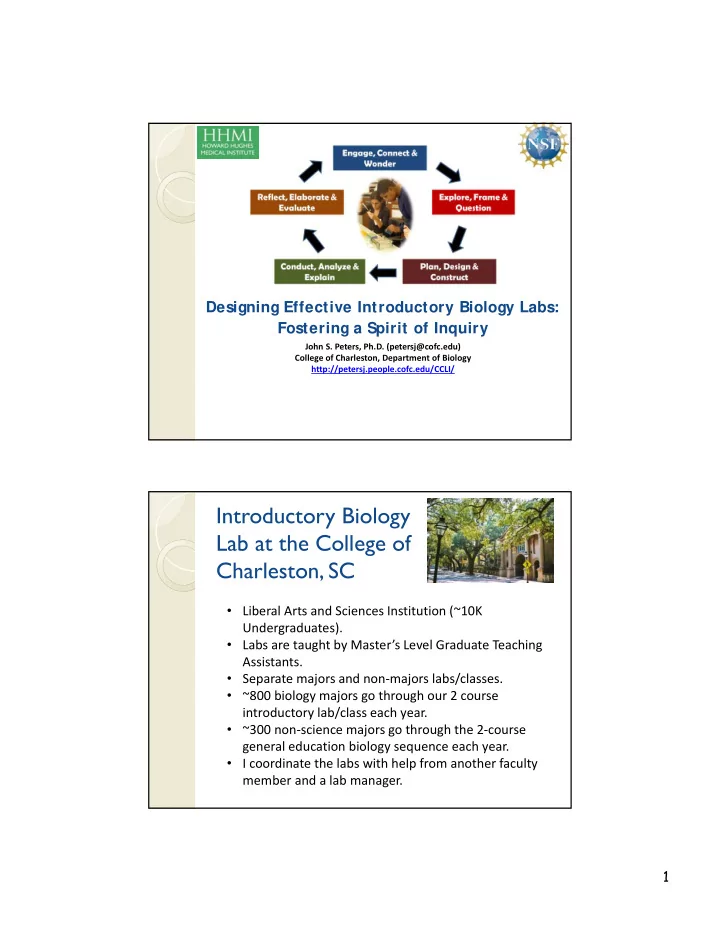
Designing Effective Introductory Biology Labs: Fostering a Spirit of Inquiry John S. Peters, Ph.D. (petersj@cofc.edu) College of Charleston, Department of Biology http://petersj.people.cofc.edu/CCLI/ Introductory Biology Lab at the College of


slide-1
SLIDE 1

1

Designing Effective Introductory Biology Labs: Fostering a Spirit of Inquiry

John S. Peters, Ph.D. (petersj@cofc.edu) College of Charleston, Department of Biology http://petersj.people.cofc.edu/CCLI/

Introductory Biology Lab at the College of Charleston, SC

  • Liberal Arts and Sciences Institution (~10K

Undergraduates).

  • Labs are taught by Master’s Level Graduate Teaching

Assistants.

  • Separate majors and non‐majors labs/classes.
  • ~800 biology majors go through our 2 course

introductory lab/class each year.

  • ~300 non‐science majors go through the 2‐course

general education biology sequence each year.

  • I coordinate the labs with help from another faculty

member and a lab manager.

slide-2
SLIDE 2

2 Think back to your science labs when you were in

  • college. What was your experience more like?

A B C

Guided verification- style lab Inquiry-based lab

What was the initial context for the lab Concepts/processes initially discussed in lecture Student observations of nature

  • r relevant science-related

issues How was knowledge required to perform the lab acquired by students? Class or pre-lab lecture or assigned textbook chapter Independent research of questions leading from initial lab context What was source of experimental question, hypothesis, methods and predictions. Explicitly provided by the lab manual or instructor Students formulate; guided by prior research, and with support from the instructor & lab manual What support was provided to help students explain their findings? The lab manual or instructor provided specific conceptual questions to answer. Instructor or lab manual served as a guide to assist students with interpreting & explaining findings. How did students communicate findings? Lab report with specific questions to answer or topics to address. Authentic assignments (i.e. scientific article, presentation, poster, policy statement, stakeholder letter)

What do scientists do? What do they produce? Traditional Verification‐style Labs

slide-3
SLIDE 3

3

How was lab like/different from science?

Savannah - I think most scientists…are looking for new things and I think what we did was to learn what’s already

  • known. So it wasn’t in a sense really research or what I

would consider research…, I was also really disappointed in the labs…it was just a lot that we did that just wasn’t really that exciting. Lindsay - …we’re not really coming up with anything on

  • ur own, like John was saying, we’re just like doing

something in a book that’s been done numerous times. We’re not …applying anything that we’ve learned. We’re just… following a procedure, which is like part of the scientific method I guess but we’re not coming up with our

  • wn ideas. I guess we’re only in an intro class so I guess we

wouldn’t…

Spirit of Scientific Inquiry…what is it?

Some of the obvious ones we started with in the reform of our lab curriculum…

Interested Questioning Engaged Confident Curious

slide-4
SLIDE 4

4 Requiring proper reasoning, empirical, verifiable evidence before making or agreeing with a new claim.

Skeptical

From the Mini‐guide to Critical Thinking ‐ https://www.criticalthinking.org/files/Concepts_Tools.pdf

Confidence in reason

People can learn to form rational viewpoints, draw reasonable conclusions, think logically, and be persuaded using proper reasoning.

Creative

Questioning, hypothesizing, devising experiments, seeing patterns require thoughtful

  • bservation, insight,

imagination, careful planning and use of learned skills.

slide-5
SLIDE 5

5 Seeks new intellectual insights in spite of difficulties, obstacles & frustrations.

Intellectual Perseverance & Courage

Honestly admit discrepancies & inconsistencies in ones thought, or conclusions.

Intellectual Integrity

Values intellectual autonomy but also understands the value

  • f collaboration.

Independent & Collaborative

Open to; not threatened by new understandings that sit outside deeply-held views

Open‐minded

slide-6
SLIDE 6

6

From the Pew Research Center

Public Acceptance of Evolution

Why does fostering a spirit of scientific inquiry matter?

“Intelligent Design” should be taught as a valid alternative theory in addition to evolutionary theory in public high school biology classes.

Strongly Agree/Agree Don’t Know Strongly Disagree/Agree

What do you think are the justifications students most often use to advocate teaching ID in addition to evolution?

  • 1. So that students can make up their own minds as

to what they want to believe. This creates well‐ rounded students who think critically.

  • 2. Because evolution has not been proved and

schools should be open to teaching other explanations.

  • 3. Because ID is viewed as a valid theory by many

people.

slide-7
SLIDE 7

7

Why does fostering a spirit of scientific inquiry matter?

http://www.pewinternet.org/2016/10/04/public‐ views‐on‐climate‐change‐and‐climate‐scientists/

When [her teacher], ascribed the recent warming of the Earth to heat-trapping gases released by burning fossil fuels…she asserted that it could be a result of other, natural causes. When he described the flooding, droughts and fierce storms that scientists predict within the century if such carbon emissions are not sharply reduced, she challenged him to prove it. “Scientists are wrong all the time,” she said with a shrug.

NY Times, June 4 2017 https://nyti.ms/2sFhOTI

slide-8
SLIDE 8

8

Fostering a spirit of inquiry in lab from DAY ONE…

 …which engages the learner.  …elicits wonder.  …encourages students to reveal their thinking about scientific inquiry.

http://pal.lternet.edu/docs/outreach/ educators/education_pedagogy_resea rch/start_with_a_story.pdf

slide-9
SLIDE 9

9

Animal Minds Animal Minds

https://www.wnycstudios.org/story/91701‐animal‐minds

Do you think that whale was saying “thank you” (exhibiting gratefulness)?

  • A. Yes
  • B. No
slide-10
SLIDE 10

10

Is “gratefulness for the divers’ actions” a valid scientific hypothesis explaining the whales behavior at the end of the story?

  • A. Yes it is.
  • B. No it is not.
  • C. Not sure?

What justifications do you think students would use to explain their choice?

Termite Trails

slide-11
SLIDE 11

11 https://youtu.be/4ClwpgtWP_Y

T ermite Trails Lab

Team Work

 Pose hypothesis  Plan experiment  Develop prediction  Conduct experiment  Summarize results  Share with class

Individual Work

 Use EXPLICIT feedback from post‐lab discussion & follow‐ up readings to revise protocols and predictions

slide-12
SLIDE 12

12

Which aspects of a “spirit of scientific inquiry” do we begin to foster in this opening lab?

Pedagogical structure of labs…

Engage, Connect & Wonder Explore, Frame & Question Plan, Design & Construct Conduct, Analyze & Explain Reflect, Elaborate, Evaluate

An observation, question, topic, or case study that contextualizes the lab exploration, engages the learner and elicits wonder & reflection.. Reveal current conceptions What do we know (or think we know)? Framing the problem

  • r question

What do we need to know? Organize and connect knowledge from background research. Readings, interactive tutorials and homework activities Experiment, collect, summarize & analyze data; Research to inform conclusions. Draft conclusions. Feedback to Build Deeper Understanding Peer‐evaluation & instructor feedback, and opportunities to revise work & thinking. Research & Formulate hypotheses, experimental predictions Design experimental and analysis protocols.

slide-13
SLIDE 13

13

Evaluative Assignments which:

  • Connect lab finding to science‐related issues

AND encourage action!

  • Foster communication of science BOTH to

scientists and to the public.

Inquire Engage, Connect & Wonder Action

Connecting inquiry & action…

Case Study: The Evolution of Intelligent Design Students use what they have learned in lab and class to develop a policy brief to the local school board regarding teaching evolution and ID in biology classrooms. SimBio: Darwinian Snails & Sickle Cell Alleles Labs

slide-14
SLIDE 14

14

Case Study Part 1: Amazon Deforestation, Once Tamed, Comes Roaring Back Part 2: Hahai no ka va i ka ululáau

Engage, Connect & Wonder

Exploring Water & Nutrient Transport in Plants

Students, working in teams, devise an experiment exploring factors they hypothesize may influence transpiration.

Inquire

Students use what they have learned in lab and class to evaluate the “rain follows the forest” hypothesis; it’s implications for preserving/restoring rainforests.

Action

Connecting inquiry & action…

Amazon Deforestation Roars Back

Part 2: Hahai no ka va i ka ululáau Why do rainforest exist where they do? Do they exist where they are solely because it happens to rain a lot where these forests occur? Or, is it as the ancient Hawaiian proverb states – “Hahai no ka va i ka ululáau” – the rain follows after the forest. That is, the rain is there because of the forest. If the latter is true, how could rainforests produce rain? And what are the implications of this for rainforest protection & reforestation?

slide-15
SLIDE 15

15

Independent Research Projects

Lab curricular structure

slide-16
SLIDE 16

16

Independent Research Projects

Ahoy!!…there are some mitochondria in there!

Independent Research Projects

slide-17
SLIDE 17

17

Independent Projects Labs

  • Multi‐week and in‐depth exploration
  • Done in both biology majors’ and non‐majors’ labs
  • Student‐directed:
  • Student observations, experiences and interests set the

context for the project.

  • Students
  • formulate questions, hypotheses, experimental

predictions.

  • design procedures
  • summarize and analyze quantitative data
  • draw conclusions
  • authentically communicate findings
  • work collaboratively and independently
  • Model how the scientific community works to

strengthen studies and validate knowledge.

Effective team projects engender positive interdependence among team members while facilitating individual accountability for learning concepts and intellectual skills.

slide-18
SLIDE 18

18

Background research to inform hypotheses, protocols & predictions Develop proposal Revise & conduct experiment, summarize and analyze date Research to explain findings Proposal Peer‐review Develop questions & initial hypotheses

Team Work Individual Work

Independent Research Project: Scientific Article & Symposium

Share research and formulate general conclusions Research Symposium Write article abstract, introduction & conclusion

Peer Evaluation of Presentations & Publication

http://visionandchange.org/resources/

slide-19
SLIDE 19

19

Core Competencies…

APPLY THE PROCESS OF SCIENCE: Biology is evidence based and grounded in the formal practices of

  • bservation, experimentation, and hypothesis testing.

USE QUANTITATIVE REASONING: Biology relies on applications of quantitative analysis and mathematical reasoning. USE MODELING AND SIMULATION: Biology focuses on the study of complex systems. TAP IN TO THE INTERDISCIPLINARY NATURE OF SCIENCE: Biology is an interdisciplinary science. COMMUNICATE AND COLLABORATE WITH OTHER DISCIPLINES: Biology is a collaborative scientific discipline. UNDERSTAND THE RELATIONSHIP BETWEEN SCIENCE AND SOCIETY: Biology is conducted in a societal context.

From Vision & Change in Undergraduate Biology Education, 2011 ‐ http://visionandchange.org/files/2015/07/VISchange2015_webFin.pdf

Action Items from Vision & Change

slide-20
SLIDE 20

20

What do scientists do? What do they produce? Traditional Verification‐style Labs What do scientists do? What do they produce? Inquiry‐based Labs

slide-21
SLIDE 21

21

Classroom Undergraduate Research Experience (CURE) Survey Findings

  • Perceived Learning Gains ‐ IBL fostered greater perceived

learning gains in conducting open inquiry, conducting scientific investigations and nature and process of science

  • literacy. Traditional lab students valued individual and

whole class work more than students in IBL.

  • Science

Literacy ‐ Traditional lab students adopted significantly less literate views about the process of science in comparison to IBL students AND in comparison to their pre‐course literacy. (small effect)

  • Perceived Benefits of Lab Experiences – IBL fostered greater

perceived benefits regarding Doing Science, Understanding Science, Self Confidence, Creating a Learning Community, and Communicating Science (moderate effect)

Why does fostering a spirit of scientific inquiry matter?

“Intelligent Design” should be taught as a valid theory in addition to evolutionary theory in public high school biology classes.

Pre‐survey

slide-22
SLIDE 22

22

 Student Support Materials

  • Team Lab Notebooks (TLNs)
  • Homework Activities
  • Interactive Tutorials
  • “Doing Science” Guides

 Instructional Guides

  • Conceptual and scientific skills goals
  • Materials & lab setup instructions
  • Pedagogical tips for facilitating

student centered, inquiry‐based & collaborative learning.

  • Assignment grading & feedback

rubrics

  • Instructional PowerPoints
  • Ideas for connecting lab & class

(coming soon)

Student & Instructional Support Materials For more information on the Discovering Biological Science labs…

Visit my website: http://petersj.people.cofc.edu/CCLI/ Or visit Hayden‐McNeil at Macmillan Learning ‐ https://haydenmcneil.com/educators/inquiry‐ based‐biology‐labs