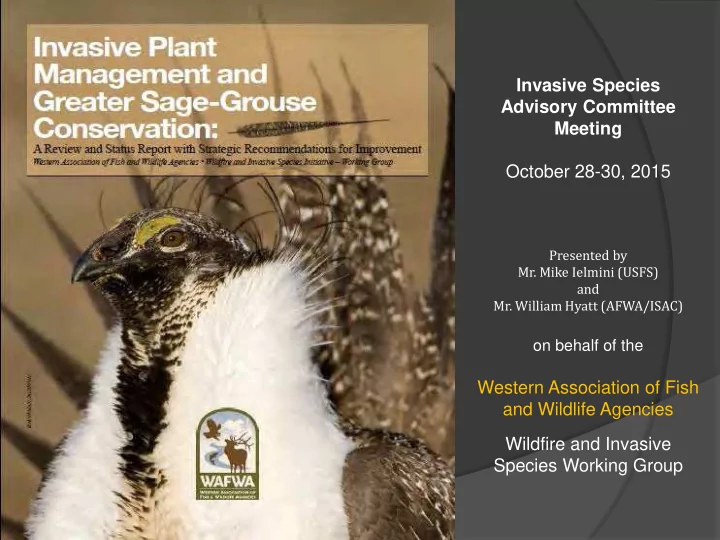
Invasive Species Advisory Committee Meeting October 28-30, 2015
Presented by
- Mr. Mike Ielmini (USFS)
and
- Mr. William Hyatt (AFWA/ISAC)
- n behalf of the
Western Association of Fish and Wildlife Agencies Wildfire and Invasive Species Working Group
Invasive Species Advisory Committee Meeting October 28-30, 2015 - - PowerPoint PPT Presentation
Invasive Species Advisory Committee Meeting October 28-30, 2015 Presented by Mr. Mike Ielmini (USFS) and Mr. William Hyatt (AFWA/ISAC) on behalf of the Western Association of Fish and Wildlife Agencies Wildfire and Invasive Species
Invasive Species Advisory Committee Meeting October 28-30, 2015
Presented by
and
Western Association of Fish and Wildlife Agencies Wildfire and Invasive Species Working Group
A 16 Member Working Group Representing Expertise in:
Forester; Laurie Kurth-USFS; Ted Milesneck-BLM)
(Chad Boyd-OSU/USDA-ARS; Jeanne Chambers-USFS; Mike Ielmini- USFS; Brian Mealor-UoWY; Mike Pellant-BLM; David Pyke-USGS Research; Jason Vernon-UTDW
Christiansen-WYGF; Dawn Davis-ODFW; Shawn Espinosa-NDOW; Don Kemner-IDFG; Jeremy Maestas-NRCS)
Great Basin Wildfire/Invasive Species Gaps Analysis Report - (Wildfire and invasive species in the west: Challenges that hinder current and future management and protection of the sagebrush-steppe ecosystem.
A Conceptual Landscape Approach to Assessing the Wildfire/Invasive Threat (Managing invasive annual grasses and altered fire regimes using resilience concepts – An integrated approach.
Fire and Fuels Management Contributions to Sage-Grouse Conservation – (Havlina, D., et. al, 2014)
Initiation of the Greater Sage-Grouse Wildfire, Invasive Annual Grasses, and Conifer Expansion Assessments (FIAT Assessments)
Invasive Plant Management and Greater Sage-Grouse Conservation: A Review and Status Report with Strategic Recommendations for Improvement – (Ielmini, M.R, et. al, 2015)
Using Resistance and Resilience Concepts to Reduce Impacts of Invasive Annual Grasses and Altered Fire Regimes on the Sagebrush Ecosystem and Greater Sage-Grouse: A Strategic Multi- Scale Approach– WAFWA Team Next Steps.
Collaborating Participant - Western Invasive Weed Summit.
Service (ARS)
2014 targeted survey of local, state, and federal weed management organizations across the entire 11-state range of the Greater Sage- grouse. Led and Analyzed by the Center for Invasive Species Management – Montana State University, Bozeman, MT. Funding from the Great Basin Landscape Conservation Cooperative (GBLCC) Responses to the survey were recorded from nearly 300 individuals and
Federal, State, and County Weed Managers, and other Professionals
Western Weed Coordinating Committee
North American Invasive Species Network
North American Exotic Pest Plant Council
Missouri River Watershed Coalition
North American Invasive Species Management Association
Federal Interagency Committee for the Management of Noxious and Exotic Weeds
Aquatic Nuisance Species Task Force
Center for Invasive Species and Ecosystem Health
Tamarisk Coalition
The National Invasive Species Advisory Committee (ISAC)
The National Invasive Species Council (NISC)
The Government Accountability Office (GAO)
Congressional Reports and Hearings
National Fish and Wildlife Foundation (NFWF)
University Research Programs and Professional Societies
Invasive annual grasses fuel the wildfire threat and
The invasion and spread of invasive plants across
Invasive species transform ecosystems by altering
Invasive Weed Management Regulatory Framework: BLM and USFS ROD’s and State Regulations Fire Management and Restoration
Information Management and Science
Barrier: Lack of emphasis on surveys,
Barrier: Failure to re-establish desired perennial
Barrier: Inadequate collection, retrieval, and
Barrier: Lack of certainty for actions under a
Leadership, Coordination, and Communication
Barrier: Insufficient governmental leadership and
Barrier: Very limited coordination and
Barrier: Lack of effective communication and
Barrier: Low level of public awareness and
Operational Capacity and Program Management
Challenges:
invasive plants; Programs do not emphasize sagebrush restoration when targeting invasive plants across the range of the GRSG
management programs at all levels
risk to state and local governments
(EDRR) system across the landscape
approaches
INFORMATION MANAGEMENT AND SCIENCE
LEADERSHIP, COORDINATION, AND
POLICY AND REGULATORY
PROGRAM MANAGEMENT AND OPERATIONAL
for CWMAs and County Weed Districts
“The current state of the law is fragmented and
state and federal rules and regulations … allocating responsibilities to many different agencies.” ”Interstate and regional coordination … is complex and
between state priorities, program capacities and jurisdictional authorities.” “In most states, management activities are often conducted … with no shared, central goals … or measurable benchmarks to demonstrate progress”
LEADERSHIP, COORDINATION, AND
Boise, Idaho November 17-19, 2015
Welcome Address from the State of Idaho - Lt. Governor Brad Little The Greater Sage-grouse Listing Decision: Timing, planning, and the importance of providing strategic actions to address the invasive plant threat across the range of the Greater sage-grouse and the link to fire in the West Invasive Plant Management in the West – A Scientific Assessment Impacts of Invasive Species on Greater Sage-grouse Habitat – Risks and Considerations Overview of WAFWA Invasive Species Report, “Invasive Plant Management and Greater Sage-grouse Conservation: A Review and Status Report with Strategic Recommendations for Improvement” Management of Invasive Plants across the Range of the Greater Sage-grouse Setting the Stage for Breakout Sessions – Andrus Center Facilitation Presentation by Executive Director of the National Invasive Species Council – Dr. Jamie Reaser Breakout Session – Challenges and Barriers
Breakout Session – Developing Actions to Address/Resolve Challenges and Barriers
Conference Summary and Next Steps
Wyoming Big Sage Mtn Big Sage Mtn Big Sage
Warm-Dry Cold-Moist
Elevation/Productivity
High Resistance Low Resistance reflects environmental suitability
warm-dry conditions
sage/shrub
Productivity Elevation
(Adapted from Chambers et al. 2007)
Wyoming Big sage Mtn big sage Mtn brush Warm-Dry Cold-Moist
Proportion of Landscape Dominated by Sagebrush Resilience to Disturbance & Resistance to Invasive Annual Grasses
Low < 25% Sagebrush- Dominated Landscape Medium 25-65% Sagebrush- Dominated Landscape High > 65% Sagebrush- Dominated Landscape High
Sagebrush lacking
Sufficient PNH Low annual invasive risk Strategies - M1, M5, M6, M7, R1, R2
Sagebrush limiting
Sufficient PNH Low annual invasive risk Strategies - M5, M6, M7, R1, R2, R3
Sagebrush sufficient
Sufficient PNH Low annual invasive risk Strategies - M2, M5, M6, M7, R3
Medium
Sagebrush lacking
PNH site dependent Invasive risk site dependent Strategies - M1, M4, M5, M6, M7, R1, R2, R3, R5
Sagebrush limiting
PNH site dependent Invasive risk site dependent Strategies - M4, M5, M6, M7, R1, R2, R3
Sagebrush sufficient
PNH site dependent Invasive risk site dependent Strategies: M2, M4, M5, M6, R3
Low
Sagebrush lacking
PNH lacking High annual invasive risk Strategies - M1, M2, M3, M4, M7, R4, R5, R6
Sagebrush limiting
PNH lacking High annual invasive risk
Strategies - M1, M2, M3, M4, M7, R4, R5, R6
Sagebrush sufficient
PNH lacking High annual invasive risk
Strategies - M1, M2, M3, M4, M6, M7, R3, R5, R6
PNH = Perennial Native Herbaceous Adapted from Chambers, et. al, 2014