Invesco, Ltd. Citigroup 2016 Asset Management and Broker Dealer - - PDF document

invesco ltd citigroup 2016 asset management and broker
SMART_READER_LITE
LIVE PREVIEW

Invesco, Ltd. Citigroup 2016 Asset Management and Broker Dealer - - PDF document

Invesco, Ltd. Citigroup 2016 Asset Management and Broker Dealer Investor Conference March 3, 2016 Bill: Bill Katz, Citigroup. I cover the asset management brokers. Welcome to the Third Annual Conference that we're hosting. Very happy to be


slide-1
SLIDE 1

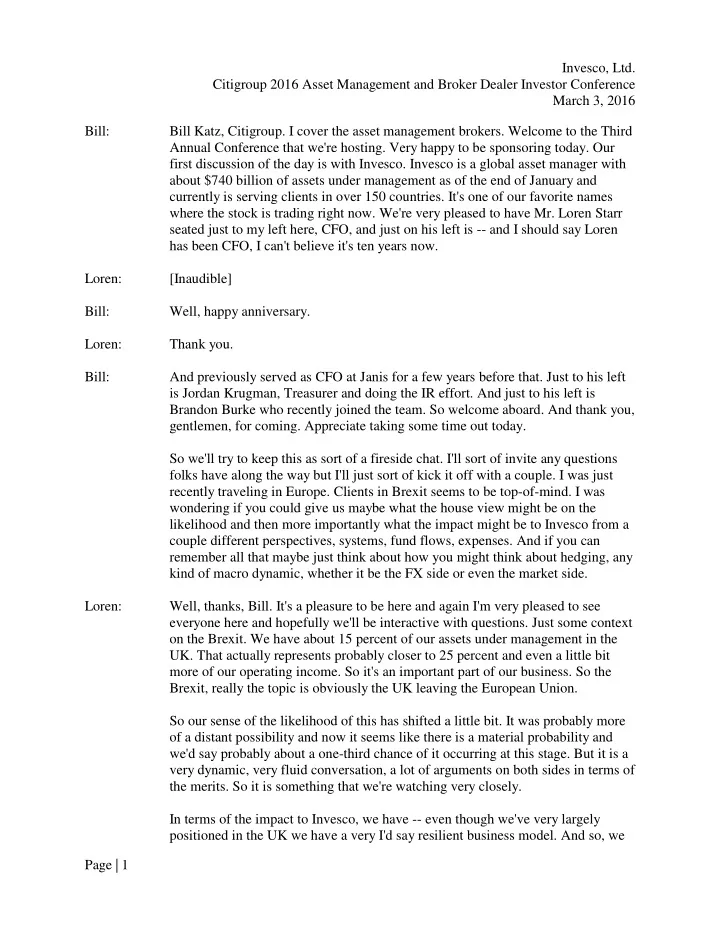
Invesco, Ltd. Citigroup 2016 Asset Management and Broker Dealer Investor Conference March 3, 2016 Page | 1 Bill: Bill Katz, Citigroup. I cover the asset management brokers. Welcome to the Third Annual Conference that we're hosting. Very happy to be sponsoring today. Our first discussion of the day is with Invesco. Invesco is a global asset manager with about $740 billion of assets under management as of the end of January and currently is serving clients in over 150 countries. It's one of our favorite names where the stock is trading right now. We're very pleased to have Mr. Loren Starr seated just to my left here, CFO, and just on his left is -- and I should say Loren has been CFO, I can't believe it's ten years now. Loren: [Inaudible] Bill: Well, happy anniversary. Loren: Thank you. Bill: And previously served as CFO at Janis for a few years before that. Just to his left is Jordan Krugman, Treasurer and doing the IR effort. And just to his left is Brandon Burke who recently joined the team. So welcome aboard. And thank you, gentlemen, for coming. Appreciate taking some time out today. So we'll try to keep this as sort of a fireside chat. I'll sort of invite any questions folks have along the way but I'll just sort of kick it off with a couple. I was just recently traveling in Europe. Clients in Brexit seems to be top-of-mind. I was wondering if you could give us maybe what the house view might be on the likelihood and then more importantly what the impact might be to Invesco from a couple different perspectives, systems, fund flows, expenses. And if you can remember all that maybe just think about how you might think about hedging, any kind of macro dynamic, whether it be the FX side or even the market side. Loren: Well, thanks, Bill. It's a pleasure to be here and again I'm very pleased to see everyone here and hopefully we'll be interactive with questions. Just some context

  • n the Brexit. We have about 15 percent of our assets under management in the
  • UK. That actually represents probably closer to 25 percent and even a little bit

more of our operating income. So it's an important part of our business. So the Brexit, really the topic is obviously the UK leaving the European Union. So our sense of the likelihood of this has shifted a little bit. It was probably more

  • f a distant possibility and now it seems like there is a material probability and

we'd say probably about a one-third chance of it occurring at this stage. But it is a very dynamic, very fluid conversation, a lot of arguments on both sides in terms of the merits. So it is something that we're watching very closely. In terms of the impact to Invesco, we have -- even though we've very largely positioned in the UK we have a very I'd say resilient business model. And so, we

slide-2
SLIDE 2

Invesco, Ltd. Citigroup 2016 Asset Management and Broker Dealer Investor Conference March 3, 2016 Page | 2 have our operations in Europe, a lot of the cross-border fund activity is based out

  • f our Luxembourg domiciled fund. So the UCITS are sold across Europe. And

because they're Luxembourg-based we really would not have the impact that some

  • ther purely UK-based asset managers might experience in such a scenario who

are using their UK-based funds to sell across into Europe. Those types of activities would probably be very much impacted through an exit and there would be a lot of cost disruption for those firms. So in terms of our impact short-term if the Brexit happened, I think we would not sort of see an immediate issue on our ability to sell product since we have ICVCs which are the UK-based funds sold directly to the UK population. Again, those would not be impacted. But I do think long-term there's probably volatility and market disruption. None of that would necessarily be helpful to any asset

  • manager. And so I think we would certainly see a Brexit scenario creating a lot of

fear and general sort of market disruption, which is a challenge for our portfolio managers and probably for the population that has to deal with that. So I mean probably generally a negative thing in terms of the flow dynamic in the UK

  • verall. But we would probably be best positioned to weather through that relative

to the competition. The other thing I would say that would be impacted and you've seen it already in terms of the fears is the pound versus the dollar. And so the idea that if there was truly a Brexit the UK currency would be further weakened. So we a long time ago, at least a year ago, put in a hedge to protect our operating income, the pound, sterling-based. And we have hedging actually for this quarter struck at the out of the money puts that we had purchased and that's struck at 1.493. So it's in the money right now. So there is some value to those hedges and we are further hedged through Q1 of 2017 at a lower rate this time; 1.436 roughly is what the hedge is struck at. So that provides a little bit of an insurance policy, a blanket coverage in terms of our cash flow if in fact the pound were to dramatically weaken from here due to a Brexit. The vote is going to take place on June 23rd, so mark it on your calendars. We will know what happens hopefully at that point. But in the meantime we think it will create further anxiety and volatility until we get to that point. Bill: Are you doing anything on the market side beyond the currency to hedge? Loren:

  • No. Not explicitly, no. I mean I think within our portfolios themselves they may

be doing things to protect certain aspects of their portfolio. So each of the portfolio managers will have perhaps a different view and different probability associated with the likelihood of a Brexit and what they might do. But the firm itself is really just kept the hedge in terms of the currency.

slide-3
SLIDE 3

Invesco, Ltd. Citigroup 2016 Asset Management and Broker Dealer Investor Conference March 3, 2016 Page | 3 Bill: Another question I was thinking about is in the fourth quarter you announced a business optimization initiative which I think you laid out some guidance of somewhere between $0.06 to $0.08 of accretion beginning I think in 2017. Can you maybe give us an update now that you've had a little bit of time under your belt in terms of starting to put this to work? Can you update us on the timeline, where the savings might be coming from, and then any sort of update on that $0.06 to $0.08 and the sort of risks both ways for that? Loren:

  • Absolutely. So in light of the decline in markets and certainly the associated

decline in AUM, we started thinking about how we were going to manage the firm in light of perhaps a lower revenue base. And so we underwent a series of activities, optimization activities which included looking at increased use of shared services, the potential for outsourcing certain back office, middle office activities, looking at technology and automation generally to eliminate sort of manual activity and then also what we call location strategy and really just thinking about if you had a clean sheet of paper who would be doing what where. And so in light of those kind of primary themes we announced last quarter that we would be looking at a charge of up to $85 million through the course of 2016 to create this run rate savings, cost savings of somewhere between $30 to $45 million in reduction of run rate expenses. We feel we're very much on path to deliver that. We certainly have not seen anything that would cause us to fall short of those goals and hopefully we can do

  • better. So I think in terms of people's thinking it is still that range that we suggest

people think about us achieving. But we're actually seeing perhaps more traction, things happening even more quickly. We did say that there would be in 2016 $15 million of cost saves that we would be able to extract through the course of the year through these activities where they ramp up in terms of their magnitude on a quarterly basis through Q4. So think of it more like $2.5 million savings in Q1, $3 million, $4 million, $5.5 million in Q4 ultimately getting us to that run rate of $30 to $45 million as we kick off into 2017. Bill: That's helpful. Even before you even announced this, Invesco has done a very good job of sort of moving things offshore to lower cost regions. You have Hyderabad, India. You have Prince Edward Island operation off the coast of

  • Canada. How much more capacity do you have with that initiative and then how

does that tie in if at all with the business optimization program? Loren: It's very fundamental to the whole business optimization concept. And again, it's looking at, because as people know, I mean Invesco was sort of born through this series of acquisitions. And so the legacy was not a clean sheet of paper. It was more kind of what you got based on those acquisitions. And through the ten years

slide-4
SLIDE 4

Invesco, Ltd. Citigroup 2016 Asset Management and Broker Dealer Investor Conference March 3, 2016 Page | 4 I've been here, I mean it's been a continual kind of -- I don't want to call it clean up but it's a more rationalization. We've pushed further to try to figure out in particular for local activities what belongs locally, what things need to be done on a regional basis and then ultimately what things can be done on a global basis. And the things that can be done on a global basis across the firm you would look to a lower cost center to do those activities. And so Hyderabad and Prince Edward Island have been great centers for us in terms of being able to position global activities. There's a lot of capacity still for us to do that. We did take on more space, so we certainly have the space available. There's certainly resources and people available. And so, fundamental to a lot of that optimization in terms of the shared service part, that's exactly what we're talking about is rationalizing some of those roles and positions that could be done on a global basis that might otherwise be done regionally or locally. And there's a significant cost save obviously to being able to do those activities on a global basis in a lower cost center. Bill: Maybe a two-part question off of that. One is there any thoughts about any kind of revenue attrition as a result of those changes? And then from a marginal cost save, are you able to plow those savings back into growth net of the savings you've announced? Loren: So in terms of your latter question, I mean we certainly have been doing this so we can continue to invest in the business. We think lack of investment as a strategy is not a good long-term strategy. And so, the savings and the cost saves that we're talking about are net of investment. I mean so we certainly are going to continue to invest in key new products, new markets. So again, people shouldn’t think of whatever that run rate cost save that I provided is sort of somehow going to get

  • ffset by an enormous investment someplace else. And, I'm sorry, your first

question, Bill, was...? Bill: Any risk to the revenues as a result of these saves? Loren:

  • No. These are purely invisible to clients and in fact should only make our delivery
  • f products and services to clients that much better and more effective. We don't

see this as impacting revenues. Bill: I've got a series of questions. But if anyone in the room would like to ask a question, please just raise your hand. We'll be happy to take it. Oh, here we go. Excellent, thank you.

slide-5
SLIDE 5

Invesco, Ltd. Citigroup 2016 Asset Management and Broker Dealer Investor Conference March 3, 2016 Page | 5 Q: Are you finding that you have to shift your product mix with people looking at alternatives and smart beta and various other things maybe rotating away from traditional mutual funds? Loren:

  • Yes. I mean understanding what our clients need and where the demand is is

fundamental to I think us serving our clients well. And so we have been on that path for a long time. We were very much early out of the gate when we introduced for example some alternative products that retail clients would have access to that they otherwise would not have access to. And these are not -- I don't want people to think when I say alternative products like direct real estate or private equity. But these are products that might give returns that are more outcome-oriented, that give a total return of X percentage over cash, for example, as opposed to being market-correlated products, more traditional types of products. So we have invested a fair amount of time and effort to make sure that we do have a product suite that does and will appeal to this sort of clear trend in terms of desire for yield, desire for uncorrelated, products that have returns uncorrelated to the market certainly on the retail side. A good example would be our global targeted return product which is managed out of the UK. That has grown from virtually nothing to I think it's certainly well in excess of $10-$11 billion just in a very short period of time because the demand for that type of product is so large. Smart beta as well has been a theme. We invested in PowerShares back in 2006 when we bought the business. So their whole focus and premise was on providing smarter beta to clients which included the suite that we have today. So we have certainly more than $50 billion of products in smart beta now and it is one of our faster growing elements within our product mix and we continue to focus on new product introductions, not just in the US but outside of the US to satisfy that need. Bill: Just coming back to margins for a second, you're one of the few that actually gave some explicit guidance. I think that hurts and helps you in the same sense. So I'll just keep your feet to the fire for a second. You've articulated incremental margins

  • f a range of 50 to 65 percent if I recall correctly. Obviously markets are very

turbulent out of the chute here. But what's your sort of latest structural thinking on that? What might be the key swing factors? And then underneath that flows coming in, flows going out, how does that all play into sort of your thought process? Loren: Great question. We've seen a couple things push their way in on this whole incremental margin topic. So one is obviously the markets are down. Assets are down as a result of that. And I think if you look at it from your end we had to January roughly a five percent decline in assets under management purely due to market and FX. So when the markets go down and certainly we have had FX work against us too, that has some squeeze on our effective fee rates because equities as

slide-6
SLIDE 6

Invesco, Ltd. Citigroup 2016 Asset Management and Broker Dealer Investor Conference March 3, 2016 Page | 6 a percentage of our total assets shrink and they tend to have a higher fee rate. And then the pound obviously shrinking, the UK is a pretty high fee rate relative to the rest of our business. So that will reduce and compound our revenue impact as we look out into 2016. And so if you were to look at it just based on today with no further market impacts, you'd say well revenues may be adversely impacted year-over-year. It could be down. So in a revenue down scenario incremental margins work against

  • you. So again, with the idea that you have a reasonable amount of fixed expense, a

little bit less variable expense, and so you'd have an incremental margin working against you on the downside. That is why we put into place these structural

  • ptimization things where we're actually removing fixed costs. And so that's

probably the only way for us to truly address and try to mitigate the negative impact of incremental margin on the way down. And so, that is our goal. We definitely have explicit desire for our margin to improve over time and in sort of a more business as usual environment that incremental margin guidance, which would help us on the way up, would actually still be the case if not even higher given some of the work that we're doing right now. The fee mix on the flows is positive so the flows coming in are good. We are seeing good flows, net flows coming in from Asia and still Europe and our institutional pipeline, which is still very healthy, has a higher fee rate than it had a year ago and certainly relative to any potential outflows. So we're feeling good about the flow mix on our fee rate. The only thing that we're combating right now is really just the market and the FX impact. So hopefully that is helpful. Bill: That's very helpful. Excellent. Let me look around. Let me fire another one at you

  • then. To turn to flows for a moment, I think on the fourth quarter conference call,

I think _____ incorrectly but Marty mentioned, Marty Flanagan the CEO mentioned that he thought Invesco could manage a sort of three to five percent long-term organic growth rate if you will in '16. Clearly, the markets are off to a turbulent start as you just sort of talked about in the margins. In January, flows were better than most of your peers but still somewhat soft in the aggregate. Can you sort of walk us through the key drivers and sort of maybe touch on the future for a second but maybe do it from a geographic perspective or distribution, retail versus institutional and then maybe where you're seeing the greatest lift in terms

  • f from a product perspective?

Loren:

  • Absolutely. So I think we would say three to five percent is an organic growth rate

that Invesco should aspire to achieve, can achieve and barring kind of the extraordinary kind of market situation we're in right now we're you've got a lot of

slide-7
SLIDE 7

Invesco, Ltd. Citigroup 2016 Asset Management and Broker Dealer Investor Conference March 3, 2016 Page | 7 risk off activity and people are not actively investing cash, we still feel very strongly about being able to achieve those levels. What we're seeing is very different from region to region. So in Asia-Pac, which tends to be a higher fee region for us, we're seeing actually very good flows, both institutionally and retail, and a lot of that is in fixed income alternatives types of

  • products. In Europe the institutional business is still extremely strong but we've

seen a little bit of a pause in Europe in particular on the cross-border fund range. And so I'd say that is still sort of a modest to flattish flow perspective. So some things are in. Our GTR product, as I mentioned earlier, the one that provides sort

  • f this uncorrelated return, is still flowing very nicely. Some of the more

traditional products like our corporate bond, European corporate bond product in Europe is an outflow. So some of that is offsetting. The US is probably the most challenging location for us generally. We still have good institutional pipeline but it has sort of slowed a little bit. As you know, Bill, when things get a little bit more volatile, activity around funding slows down a

  • bit. And so when we think about let's say our direct real estate business, flows

come in when they invest around buildings. So they actually have to be making

  • investments. It's not the commitment that sets you up as flows. It's the actual

activity of investing and closing those deals. And so that may slow down in this type of environment. And so we're seeing a little bit of a pause on the speed with which flows are coming in on the US just given the volatility. But overall, I'd say we're still, despite the challenge hopefully we can do better than our peers and that's still our thinking that we should be able to do that. Bill: I know AUM will be out I guess later this -- next week. Any general trends you can share with us or would like to share with us in terms of activity in February? Loren: I think it's going to be a little bit similar to what we saw in January, maybe a little in some ways worse. I mean the idea that in February we saw the idea of a US recession being sort of lifted as a possibility, that's not very helpful for people and

  • participants. So but some of that is coming off towards the end of February too.

As we know, the markets have been a little bit more robust. So February is kind of a weird story of doom, gloom and then maybe a little bit better. So we'll see where it brings us into March. Bill: We have a question in the back. Q: Thanks, Bill. Good morning, Loren. I came a little bit late so I wasn't sure if you addressed Brexit. But that's on a lot of investors' minds. I think in spite of your success and the quality of your franchise _____ long-term Invesco PLC a lot of talent exposure _____ with respect to some of the higher fee mix assets.

slide-8
SLIDE 8

Invesco, Ltd. Citigroup 2016 Asset Management and Broker Dealer Investor Conference March 3, 2016 Page | 8 Loren: So, yes, we did cover it so I don't want to repeat too much. But I mean basically it's there is a probability, one-third percent chance of it happening. It won't have a direct impact on us in the sense that our business model is so resilient that we think in terms of fund flows and products being able to sell we have the right structure in order for us to continue to be able to provide product to our clients in Europe and the UK without disruption. With that said, if there was a Brexit it would create a lot of market volatility which is just going to be challenging for people wanting to invest. So there could be just an overall industry-wide pause. And then the final thing is on the hedge. Our hedges are working. We're protected from a cash flow perspective. Our hedges are in place through Q1 of 2017. Our current hedges are in the money. So certainly in terms of protecting cash flow that's going to be our approach. So hopefully that's a good synopsis. Q: And then when I look at your profitability over the last few years _____ your

  • perating margins _____. Where would you -- I mean we're stress testing a lot of

assets for energy, we're stress testing assets for down interest rates. Where do you think that margin can go in a down _____ if you will in spite of those structural ... Loren: I mean again it's always we don't -- there's no way that any asset manager can manage his expenses in line with revenues, particularly if they move very, very

  • quickly. And so I think the modeling and stress tests that you would do is exactly

the same that we do. That's why we sort of have gone to the point of removing fixed costs. I mean we're really working on trying to address this and ultimately if the market were to leg down even further, there would probably be even more that we would consider doing. I mean it is our general perception that this volatility is going to continue on for some time but it's not going to be a one-way street. And so but we do think it's very prudent for us to continue to take these costs out and it's actually going to make it a stronger firm and it's the right environment for us to be able to make these changes. We certainly from a competitive perspective don't want to have a margin that is anywhere below industry levels. So it is always going to be our goal and we'll manage ourselves to try to achieve a margin that is going to be better than average and certainly top quartile. So that's about as good as I can kind of offer you in terms of what we try to do because we do feel that that is what you should expect from an industry leader in this space is that the margins should be industry- leading. Bill: You had brought up PowerShares. You were certainly one of the early adopters of

  • this. 2006, I don't think anyone is really thinking about it. So you guys were the

big visionary on that. Can you talk about how you see the market evolving and then even where PowerShares is today, are they well enough positioned? So I was

slide-9
SLIDE 9

Invesco, Ltd. Citigroup 2016 Asset Management and Broker Dealer Investor Conference March 3, 2016 Page | 9 wondering if you could sort of address US versus non-US or by product set, distribution channel. And then I still have a couple of follow-ups on that. Loren: Great question. I mean we do feel very well-positioned in terms of our PowerShares franchise. It's probably the best diversified set of smart beta products relative to any of our competitors. As I mentioned, we have about $50 billion of sort of the traditional PowerShares products, which would be the smart beta types

  • f offerings.

It is a competitive market. It's not like we're the only ones there and there are probably more and more entrants who are going to continue to explore getting in. But in terms of the track record, we have the longest track records because we've been doing this longer than anybody else. And it is certainly a product that has an enormous appeal to advisors, to clients, and I think could challenge a lot of use of traditional cap weighted type of product over time. And in the US, it's probably the best accepted, most accepted in terms of its use. In Europe and in Asia less so. There are some structural differences between ETFs in the US versus Europe where you have the tax benefits in the US that work for you from an ETF perspective. The same tax benefits are not applicable outside of the US. So there may be a few reasons why ETFs may not be taken on as well and to the same extent in the US as they have been in Europe. But ultimately for us I think the topic isn't as much ETFs being the answer. It has more to do with our ability to provide both active product as well as passive product to clients to meet their needs and we don't think there's any one right

  • answer. Every client is going to have a different need and it's not going to be one
  • r the other. It's going to be some combination of both. We think that those firms

that are able to sort of synthesize and bring both to clients are going to be in the best position to succeed going forward as opposed to just one or the other. And we think that we're really well-positioned in that sense. And the other point I'd say is just factor-based investing, which gets to this smart beta idea, can be delivered in an ETF. It can also be delivered in a separate

  • account. It can be delivered in a mutual fund. And we've been doing factor-based

investing for decades. And so, again, I think the topic is a little bit broader than just smart beta ETF kind of discussion. I mean that's probably true in the US where it's manifesting itself. But when you get outside of the US it becomes sort

  • f a different discussion. It's not just an ETF discussion. It's a can you provide

factor-based smart beta. Bill: Just you mentioned stepped up competition. We've been tracking that ourselves and just the number of sponsors has more than doubled even in the last year or so and the number of funds out there is just going up even at a faster rate than that.

slide-10
SLIDE 10

Invesco, Ltd. Citigroup 2016 Asset Management and Broker Dealer Investor Conference March 3, 2016 Page | 10 Any pressure, I think you addressed it a little bit on the conference call but any pressure on pricing? And then the converse to that is what's the incremental margin on an ETF flow versus maybe the legacy basis? Loren: So the question on pricing, obviously when you look at overall the industry has seen some significant moves on pricing but they have been very much focused on the cap weighted types of products where you've seen this race to the bottom really driven by these are I don't want to call them commoditized but they're largely commoditized offerings and then it is sort of being done on a fee basis. For the smart beta products the first mover advantage is a big deal because ultimately the demand for a lot of these smart beta products is a lot smaller than they are for the traditional cap(?) weighted products and so the one who is first there gets the most assets and typically the greatest liquidity. And the liquidity is big because you can actually have a lower fee but if you don't have the liquidity you're going to get killed on the bid/ask spread. And so you need to factor both of those things in and that bid/ask spread can make all the difference, can just crush any differential in fee pricing. So we still believe that there is sort of some structural things that are going to help allow us to continue to maintain the much higher fee rate that we have on our smart beta products which is closer to 35 basis points on average, 38-35 basis

  • points. But I mean as the industry matures, I mean we're not naïve. We do think

that there will be some probably fee erosion which is just a natural thing but we don't think it's going to be a race to the bottom like you've seen in these other products, particularly because of the people who are providing smart beta really haven't been down that path and the ones who have tried to do that have not -- don't have the size and the liquidity to actually make it happen. Bill: A question here? Q: Can you talk about your acquisition of Jemstep and how you think ... Loren: Great question. So Invesco did announce recently that we bought Jemstep which people will use the term as a robo-advisor. Importantly, it is a complement to what we think the right answer for clients is to partner with a financial advisor. We don't believe in using this technology to sort of go direct to clients. We think that providing this technology, this Jemstep technology to third party advisors will be seen as a very helpful and facilitating element in a couple of ways. One, with the potential for DOL, Department of Labor regulations coming in, the idea that you have a structured way that provides a certain number of funds provided to clients that sort of shows these are the right -- this is the right mix for your needs helps check that box very nicely. It also I think importantly leverages the trend that we've all seen which is people use technology more and more and advisors need

slide-11
SLIDE 11

Invesco, Ltd. Citigroup 2016 Asset Management and Broker Dealer Investor Conference March 3, 2016 Page | 11 to also get behind that concept to help leverage, use technology to their advantage and it's not to replace them but it's ultimately to help supplement and make it cheaper for them to provide advice to their clients and potentially even reach a broader set of clients that they otherwise would not be able to reach. So we're excited to be able to offer this to our RIAs and advisors, these third party

  • advisors. There is a lot of interest in this product. It's still early days to see how it's

going to work. But ultimately it is one that I think allows us to have even a stronger relationship with these advisors than we have currently, which we think will help us ultimately. These are open architecture platforms. By no means is it like Invesco product only. I mean that is -- by any -- you can't do that. It's just not going to work. It flies in the face of what these platforms are trying to do. But we do think that there may be a few products of ours that could find their way onto these platforms and that really is ultimately our goal is to again just provide a vehicle to facilitate the effectiveness of the third party advisors. Bill: In the back? Q: To delve a little bit deeper on that RIA versus traditional home office _____. Do you see yourself _____ how do you structure your distribution sales force _____? What do you see as the distribution model in the future? Loren: I mean I think it is an evolving one. I mean we have distinct coverage of our RRAs' warehouses. So I mean we've sort of long sort of treated them very differently because they are different. We've probably had less success with the RRA channel generally than some of the other traditional channels that we've been in. We do think that it is an opportunity for us to maybe deepen our reach into that channel. So again, it's as I mentioned still early days but it's one that we're not sort of placing huge bets one way or the other. We think they all are

  • valid. They're all important and we need to improve our effectiveness in each of

the channels that we're in. So we haven't shut down any of them or chosen any of them solely to say this is the one that's going to work. Bill: We have just a few more minutes left, so a couple other topics. I don't think we can get to all of them. But can we talk about capital. I think you now -- maybe just give us an update of where you are from a regulatory perspective or even just from an Invesco standing relative to the regulatory capital needs and how you're thinking about capital priorities from here. Loren: So I think many may know that we do hold capital in Europe. We're required to from the perspective of how the regulators view us. They do think of us largely kind of like a bank or insurance company. So we, the number is probably around $550 million of capital that we're holding right now to support our business and that can scale up or down a little bit based on the size of the business.

slide-12
SLIDE 12

Invesco, Ltd. Citigroup 2016 Asset Management and Broker Dealer Investor Conference March 3, 2016 Page | 12 What we have said is as a firm that we want to hold a billion dollars of cash in excess of what we need to hold from a regulatory capital perceptive. We think that billion dollars in cash provides us financial flexibility, provides us with a cushion in difficult times and makes us less reliant on seeking external financing if we ever need to access that, which is an important thing. We're at $1.8 billion in terms of the cash at the end of the year so we have that billion in excess of regulatory capital at this stage. And as we discussed, I mean that provides us with good comfort that we can be more active in terms of returning capital back to shareholders and increase the payout ultimately that people have seen us provide, both through dividends and buybacks. Q: Was that did you say $1.8 billion? Loren: 1.8. Q: That's above the $550 or that's...? Loren: $1.8 is total. So subtract $550 from that and then our excess is -- so we have more than a billion in excess right now. Bill: So with the stock where it's trading today notwithstanding the market volatility, is your priority or preference now buyback versus dividend change? And then how are you thinking about any product gaps along the way and M&A? Loren: So we definitely have seen our stock trades at a pretty low multiple relative to earnings, one that actually surprises us continuously to understand why that is. Maybe you can tell me, Bill, later. Bill: We're all searching. Loren: We're all searching. But given that and given actually what's happening with the markets, I mean we've been very active with buyback and you saw we bought well in excess of $200 million in the last quarter, in the fourth quarter. We've continued a fairly sort of higher level pace. We talked about certainly not being in a business as usual mode in our buybacks coming into 2016 given the valuation of the stock. So, again, that's kind of the context for us still being very interested in doing buybacks given the valuation. And in terms of acquisitions and other things that might divert our need for capital, we certainly don't feel that there's any significant holes in our product lineup or anything that's a strategic imperative for us to go out and do a major

  • acquisition. So I wouldn't assume that's going to be the case at all. We do see
slide-13
SLIDE 13

Invesco, Ltd. Citigroup 2016 Asset Management and Broker Dealer Investor Conference March 3, 2016 Page | 13 things because we're in a position for people to bring stuff to us but we have very stringent criteria about doing acquisitions in terms of 20 percent IRR, they have to be accretive from earnings day one, cash payback within seven years. And ultimately they've got to work strategically with the business and for them, for anything to fit those three things or four things that I just mentioned, it really is a very, very limited number of things that could ever possibly be considered. Bill: I've got like two minutes left. A couple hot button topics: Can you frame out the sovereign wealth exposure, petro versus maybe Asia-based and where it might lie? Loren: I mean the total sovereign wealth exposure we have related to oil let's say is probably around $10 billion. We have a very diversified set of exposure there so it's not one where one client represents the $10. And the other thing that gives me a lot of comfort is when we look at the list of where we are in their chain of managers we're probably well down the list. So we're not the first sort of point of call if they have to do something. We have not received any indications of

  • redemptions. We feel very comfortable with our exposure. And so I understand

that may be a little bit different for other asset managers. So I do understand the

  • question. But it is not something that we're spending -- or worried about at this

point. We do have some larger exposures in Asia that are not oil-based. So there's probably another $10 billion out there that -- between other countries. But if anything we're seeing those exposures or not -- well, assets under management

  • increase. So there's really not been a worry about redemptions.

Bill: My last question. You may not be able to give a full answer in less than a minute and maybe the dynamics have changed in the last three or four days based on some of the economic data in the US. But negative interest rate discussion in the US has picked up a little bit. Obviously you're contending with that a little bit in

  • Europe. How would that affect the US money market business?

Loren: Well, it's interesting. I mean just looking at the European money market business, and yes they are negative rates there and we're an inflow. So it has not really affected the European markets. People need to put their cash somewhere and often banks don't even -- won't even take your money. So it is still a viable product even in a negative interest rate and there's no waiving of fees. People are still getting management fees from these products. So I don't want to translate what we're seeing in Europe to what happens in the US because they are different markets. Our people would actually view that likelihood as being a pretty slim likelihood of going to negative interest rates. And ultimately I think given the positioning of the

slide-14
SLIDE 14

Invesco, Ltd. Citigroup 2016 Asset Management and Broker Dealer Investor Conference March 3, 2016 Page | 14 products we still feel that they would still work and be used in a negative interest rate environment. Bill: We're just about out of time. So Loren, Jordan, Brandon... Loren: It's a pleasure. Bill: ...thanks so much for coming today. Really appreciate it. Loren: Thank you. Bill: And thanks so much. Loren: I look forward to further questions from people. Thank you very much. Bill: A couple minutes from now we'll get up with Ameritrade. Thank you. END