Investigations of Work Place Accidents Environmental Harm & - - PowerPoint PPT Presentation

investigations of work place accidents environmental harm
SMART_READER_LITE
LIVE PREVIEW

Investigations of Work Place Accidents Environmental Harm & - - PowerPoint PPT Presentation

Investigations of Work Place Accidents Environmental Harm & Employee Injury ABA White Collar Crime Conference Marc R. Greenberg, March 2016 San Diego, CA Overview of Presentation Topics - Will Discuss 2 New DOJ Policies -


slide-1
SLIDE 1

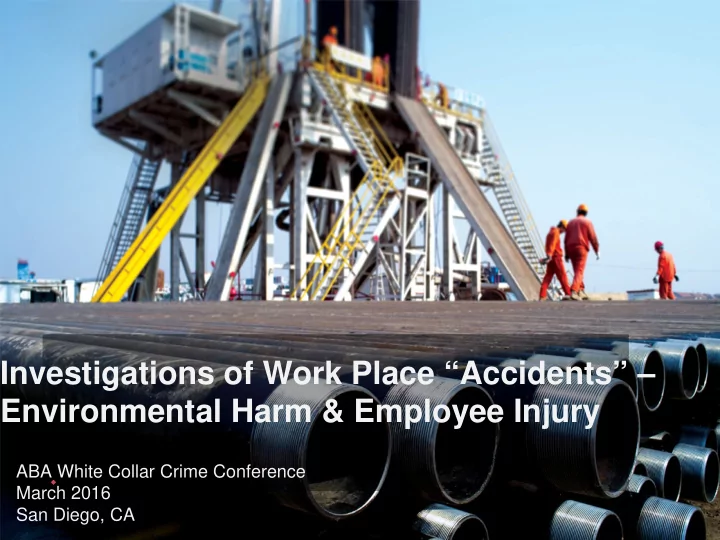
Investigations of Work Place “Accidents” – Environmental Harm & Employee Injury

Marc R. Greenberg,

ABA White Collar Crime Conference March 2016 San Diego, CA
slide-2
SLIDE 2
slide-3
SLIDE 3

Overview of Presentation Topics

  • Will Discuss 2 New DOJ Policies
  • Yates Memo re: “Individual Accountability”
  • Yates Memo re: “Worker Endangerment”
slide-4
SLIDE 4

Yates September 2015 Memo

  • Focus: pursuit of individuals for corporate

misdeeds

  • Corporation must disclose all relevant facts

regarding misconduct of individuals to qualify for cooperation credit

  • Coordination between civil and criminal

investigators from the start

  • Release of individuals will be very rare, and

require AAG or US Attorney approval

slide-5
SLIDE 5

Worker Safety Initiative

– December 2015 Memorandum of Understanding between DOL and DOJ – Memorandum to U.S. Attorneys’ Offices indicating that each office will have a Criminal Coordinator for worker safety cases – Delegation of authority to ECS to enforce worker safety statutes (OSH Act, MSHA, Migrant and Seasonal Worker Protection Act, Atomic Energy Act)

slide-6
SLIDE 6

Overview of Presentation Topics

  • Various Hypotheticals as a Teaching Vehicle that

involves key factors

  • Most Egregious and Extreme Facts
  • Worker Death
  • Massive Environmental Release
  • Less Extreme Facts (but still “serious”)
  • “Bread and Butter” Violations
slide-7
SLIDE 7

Worker Endangerment Facts also Give Huge Advantages to Government

  • Evidentiary:

No Pre-Trial 403 Exclusion

  • Strategic:

More Difficult to Defend Jury Appeal/Sympathy

  • Sentencing:

Increased Punishment

slide-8
SLIDE 8

Foundations of a Strong Environmental Prosecution

Worker Safety

  • An Actual and Identifiable Victim
  • Emotional and Anger Factor

Process

  • Lying, Cheating, Stealing
  • Obstruction
  • False Statements

Env

  • Basic Regulatory Violations
  • Clarity of Regs/Law
  • Toxicity
  • Duration
slide-9
SLIDE 9

Scenario One

  • An explosion occurs at a wastewater treatment

facility resulting from the mixing of incompatible

  • wastes. The facility had no history of violations

and the mixing was the result of operator error.

  • The released materials ignite sending a cloud

containing detectable quantities of released materials over a nearby neighborhood.

  • One employee is killed, several employees are

transported to the hospital and hundreds of people from the neighborhood seek medical attention.

slide-10
SLIDE 10

Major accident . . . now what?

  • Emergency response
  • Disclosures and notifications
  • Preservation of physical evidence and

documents

  • Communications
  • Assume a criminal investigation
slide-11
SLIDE 11

Wide Range of Criminal Statutes

  • The underlying event

– CWA/RCRA/CAA . . .

  • The response

– False statements – Obstruction of justice – Witness intimidation – Conspiracy to defraud

slide-12
SLIDE 12

The On-Scene Response

  • Determine which government agencies are on

site

  • Establish a protocol and point of contact for

government-company communications

  • Track government requests for information/

interviews/documents/physical evidence/ samples

  • Coordinate with company counsel
slide-13
SLIDE 13

On-Site Interviews

  • Government responders will immediately

focus on employees and contractors with first- hand knowledge and first-line supervisors

  • Inform employees of their rights and

employer’s expectations

  • Interviews and preparation for government

interviews

  • Representation issues
slide-14
SLIDE 14

Physical Evidence

  • Sampling and testing
  • Preservation
  • Communication and coordination with

government agencies

  • Common nor agencies to request agreement

regarding preservation of evidence and changes to incident site

  • Consider scope of “exclusion zone”
slide-15
SLIDE 15

Document Collection and Production

  • Insist all document requests be in writing
  • Identify main custodian
  • Establish process for collection, review and

production

  • Review for privilege and withhold privileged

documents

  • Review and label documents for CBI or SSI
slide-16
SLIDE 16

Documents

  • Operating procedures for plant/unit/

equipment

  • Work orders
  • Inspection and maintenance logs
  • Inspection reports
  • Prior incident reports, release reports, NOVs
slide-17
SLIDE 17

Communications

  • Very limited information, but need to

communicate

  • Facts versus speculation/legal conclusions
  • Must generally provide:

– General statement of the situation – Number of response personnel involved – Number of fatalities/injuries, if any, and where they were taken – Non-technical description of damaged equipment and the functions performed

slide-18
SLIDE 18

Communications

  • Identify company’s commitment to cooperate,

investigate and fully understand what happened, and prevent future recurrences

  • Express sympathy as appropriate
slide-19
SLIDE 19

Company Root Cause Investigation

  • Understand methodology and scope
  • Identify needed expertise

– When to retain – Privileged versus non-privileged review issues

  • Avoid pitfalls of personal agendas and

speaking in hyperbole

slide-20
SLIDE 20

Findings

  • Series of past incidents involving mixing of

incompatible wastes

  • Written procedures out of date
  • Facility lacks required planning documents,

including RMP

  • Lack of RMP was a causal factor in scope of

incident

slide-21
SLIDE 21

Scenario Two

  • An explosion occurs at a wastewater treatment

facility resulting from the mixing of incompatible

  • wastes. The facility had no history of violations

and the mixing was the result of operator error.

  • There is no release to ground or water and fence-

line monitors do not detect the presence of released materials in excess of permit limits.

  • One employee is killed, several employees are

transported to the hospital.

slide-22
SLIDE 22

Worker Endangerment Initiative

  • ECS can prosecute OSH Act 666(e) cases

without an environmental tie-in

slide-23
SLIDE 23

Scenario Three

  • Same facility
  • Written procedures out of date
  • Facility lacks required planning documents,

including RMP

  • No explosion, fire or release
slide-24
SLIDE 24

Query

  • Will DOJ investigate “paper” violations for

possible criminal prosecution?

slide-25
SLIDE 25

25

Broad Prosecutorial Discretion

What conduct should be prosecuted?

  • ---- Higher Standard

Zone of Discretion

  • ---- Low Threshold

What conduct can be prosecuted?

slide-26
SLIDE 26

Focus of Prosecutor’s Review (Relative to Incident)

During After Before

slide-27
SLIDE 27

Influencing the Three Phases of a Prosecutor’s Review

Before/Prevention

“Effective” Compliance & Self- Governance

  • What is

Declared?

  • What is

Done?

  • Funded
  • Measured

During Incident

Cooperation ”Responsible Triage” Litigation Hold Internal Investigation

After/Reactive Remediation

  • Prompt
  • Voluntary

Compliance Improvements

  • Prevent

Recurrence

slide-28
SLIDE 28
  • “Effective Compliance?”
  • Be Prepared to “Show” – not just “Tell.”
  • Risk Assessments
  • Training
  • Monitoring & Auditing – Paper Trail
  • Past Regulatory History
  • Maintaining Constructive Regulatory

Relationships

  • What do you Declare / Measure / Fund ?

“Before” Responsible Corporate Citizenship

slide-29
SLIDE 29
  • Regulatory Triage? Stop the Bleeding
  • Cooperation
  • Initiate Internal Investigation
  • Open Lines of Communication

“During” Responsible Corporate Citizenship

slide-30
SLIDE 30
  • Remediation?
  • Continued Dialogue with Regulators
  • Root Cause Analysis
  • Corrective Measures to Fill “Gaps” and Improve

Compliance

“After” Responsible Corporate Citizenship

slide-31
SLIDE 31

Mens Rea

  • Knowing
  • Responsible Corporate Officer Doctrine
  • Willful blindness/deliberate ignorance
  • Corporate collective knowledge applied to willful

standard

– where a corporation has a legal duty to prevent violations, and the knowledge of that corporation’s employees collectively demonstrates a failure to discharge that duty, the corporation can be said to have “willfully” disregarded that duty.– United States

  • v. Pac. Gas & Elec. Co., No. 3:14-cr-00175 (N.D. Cal.
  • Dec. 23, 2015).