INVESTING Simple Rely primarily on public markets as traditionally - - PowerPoint PPT Presentation

investing
SMART_READER_LITE
LIVE PREVIEW

INVESTING Simple Rely primarily on public markets as traditionally - - PowerPoint PPT Presentation

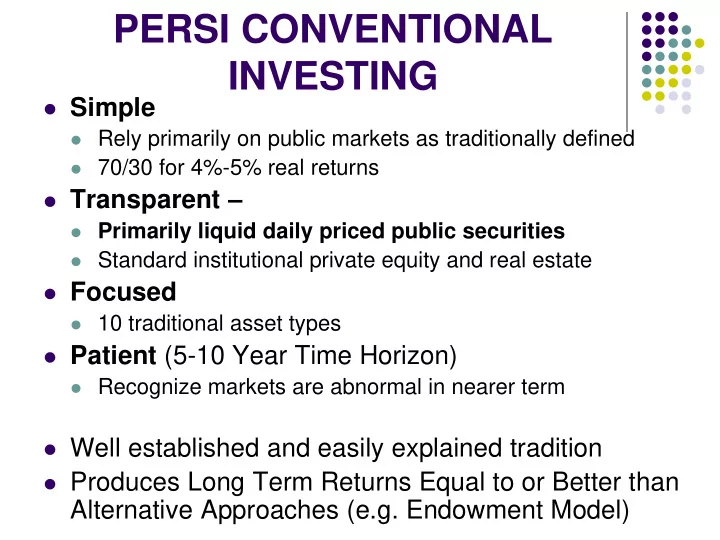
PERSI CONVENTIONAL INVESTING Simple Rely primarily on public markets as traditionally defined 70/30 for 4%-5% real returns Transparent Primarily liquid daily priced public securities Standard institutional private equity


slide-1
SLIDE 1

PERSI CONVENTIONAL INVESTING

 Simple

 Rely primarily on public markets as traditionally defined  70/30 for 4%-5% real returns

 Transparent –

 Primarily liquid daily priced public securities  Standard institutional private equity and real estate

 Focused

 10 traditional asset types

 Patient (5-10 Year Time Horizon)

 Recognize markets are abnormal in nearer term

 Well established and easily explained tradition  Produces Long Term Returns Equal to or Better than

Alternative Approaches (e.g. Endowment Model)

slide-2
SLIDE 2

PORTFOLIO DECISIONS

 Determine Basic Equity/Fixed Split

 70/30 FOR 3%-5% REAL RETURNS

 Home Country Bias

US BIAS  Additional Diversification and Other Changes

 10 Traditional Asset Types

 Monitor Drift and Rebalancing  Active/Passive Management Impact

 50% Indexed, 35% Traditional Active, 15% Private

slide-3
SLIDE 3

PERSI BASE ALLOCATIONS

Since 1998

slide-4
SLIDE 4

Managers

 Core Passive – 50%

Basic Exposure

Cost Control

Risk Control, Rebalancing, Easy Transitions  Active Public Managers – 35% Private -15%

Clear Styles or Concentrated Portfolios

 No “Black Boxes” 

No “Nine Box” Structures

“No Whining” Rule

Control Cash through Drift

 “Guidelines” are Manager Expectations in Normal Times 

Concentrated Relationships

 Public – 18  Private -22  Real Estate - 2

slide-5
SLIDE 5
slide-6
SLIDE 6

WHY CONVENTIONAL FOR PERSI?

Conservative Return Needs

PERSI only needs market returns – 7.0% Nominal 4.0% Real

No evidence complexity adds to returns

Resource Constraints

Small staff and public five member Board

In-house budget appropriated

All actions public

Control

Simpler the portfolio, easier to monitor and operate

Other

Easier to explain with well-understood concepts

Inexpensive (< 30 Basis Points)

Constituency has accepted through crises – has shown patience

Past was a mess: 1992 60% funded, bottom of peer universe

Competitive Returns, both in normal and crisis periods

slide-7
SLIDE 7

SIMPLE COMPLEX RESULTS

THE SWENSEN “J” CURVE

“Few institutions and even fewer individuals exhibit the ability and commit the resources to produce risk-adjusted excess returns. . . .. No middle ground exists. Low-cost passive strategies suit the overwhelming number of individual and institutional investors without the time, resources, and ability to make high-quality active management decisions. The framework

  • f the Yale model applies to only a small number of investors with the resources and

temperament to pursue the grail of risk-adjusted excess returns.”

  • Dr. David Swensen The Yale Endowment 2013 Annual Report at p. 15 (emphasis added)
slide-8
SLIDE 8

DAVID SWENSEN UNCONVENTIONAL SUCCESS: A FUNDAMENTAL APPROACH TO PERSONAL INVESTMENT, Free Press, 2005

US Equity 30% REITs 20% EAFE 15% Emerging 5% TIPS 15% Fixed 15%

8

slide-9
SLIDE 9

June 30, 2018

slide-10
SLIDE 10

June 30, 2018

slide-11
SLIDE 11

Performance vs CAI Public Fund Sponsor Database

(30%) (25%) (20%) (15%) (10%) (5%) 0% 5% 10% 15% 20% Last Last Last 2 Last 3 Last 4 Last 5 Last 7 Last 10 Quarter Year Years Years Years Years Years Years (39) (10) (33) (46) (30) (61) (20) (67) (11) (80) (10) (81) (6) (82) (18) (97) 10th Percentile 13.58 (10.92) (6.79) (0.01) 2.08 3.59 5.29 4.15 25th Percentile 12.41 (15.24) (9.97) (1.85) 0.98 2.63 4.70 3.59 Median 11.23 (18.09) (11.73) (2.77) 0.42 2.25 4.21 3.08 75th Percentile 9.80 (20.32) (13.15) (3.60) (0.38) 1.43 3.74 2.50 90th Percentile 8.36 (22.64) (14.64) (4.93) (1.37) 0.75 3.07 2.03 Total Fund 11.70 (16.04) (10.36) (1.19) 2.00 3.70 5.64 3.79 Total Fund Target 13.60 (17.48) (12.23) (3.46) (0.53) 1.24 3.52 1.65

June 30, 2009

slide-12
SLIDE 12

SWENSEN PEER RANKINGS Total Funds: Foundations and Endowments BNY Mellon Universe – June 30, 2012 (236 Funds)

1 Yr 2Y 3Y 4Y 5Y 7Y 10Y

Return %

Yale

4.1

4.7

13.7

13.0

15.9

11.6

5.0

1.2

2.9

1.8

6.1

8.1

8.0

10.6

Median 0.2 9.4 10.6 2.4 1.5 5.1 6.6

Rank

(1 Highest)

Yale

7

6

2

5

1

15

5

73

16

43

22

4

15

1

slide-13
SLIDE 13

ENDING June 30, 2014 ENDING December 31, 2013 ENDING March 31, 2014

slide-14
SLIDE 14

PROBLEMS WITH STANDARD APPROACH: EMOTIONAL EXHAUSTION

NEED PATIENCE

Need to wait 5-20 years for results

Dependent on “Equity Risk” and Return

Must accept short term roller coaster volatility

Abandon quest for higher than market returns

The Vegas Effect

Boring

Harder to do nothing rather than something – “CNBC disease”

Assumptions do not apply in shorter term (1-4 Years)

Markets not efficient or rational

Prices are not random in “coin tossing sense”

Risk often not related to return

Diversification no protection in crisis: just equities, government bonds, and cash

Problem of complex markets and complex adaptive systems in near term:

  • Mandelbrot and Hudson, The (Mis)Behavior of Markets, (Basic Books 2004)
  • Phillip Ball, Critical Mass (Farrer, Strauss and Giroux 2004)
  • Nassim Taleb, The Black Swan (2nd Ed) (Random House 2007)
slide-15
SLIDE 15
slide-16
SLIDE 16

Daily S&P Price Movements 2002-2010

  • 10%
  • 8%
  • 6%
  • 4%
  • 2%

0% 2% 4% 6% 8% 10% Jan-02 Apr-02 Jul-02 Oct-02 Jan-03 Apr-03 Jul-03 Oct-03 Jan-04 Apr-04 Jul-04 Oct-04 Jan-05 Apr-05 Jul-05 Oct-05 Jan-06 Apr-06 Jul-06 Oct-06 Jan-07 Apr-07 Jul-07 Oct-07 Jan-08 Apr-08 Jul-08 Oct-08 Jan-09 Apr-09 Jul-09 Oct-09 Jan-10 Apr-10 Jul-10 Daily Price Movement

slide-17
SLIDE 17

Daily Dow Jones Returns vs. Expected October 1928 - December 2010 (3.5 Standard Deviations)

93 151 3,041 7 3 1,845 500 1000 1500 2000 2500 3000 3500

  • 3.9%
  • 3.7%
  • 3.4%
  • 3.1%
  • 2.9%
  • 2.6%
  • 2.3%
  • 2.1%
  • 1.8%
  • 1.6%
  • 1.3%
  • 1.0%
  • 0.8%
  • 0.5%
  • 0.2%

0.0% 0.3% 0.5% 0.8% 1.1% 1.3% 1.6% 1.9% 2.1% 2.4% 2.6% 2.9% 3.2% 3.4% 3.7% 4.0% 4.2% Daily Return (log) Number of Days Actual Returns "Normal" Distribution

slide-18
SLIDE 18

Dow Jones Daily Returns 1928-2010 Frequency vs % of Action

3.7% 5.5% 0% 1% 2% 3% 4% 5% 6% 7% 8% 9%

  • 3.92%
  • 3.66%
  • 3.40%
  • 3.13%
  • 2.87%
  • 2.61%
  • 2.35%
  • 2.08%
  • 1.82%
  • 1.56%
  • 1.29%
  • 1.03%
  • 0.77%
  • 0.51%
  • 0.24%

0.02% 0.28% 0.54% 0.81% 1.07% 1.33% 1.59% 1.86% 2.12% 2.38% 2.65% 2.91% 3.17% 3.43% 3.70% 3.96% 4.22% Daily Return % of Action 500 1000 1500 2000 2500 3000 3500 Days % of Action Frequency

slide-19
SLIDE 19

Frequency vs Action in Monthly Returns

1926-2008 (log)

0% 2% 4% 6% 8% 10% 12%

  • 14%
  • 12%
  • 10%
  • 8%
  • 6%
  • 4%
  • 2%

0% 2% 4% 6% 8% 10% 12% 14% 16% More

Monthly Return (log) Frequency

0% 2% 4% 6% 8% 10% 12%

Action Actual

2% of months gives 10% of action 5% of months gives 20% of action 10% of months gives 33% of action

19

Source: Actual returns from Ibbotson’s Stocks, Bonds Bills and Inflation, as of 12/31/08. Expected returns generated randomly using Ibbotson data. Past performance is not a guarantee of future results.

slide-20
SLIDE 20

SHAPE OF ROLLING DOW jONES DISTRIBUTIONS 1928-2010 (Log)

49 184 Daily Expected 3Y 6Y

20

slide-21
SLIDE 21

REBALANCING

APPENDIX I

slide-22
SLIDE 22

DRIFT AND REBALANCING

 Drift

 Equity Bias for Long Term Return and Cash

Reinvestment

 Occasional rather than Strict Rebalancing

 Non-Linear Benefits from “Free Lunch”  Macro Consistency/ Active Management Issue

 Everyone can’t do a mean reversion strategy at once

 Benefits only in 10-30 year period

 Longer Periods (30+ years) should never rebalance:

stocks should become main asset

 40 basis points a year over 10 years, not consistently

 Needs to be monitored

slide-23
SLIDE 23

MAY 31, 2017

Month 3 MO FYTD 1 Yr 2 Yr 3 Yr 4 Yr 5 Yr

Total Fund

1.8% 3.7% 12.1% 12.8% 6.0% 6.1% 7.8% 9.1%

No rebalancing

1.4% 3.0% 12.7% 12.7% 5.9% 6.4% 8.4% 10.7%

Benchmark (55-15-30)

1.4% 3.0% 12.4% 12.6% 6.2% 6.6% 8.6% 10.8%

PERSI rebalancing

1.4% 3.0% 13.1% 13.3% 6.4% 6.9% 9.0% 11.1%

slide-24
SLIDE 24

THE ALTERNATIVES

ENDOWMENT MODEL RISK BASED PORTFOLIOS RISK BUDGETING RISK PARITY RISK FACTORS

APPENDIX II

slide-25
SLIDE 25

“Kristopher "Kip" McDaniel, Editor-in-Chief and EVP, aiCIO; Ken Frier, CIO, UAW Retiree Medical Benefits Trust; Eugene Podkaminer, Vice President, Capital Markets Research Group, Callan Associates; and Andrew Ang Columbia Business School share a hearty laugh over the

poor souls still using the asset class model.”

Picture and Caption aiCIO Alert 12/16/2013 (emphasis added)

slide-26
SLIDE 26

The “Endowment Model”

Reduces Exposures to Public Securities

Few Investment Grade Bonds, Reduced Public Equities

Discourages “Buy and Hold” Public Securities

Reliance on Intense Active Management

Hedge Fund, Opportunistic Investment

Greater Investment in Private and Illiquid Vehicles

Belief in Commodities and other non-traditional assets (Timber, Infrastructure) as “real return” asset types

Often re-structures the fund into investment factors rather than asset classes

Separation of “beta” (market) and “alpha” (manager skill)

Inflation, credit exposure, interest rates, special opportunities

Attempts to Manage through a Crisis

Changing allocations for “new” investment environment

Delay or soften rebalancing to await calmer times

26

slide-27
SLIDE 27

2008

slide-28
SLIDE 28

Example: ENDOWMENT MODEL FAILED STRESS TEST OF 2008-2009 Conventional Investing Passed

More volatile than simple portfolios

Extra “diversification” failed – no place to hide

Lost 10% more than simple funds in FY 2009

Harvard -27.3%, Stanford -25.9%, Yale -24.3%

PERSI -16.3%, Nevada -15.7%, Median Public -16.9%

Active opportunistic and absolute return strategies devastated

Hedge funds (-15% to -20%) vs fixed income (+6.0%)

Government bonds in conventional approach did their job

Liquidity disappeared when needed most

Hedge funds gated, margin calls on leveraged strategies and portable alpha, no access to private assets

Sold liquid investments or borrowed at worst time

Opportunity Lost

Unable to rebalance, missed rebound and 2%-3% rebalancing gain

Headline risk (e.g. Madoff and Westridge)

Resource risks: Incentive compensation and resources restricted

Need to pick top quartile or top decile managers consistently

Institutions crippled and taking years to recover

Many still below levels at Lehman Bankruptcy

Conventional approach had moderate losses and recovered quickly

  • 16% in 2009, all losses from Lehman recovered in 17 months (September 2008 to February 2010)

28
slide-29
SLIDE 29

RESPONSE TO 2008-2009 RISK CENTRIC ASSET ALLOCATION

 Risk Budgeting

 Attempts to Control Volatility  Problem of Time Frame – No Unit of Risk  Volatility and Diversification Paradox

 Risk Parity

 Reduce dependence on equities, maintain return by levering

bonds and other assets

 Problem: Works when leverage works, fails when doesn’t

 Risk Sleeves

 Recast Asset Classes and group by “macro risks and

returns”

 Problem – no agreement on risk factors. Two current

approaches

 Re-slice the pie (e.g., real assets, corporate exposure, etc.)

  • But still have overlapping pieces

 Add new factors (e.g., volatility, political risk, etc.)

  • But no real history, difficult to benchmark and invest
slide-30
SLIDE 30

Levered Bond Returns in Down Stock Years 1871-2010

  • 50%
  • 40%
  • 30%
  • 20%
  • 10%

0% 10% 20%

1 8 7 3 1 8 7 6 1 8 7 7 1 8 8 3 1 8 8 4 1 8 8 7 1 8 9 1 8 9 3 1 9 3 1 9 7 1 9 1 1 9 1 3 1 9 1 4 1 9 1 7 1 9 2 1 9 3 1 9 3 1 1 9 3 2 1 9 3 4 1 9 3 7 1 9 3 9 1 9 4 1 9 4 1 1 9 4 6 1 9 5 3 1 9 5 7 1 9 6 2 1 9 6 9 1 9 7 3 1 9 7 4 1 9 7 7 1 9 8 1 1 9 9 2 2 1 2 2 2 8

Stock Levered Bond

Levered Bonds and Risk Parity only worked consistently in last 20 years But previous 20 years would have been a disaster, and in most of the big stock crashes

slide-31
SLIDE 31

Norway 1. Term 2. Credit Aa 3. Credit Baa 4. Credit HY 5. FX Carry 6. Liquidity 7. Value/Growth 8. Small/Large Cap 9. Momentum

  • 10. Volatility

Danish Pension PKA (Equity Premia includes) 1. Developed Markets 2. EM Markets 3. Frontier Markets 4. Small Cap 5. Low Volatility 6. Dividends 7. Implied Volatility 8. Momentum 9. Value

  • 10. Quality
  • 11. Merger Arb
  • 12. Liquidity
  • 13. “Tactically Traded Risk”

CalSTRS (Jan 2013) 1. Growth Risk 2. Interest Rate 3. Going-In Yield 4. Inflation 5. Liquidity 6. Market Leverage 7. Regulatory/Govt 8. Unexplained BlackRock 1. Real Rates 2. Inflation 3. Credit 4. Liquidity 5. Political 6. Economic Alaska Permanent Fund 1. Company Exposure 2. Cash and Interest Rates 3. Real Assets 4. Special Opportunities Janus Institutional Equity

  • 1. Systematic
  • 2. Emerging
  • 3. Size
  • 4. Value

Fixed

  • 1. Credit
  • 2. Duration
  • 3. Momentum

Currency

  • 1. Carry
  • 2. Momentum

Commodity

  • 1. Relative Value
  • 2. Momentum
  • 3. Roll Yield

PCA (Jan 2013) 1. Growth 2. Private Growth 3. Absolute Return 4. Growth Diversify 5. Inflation 6. Interest Rates 7. Interest Rate Uncertainty SDCERA 1. Growth 2. Stable Value 3. Real Assets ATP 1. Interest Rates 2. Credit 3. Equities 4. Inflation 5. Commodities CalPERS 1. Growth 2. Income 3. Liquidity 4. Real Assets 5. Inflation 6.

  • Abs. Rtn.

7. Multi

RISK SLEEVE STRUCTURES (2013)