Investor Meeting on Financial Results for 1H FY2018 (November 21, - - PDF document

investor meeting on financial results for 1h fy2018
SMART_READER_LITE
LIVE PREVIEW

Investor Meeting on Financial Results for 1H FY2018 (November 21, - - PDF document

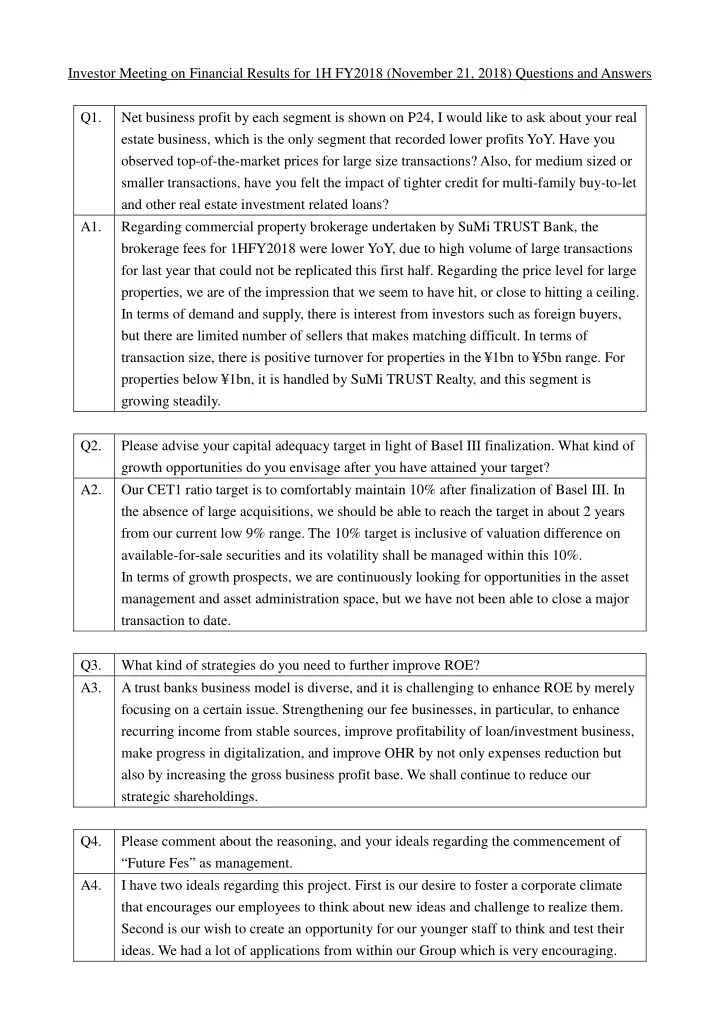
Investor Meeting on Financial Results for 1H FY2018 (November 21, 2018) Questions and Answers Q1. Net business profit by each segment is shown on P24, I would like to ask about your real estate business, which is the only segment that recorded


slide-1
SLIDE 1

Investor Meeting on Financial Results for 1H FY2018 (November 21, 2018) Questions and Answers Q1. Net business profit by each segment is shown on P24, I would like to ask about your real estate business, which is the only segment that recorded lower profits YoY. Have you

  • bserved top-of-the-market prices for large size transactions? Also, for medium sized or

smaller transactions, have you felt the impact of tighter credit for multi-family buy-to-let and other real estate investment related loans? A1. Regarding commercial property brokerage undertaken by SuMi TRUST Bank, the brokerage fees for 1HFY2018 were lower YoY, due to high volume of large transactions for last year that could not be replicated this first half. Regarding the price level for large properties, we are of the impression that we seem to have hit, or close to hitting a ceiling. In terms of demand and supply, there is interest from investors such as foreign buyers, but there are limited number of sellers that makes matching difficult. In terms of transaction size, there is positive turnover for properties in the ¥1bn to ¥5bn range. For properties below ¥1bn, it is handled by SuMi TRUST Realty, and this segment is growing steadily. Q2. Please advise your capital adequacy target in light of Basel III finalization. What kind of growth opportunities do you envisage after you have attained your target? A2. Our CET1 ratio target is to comfortably maintain 10% after finalization of Basel III. In the absence of large acquisitions, we should be able to reach the target in about 2 years from our current low 9% range. The 10% target is inclusive of valuation difference on available-for-sale securities and its volatility shall be managed within this 10%. In terms of growth prospects, we are continuously looking for opportunities in the asset management and asset administration space, but we have not been able to close a major transaction to date. Q3. What kind of strategies do you need to further improve ROE? A3. A trust banks business model is diverse, and it is challenging to enhance ROE by merely focusing on a certain issue. Strengthening our fee businesses, in particular, to enhance recurring income from stable sources, improve profitability of loan/investment business, make progress in digitalization, and improve OHR by not only expenses reduction but also by increasing the gross business profit base. We shall continue to reduce our strategic shareholdings. Q4. Please comment about the reasoning, and your ideals regarding the commencement of “Future Fes” as management. A4. I have two ideals regarding this project. First is our desire to foster a corporate climate that encourages our employees to think about new ideas and challenge to realize them. Second is our wish to create an opportunity for our younger staff to think and test their

  • ideas. We had a lot of applications from within our Group which is very encouraging.
slide-2
SLIDE 2

Q5. By the time to formulate the next Midterm Management Plan, I anticipate that you will have enough capital accumulated to attain CET1 capital ratio of 10%. In light of the fact that Mega banks have also announced policies to strengthen shareholder return, I would like to hear your views on whether there is room to stretch your current policy of total payout ratio of 40%, and dividend payout ratio of 30%. Is there a possibility to boost your dividend payout ratio as a higher proportion (dividend or share buyback) of your total payout ratio target of 40% for next year? A5. Strategies for the next Midterm Management Plan are to be discussed going forward, and as shareholder return is one of the most important policies, we shall review it and make any necessary changes as required. While our FY2019 total payout ratio target is 40%, we do not deem this number as our final goal, and we shall review its direction going forward in terms of both the level and method of shareholder return. Regarding the next year’s total payout ratio of 40%, we shall consider the ratio between share buyback and dividends in due course. We would like to hear the opinion of our investors in formulating our shareholder return policy. Q6. I would like to ask about your branch strategy discussed on P25. Compared with existing branches, by how much can you reduce branch operating cost in your trust type next generation branch format? Also, can you open around 10 Next generation type branches during your next Midterm Management Plan? Assuming you reassign 500 staff to front-office marketing roles from the 1,600 staff equivalent freed up by reduction of backoffice work, that would roughly increase your marketing staff by around 15%, would that have a proportional growth impact on your topline? A6. I do not have an accurate number regarding the reduction of cost level on hand, but Consulting Plaza Chofu is an asset-light branch that is difficult to compare directly with existing branches. Cost would vary depending on branch location and business configuration. Regarding the deployment of future trust type next generation branches, we shall explore possibilities to open them in areas within the 3-metropolitan areas where we have no current footprint, and we shall also proceed to convert our existing branches into the new format by relocation or refurbishment. Regarding the question of topline growth in relation to staff deployment, when we managed to increase client contact by 10% by reducing administrative burden of our marketing staff, gross profit actually increased by around 10%. Whether this case is directly applicable depends on other factors such as staff retraining, but I believe we can increase our topline in proportion to our improvement in client contact.

slide-3
SLIDE 3

Q7. Regarding your competition environment, others are also pursuing the fusion of trust and banking services and overseas M&A, how are these strategies of your competitors affecting your strategy formulation? A7. We have noted that our competitors’ strategies are converging towards ours, and how to differentiate ourselves is one important agenda in formulating our strategy. I believe it is important to raise the effectiveness of our business model, and there are two points to note. First is to strengthen our offering of high value-added products and services, leveraging our expertise. This applies not only to our existing businesses but also to our challenges in new areas where our competition has not explored. Second is to strengthen our client marketing (RM) functions. Our task is to elevate our total solution service capability that encompasses real estate, stock transfer agency and pension businesses. Q8. The Group has a medium-term target to attain AUM of ¥100trn through organic growth to increase the profitability of the asset management business. Please tell us about your current market views and future strategies to reach the AUM target. A8. As passive investments gain market share, it is important to strengthen fundamental profitability by increasing our AUM. In addition, we aim to enhance the profitability of

  • ur overall asset management business by developing competitive active management

products. While not emphasizing increase of AUM as its sole objective, in considering inorganic growth opportunities such as M&A, we need to be cognizant of whether the opportunity would have synergies with our asset management functionality and product development knowhow, or fulfill requirements of our retail and institutional clients. Regarding specific policies, we shall be flexible in its execution including alliances. Q9. When you look at ROE by segment, each segment’s ROE exceeds that of the Group shareholder ROE, so there seems to be items not covered in this presentation. Please give us your views on what you learned from this disclosure and future room for improvement. A9. One reason for this discrepancy is that there are Head Office expenditures that are difficult to allocate to respective segments. We acknowledge that we need to raise each segment’s ROE with this shortfall in mind.

  • Q10. Regarding your yen funding cost, please give us your views on whether there is room for

further decrease in deposit rates. Regarding foreign currency funding, SMFG has announced a covered bond issuance, do you have similar ideas utilizing your high-quality mortgage book?

  • A10. I would say that the management of yen funding cost went very well during this first
  • half. While there is some room for further reduction, the pace of reduction might be

slower than what has been achieved in the first half.

slide-4
SLIDE 4

Regarding foreign currency funding, we have managed to achieve diversification of funding sources, cost reduction, and while paying careful attention to liquidity risk, to reduce our reliance on CCS funding through schemes such as repo funding utilizing clients’ custody assets. We have utilized a scheme similar to covered bonds in the past, and we are investigating these ideas going forward.

  • Q11. Please give us your ideas on what is required to raise ROE by each business segment,

and strategies to deal with them. I think improving ROA is the priority, but please offer your thoughts on this.

  • A11. As our business model has numerous cross-divisional interactions, we concluded that

ROE by each business segment could be difficult to interpret, so we decided to disclose ROE by client segment. With regard to ROA, our corporate portfolio is centered on large corporations and in the case of project finance, for example, our portfolio is centered on transactions in which we are careful about off-taker’s credit risk and existence of guarantees from sovereign export credit agencies to mitigate risk, as a result of which

  • ur portfolio’s return could become somewhat lower. However, given our resource

constraints, entering the SME market would not make sense in terms of risk-return is our

  • assessment. While acknowledging improvement of ROA is important for our corporate

business, I believe it should be viewed in conjunction with a balanced approach coordinating our real estate, pension and stock transfer agency businesses to offer total solution services.

  • Q12. The group is considering a dividend payout of ¥35bn from its subsidiaries to the parent

in FY2018 to raise capital efficiency, but how is this expected to improve efficiency? Also, is this kind of dividend payout from subsidiaries expected to happen continuously in the future?

  • A12. To maintain our current mortgage loan portfolio of ¥10trn, taking client repayments and

churn into account, we need to generate around ¥1trn of new loans per annum. I believe we have room to grow our portfolio a little further without compromising high client credit quality. Regarding interest rates offered, our fixed rate offerings have increased slightly, which is not just limited to our bank, and we would like to increase our exposure while improving profitability.

  • Q13. What is the biggest risk you currently envisage?
  • A13. Stock prices have the biggest negative impact on us. Regarding strategic shareholdings,

we have hedged a substantial portion of its risk, but ripple effects of stock price falls would be felt across the businesses such as reduced AUM leading to fall in fiduciary business income, and impact on investment trust sales for retail clients.

slide-5
SLIDE 5
  • Q14. Looking at profit situation of your major subsidiaries, without the profit boost from

Nikko AM, overall group company profit seems to have decreased. Please explain your strategies for strengthening profitability of your group companies.

  • A14. Our group companies can be categorized into two types; first is companies managed to

contribute to our top line growth, and second is companies intended to manage

  • utsourced administration work. For companies with objective to boost our group top

line, we aim to differentiate ourselves from our competition by working closely together amongst our group companies to enhance our competitiveness. Cautionary Statement regarding Forward-Looking Statements This document contains information that constitutes forward-looking statements. Such forward-looking statements are not guarantees of future performance and involve risks and uncertainties, and actual results may differ from those in the forward-looking statements as a result of various factors including changes in managerial circumstances. Information regarding companies and other entities outside the group in this document has been

  • btained from publicly available information and other sources. The accuracy and appropriateness of

that information has not been verified by the group and cannot be guaranteed. This document does not constitute an offer to sell or a solicitation of an offer to subscribe for or purchase any securities.