
SLIDE 1
Team Four: Megha Andrews, Madlyn Kates, Christine Lu, Katherine Miao, Archana Raghunath, Angeli Sharma, Grace Shen, Michael Tai, Mary Tresvalles, Elena Wei, Destiny West, Audrey Zhou
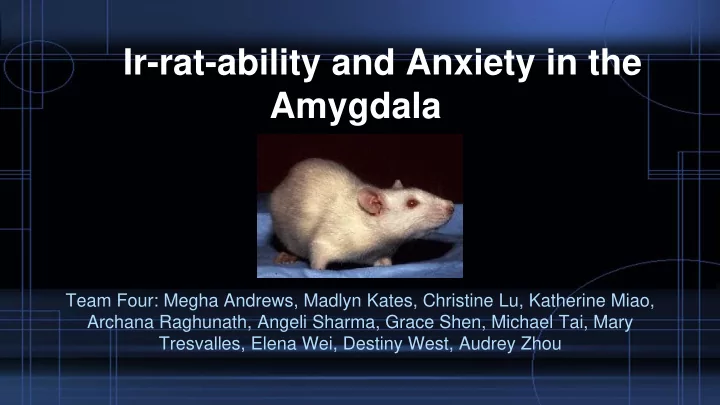
Ir-rat-ability and Anxiety in the Amygdala Team Four: Megha - - PowerPoint PPT Presentation
Ir-rat-ability and Anxiety in the Amygdala Team Four: Megha Andrews, Madlyn Kates, Christine Lu, Katherine Miao, Archana Raghunath, Angeli Sharma, Grace Shen, Michael Tai, Mary Tresvalles, Elena Wei, Destiny West, Audrey Zhou Anxiety/Anxiety
Team Four: Megha Andrews, Madlyn Kates, Christine Lu, Katherine Miao, Archana Raghunath, Angeli Sharma, Grace Shen, Michael Tai, Mary Tresvalles, Elena Wei, Destiny West, Audrey Zhou
disorders
mental illness
INVESTIGATE THE ROLE OF THE AMYGDALA/AMYGDALOID COMPLEX IN ANXIETY LIKE BEHAVIORS Predator odor used as model for anxiety disorders
decisions, and processing emotions.
corticomedial amygdala (CMA).
Fades quickly Pervasive Visible Threat Potential Unseen Danger
The amygdala receives input from multiple olfactory systems:
The rats surprisingly spent more time in the zones containing the predator pheromones.
In the general the rats moved in greater speeds in the presence of the
On average the rats stayed closer to the points containing the predator odors. Overall it seems that the rats displayed the most aversion to the pheromones from the cat urine and fox urine.
startle responses
“baseline” response to when the pheromones/ odorants are released (presence of anxiety).
3 Handling Sessions Baseline Test 1 Baseline Test 2 Baseline Test 3 Olfactory Startle Test 1 Olfactory Startle Test 2 Baseline Test 4 Olfactory Startle Test 3 Olfactory Startle Test 4
▪ Purpose) To test equipment as well as record initial startle responses of each subject without odor present ▪ Acclimation period of 2 minutes ▪ 40 sound pulses of varying intensities played in a pseudo-random order ▫ Played in 15 second intervals ▫ Order kept constant for all subjects
3 Handling Sessions Baseline Test 1 Baseline Test 2 Baseline Test 3 Olfactory Startle Test 1 Olfactory Startle Test 2 Baseline Test 4 Olfactory Startle Test 3 Olfactory Startle Test 4
The decrease in response across sessions shows evidence of habituation
▪ Odorants) fox urine, cat urine, female rat urine, propyl butyrate ▪ Acclimation period of 5 minutes ▪ 70 sound pulses of 95 dBA played in 15 second intervals ▫ On 31st sound pulse, odorant is first introduced ▪ Every 4th sound pulse after 31, odorant is reintroduced into chamber (35th pulse, 39th pulse, etc.) ▪ Order of odorants counterbalanced to avoid repeated testing 3 Handling Sessions Baseline Test 1 Baseline Test 2 Baseline Test 3 Olfactory Startle Test 1 Olfactory Startle Test 2 Baseline Test 4 Olfactory Startle Test 3 Olfactory Startle Test 4
increased response which indicates that there was another factor involved.
phasic fear response.
Thermocouple Electrode E Oscilloscope Amplifier Computer
Thermocouple Electrode E Oscilloscope Amplifier Computer Data Analysis
Analysis of electrophysiology data yields two distinct waveforms.
Trough
potential
Crest of action potential Unit A Unit B
Results from a previous experiment that would corroborate our hypothesis that the detected cells process specific odors.
Our results did not match. Neither control nor experimental odors elicited an obvious response from the detected cells.
❖Sample Cell ➢showed both odor responsivity and specificity ❖Our 3 Tested Cells ➢Neither odor specificity or responsivity ❖Sample size did not permit an accurate estimation of the population of corticomedial amygdala cells.
ksdksd
❖Most of the results did not align with our hypothesis, that predator pheromones would have an effect on the neurons of the corticomedial amygdala in processing
❖Main Findings ➢Open Maze ➢Acoustic Startle ➢Electrophysiology ❖Possible Sources of Error ❖Future Implications
1. Bind RH. The role of pheromonal responses in rodent behavior: future directions for the development of laboratory protocols. Journal
http://www.ncbi.nlm.nih.gov/pmc/articles/PMC3624779/ 2. Curzon P, Zhang M, Radek RJ. The behavioral assessment of sensorimotor processes in the mouse: acoustic startle, sensory gating, locomotor activity, rotarod, and beam walking. Methods of Behavior Analysis in Neuroscience. 2009 [Internet]. [cited 2015 Jul 27] 2nd
3. Davis M, Walker D, Miles L, Grillon C. Phasic vs sustained fear in rats and humans: role of the extended amygdala in fear vs anxiety.
4. Harris A, D'eath R, Healy S. Environmental enrichment enhances spatial cognition in rats by reducing thigmotaxis (wall hugging) during testing. Animal Behaviour: 1459-1464. 5. Koch M. The neurobiology of startle. Prog Neurobiol. 1999 Oct; 59(2): 107-28. Available from: http://www.sciencedirect.com/science/article/pii/S0003347209001183 6. Lowry R. One-way ANOVA. VassarStats. 2015; [Internet]. [cited 27 July 2015]. Available from: http://vassarstats.net/anova1u.html 7. Stoelting ANY-maze flexible video tracking for neuroscience experiments. [updated 2011]. [cited 2015 Jul 26]. Available from: http://www.anymaze.com/ 8. Takahashi L. Olfactory systems and neural circuits that modulate predator odor fear. Frontiers in Behavioral Neuroscience. 2014; [Internet]. [cited 2015 Jul 28]: 1-13. Available from: http://www.ncbi.nlm.nih.gov/pmc/articles/PMC3949219/ 9. Valsamis B, Schmid S. Habituation and prepulse inhibition of acoustic startle in rodents. Journal of Visualized Experiments. 2011; [Internet]. [cited 2015 Jul 27]: (55): 3446. Available from: http://www.ncbi.nlm.nih.gov/pmc/articles/PMC3217252/
Jul 29]: 12–20 p. Available from: http://www.sciencedirect.com/science/article/pii/S0306452212008159
Jul 29] Available from: http://www.adaa.org/understanding-anxiety
○ (MAZE) Elliot the Scrub Rat, Simon, Michael, George, Russell, Mercutio, Remy ○ (STARTLE) Ace, Felix, Tucker, Mrs. Frisby, Stitch, Jerry, Finnegan, Julius ○ (ELECTROPHYSIOLOGY) Ratsby, Sirius RIP
○ AT&T, Bayer Healthcare, Independent College Fund of New Jersey, Johnson & Johnson, The Overdeck Family Foundation, NJGSS Alumnae and Parents, Corporate Matching Funds, The State of New Jersey, Board of Overseers, New Jersey Governor’s School