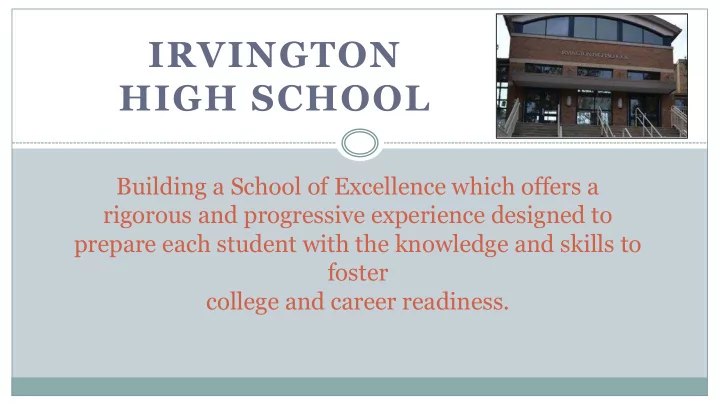
IRVINGTON HIGH SCHOOL Building a School of Excellence which offers - - PowerPoint PPT Presentation

irvington
SMART_READER_LITE
LIVE PREVIEW

IRVINGTON HIGH SCHOOL Building a School of Excellence which offers - - PowerPoint PPT Presentation

IRVINGTON HIGH SCHOOL Building a School of Excellence which offers a rigorous and progressive experience designed to prepare each student with the knowledge and skills to foster college and career readiness. Enrollment & Staffing 61


slide-1
SLIDE 1

IRVINGTON HIGH SCHOOL

Building a School of Excellence which offers a rigorous and progressive experience designed to prepare each student with the knowledge and skills to foster college and career readiness.

slide-2
SLIDE 2

Enrollment & Staffing

61 teachers (10 shared), 4 Counselors, 1 School Psychologist, 1 Student Assistance Counselor, 1 Teaching Assistant, 1 Nurse, 13 Aides, 3 Clerical

slide-3
SLIDE 3

District Theories of Action

Robust Curriculum & Instruction Professional Learning Reflection & Feedback

slide-4
SLIDE 4

IHS BUILDING THEORY OF ACTION

If we provide students with rigorous content, balanced with learning activities that foster collaboration and effective communication, then they will successfully demonstrate deeper levels

  • f understanding and higher levels of thinking.
slide-5
SLIDE 5

THE IHS EXPERIENCE

Developing a high school program that provides students with:

 Robust Academic Curriculum

 Sequence of Courses that Build Knowledge and Skills  Choices that Support Interest and Rigor

 Supporting Students

 Special Education Services  Counseling Program Aligned to Student Goals

 Opportuntities to Define and Celebrate Student’s Personal Excellence  Enhancing Student Life

slide-6
SLIDE 6
  • Curriculum that supports individual interests and prepares

students for college and career readiness.

  • Rigorous content with opportunities to advance through a

progressive sequence of courses.

  • Instructional design which fosters intellectual engagement

and skill development.

Robust Academic Curriculum

slide-7
SLIDE 7

Sequence of Courses

Student Choices Grow as they Progress through the 4 Year Experience

9th Grade

Core Classes Electives

10th Grade

Core Classes Electives

11th Grade

Core Classes College Level Courses, Selectives and Electives

12th Grade

Core Classes College Level Courses, Selectives and Electives

slide-8
SLIDE 8

English Language Arts

Variety Rigor Instruction

Opportunities for ELA Explorations:

  • Themes in American Literature
  • Graphic Novel and Comic Book Literature
  • Existential Literature: Heroes & Victims
  • Creative Writing
  • Journalism
  • Presentational Speaking

Advancement to College Level Courses including:

  • AP Literature
  • AP Language & Composition
  • SUPA Public Speaking
  • SUPA Critical Reading and Intensive Writing

Alignment to the Common Core Standards to enhance critical analysis with increased text complexity, to engage in rich, evidence based conversations about text and to produce evidence-based writing across genres and content areas. Freshman Writing Course – Focus on process writing and feedback cycle and transfer of writing skills from ELA to the content areas through explicit instruction

slide-9
SLIDE 9

Social Studies

Variety Rigor Instruction

Opportunities for Social Science Explorations:

  • Economics
  • Psychology
  • Philosophy
  • Women's Studies
  • American Civil War
  • Sociology
  • Sports History & Marketing

Advancement to College Level Courses including:

  • AP World
  • AP American
  • AP European
  • AP Psychology
  • AP Macro Economics
  • AP Micro Economics

Adoption of NYS College, Career and Civic Life (C3) Framework for Social Studies State Standards: Calls upon teachers to enhance the rigor of the social studies disciplines and build critical thinking skills of students to become engaged citizens.

slide-10
SLIDE 10

Science

Variety Rigor Instruction

Opportunities for Science Explorations:

  • Biology
  • Earth Science
  • Chemistry
  • Physics
  • Forensics
  • Marine Science
  • Astronomy
  • Sustainability

Advancement to College Level Courses including:

  • AP Biology
  • AP Environmental Science
  • AP Chemistry
  • SUPA Forensics
  • 3 Year Science Research Program

(Potential to earn 12 credits through Albany State University) Inquiry based learning through hands on lab experiences. Next Generation Standards will guide curriculum development through a framework of scientific investigation to extend, refine and revise knowledge.

slide-11
SLIDE 11

Mathematics

Variety Rigor Instruction

Opportunities for Mathematics Explorations:

  • Pre-Calculus
  • Calculus
  • Fundamentals of College Algebra
  • Business Math
  • Computer Programming I
  • Computer Programming II

Advancement to College Level Courses including:

  • AP Calculus AB
  • AP Calculus BC
  • AP Statistics
  • AP Computer Science

Alignment to the Common Core Standards to enhance conceptual understanding through the use of modeling, abstract reasoning, and analytical discussion.

slide-12
SLIDE 12

World Language

Variety Rigor Instruction

Opportunities for World Language Explorations:

  • French
  • Spanish
  • Latin
  • Greek

Advancement to College Level Courses including:

  • AP Spanish
  • AP French
  • AP Latin

Tri States Review (2014-2015) informed the Modern Language focus on:

  • Horizontal and Vertical Articulation of Curriculum
  • Authentic use of the Target Language
  • Performance Assessments
slide-13
SLIDE 13

Physical Education & Health

NYS Curriculum follows the learning standards for Physical Education & Health:

 Personal Health & Fitness

 All students fulfill a .5 credit PE class each year

 Safe and Healthy Environment

 Students participate in drug and alcohol, sex education, and mental health awareness

lessons through the Health Curriculum

 Overall Curriculum Analysis and Revision Process using Understanding by

Design

 Opportunities to partner with iASK, Student Assistance Counselor, Support

Staff, and Local Agencies to enrich learning experiences for students.

Variety Rigor Instruction

slide-14
SLIDE 14

The Arts

Variety Rigor Instruction

Opportunities for Visual Art Explorations:

  • Photography
  • Advanced photography
  • Graphic Design
  • Advanced Publishing.
  • Studio Art
  • Portfolio Honors
  • Design and Drawing for Production
  • Architecural Design
  • Architectural Modeling

Advancement to College Level Courses:

  • AP Art
  • AP Music Theory
  • PLTW: Intro to Engineering

Civic Engineering & Architecture Opportunities for Music Performance Arts – 4 year sequences:

  • Band
  • Orchestra
  • Chorale
  • Marching Band
  • Wind Ensemble
  • Jazz Ensemble
slide-15
SLIDE 15

How is Success Measured at the High School?

 Summative Assessments

 Quizzes/Chapter Tests  Unit Exams  Midterms/Finals  NYS Regents Exams  AP College Board Exams  Progress Reports  Report Cards  Transcripts

 Formative Assessments

 Portfolios (AWE)  Google Classroom  Closure/Exit Tickets  1:1 Conferences  Performance Assessments  Projects/Presentations  Peer Review  Self-Assessments

slide-16
SLIDE 16

THE IHS EXPERIENCE

Developing a high school program that provides students with:

 Robust Academic Curriculum

 Sequence of Courses that Build Knowledge and Skills  Choices that Support Interest and Rigor

 Supporting Students

 Special Education Services  Counseling Program Aligned to Student Goals

 Opportuntities to Define and Celebrate Student’s Personal Excellence  Enhancing Student Life

slide-17
SLIDE 17

Special Education & Support Staff

Students with Classifications are supported through:

  • Academic Support and Resource Room Settings
  • ICT classes across the content areas and grades
  • Collaboration between Teachers, Counselers and Support Staff
  • School Psychologist and Clinical Staff
  • Testing room with dedicated staff to provide accommodations for assessments
  • Partnership with families to support college testing processes and transition plans

# Student s with IEP’s # Students with 504’s 73 71

slide-18
SLIDE 18

Guidance Counseling Department

4 Year Counseling Program that includes:

  • 8th-9th grade transition
  • Goal Setting Opportunities for all Students
  • Building Relationships with Students to Support Social-Emotional Development
  • Articulation of course offerings
  • Analysis of Scheduling Process to Increase Student Opportunities
  • Develop Partnerships to Infuse Counseling in the Classroom Setting

Fostering Communication and Community with:

  • Enhancement of Parent Events
  • Increased Engagement of Students and Families in the Counseling Program
  • Implementation of Feedback Surveys to Inform Planning

Building Capacity of College Counseling through:

  • Irvington University – Annual College Night
  • Fostering Relationships with College Representatives
  • Enhanced Usage of Naviance
  • Attending Campus Tours and Conferences
slide-19
SLIDE 19

THE IHS EXPERIENCE

Developing a high school program that provides students with:

 Robust Academic Curriculum

 Sequence of Courses that Build Knowledge and Skills  Choices that Support Interest and Rigor

 Supporting Students

 Special Education Services  Counseling Program Aligned to Student Goals

 Opportuntities to Define and Celebrate Student’s Personal Excellence  Enhancing Student Life

slide-20
SLIDE 20

Student Leadership, Character Building & Celebrating Student Success

Student Leadership Opportunities include:

  • Peer Leadership
  • Character Building Facilitator
  • Student Council Representative and Class Officers
  • Varsity Team Captains
  • Club Leaders
  • Student Representation on CAB, iASK and other community committees

Character Building:

  • Character Building Committee- Research and development to design how the Irvington Character Building

Framework (K-12) can live and breathe at the high school

  • School Based Assemblies
  • School Spirit Events and Programs
  • Community Service Opportunities

Celebrating Student Success:

  • Awards and Ceremonies
  • Honor Rolls
  • Cum Laude Society
  • French Honor Society
  • SITE Committee Initiative – Core Value Awards
slide-21
SLIDE 21

THE IHS EXPERIENCE

Developing a high school program that provides students with:

 Robust Academic Curriculum

 Sequence of Courses that Build Knowledge and Skills  Choices that Support Interest and Rigor

 Supporting Students

 Special Education Services  Counseling Program Aligned to Student Goals

 Opportuntities to Define and Celebrate Student’s Personal Excellence  Enhancing Student Life

slide-22
SLIDE 22

Athletics & Extracurricular Opportunities

JV & Varsity Athletics: Baseball Boys & Girls Basketball Boys & Girls Bowling Fencing Field Hockey Football Golf Ice Hockey Boys & Girls Lacrosse Softball Boys & Girls Soccer Boys & Girls Swimming Boys & Girls Tennis Boys & Girls Track Volleyball Wrestling Extracurricular Opportunities: Mock Trial Model UN Key Club Latin Club Robotics LGBTQIA Film Club Glamour Girls Midnight Run JSA Israel Culture Club Free the Children Ocean Club Extracurricular Opportunities: Positive Impact Club Invisible Children Dance Crew Literary Magazine Academic Challenge Innovation Fund Projects Theatre Performances

slide-23
SLIDE 23

Opportunities: Trips:

  • BRIDGES
  • Senior Internships
  • BOCES/Occupational Education
  • Science Research Symposium
  • Young Historian Symposium
  • Community Service
  • School Spirit Events
  • The Canada Trip
  • The Frick Museum
  • Wall Street/Stock Exchange
  • The Bodies Exhibit
  • Gettysburg
  • The Hudson River Environmental

Exploration

  • Creperie
  • The Guggenheim Museum

Learning Experiences Beyond the Classroom

slide-24
SLIDE 24

Communication Teaching & Learning Student Life Scheduling and Data Reporting Student Supports

Theory 2: Building Capacity

slide-25
SLIDE 25

Building Capacity through Professional Learning

 District and Building Level Professional Development Teams:

  • UBD
  • Rubicon
  • Character Ed
  • GAFE
  • ETDT

 District-Wide Instructional Leader Meetings  Superintentent’s Conference Days  Building Based Structures:

  • Bi-Monthly Department Chair Meetings (6-12 & 9-12)
  • Double Period Monthly Meetings with Departments
  • Weekly Guidance Counseling Department Meetings
  • Monthly Full Faculty Meetings
  • Monthly Department Meetings

Capacity = Systems

slide-26
SLIDE 26

Educational Technology

Working with teachers to infuse technology into instructional design to enhance learning and engagement:

 Educational Technology Initiatives:

 Wireless  BYOD  Chromebooks  Google Classroom  Google Apps for Education  Paperless Initiative  Castle Learning

slide-27
SLIDE 27

Focus on Instructional Coaching

Working with teachers to develop pedagogy and practice to enhance teaching and learning:

 Curriculum Mapping  Closure and Summary Strategies  Formative vs. Summative Assessment  Habits of Mind and 21st Century Dispositions  Engagement and Questioning Techniques  Levels of Vocabulary  Authentic Learning Experiences  Building Sytems of Communication

slide-28
SLIDE 28

Dispositions & 21st Century Skills

What does each disposition “look and sound like” in a high school classroom?

To what extent do we name them for students, coach into them, plan instruction to provide opportunities to practice them and hold students accountable to them?

How can we develop rubrics and closure activities to include dispositional reflection and evalution to increase metacognition?

  • Collaborative Learner
  • Creative Thinker
  • Flexible Thinker
  • Risk Taker
  • Empathetic Citizen
  • Problem Solver
  • Effective Communicator
slide-29
SLIDE 29

Theory 3: Professional Reflection & Feedback

  • Administrative Council Instructional Rounds
  • Evidence of Building Theory of Action Collected
  • Evidence shared at Faculty Meeting for Analysis
  • APPR Supervision Cycle
  • 2 Observations and 1 Walkthrough
  • Pre & Post Observation Forms and Response to Questions
  • Building Administration Instructional Rounds
  • Each teacher participates in a reflection:

“To what extent did each student in the given period, meet your learning outcomes for the day? How do you know? What is your measure?” “What is the relationship between the essential questions/big ideas and the instructional design of a daily period? How do you ensure that students make the connection?”

slide-30
SLIDE 30

IRVINGTON HIGH SCHOOL

Q & A Thank You!