Is the efficacy of the pediatric-like protocols for ALL superior to - - PowerPoint PPT Presentation

is the efficacy of the pediatric like protocols for all
SMART_READER_LITE
LIVE PREVIEW

Is the efficacy of the pediatric-like protocols for ALL superior to - - PowerPoint PPT Presentation

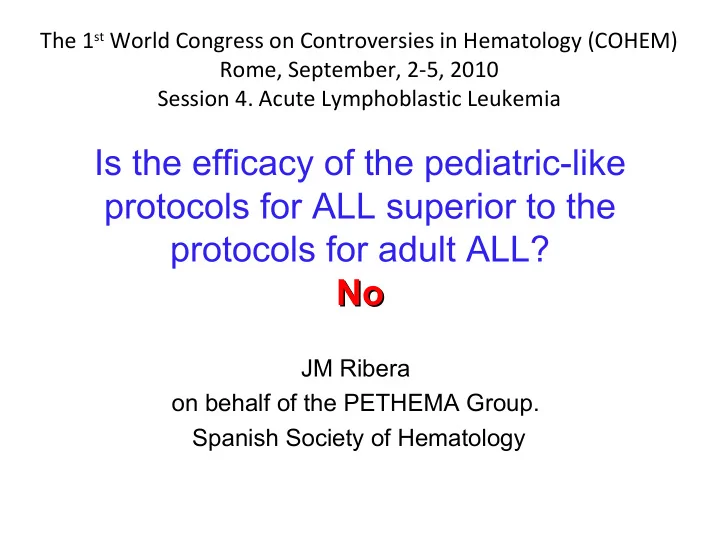
The 1 st World Congress on Controversies in Hematology (COHEM) Rome, September, 2-5, 2010 Session 4. Acute Lymphoblastic Leukemia Is the efficacy of the pediatric-like protocols for ALL superior to the protocols for adult ALL? No No JM


slide-1
SLIDE 1

Is the efficacy of the pediatric-like protocols for ALL superior to the protocols for adult ALL? No No

JM Ribera

  • n behalf of the PETHEMA Group.

Spanish Society of Hematology The 1st World Congress on Controversies in Hematology (COHEM) Rome, September, 2-5, 2010 Session 4. Acute Lymphoblastic Leukemia

slide-2
SLIDE 2

Incidence of ALL

1 1 2 2 3 3 4 4 5 5 6 6 7 7 8 8

0-4 5-9 10-14 15-19 20-24 25-29 30-34 35-39 40-44 45-49 50-54 55-59 60-64 65-69 70-74 75-79 80-84 >85 yrs 0-4 5-9 10-14 15-19 20-24 25-29 30-34 35-39 40-44 45-49 50-54 55-59 60-64 65-69 70-74 75-79 80-84 >85 yrs

children adolescents adults elderly

SEER Program (www.seer.cancer.gov) Public-Use, Nov 2003 (incidences 1992-2001) )

slide-3
SLIDE 3

AIEOP and GIMEMA. 5,203 ALL Patients Distribution by age

Chiaretti S, et al , EHA 2010

slide-4
SLIDE 4

Moorman, A. V. et al. Blood 2010;116:1012

Age-specific incidence of adults with acute lymphoblastic leukemia (ALL) in the North East of England by sex

slide-5
SLIDE 5

Smith, M. A. et al. J Clin Oncol 2010; 28:2625-2634.

US age-adjusted childhood mortality trends for lymphoma and leukemia, and all

  • ther cancer sites with annual percentage changes (APCs) for join point

segments for males and females <20 yr (1975 -2006)

slide-6
SLIDE 6

Pui CH, NEJM 2006

Childhood ALL. Overall survival

slide-7
SLIDE 7

Smith, M. A. et al. J Clin Oncol; 28:2625-2634 2010

5-yr. survival rates for (A) ALL, (B) AML, (C) NHL, and (D) HL among children by age group and period of diagnosis, (1975-2002). SEER 9 Registries

slide-8
SLIDE 8

Juliusson, G. et al. Blood 2010;116:1011

ALL incidence and survival among adults in Sweden

slide-9
SLIDE 9

Moorman, A. V. et al. Blood 2010;115:206-214

OS of adults with ALL by age at diagnosis

slide-10
SLIDE 10

Survival in adult ALL Has Improved in All Age Groups Except the Oldest Patients

Pulte D, et al. Blood. 2009;113:1408-1411.

*Point estimates.

5-Yr Relative Survival* Age Range,% ± SE 1980-1984 2000-2004 Increase, % P Value 15-29 yrs 33.7 ± 3.5 53.6 ± 3.2 19.9 < .0001 30-44 yrs 20.2 ± 4.8 34.3 ± 3.9 14.1 .002 45-59 yrs 10.3 ± 4.9 24.3 ± 3.4 14.0 .0002 > 60 yrs 8.4 ± 3.4 12.7 ± 2.9 4.3 .48

slide-11
SLIDE 11

Reason for today’s debate on treatment of ALL in adolescent and young adults (AYA) Retrospective comparative studies

slide-12
SLIDE 12

AL in AYA. Retrospective comparative studies “Pediatric” vs “adult” treatments

Country Protocol Age N CR(%) 5yr.EFS(%)

USA CCG(P) 16-21 197 96 64 CALGB(A) 16-21 124 93 38 France FRALLE93(P) 15-20 77 94 67 LALA94 (A) 15-20 100 83 41 Holland DCOG (P) 15-18 47 98 69 HOVON (A) 15-20 44 91 34 UK ALL97 (P) 15-17 61 98 66 UKALLXII(A) 67 94 49 Italy AIEOP (P) 14-18 150 94 80 GIMEMA (A) 95 89 71(2yr) Sweden NOPHO-92(P) 10-18 144 99 66 Adult (A) 15-25 99 90 42 Finland NOPHO (P) 10-25 128 96 67 ALL (A) 97 97 60

Reviewed in: Ribera JM. Hematol Oncol Clin North Am 2009; 23:1033-42

slide-13
SLIDE 13

Boissel, N. et al. J Clin Oncol 2003; 21:774-780.

FRALLE-93 vs. LALA-94

P<0.001 P<0.001

slide-14
SLIDE 14

Age * Sex ** WBC * B vs T ** Cytogenetics ** Trial ** (LALA vs. FRALLE) 0.6 0.8 0.005 0.8 0.06 0.04 0.4 0.1 <0.0001 0.02 0.03 <0.0001 EFS

* : Mann-Whitney test (CR) and univariate Cox (EFS) ** : Fisher’s test (RC) and log-rank (EFS)

CR

Global outcome LALA-94 / FRALLE-93

Boissel, N. et al. J Clin Oncol 2003; 21:774-780.

slide-15
SLIDE 15

Reasons for the best results of pediatric protocols

  • Higher dose-intensity of chemotherapy
  • Higher adherence to treatment
  • Better possibility to conduct clinical studies in

children (ALL more frequent)

  • Economic problems in emancipated AYA in

certain countries

slide-16
SLIDE 16

Major differences in pediatric vs. adult protocols

  • Higher dose of essential drugs

– Up to 3x vinca alkaloids – Up to 5x prednisolone – Up to 20x asparaginase

  • Less use of myelosuppressive drugs

– eg, anthracyclines, cyclophosphamide, cytarabine

  • Less use of BMT

– BMT only recommended by pediatricians for very high-risk ALL

  • Less delays between therapy elements

– Time to treatment following initial CR was 2 days in pediatric practice vs. 7 days in adult practice (P = .002)

slide-17
SLIDE 17
  • L-asparaginase (L-asp): essential treatment component in

pediatric ALL patients

– Can also cause frequent treatment delays and toxicity (eg, increased risk of bleeding or thrombosis), compromising overall therapy

  • CAPELAL: retrospective study of 214 adults with either ALL or

lymphoblastic lymphoma

– Treatment: E. coli–derived L-asp 7500 IU/m2 x 6

  • Toxicity effects

– L-asp delayed in 22%, reduced dose in 41% – Typically due to coagulation abnormalities as well as hepatotoxicity

Hunault-Berger M, et al. Haematologica. 2008;93:1488-1494.

Biology of Patient Affects Toxicity: L-Asparaginase

slide-18
SLIDE 18
  • CAPELAL study: thrombotic

events observed in 9.3% of 214 adults; none fatal[1]

  • Worse ALL outcome in those

with a thrombotic event; many discontinued L-asp

  • UKALL 2003 study:

thrombosis noted in 3% of 1824 pediatric patients receiving PEG-ASP[2]

  • 1. Hunault-Berger M, et al. Haematologica. 2008;93:1488-1494.
  • 2. Qureshi A, et al. ASH 2008. Abstract 900.

Biology of Patient Affects Toxicity: L-Asparaginase

No thrombosis (median OS: 53 mos) Thrombosis (median OS: 19 mos) Months

P = .06

OS (%)

20 40 60 80 100

20 40 60 80 100 120

slide-19
SLIDE 19

Additional evidence in favor of the use of pediatric protocols for AYA Prospective (but non- comparative) studies conducted by adult grups using “pediatric- inspired” protocols

slide-20
SLIDE 20

Prospective studies on therapy of ALL in AYA

Group-Protocol Age N CR(%) EFS (%) DFCI 91-01,95-01 15-18 51 94 78 GRAALL-03* 15-45 172 95 58 PETHEMA ALL96** 15-18 35 94 60 19-30 46 100 63 DFCI 18-50 74 82 72 Toronto-Modified DFCI 18-60 85 89 71 FRALLE 93 HR-derived*** 18-55 40 90 72 (OS)

*Increase of 8.6-fold, 3.7-fold and 16-fold in cumulated doses of PDN, VCR and L-ASP compared to ALL-94 protocol. Better results in patients up to 45 yr ** No differences between adolescents and young adults ***Better results in patients up to 40 yr

Reviewed in: Ribera JM. Hematol Oncol Clin North Am 2009; 23:1033-42

slide-21
SLIDE 21

Huguet, F. et al. J Clin Oncol; 27:911-918 2009

GRAALL-03

slide-22
SLIDE 22

Ribera, JM. et al. J Clin Oncol 2008; 26:1843-1849

PETHEMA ALL-96

slide-23
SLIDE 23

Princess Margaret Hospital Toronto. Modified DFCI.

Storring JM. Br J Haematol 2009; 146: 76-85

slide-24
SLIDE 24

Haïat S, et al. Leuk Res 2010 (in press)

FRALLE-93 vs EORTC ALL4

slide-25
SLIDE 25

Barry, E. et al. J Clin Oncol; 25:813-819 2007

DFCI ALL Consortium Protocols, 1991-2000

slide-26
SLIDE 26

Nachman, J. B. et al. J Clin Oncol; 27:5189-5194 2009

EFS and OS for AYA (16-21 yr.) treated on Children's Cancer Group 1961 (n = 262)

slide-27
SLIDE 27

FRALLE-2000 GRAALL-03 Event-free survival years

,2 ,4 ,6 ,8 1 1 2 3 4

p=0.01 (Censored at allograft) p=0.003 3-y 69 % (± 13) 3-y 66 % (± 11) 3-y 85 % (± 8)

Event-free survival GRAALL-2003 / FRALLE-2000

Courtesy of H Dombret and A Baruchel

slide-28
SLIDE 28

The turtle and the hare La tortuga y la liebre

slide-29
SLIDE 29

Evidences in favor of the use of pediatric protocols for AYA

– Retrospective comparisons – Prospective -but non-randomized- protocols in AYAs by adult teams using pediatric-inspired protocols – Results of current pediatric protocols are improving in adolescents

slide-30
SLIDE 30

However…

  • Retrospective comparisons: weak design
  • Groups not fully comparable in retrospective

comparisons

  • In some studies the protocol itself had no

impact on survival in the multivariate analysis (although in others had)

  • Current adult protocols (without “pediatric

inspiration”) show promising results in young adults

  • Absence of direct prospective comparative

studies (“pediatric” vs. adult-type”)

slide-31
SLIDE 31

Non full comparability of “pediatric” vs. “adult” AYA groups

  • f patients in baseline ALL parameters (i.e.: age)

Country Protocol Median age P-value

France FRALLE-93 (P) 15.9 0.001 LALA-94(A) 17.9 Holland DCOG (P) 15.4 <0.01 HOVON (A) 16.9 19.5 Sweden NOPHO (P) 13 <0.01 Adult 21 USA CCG (P) 16 <0.001 CALGB (A) 19 Finland NOPHO (P) 12.9 <0.001 ALL (A) 18.9

slide-32
SLIDE 32

Ramanujachar R, et al. Pediatr Blood Cancer. 2007;48:254-261.

Lack of impact of the protocol by multivariate

  • analysis. ALL97 vs. UKALLXII/E2993

OS (%) 25 50 75 100 1 2 3 4 5 Years UKALLXII/E2993 ALL97 No. Pts 67 61 No. Events 29 17 Obs/ Exp 1.3 0.7 P = .04 UKALLXII/E2993 (adult) ALL97 (pediatric) 71% 56%

  • No. at risk:

UKALLXII/E2993 ALL97 67 51 43 32 23 17 61 55 50 43 31 21

Prognostic factors Yes: Age, Ph / No: protocol

slide-33
SLIDE 33

Current adult protocols without “pediatric inspiration” have promising results in young adults

GMALL MRC/ECOG MDACC

slide-34
SLIDE 34

Results of Induction Therapy in Adolescents GMALL Studies 06/99-07/03

N CR ED Total 417 90% 2% 15-17 yrs 73 93% 3% 18-20 yrs 171 92% 2% 21-25 yrs 173 88% 2%

Courtesy of N Goekbuget and D Hoelzer

5-yr DFS: 67%

slide-35
SLIDE 35

UKALLXII/ECOG E2993: prospective study of allogeneic SCT vs autologous SCT plus chemotherapy in adults with standard-risk ALL[2] ALL-96: prospective study of pediatric regimens in adolescents and young adults with standard-risk ALL[1]

2.Goldstone AH, et al. Blood. 2008;111:18271

MRC UKALLXII/ECOG E2993

CR: 97% 5-yr OS with donor: 62% 5-yr OS without donor: 52% P = NS OS (%) Time From Diagnosis (Years) 20 40 60 80 100 1 2 3 4 5 6 7 8 9 10 Young adults (n = 46) Adolescents (n = 35) P = .02 OS (%) Years 20 40 60 80 100 1 2 3 4 5 No donor (n = 323) Donor (n = 239) CR: 98% 6-yr OS in young adults: 63% 6-yr OS in adolescents: 77%

  • 1. Ribera J-M, et al. J Clin Oncol. 2008;26:1843-1849
slide-36
SLIDE 36

HyperCVAD +Rituximab (if CD20+)

Age N CR(%) CR duration (%) OS 3-yr. 5-yr. 3-yr. 5-yr. Overall 282 95 60 50 58 50 ≤30 96 99 63 50 70 64 31-59 128 98 66 55 60 50 ≥60 58 88 53 47 29 21

Whole series

Modified HyperCVAD+rituximab (if CD20+)

Without intensification (n=126) With intensification (n=47) CD20- CD20+ CD20- CD20+ 3-yr CRD (%) ≤30 84 75 62 40 31-59 89 75 45 67 ≥60 71 65 45 3-yr OS (%) ≤30 77 75 63 80 31-59 56 66 55 78 ≥60 66 15 45

Thomas DA et al J Clin Oncol 2010; 28:3880-3889

slide-37
SLIDE 37

Thomas, D. A. et al. J Clin Oncol 2010; 28:3880-3889

Outcomes for pts < 60 yr with Ph-negative ALL

CD20+ CD20+ CD20+ CD20-

slide-38
SLIDE 38

But we need prospective comparative studies…

Do they exist?

slide-39
SLIDE 39

Phase II Study of Combination Chemotherapy in Treating Young Patients With Newly Diagnosed Acute Lymphoblastic Leukemia

Type of study: CALGB-SWOG-ECOG C10403 trial based on COG AALL0232.

Intergroup phase II trial.

Sponsors and Collaborators: CALGB/ NCI/ ECOG/ SWOG Objectives:

  • To describe the outcomes of AYAs with ALL treated with a pediatric regimen

by adult hematologists/oncologists at multiple sites.

  • To compare the outcomes of patients treated on this protocol with similar

patients treated by pediatric oncologists on protocol COG-AALL0232.

  • To evaluate the adherence of adult hematologists/oncologists and their

patients to a "pediatric" ALL treatment regimen and identify reasons for variances.

  • To analyze and describe the outcomes of patients treated on this study

according to baseline psychosocial characteristics, demographics, and family support.

Estimated Enrollment: 300 patients in 170 centers Study Start Date: October 2007 Estimated Primary Completion Date: September 2012

Bleyer A: J Clin Oncol 26 (Suppl 15): A-18034, 2008 www.clinicaltrials.gov NCT00558519

slide-40
SLIDE 40

Optimizing Treatment of ALL in AYA Summary

  • Use pediatric protocols. No mature data to
  • date. Results of prospective trials are awaited
  • Given with a “pediatric spirit”: minimize

delays and dose reductions. Yes

  • Treat at large centers with experience

treating this population. Yes

  • Enroll patients on clinical trials if possible.

Yes

slide-41
SLIDE 41

Conter, V. et al. Blood 2010;115:3206-3214

AIEOP-BFM ALL 2000 study (3184 pB-ALL patients ) PETHEMA ALL-03 study (High-risk adult patients)

JM Ribera et al. ASH, 2009

slide-42
SLIDE 42

Bruggemann, M. et al. Blood 2006;107:1116-1123

GMALL 07/03. Standard-risk ALL

MRD and Prognosis in Adult ALL

  • NILG. Standard-risk and High-risk ALL

Bassan, R. et al. Blood 2009;113:4153-4162

slide-43
SLIDE 43

Final message

Either pediatric or not, use the protocol that provides the best probability of clearance of MRD!

slide-44
SLIDE 44

Acknowledgments

  • PETHEMA members
  • GMALL: D Hoelzer, N Goekbuget
  • GRAALL: H Dombret
  • FRALLE: N Boissel, A Baruchel
  • GIMEMA: S Chiaretti, G Meloni, R Foà
  • NILG: R Bassan
  • MRC: A Fielding, A Goldstone

E European

W Working Group for Adult A Acute L Lymphoblastic L Leukemia