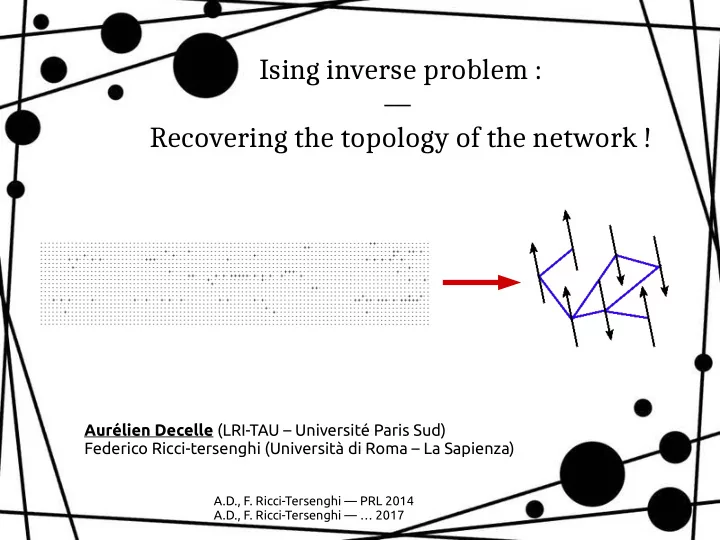
Ising inverse problem : — Recovering the topology of the network !
Aurélien Decelle (LRI-TAU – Université Paris Sud) Federico Ricci-tersenghi (Università di Roma – La Sapienza)
A.D., F. Ricci-Tersenghi — PRL 2014 A.D., F. Ricci-Tersenghi — … 2017
Ising inverse problem : Recovering the topology of the network ! - - PowerPoint PPT Presentation
Ising inverse problem : Recovering the topology of the network ! Aurlien Decelle (LRI-TAU Universit Paris Sud) Federico Ricci-tersenghi (Universit di Roma La Sapienza) A.D., F. Ricci-Tersenghi PRL 2014 A.D., F.
Aurélien Decelle (LRI-TAU – Université Paris Sud) Federico Ricci-tersenghi (Università di Roma – La Sapienza)
A.D., F. Ricci-Tersenghi — PRL 2014 A.D., F. Ricci-Tersenghi — … 2017
For further details, see http://tao.lri.fr
Why (Ising) inverse problems ? → inferring parameters from observed confjgurations (this is what physicists do) → in social science: infer latent features of the system (community detection (using potts model), …) → in neuroscience: infer the structure between neurons → in Machine Learning : generative model of neural network (typically Restricted Boltzmann Machines)
Machine Learning (Lee et al.) Neuron spiking (Tkacik et al.)
In inverse problems, if you put all the possible parameters, you tend to overfjt ! OverFIT !
Direct problems are already hard : understanding equilibrium properties can be (very) challenging (e.g. spin glasses) Inverse problems can be harder : maximizing the likelihood would involve to compute the partition function many times You need to compute : In particular, serious problems can appear because of
Set of confjgurations : {σ}k=1..M
σi (k) = ±1
N variables M Confjgurations Defjne a model that can describe these data Find the parameters θ that match the data (according to the model)
How can we fjnd a good model that can explain the correlations and the biases ! Maximum entropy model :
p(σ)= exp(∑i< j J ij sis j+∑i hi si) Z Reproduce the correlations and biases
Static process : no time correlations (altough possible) Maximizing the likelihood The Ising model
Maximizing the likelihood
Gradient ascent :
Mean Field approach ! Maximizing likelihood !
Direct process : Polynomial in N !
The approximation can be improved : 1) naïve MF (independant spins) 2) TAP, correction or order √N-1 3) Bethe Approx, tree like structure Exactly ? N=20 max Approx to the likelihood : PseudoLikelihood 1) polynomial in N and M 2) can be improved
Useful to recover the graph Can deal with many-bodies interactions
Goal: fjnd a function that can be maximized and would infer correctly the J’s, h’s we keep only this part !
Why should it work ? 1)Maximizing the marginal of site i, ~ok 2)When data are following Gibbs, infer the true value for infjnite sampling 3)Convex function, complexity goes as O(N3M) Then we can maximize the following quantity :
With reasonnable sampling you get good results ! SK model, N=64, with M=106, 107, 108 b) with sparsity 2D ferro model, N=49, with M=104, 105, 106
Results for a 2D diluted ferromagnet (N=49)
We know that a Laplace prior impose sparsity in the inference process ! But how do I fjx λ ?
Results for a 2D diluted ferromagnet (N=49)
Progressively decimating parameters with a small absolute values Not NEW :
In RED : PLM In BLUE : true couplings In GREEN : PLM-L1
Given a set of equilibrium confjgurations and all unfjxed parameters
exit
goto 1.
Random graph with 16 nodes
Random graph with 16 nodes The difgerence increases The difgerence decreases
2D ferro, M=4500, β=0.8
Systems can sometimes have many-body interactions ! Easy generalization of the PseudoLikelihood : Problem : derivative w.r.t all parameters complexity O(N →
4M)
Get worse and worse for interaction between many spins ! You don’t want to add all possible parameters (meaningless)
Let’s consider the following experience
ake a system S1, 2D ferro without fjeld
ake a system S2, 2D ferro without fjeld but with some 3-body interactions
model with 3B interactions included
On the left : inference on S1 with the correct model On the right : inference on S2 with only pairwise interactions Anomally ! But: this can be corrected using a magnetic fjeld !
Error on the three points correlations function T ake the error on the 3points correlation functions, plot them by decreasing order! Can you guess how many three-body interactions there are ?
Histogram of the error on the 3p-corr
Histogram of the error on the 3p-corr 4 outliers these are the ones that were added ! →
Using higher order Likelihood ? (cf Yasuda et al.) Application to model with hidden variables ? (Machine Learning)