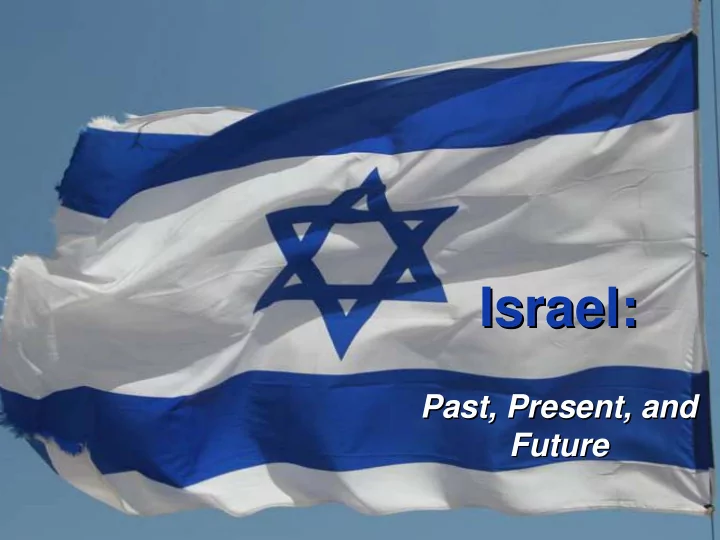
SLIDE 1
Israel: Israel:
Past, Present, and Past, Present, and Future Future
SLIDE 2
Ezekiel 5:5 “Thus says the Lord GOD: Ezekiel 5:5 “Thus says the Lord GOD: ‘This ‘This is is Jerusalem; I have set her in the Jerusalem; I have set her in the midst of the nations and the countries all midst of the nations and the countries all around her’.” around her’.”
SLIDE 3
- 1. Does the modern state of Israel have a
legitimate claim on their historic homeland today?
- 2. Is the existence of the modern state of
Israel prophetically significant?
- 3. What should the role of the believer be in
relationship to modern Israel?
- 4. What is the history of the Jews since AD 70
in relation to their historic homeland?
SLIDE 4 Israel:
Past, Present, and Future
Israel: Israel:
Past, Present, and Future Past, Present, and Future
Biblical Biblical Period Period 2091 2091 BC
BC –
– AD
AD 70
70 Post Post-
Biblical Period Period
AD AD 70
70 – – 1839 1839 Modern Modern Period Period 1839 1839 – – 2006 2006
SLIDE 5 Israel:
Past, Present, and Future
Israel: Israel:
Past, Present, and Future Past, Present, and Future
Biblical Biblical Period Period 2091 2091 BC
BC –
– AD
AD 70
70 Post Post-
Biblical Period Period
AD AD 70
70 – – 1839 1839 Modern Modern Period Period 1839 1839 – – 2006 2006
- 1. Patriarchal
- 2. Sojourn and
- 3. Theocracy
- 4. United Kingdom
- 5. Divided Kingdom
- 6. Exile
- 7. Post-exile
- 8. Hasmonean
- 9. Roman
- 1. Rome
- 2. Byzantine
- 3. Persian
- 4. Moslem Arab
- 5. Crusaders
- 6. Mamluks
- 7. Ottoman Turks
SLIDE 6 Rome, 63 BC–ca. AD 364 Byzantine, ca. AD 364–614 Persians, AD 614–636 Moslem Arab, AD 636–1099 Crusaders, AD 1099–1291 Mamluks, AD 1291–1516 Ottoman Turks, AD 1516
Conquerors of Conquerors of Jerusalem Jerusalem
SLIDE 7 The Ottoman Empire (1517–1917) 1453, May 29: Fall of Constantinople 1517 Fall of Jerusalem: Salim I overruns Syria-Palestine 1529 Siege of Vienna 1683 Siege of Vienna
SLIDE 8
SLIDE 9 The English Protestants The English Protestants
“Starting with the Puritan ascendancy the movement among the English for the return of the Jews to Palestine began.” Barbara Tuchman, The Bible and the Sword “Starting with the Puritan ascendancy the movement among the English for the return of the Jews to Palestine began.” Barbara Tuchman, The Bible and the Sword
SLIDE 10
Cromwell’s official document returning the Jews to England. Cromwell’s official document returning the Jews to England.
The English Protestants The English Protestants
SLIDE 11
- Reformation: Emphasis on the Bible,
sola Scriptura
- Premillennialism: Literal Kingdom, future
for Israel
- English Puritans: Saw the Biblical
prophecy of a return of the Jews to their homeland
- French Revolution: Put the focus of
Britain on the future. Fears of the rise of the Antichrist, the end times.
- Napoleon invades the Middle East in
1798
SLIDE 12
There were a number of Restorationists in Holland during the time of the Puritan movement. Isaac de la Peyrere (1594–1676), who served as the French Ambassador to Denmark wrote a book wherein he argued for a restoration of the Jews to Israel without conversion to Christianity. There were a number of Restorationists in Holland during the time of the Puritan movement. Isaac de la Peyrere (1594–1676), who served as the French Ambassador to Denmark wrote a book wherein he argued for a restoration of the Jews to Israel without conversion to Christianity.
SLIDE 13 In 1655, Paul Felgenhauever, wrote Good News for Israel in which he taught that there would be the permanent return
- f the Jews to their own country eternally
bestowed upon them by God through the unqualified promise to Abraham, Isaac and Jacob. In 1655, Paul Felgenhauever, wrote Good News for Israel in which he taught that there would be the permanent return
- f the Jews to their own country eternally
bestowed upon them by God through the unqualified promise to Abraham, Isaac and Jacob.
SLIDE 14
The Dane, Holger Paulli (1644–1714) believed wholeheartedly in the Jewish return to the Holy Land, as a condition for the Second Coming. He even lobbied the kings of Denmark, England, and France to go and conquer Palestine from the Ottomans in order that the Jews could regain their nation. The Dane, Holger Paulli (1644–1714) believed wholeheartedly in the Jewish return to the Holy Land, as a condition for the Second Coming. He even lobbied the kings of Denmark, England, and France to go and conquer Palestine from the Ottomans in order that the Jews could regain their nation.
SLIDE 15 Frenchman, Marquis de Langallerie (1656–1717), schemed with the Turkish Ambassador in the Hague on a plan to defeat the Pope and trade the papal empire for a return of the Jews to the Holy
- Land. Langallerie was arrested in
Hamburg, tried and convicted of high treason and died in prison a year later. Frenchman, Marquis de Langallerie (1656–1717), schemed with the Turkish Ambassador in the Hague on a plan to defeat the Pope and trade the papal empire for a return of the Jews to the Holy
- Land. Langallerie was arrested in
Hamburg, tried and convicted of high treason and died in prison a year later.
SLIDE 16
Other European Restorationists of the era include: Isaac Vossius, Hugo Grotius, Gerhard John Vossius, David Blondel, Vasover Powel, Joseph Eyre, Edward Whitaker, and Charles Jerran. Other European Restorationists of the era include: Isaac Vossius, Hugo Grotius, Gerhard John Vossius, David Blondel, Vasover Powel, Joseph Eyre, Edward Whitaker, and Charles Jerran.
SLIDE 17
Colonial America Colonial America
In addition to John Cotton (1584–1652), early Restorationists included: John Davenport (1597–1670), William Hooke (1601–1678), John Eliot (1604– 1690), Samuel Willard (1640–1707), and Samuel Sewall (1652–1730). Ephraim Huit, a Cambridge-trained early minister in Windsor, Connecticut believed that the Jews would be regathered to their homeland in 1650. In addition to John Cotton (1584–1652), early Restorationists included: John Davenport (1597–1670), William Hooke (1601–1678), John Eliot (1604– 1690), Samuel Willard (1640–1707), and Samuel Sewall (1652–1730). Ephraim Huit, a Cambridge-trained early minister in Windsor, Connecticut believed that the Jews would be regathered to their homeland in 1650.
SLIDE 18 One of the standout advocates of the restoration doctrine was Increase Mather, the son of Richard and father of Cotton. Increase wrote over 100 books in his life & was a president of Harvard. His first work was The Mystery
- f Israel’s Salvation, which
went through about a half dozen revisions during his
national restoration of Israel to her land in the future was typical of American Colonial Puritans and was generally widespread. One of the standout advocates of the restoration doctrine was Increase Mather, the son of Richard and father of Cotton. Increase wrote over 100 books in his life & was a president of Harvard. His first work was The Mystery
- f Israel’s Salvation, which
went through about a half dozen revisions during his
national restoration of Israel to her land in the future was typical of American Colonial Puritans and was generally widespread.
Increase Mather
(1639–1723)
SLIDE 19 The French and the Middle East The French and the Middle East
- French Revolution: Fears of the
Antichrist
- James Bicheno, The Signs of the Times
- Charles-Joseph Prince de Ligne (1735–
1814) lobbied the Turkish Sultan for a Jewish homeland.
- Napoleon invades Egypt, 1798, defeated
at Acre
- French Revolution: Fears of the
Antichrist
- James Bicheno, The Signs of the Times
- Charles-Joseph Prince de Ligne (1735–
1814) lobbied the Turkish Sultan for a Jewish homeland.
- Napoleon invades Egypt, 1798, defeated
at Acre
SLIDE 20 The English and Jewish The English and Jewish Evangelism Evangelism
- 1809 Society for Promoting Christianity
among the Jews
- Lewis Way lobbies European leaders
- 1809 Society for Promoting Christianity
among the Jews
- Lewis Way lobbies European leaders
SLIDE 21 Early America Early America
It should not be considered strange that President John Quincy Adams expressed his desire that “the Jews again [were] in Judea, an independent Nation, . . .
independent government and no longer persecuted.” It should not be considered strange that President John Quincy Adams expressed his desire that “the Jews again [were] in Judea, an independent Nation, . . .
independent government and no longer persecuted.” John Quincy Adams John Quincy Adams
SLIDE 22 Dispensationalism Dispensationalism
The 1800s marks a high point in British premillennialism & a cor- responding apex for Christian
- Zionism. Many contemporary
accounts critical of Christian Zionism focus their emphasis upon J. N. Darby and the rise of dispensationalism as the found- ation for British Restorationism. As one examines the record, such is not the case. The 1800s marks a high point in British premillennialism & a cor- responding apex for Christian
- Zionism. Many contemporary
accounts critical of Christian Zionism focus their emphasis upon J. N. Darby and the rise of dispensationalism as the found- ation for British Restorationism. As one examines the record, such is not the case. John Nelson Darby John Nelson Darby
SLIDE 23 British Restorationism British Restorationism
“Some seven hundred ministers of the Establishment were said to believe that Christ’s coming must precede His kingdom upon Earth… the number almost certainly increased in the latter half of the century.”
– Iain Murray, Reformed Historian and Theologian
“Some seven hundred ministers of the Establishment were said to believe that Christ’s coming must precede His kingdom upon Earth… the number almost certainly increased in the latter half of the century.”
– Iain Murray, Reformed Historian and Theologian
SLIDE 24 British Restorationism British Restorationism
An example of such clergymen would be J. C. Ryle, who wrote a Pre- Millennian Creed. The wave
- f premillennialism is what
produced in Britain a crop of Christian Zionists that led to political activism which likely culminated in the Balfour Declaration. An example of such clergymen would be J. C. Ryle, who wrote a Pre- Millennian Creed. The wave
- f premillennialism is what
produced in Britain a crop of Christian Zionists that led to political activism which likely culminated in the Balfour Declaration.
(1816–1900) (1816–1900)
SLIDE 25 British Restorationism British Restorationism
Shaftesbury was led into acceptance of premillennialism by Edward Bickersteth, which then gave rise to his views of Jewish Restorationism. Shaftesbury said concerning his belief in the Second Coming, that it “has always been a moving principle in my life, for I see everything going
- n in the world subordinate to
this great event.” Shaftesbury was led into acceptance of premillennialism by Edward Bickersteth, which then gave rise to his views of Jewish Restorationism. Shaftesbury said concerning his belief in the Second Coming, that it “has always been a moving principle in my life, for I see everything going
- n in the world subordinate to
this great event.”
Edward Bickersteth Edward Bickersteth
SLIDE 26
British Restorationism British Restorationism
Anthony Ashley Cooper, later Lord Shaftesbury, is said by Tuchman to have been “the most influential nonpolitical figure, excepting Darwin, of the Victorian age.” As a strong evangelical Anglican, he is said to have based his life upon a literal acceptance of the Bible and was known as the “Evangelical of Evangelicals.” Anthony Ashley Cooper, later Lord Shaftesbury, is said by Tuchman to have been “the most influential nonpolitical figure, excepting Darwin, of the Victorian age.” As a strong evangelical Anglican, he is said to have based his life upon a literal acceptance of the Bible and was known as the “Evangelical of Evangelicals.”
Lord Shaftesbury Lord Shaftesbury (1801–1885) (1801–1885)
SLIDE 27
British Restorationism British Restorationism
Shaftesbury was the greatest influence for social legislation in the nineteenth century. Shaftesbury was the greatest influence for social legislation in the nineteenth century.
SLIDE 28 British Restorationism British Restorationism
Because of his premillennialism, Shaftesbury became greatly involved as Chairman of the London Society for Promoting Christianity among the Jews. Shaftesbury spearheaded a movement that lead to the creation by the Church
- f England of an Anglican bishopric in
Jerusalem, with a converted Jew consecrated as its first bishop. Because of his premillennialism, Shaftesbury became greatly involved as Chairman of the London Society for Promoting Christianity among the Jews. Shaftesbury spearheaded a movement that lead to the creation by the Church
- f England of an Anglican bishopric in
Jerusalem, with a converted Jew consecrated as its first bishop.
SLIDE 29 British Restorationism British Restorationism
Shaftsbury lobbied Lord Palmerston, the Foreign Secretary, using political, financial, and economic arguments to convince him to help the Jews return to
- Palestine. And Palmerston did
so. Shaftsbury lobbied Lord Palmerston, the Foreign Secretary, using political, financial, and economic arguments to convince him to help the Jews return to
- Palestine. And Palmerston did
so.
Lord Palmerston Lord Palmerston (1784–1865) (1784–1865)
SLIDE 30 British Restorationism British Restorationism
One-time governor of Australia, Colonel George Gawler was
- ne of the most zealous and
influential Restorationist, next to Shaftsbury, in the 1840s. Colonel Gawler was a senior commander at the Battle of
- Waterloo. When he returned to
England in 1841 he became a strong advocate of Jewish settlements in the land of Palestine. One-time governor of Australia, Colonel George Gawler was
- ne of the most zealous and
influential Restorationist, next to Shaftsbury, in the 1840s. Colonel Gawler was a senior commander at the Battle of
- Waterloo. When he returned to
England in 1841 he became a strong advocate of Jewish settlements in the land of Palestine. George Gawler George Gawler
(1796–1869) (1796–1869)
SLIDE 31 1831 November, Egypt invades Ottoman territory, attacks the Turkish Pasha of Acre 1832 Egyptians take Acre and Jerusalem 1833 Egyptians allowed missionaries 1837 Campbell urges a British Consul in Jerusalem. 1838 LJS moves for a British Consul
SLIDE 32 “The political context of Palestine during the 1830s facilitated the marriage of British religious sentiments and strategic interests. The clergymen, whatever divergences of
- pinion existed amongst them on other
matters, were unanimous in their aspiration to prepare suitable conditions in the Holy Land for the conversion of the Jews.” Alex Carmel, historian
SLIDE 33
Psalm 132:13 For the LORD has chosen Psalm 132:13 For the LORD has chosen Zion; He has desired Zion; He has desired it it for His dwelling for His dwelling place: place:
SLIDE 34
Psalm 87:2 The LORD loves the gates of Psalm 87:2 The LORD loves the gates of Zion More than all the dwellings of Jacob. Zion More than all the dwellings of Jacob.
SLIDE 35 Psalm 74:2 Remember Your congregation, which You have purchased
- f old, Which You have redeemed to be
the tribe of Your inheritance; And this Mount Zion, where You have dwelt.
SLIDE 36
Zionism: The realization that the Jews should have a home in their historic homeland.
SLIDE 37 Israel:
Past, Present, and Future
Israel: Israel:
Past, Present, and Future Past, Present, and Future
Biblical Biblical Period Period 2091 2091 BC
BC –
– AD
AD 70
70 Post Post-
Biblical Period Period
AD AD 70
70 – – 1839 1839 Modern Modern Period Period 1839 1839 – – 2006 2006
- 1. Patriarchal
- 2. Sojourn and
- 3. Theocracy
- 4. United Kingdom
- 5. Divided Kingdom
- 6. Exile
- 7. Post-exile
- 8. Hasmonean
- 9. Roman
- 1. Rome
- 2. Byzantine
- 3. Persian
- 4. Moslem Arab
- 5. Crusaders
- 6. Mamluks
- 7. Ottoman Turks
SLIDE 38 Judah Ben Solomon Hai Alkalai
Obscure Rabbi in a Sephardic community in a small town near Belgrade. Okay for Jews to return to the land before the Messiah returns.
SLIDE 39 1840 Britain ejects Egypt from the land of Israel Palmerston and Shaftesbury propose a Jewish
- homeland. Rejected by Russia, Austria, Turkey,
France. All areas west of the Jordan River are made one province Thousands of Russian Jews move to Israel Blood libel in Damascus
SLIDE 40 Four Steps were to be taken: A formation of a society of rich Jews to begin colonization Settlements of Jews of all backgrounds in the land Training of young Jews in self defense Establish an agricultural school to teach farming and other agricultural
SLIDE 41 British Restorationism British Restorationism
Charles Henry Churchill (1814–1877), an ancestor of Winston Churchill, was a British military officer stationed in Damascus in 1840. He was a Christian Zionist and he supported the Jews against the non-Zionist Christians of
- Damascus. It was through his efforts that
he helped acquit the Jews accused of the infamous charge of blood libel. Charles Henry Churchill (1814–1877), an ancestor of Winston Churchill, was a British military officer stationed in Damascus in 1840. He was a Christian Zionist and he supported the Jews against the non-Zionist Christians of
- Damascus. It was through his efforts that
he helped acquit the Jews accused of the infamous charge of blood libel.
SLIDE 42 British Restorationism British Restorationism
- Col. Churchill was honored at a
banquet hosted by a grateful Jewish community where he spoke of the “hour
- f liberation of Israel . . . that was
approaching, when the Jewish Nation would once again take its place among the powers of the world.” In a letter to Jewish philanthropist Sir Moses Montefiore (1784–1885), dated June 14, 1841, Churchill said,
- Col. Churchill was honored at a
banquet hosted by a grateful Jewish community where he spoke of the “hour
- f liberation of Israel . . . that was
approaching, when the Jewish Nation would once again take its place among the powers of the world.” In a letter to Jewish philanthropist Sir Moses Montefiore (1784–1885), dated June 14, 1841, Churchill said,
SLIDE 43 British Restorationism British Restorationism
“I cannot conceal from you my most anxious desire to see your countrymen endeavor once more to resume their existence as a people. I consider the
- bject to be perfectly obtainable. But two
things are indispensably necessary: Firstly that the Jews themselves will take up the matter, universally and
- unanimously. Secondly that the
European powers will aid them in their views.” Sir Charles Churchill “I cannot conceal from you my most anxious desire to see your countrymen endeavor once more to resume their existence as a people. I consider the
- bject to be perfectly obtainable. But two
things are indispensably necessary: Firstly that the Jews themselves will take up the matter, universally and
- unanimously. Secondly that the
European powers will aid them in their views.” Sir Charles Churchill
SLIDE 44
European Zionism European Zionism
1840 Frederick William IV, becomes the King of Prussia. He has a vision to unite all the Protestants with the center being in Jerusalem. 1841 Approaches British with a plan to establish an evangelical Bishopric in Jerusalem 1840 Frederick William IV, becomes the King of Prussia. He has a vision to unite all the Protestants with the center being in Jerusalem. 1841 Approaches British with a plan to establish an evangelical Bishopric in Jerusalem
SLIDE 45
1843 Zvi Hersch Kalischer
SLIDE 46 Four Steps were to be taken: A formation of a society of rich Jews to begin colonization Settlements of Jews of all backgrounds in the land Training of young Jews in self defense Establish an agricultural school to teach farming and other agricultural
SLIDE 47
European Restorationism European Restorationism
A German Lutheran, C. F. Zimpel, who described himself as Doctor et Philosopiae, member of the Grand Ducal Saxon Society for Mineralogy and Geognosy at Jena, published pamphlets in the mid-1800s entitled “Israelites in Jerusalem” and “Appeal to all Christendom, as well as to the Jews, for the Liberation of Jerusalem.” He addressed a number of geographical issues and warned that if the Jews were not allowed to return to Palestine then it would lead to their persecution and slaughter. Unfortunately Zimpel proved correct on this prediction. A German Lutheran, C. F. Zimpel, who described himself as Doctor et Philosopiae, member of the Grand Ducal Saxon Society for Mineralogy and Geognosy at Jena, published pamphlets in the mid-1800s entitled “Israelites in Jerusalem” and “Appeal to all Christendom, as well as to the Jews, for the Liberation of Jerusalem.” He addressed a number of geographical issues and warned that if the Jews were not allowed to return to Palestine then it would lead to their persecution and slaughter. Unfortunately Zimpel proved correct on this prediction.
SLIDE 48 Early America Early America
President Abraham Lincoln in a meeting with Canadian Christian Zionist, Henry W. Monk, in 1863 said, “Restoring the Jews to their homeland is a noble dream shared by many Americans. He (the Jewish chiropodist of the President) has so many times ‘put me on my feet’ that I would have no
countrymen a ‘leg up’.” President Abraham Lincoln in a meeting with Canadian Christian Zionist, Henry W. Monk, in 1863 said, “Restoring the Jews to their homeland is a noble dream shared by many Americans. He (the Jewish chiropodist of the President) has so many times ‘put me on my feet’ that I would have no
countrymen a ‘leg up’.”
Abraham Lincoln Abraham Lincoln
SLIDE 49
1866 Moses Hess; Bonn, Germany
SLIDE 50 Christian Zionism Christian Zionism
The modern Jewish founder
- f Zionism is recognized to
have been Theodor Herzl. His earliest and closest advisor just happened to have been the Christian minister William Hechler who was a zealous Christian
- Zionist. Rev. Hechler was a
pastor who was born in India of German missionary
college in Basel, Switzerland, which is where Herzl was living when he first met him. The modern Jewish founder
- f Zionism is recognized to
have been Theodor Herzl. His earliest and closest advisor just happened to have been the Christian minister William Hechler who was a zealous Christian
- Zionist. Rev. Hechler was a
pastor who was born in India of German missionary
college in Basel, Switzerland, which is where Herzl was living when he first met him.
William Hechler William Hechler (1845–1931) (1845–1931)
SLIDE 51
British Restorationism British Restorationism
British General Charles Warren, also known for his archeological work in Jerusalem, served in Syria on behalf of the Palestine Exploration Fund. In 1875 he wrote, The Land of Promise: or Turkey’s Guarantee. Warren proposed that the land be developed with the “avowed intention of gradually introducing the Jews, pure and simple, who would eventually occupy and govern the country.” He even speculated that the land could hold “a population of fifteen million.” British General Charles Warren, also known for his archeological work in Jerusalem, served in Syria on behalf of the Palestine Exploration Fund. In 1875 he wrote, The Land of Promise: or Turkey’s Guarantee. Warren proposed that the land be developed with the “avowed intention of gradually introducing the Jews, pure and simple, who would eventually occupy and govern the country.” He even speculated that the land could hold “a population of fifteen million.”
SLIDE 52
Late 1870s Chovevie Zion
SLIDE 53
British Restorationism British Restorationism
Laurence Oliphant was an evangelical British Protestant, an officer in the British Foreign Service, a writer, world-traveler and an unofficial diplomat. Oliphant was passionate about the Jewish Restoration to their land that came from his intense religious convictions, which he tried to conceal them behind arguments based on strategy and politics. Laurence Oliphant was an evangelical British Protestant, an officer in the British Foreign Service, a writer, world-traveler and an unofficial diplomat. Oliphant was passionate about the Jewish Restoration to their land that came from his intense religious convictions, which he tried to conceal them behind arguments based on strategy and politics. Laurence Oliphant Laurence Oliphant
(1829–1888) (1829–1888)
SLIDE 54
1881 Assassination of Alexander II; a Jewess was involved, this sparks riots and pogroms against the Jews in the Pale.