It was quickly confirmed to be the solution to the FQHE mystery - - PowerPoint PPT Presentation

it was quickly confirmed to be the solution to the fqhe
SMART_READER_LITE
LIVE PREVIEW

It was quickly confirmed to be the solution to the FQHE mystery - - PowerPoint PPT Presentation

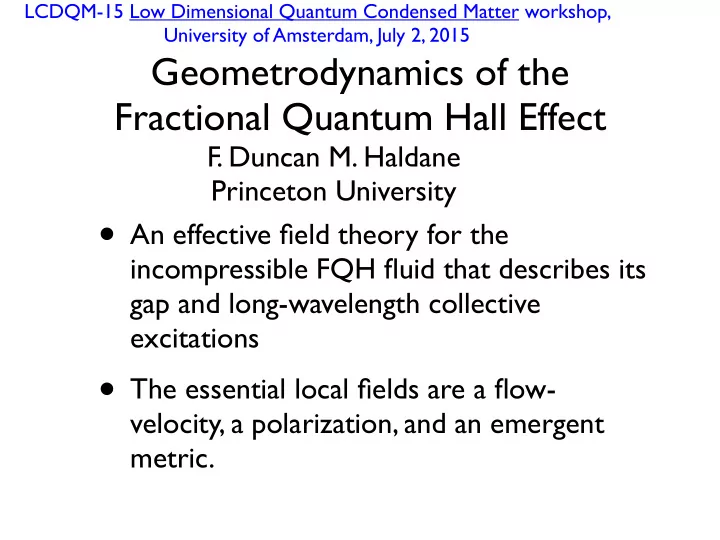
LCDQM-15 Low Dimensional Quantum Condensed Matter workshop, University of Amsterdam, July 2, 2015 Geometrodynamics of the Fractional Quantum Hall Effect F. Duncan M. Haldane Princeton University An effective field theory for the


slide-1
SLIDE 1

Geometrodynamics of the Fractional Quantum Hall Effect

  • An effective field theory for the

incompressible FQH fluid that describes its gap and long-wavelength collective excitations

  • The essential local fields are a flow-

velocity, a polarization, and an emergent metric.

  • F. Duncan M. Haldane

Princeton University

LCDQM-15 Low Dimensional Quantum Condensed Matter workshop, University of Amsterdam, July 2, 2015

slide-2
SLIDE 2
  • in case I run out of time, I will quickly show

the effective action that is finally obtained.

slide-3
SLIDE 3
  • three dynamical ingredients gab, va,Pa:
  • a “dynamic emergent 2D spatial metric”

gab(x,t) with g ≡ det g, and Gaussian curvature current

  • a flow velocity field va(x,t)
  • an electric polarization field Pa(x,t)
  • a composite boson current

here a is a 2D spatial index, and µ is a (2+1D) space-time index. The fluid motion is non-relativistic relative to the preferred inertial rest frame of the crystal background

g = ✏µνλ@ν!λ(x, t)

b = √g(x, t) (δµ 0 + va(x, t)δµ a)

slide-4
SLIDE 4
  • effective bulk action:

S = Z d2xdt L0 − H L0 = ~ 4⇡ ✏µνλ (Kbµ@νbλ + !µ@ν!λ) +Jµ

b (~(∂µϕ − bµ − Sωµ) + peAµ)

kinetic energy

  • f flow

metric-dependent correlation energy

U(1) Chern-Simons field

U(1) condensate field

“spin connection”

  • f the metric

σH = (pe)2 2π~K H = √g

  • "(v, B) − U(g, B, P) − (Ea + ✏abvbB)P a
slide-5
SLIDE 5

256 citations PRB

Quantized motion of three two-dimensional electrons in a strong magnetic field (/prb/abstract/10.1103/PhysRevB.27.3383)

  • R. B. Laughlin
  • Phys. Rev. B 27, 3383 (1983) - Published 15 March 1983

We have found a simple, exact solution of the Schrödinger equation for three two-dimensional electrons in a strong magnetic field, given the assumption that they lie in a single Landau level. We find that the interelectronic spacing has characteristic values, not dependent on the form of the interaction, which change discontinuously as pressure is applied, and that the system has characteristic excitation energies

  • f approximately

, where is the magnetic length.

0.03 e2

a0

a0

7/2/15, 3:03 A

In 1983, Laughlin’s wavefunction was a unexpected gift to physics that seemed to emerge fully-formed from the void .....

Y

i < j

( z

i

− z

j

)

q

× Y

i

e− 1

2 z∗ i zi

Ψ =

!

I w i n

(actually, this seems to be its genesis..)

  • It was quickly confirmed to be the solution to the

FQHE mystery

  • but WHY it works has never really been explained
slide-6
SLIDE 6
  • Essentially all the key ideas in the FQHE

have emerged as interpretions and generalizations of Laughlin’s wavefunction: flux attachment composite particles topological order fractional charge braiding statistics shift chiral cft edge states conformal block wavefunctions

  • I will describe a new insight from a feature of

Laughlin’s wavefunction that remained undetected for 25 years: emergent dynamical geometry FDMH

arXiv:0906-1854 arXiv:1112-0990

PRL:107 116801 (2011)

slide-7
SLIDE 7
  • Lowest Landau level wavefunctions

|p − eA|2 2m = 1

2~ωc

  • a†a + aa†

a† = 1

2z∗ − ∂ ∂z

a = 1

2z + ∂ ∂z∗

[a, a†] = 1 aΨ = 0

holomorphic

Ψ = f(z)e− 1

2 z∗z

2D Galilean-invariant Landau levels, uniform B

  • mapping to the complex plane

z = (x + iy) √2`B

slide-8
SLIDE 8
  • filled Lowest Landau level (vandermonde determinant)

Ψ = Y

i<j

(zi − zj) Y

i

e− 1

2 z∗ i zi

  • Laughlin state (m > 1)

Ψm

L =

Y

i<j

(zi − zj)m Y

i

e− 1

2 z∗ i zi

uncorrelated highly correlated

ν = 1 m

bosons for even m, fermions for odd m

En

empty

partial filling ν

}

slide-9
SLIDE 9
  • “it is holomorphic (times a Gaussian) because it is a

lowest Landau level state”

  • “It is 2D rotationally invariant because the Landau orbits

are circular”. (angular momentum: )

  • “It has no continuously-variable variational parameters”.

some incorrect “conventional wisdom” about the Laughlin state

Ψm

L =

Y

i<j

(zi − zj)m Y

i

e− 1

2 z∗ i zi

✘ wrong ✘ wrong ✘ wrong

The probability that Laughlin himself may have believed these things does not make them true!

L = 1

2mN(N − 1)

slide-10
SLIDE 10
  • Guiding centers of Landau levels obey the algebra

[Ra, Rb] = −i`2

B✏ab

Antisymmetric 2D Levi-Civita symbol

[Ra, (p − eA)b] = 0 b† = Rx + iRy √2`B b = Rx − iRy √2`B = 1

2z − ∂ ∂z∗

= 1

2z∗ + ∂ ∂z

a† = 1

2z∗ − ∂ ∂z

a = 1

2z + ∂ ∂z∗

b†f(z)e− 1

2 z∗z = zf(z)e− 1 2 z∗z

action on LLL states

slide-11
SLIDE 11
  • A new look at the Laughlin state:

|Ψm

L (˜

g)i = Y

i<j

(b†

i b† j)m|Ψ0(˜

g)i ε(pi aA(xi))|Ψ0(˜ g)i = En|Ψ0(˜ g)i bi|Ψ0(˜ g)i = 0

L(˜ g) = ˜ gabΛab = 1

2

X

i

(b†

ibi + bib† i)

Λab = 1 4`2

B

X

i

(Ra

i Rb i + Rb iRa i )

L((˜ g)|Ψm

L i = ( 1 2mN 2 1 2(m 1)N)|Ψm L i

superextensive

extensive

generator of linear area-preserving distortions unimodular metric

det ˜ g = 1

“statistical spin” “geometrical spin”

slide-12
SLIDE 12
  • Changes from the original Laughlin formulation:

δabpapb 2m → ε(p) = ε(−p)

no need for Galilean invariance (not a property of electrons in solids) any Landau level will do, not just the “lowest”

δab → ˜ gab

the Laughlin state is PARAMETRIZED by a unimodular emergent 2D spatial metric that SHOULD NOT be identified with the Euclidean metric of Galilean invariance

˜ gab is also NOT related to an intrinsic Riemannian metric of the surface

  • n which the particles move: (This would essentially just be a local form of

Galilean invariance on curved generalizations of the 2D plane, where the kinetic energy is identified with the Laplace-Beltrami operator.).

slide-13
SLIDE 13
  • Lie Algebra (SL(2,R))

[Λab, Λcd] = 1

2i

  • ✏acΛbd + ✏adΛbc + ✏bcΛad + ✏bdΛac

[Λab, C2] = 0, C2 = det Λ = 1

2✏ac✏bdΛabΛcd

  • quadratic Casimir:
  • unitary deformation operator

U(β) = exp iβabΛab βab = βba, real

det β > 0 : pseudo rotation (elliptic)

det β = 0 : shear (parabolic)

det β < 0 : squeeze (hyperbolic)

slide-14
SLIDE 14
  • Laughlin states with different intrinsic

metrics are related by transformations

|Ψm

L (˜

g0)i = U(β)|Ψm

L (˜

g)i ˜ g0 = A(β)˜ gAT (β) det A(β) = 1

SL(2, R)

  • In contrast (in the absence of a boundary), the

filled Landau level is not parametrized by a metric, and is left invariant by the action of U(β)

slide-15
SLIDE 15
  • The Laughlin state is parametrized by a unimodular metric:

what is its physical meaning?

  • In the ν = 1/3 Laughlin state, each electron sits in a

correlation hole with an area containing 3 flux quanta. The metric controls the shape of the correlation hole.

  • In the ν = 1 filled LL Slater-determinant state, there is no

correlation hole (just an exchange hole), and this state does not depend on a metric

correlation holes in two states with different metrics

slide-16
SLIDE 16
  • Q: If we use the Laughlin state as a

variational approximation to a true ground state, what determines the choice of the metric parameter?

  • A: it should be chosen to minimize the

correlation energy

slide-17
SLIDE 17
  • The generic Hamiltonian has 2D translation

and inversion symmetry, but does not have any O(2) rotation symmetry

H = X

i<j

Vn(Ri − Rj) Ri 7! a ± Ri

  • The uniform incompressible quantum Hall states do

not break inversion or translation symmetry, and have no electric polarization.

Vn(r) = Z d2q`2

B

2⇡ |fn(q)|2 Z d2r0 2⇡`2

B

V (r0)eiq·(rr0)

Landau level form factor

Coulomb interaction potential, modified at short distance by finite layer width

regular at short distance

(property of 3D dielectric tensor) (property of 2D band structure)

slide-18
SLIDE 18
  • If the repulsive short-distance interaction

has rotational symmetry with respect to a metric, then the unimodular metric parameter that minimizes the correlation energy will be proportional to that metric.

  • The 1/2 (boson) and 1/3 (fermion) Laughlin

states with metric are exact zero- energy ground states of a model interaction

Vn(r) = (A + Bu(r))e−u(r) A, B > 0 u(r) = 1

2 ˜

gabrarb/`2

B

˜ gab

slide-19
SLIDE 19
  • Let be the exact FQH ground state of H

|Ψ0i hΨ0|U −1(β)HU(β)|Ψ0i

β→0

! E0 + 1

2Γabcdβabβcd > E0

  • The rank-4 tensor Γabcd is a kind of “shear

modulus” of the FQH fluid.

  • Girvin MacDonald and Platzman found an

inequality equivalent as wavevector k → 0 to

guiding-center structure factor excitation energy

S(k)∆E(k) < Γabcdkakbkckd

constant

∝ k4

slide-20
SLIDE 20

0.1 0.2 0.3 0.4 0.5 0.6 0.7 0.8 0.9 0.5 1 1.5 2 2.5 3 3.5 laughlin 10/30

E

Collective mode with short-range V1 pseudopotential, 1/3 filling (Laughlin state is exact ground state in that case)

“roton”

(2 quasiparticle + 2 quasiholes)

goes into continuum

gap incompressibility

1 2 0.5 klB

  • Moore-Read

ν = 2

4

“kF ”

fermionic “roton” bosonic “roton”

Collective mode with short-range three-body pseudopotential, 1/2 filling (Moore-Read state is exact ground state in that case)

  • momentum ħk of a quasiparticle-quasihole pair is

proportional to its electric dipole moment pe ~ka = abBpb

e

kB

gap for electric dipole excitations is a MUCH stronger condition than charge gap: doesn’t transmit pressure!

(origin of Virasoro algebra in FQHE ?)

slide-21
SLIDE 21
  • quantum solid
  • repulsion of other particles make an attractive

potential well strong enough to bind particle

  • unit cell is

correlation hole

  • defines geometry

solid melts if well is not strong enough to contain zero-point motion (Helium liquids)

slide-22
SLIDE 22
  • similar story in FQHE:
  • “flux attachment” creates

correlation hole

  • potential well must be

strong enough to bind electron

  • defines an emergent

geometry

  • new physics: Hall viscosity,

geometry............ e-

  • continuum model, but

similar physics to Hubbard model but no broken symmetry

slide-23
SLIDE 23
  • shape of correlation hole (flux attachment) fluctuates,

adapts to environment (electric field gradients) e- e-

  • polarizable, B x electric dipole = momentum,

e- x

  • rigin of “inertial mass”

geometric distortion

(preserving inversion symmetry)

electric polarizability creates “curvature”

  • f metric

shape=metric

new property: “spin” couples to curvature

S

slide-24
SLIDE 24

e the electron excludes other particles from a region containing 3 flux quanta, creating a potential well in which it is bound 1/3 Laughlin state If the central orbital is filled, the next two are empty The composite boson has inversion symmetry about its center It has a “spin” ..... ..... − 1 0 0

1 3 1 3 1 3

1 2 3 2 5 2

L = 1

2

L = 3

2

s = −1

slide-25
SLIDE 25

e 2/5 state e ..... ..... − 1

1 2 3 2 5 2

− 0 0 1

2 5 2 5 2 5 2 5 2 5

L = 2 L = 5 s = −3 L = gab 2`2

B

X

i

Ra

i Rb i

Qab = Z d2r rarb⇢(r) = s`2

Bgab

second moment of neutral composite boson charge distribution

slide-26
SLIDE 26
  • Now consider the inhomogeneous system

H = X

i<j

Vn(Ri − Rj) + X

i

v(Ri)

  • We must minimize the sum of correlation

energy and potential energy

  • Now we get a metric with curvature:
  • The electron density is tied to

gaussian curvature density!

peB + ~SJ0

g

“Shift” = S/p − (n + 1

2)

slide-27
SLIDE 27
  • The shape of the composite boson is

determined by minimizing the sum of the correlation energy and the background potential energy.

  • If there is no background potential, the metric

is flat and the charge density is uniform

  • If there is a background potential gab(r) varies

with position to give a charge density fluctuation

δρ(r) = esK(r)

K(r) = 1

2@a@bgab + 1 8gab✏cd✏ef@egac@fgbd

Gaussian curvature of unimodular metric

{

from Berry phase associated with shape change

{

from variation of second moment of charge distribution “spin”

slide-28
SLIDE 28
  • The metric (shape of the composite boson) has a

preferred shape that minimizes the correlation energy, but fluctuates around that shape

  • The zero-point fluctuations of the metric are seen as

the O(q4) behavior of the “guiding-center structure factor” (Girvin et al, (GMP), 1985)

  • long-wavelength limit of GMP collective mode is

fluctuations of (spatial) metric (analog of “graviton”)

δE ∝ (distortion)2

FDMH, Phys. Rev. Lett. 107, 116801 (2011)

slide-29
SLIDE 29
  • metric deforms (preserving det g =1)in

presence of non-uniform electric field potential near edge fluid compressed by Gaussian curvature! produces a dipole momemt

slide-30
SLIDE 30
  • Hall viscosity

(plus a similar term from the Landau orbit degrees of freedom (Avron et al))

dvy dx

current of px in x-direction (stress force)

ηxxxy a

b = ✏be⌘aecf H

✏cf@cvd ⌘abcd = eBs 4⇡q

1 2

  • gac✏bd + gbd✏ac + a ↔ b
slide-31
SLIDE 31

Hall viscosity determines a dipole moment per unit length at the edge of the fluid

  • Total guiding center angular momentum of a

fluid disk of N elementary droplets statistical (conformal) spin geometric (guiding-center) spin (dipole at edge) momentum electric dipole

slide-32
SLIDE 32

dPa =

~ e`2

B ✏abdpb

momentum dP

The dipole at a segment of the edge has a momentum momentum dipole

H dPa = 0

doesn’t contribute to total momentum:

∆Lz(g) = ~ H ✏abgbcrcdPa 6= 0

it does contribute an extra term to total angular momentum:

circular droplet

  • f

}

  • r

e e

  • n(k)

edge of Laughlin 1/3

  • rbital occupation