IT420 Spring 2007 Review Sheet 1. Introduction to databases Covered - - PDF document

it420 spring 2007 review sheet 1 introduction to
SMART_READER_LITE
LIVE PREVIEW

IT420 Spring 2007 Review Sheet 1. Introduction to databases Covered - - PDF document

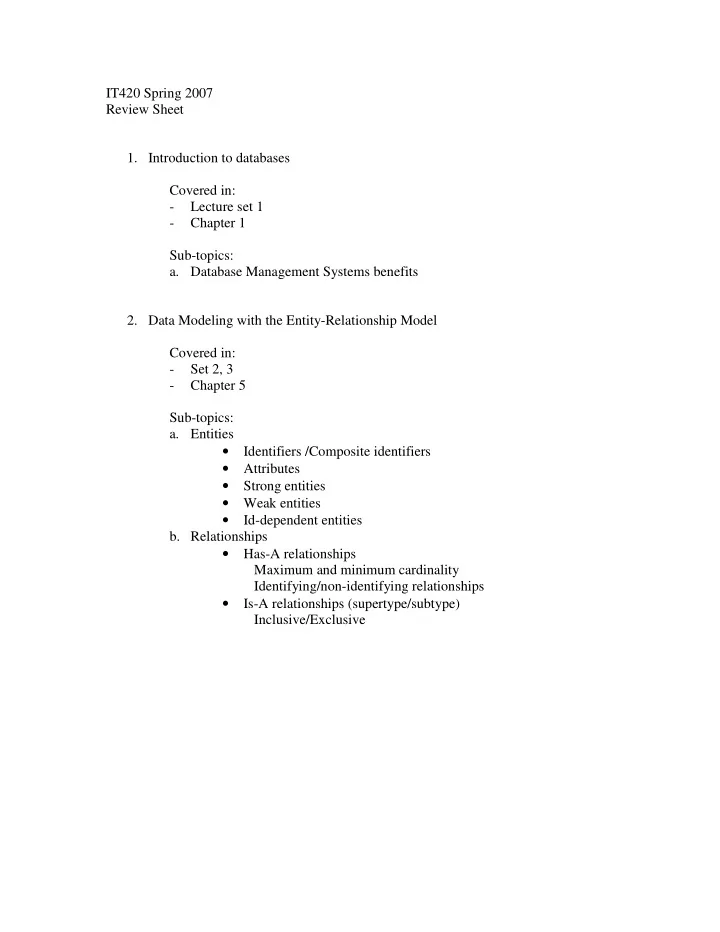
IT420 Spring 2007 Review Sheet 1. Introduction to databases Covered in: - Lecture set 1 - Chapter 1 Sub-topics: a. Database Management Systems benefits 2. Data Modeling with the Entity-Relationship Model Covered in: - Set 2, 3 - Chapter


slide-1
SLIDE 1

IT420 Spring 2007 Review Sheet

  • 1. Introduction to databases

Covered in:

  • Lecture set 1
  • Chapter 1

Sub-topics:

  • a. Database Management Systems benefits
  • 2. Data Modeling with the Entity-Relationship Model

Covered in:

  • Set 2, 3
  • Chapter 5

Sub-topics:

  • a. Entities
  • Identifiers /Composite identifiers
  • Attributes
  • Strong entities
  • Weak entities
  • Id-dependent entities
  • b. Relationships
  • Has-A relationships

Maximum and minimum cardinality Identifying/non-identifying relationships

  • Is-A relationships (supertype/subtype)

Inclusive/Exclusive

slide-2
SLIDE 2
  • 3. The Relational Model

Covered in:

  • Set 4
  • Chapter 3, pages 69-74, 79-81

Sub-topics:

  • a. Relation /Table
  • Attributes
  • b. Integrity Constraints
  • c. Keys
  • d. Primary key
  • e. Candidate key
  • f. Surrogate key
  • g. Foreign key
  • Referential integrity constraint
  • 4. Transforming ER diagrams to Relational Model

Covered in:

  • Set 5
  • Chapter 6

Sub-topics:

  • a. Transform entities
  • Specify primary key
  • Specify candidate (alternate keys)
  • Specify properties for each column
  • 1. data type
  • 2. null /not null
  • 3. default values
  • 4. other constraints
  • b. Transform relationships (foreign keys used here)
  • 1:1 relationships, 1:N relationships
  • identifying relationships
  • non-identifying relationships
  • N:M relationships
  • Supertype/subtype relationships
  • c. Specify logic to enforce minimum cardinalities
slide-3
SLIDE 3
  • 5. SQL

Covered in:

  • Set 6, 7
  • Chapter 7, pg 220-234 and Chapter 2

Sub-topics:

  • a. CREATE
  • b. DROP
  • c. ALTER
  • d. INSERT
  • e. DELETE
  • f. UPDATE
  • g. SELECT…FROM… WHERE… framework
  • h. Conceptual evaluation of queries
  • i. DISTINCT keywork
  • j. ORDER BY
  • k. Aggregate operators: COUNT, MIN, MAX, AVG, SUM
  • l. GROUP BY… HAVING
  • m. Subqueries
  • n. Join
  • 6. Normalization

Covered in:

  • Set 8
  • Chapter 3, pages 74-99
  • Chapter 4

Sub-topics:

  • a. Purpose
  • b. Insert /delete/update anomalies
  • c. Functional dependencies
  • Definition of key based on functional dependencies
  • d. Normal forms
  • First normal form
  • Boyce-Codd Normal Form
  • Decomposition into relations that are in Boyce-Codd Normal

Form

  • e. Multivalued dependencies
  • Fourth Normal Form
  • 7. PHP and MySQL
slide-4
SLIDE 4
  • a. variables, constants, arrays (numerically indexed arrays and associative

arrays)

  • b. control statements (if, for, foreach, while, …)
  • c. files
  • d. functions
  • e. objects/classes, inheritance
  • f. Work with MySQL using PHP
  • Connect to a database
  • Query
  • process results
  • close connection
  • g. authentication and sessions
  • Passwords
  • Session variables
  • 8. SQL VIEWS
  • a. SQL View is a virtual table that is constructed from other tables or views.
  • b. Syntax: CREATE VIEW viewname AS viewquery
  • c. Order By clause cannot be used in the Create View query.
  • d. A view can be queried as if it is a table.
  • e. Uses for views
  • f. Updating views
  • 9. Triggers
  • a. A trigger is a stored program that is attached to a table or view.
  • b. Type of triggers
  • c. Uses for triggers
  • d. Writing a trigger
  • 10. Stored Procedures
  • a. A stored procedure is a program that performs some common action on

database data and is stored in the database.

  • b. Advantages of stored procedures
  • c. How to write a stored procedure
  • d. Differences between triggers and stored procedures
slide-5
SLIDE 5
  • 11. Database security
  • a. Create users
  • b. Grant/revoke permissions
  • c. Changing passwords
  • d. General security guidelines
  • 12. Concurrent processing
  • a. Transactions
  • b. Concurrent transaction processing
  • Lost Updates
  • Inconsistent read
  • 1. Dirty read
  • 2. Unrepeatable read
  • 3. Phantom read
  • c. Resource locking
  • Implicit/explicit locks
  • Lock gradularity
  • Exclusive/ shared locks
  • Serializable trasactions
  • Two-phase locking, String two-phase locking
  • Deadlocks
  • 1. preventing deadlocks
  • 2. breaking deadlocks
  • Optimistic / pessimistic locking
  • Using implicit locks/ declaring transaction boundaries
  • ACID transactions
  • 1. Atomic
  • 2. Consistent
  • a. statement level
  • b. transaction level
  • 3. Isolation
  • a. read uncommitted
  • b. read commited
  • c. repeatable read
  • d. serializable
  • 4. Durable
  • 13. Storage and indexing
  • a. Disk components
  • b. Time to access a disk block
  • c. ‘Next’ concept
  • d. Hash index
  • e. B+Tree index
  • f. Clustered / unclustered index
  • g. How to choose indexes to improve performance