Ithaca, NY, 14853 - - PDF document

ithaca ny 14853
SMART_READER_LITE
LIVE PREVIEW

Ithaca, NY, 14853 - - PDF document

Ithaca, NY, 14853 zyxwvutsrqponmlkjihgfedcbaZYXWVUTSRQPONMLKJIHGFEDCBA ABSTRACT: zyxwvutsrqponmlkjihgfedcbaZYXWVUTSRQPONMLKJIHGFEDCBA protocol, the zyxwvutsrqponmlkjihgfedcbaZYXWVUTSRQPONMLKJIHGFEDCBA A NEW ROUTING PROTOCOL FOR THE RECONFIGURABLE


slide-1
SLIDE 1

A NEW ROUTING PROTOCOL FOR THE RECONFIGURABLE WIRELESS NETWORKS Zygmunt J. Haas School of Electrical Engineering, Cornell University, Ithaca, NY, 14853 zyxwvutsrqponmlkjihgfedcbaZYXWVUTSRQPONMLKJIHGFEDCBA httg://www.ee.cornell.edu/-haas/wnl.html

ABSTRACT: zyxwvutsrqponmlkjihgfedcbaZYXWVUTSRQPONMLKJIHGFEDCBA In this paper, we propose a new routing protocol, the zyxwvutsrqponmlkjihgfedcbaZYXWVUTSRQPONMLKJIHGFEDCBA Zone Routing Protocol (ZRP), for the Reconfigurable Wireless Networks, a large scale, highly mobile ad-hoc networking environment. The novelty of the ZRP protocol is that it is applicable to large Plat-routed networks. Furthermore, through the use of the zone radius parameter, the scheme exhibits adjustable hybrid behavior of proactive and reactive routing schemes. We evaluate the performance of the protocol, showing the reduction in the number of control messages, as compared with other reactive schemes, such as flooding. INTRODUCTION Recently, there has been an increased interest in ad-hoc networking zyxwvutsrqponmlkjihgfedcbaZYXWVUTSRQPONMLKJIHGFEDCBA

[l]. In general, ad-hoc networks are

network architecture that can be rapidly deployed, without preexistence of any fixed infrastructure. A special case of ad-hoc networks, the Reconfigurable Wireless Networks (RWN), was previously introduced

[2,3]

to emphasize a number of special characteristics

  • f the RWN communication environment:

P large network coverage; large network radius, zyxwvutsrqponmlkjihgfedcbaZYXWVUTSRQPONMLKJIHGFEDCBA

Y n e t ,

P large number of network nodes, and

P large range of nodal velocities (from stationary to

In particular, the topology of the RWN is quite frequently changing, while self-adapting to the connectivity and propagation conditions and to the traffic and mobility patterns. Examples of the use of the RWNs are: zyxwvutsrqponmlkjihgfedcbaZYXWVUTSRQPONMLKJIHGFEDCBA military (tactical) communication

  • for

fast establishment of communication infrastructure during deployment of forces in a foreign (hostile) terrain rescue missions - for communication in areas without adequate wireless coverage national security - for communication in times of national crisis, when the existing communication infrastructure is non-operational due to a natural disasters or a global war law enforcement - similar to tactical communication highly mobile).‘

0 zyxwvutsrqponmlkjihgfedcbaZYXWVUTSRQPONMLKJIHGFEDCBA

For example, the maximal nodal velocity is such that the

lifetime of a link can be between hundreds of milliseconds to few seconds only.

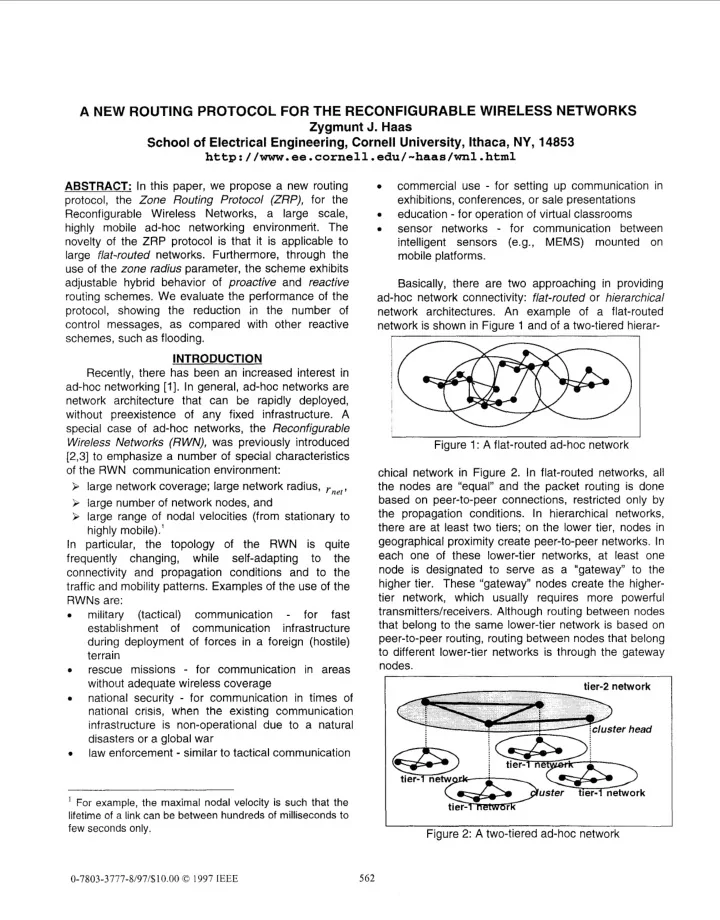
commercial use - for setting up communication in exhibitions, conferences, or sale presentations education - for operation of virtual classrooms sensor networks - for communication between intelligent sensors (e.g., MEMS) mounted on mobile platforms. Basically, there are two approaching in providing ad-hoc network connectivity: flat-routed or hierarchical network architectures. An example of a flat-routed network is shown in Figure 1 and of a two-tiered hierar-

I

Figure 1

:

A flat-routed ad-hoc network chical network in Figure 2. In flat-routed networks, all the nodes are “equal” and the packet routing is done based on peer-to-peer connections, restricted only by the propagation conditions. In hierarchical networks, there are at least two tiers; on the lower tier, nodes in geographical proximity create peer-to-peer networks. In each one of these lower-tier networks, at least one node is designated to serve as a “gateway” to the higher tier. These “gateway” nodes create the higher- tier network, which usually requires more powerful

  • transmittersheceivers. Although routing between nodes

that belong to the same lower-tier network is based on peer-to-peer routing, routing between nodes that belong to different lower-tier networks is through the gateway nodes.

tier-2 network

I

I

Figure 2: A two-tiered ad-hoc network

0-7803-3777-8/97/$10.00 zyxwvutsrqponmlkjihgfedcbaZYXWVUTSRQPONMLKJIHGFEDCBA 1997 IEEE 562

slide-2
SLIDE 2

We will omit here the comparison of the two

  • architectures. Nevertheless, we note that the flat-routed

networks are more suitable for the highly versatile communication environment as the RWN-s. The reason is that the maintenance of the hierarchies (and the associated cluster heads) is too costly in network resources when the lifetime of the links is quite short. Thus, we chose to concentrate on the flat-routed network architecture in our study of the routing protocols for the RWN. zyxwvutsrqponmlkjihgfedcbaZYXWVUTSRQPONMLKJIHGFEDCBA PREVIOUS AND RELATED WOFE The currently available routing protocols are inadequate for the RWN. The main problem i:j that they do not support either fast-changeable network architecture or that they do not scale well with the size

  • f the network (number of nodes). Surprisingly, these

shortcomings are present even in some routing protocols that were proposed for ad-hoc networks. More specifically, the challenge stems from the fact that, on one hand, in-order to route packets in a network, the network topology needs to be known to the traversed nodes. On the other hand, in a RWN, this topology may change quite often. Also, the number of nodes may be very large. Thus, the cost of updates is quite high, in contradiction with the fact that updates are expensive in the wireless comrnunication

  • environment. Furthermore, as the number of network

nodes may be large, the potential number of destinations is also large, requiring large and frequent exchange of data (e.g., routes, routes updates, or routing tables) between network nodes. The wired Internet uses routing protocols based on topological broadcast, such as the OSPF zyxwvutsrqponmlkjihgfedcbaZYXWVUTSRQPONMLKJIHGFEDCBA

[ 4 ] .

These protocols are not suitable for the RWN due to the relatively large bandwidth required for update messages. In the past, routing in multi-hop packet radio networks was based

  • n

shortest-path routing algorithms [5], such as Distributed Bellman-Fiord (DBF)

  • algorithm. These algorithms suffer from very slow

convergence (the “counting to infinity” problem). Besides, DBF-like algorithms incur large update message penalty. Protocols that attempted to cure some zyxwvutsrqponmlkjihgfedcbaZYXWVUTSRQPONMLKJIHGFEDCBA

  • f

the shortcoming of DFB, such as Destination-

Sequenced Distance-Vector Routing (DSDV) zyxwvutsrqponmlkjihgfedcbaZYXWVUTSRQPONMLKJIHGFEDCBA [6], were proposed and studied. Nevertheless, synchronization problems and extra processing overhead are common in these protocols. Other protocols that rely on the information from the predecessor of the shortest path solve the slow convergence problem of DBF (e.g., [7]). However, the processing requirements of these protocols may be quite high, because of the way they process the update messages. Use of dynamic source routing protocol, which utilizes flooding to discover a route to a destination, is described in [

8 ] .

A number of optimization techniques, such as route caching are also presented that reduce the route determinatiotdmaintenance overhead. In a highly dynamic environment, such as the RWN is, this type of protocols lead to a large delay and the techniques to reduce overhead may not perform well. A query-reply based routing protocol has been introduced recently in [9]. Practical implementation of this protocol in the RWN-s can lead, however, to high communication requirements. A new distance-vector routing protocol for packet radio networks (WRP) is presented in [lo]. Upon change in the network topology, WRP relies on communicating the change to its neighbors, which effectively propagates throughout the whole network. The salient advantage of WRP is the considerable reduction in the probability of loops in the calculated

  • routes. The main disadvantage of WRP for the RWN is

in the fact that routing nodes constantly maintain full routing information in each network node, which was

  • btained at relatively high cost in wireless resources

In zyxwvutsrqponmlkjihgfedcbaZYXWVUTSRQPONMLKJIHGFEDCBA

[ll], routing is based on temporary addresses

assigned to nodes. These addresses are concatenation

  • f the node’s addresses on a physical and a virtual
  • networks. However, routing requires full connectivity

among all the physical network nodes. Furthermore, the routing may not be optimal, as it is based on addresses, which may not be related to the geographical locations, producing a long path for communication between two close-by nodes. The above routing protocols can be classified either as proactive or as reactive. Proactive protocols attempt to continuously evaluate the routes within the network, so that when a packet needs to be forwarded, the route is already known and can be immediately used. Reactive protocols, on the other hand, invoke the route determination procedures on demand only. Thus, when a route is needed, some sort of global search procedure is employed. The advantage of the proactive schemes is that,

  • nce a route is requested, there is little delay until route

is determined. In reactive protocols, because route information may not be available at the time a routing request is received, the delay to determine a route can be quite significant. Because of this long delay, pure reactive routing protocols may not be applicable to real- time communication. However, pure proactive schemes are likewise not appropriate for the RWN environment, as they continuously use large portion of the network capacity to keep the routing information current. Since in an RWN nodes move quite fast, and as the changes may be more frequent than the routing requests, most

563

slide-3
SLIDE 3
  • f this routing information is never used! This results in

an excessive waste of the network capacity. What is needed is a protocol that, on one hand, initiates the route-determination procedure on-demand, but with limited cost of the global search. The introduced here routing protocol, which is based on the notion of zyxwvutsrqponmlkjihgfedcbaZYXWVUTSRQPONMLKJIHGFEDCBA routing zones, incurs very low

  • verhead in route determination. It requires maintaining

a small amount of routing information in each node. There is no overhead of wireless resources to maintain routing information of inactive routes. Moreover, it identifies multiple routes with no looping problems. zyxwvutsrqponmlkjihgfedcbaZYXWVUTSRQPONMLKJIHGFEDCBA The zyxwvutsrqponmlkjihgfedcbaZYXWVUTSRQPONMLKJIHGFEDCBA ZONE ROUTING PROTOCOL (ZRP) Our approach to routing in the RWN is based on the notion of a routing zone, which is defined for each node and includes the nodes whose distance (e.g., in hops) is at most some predefined number. This distance is referred to here as the zone radius, Yzone. Each node is required to know the topology of the network within its routing zone only and nodes are updated about topological changes only within their routing zone. Thus, even though a network can be quite large, the updates are only locally propagated. Since for radius greater than 1 the routing zones heavily overlap, the routing tends to be extremely robust. The routes within the network are specified as a sequence of nodes separated by approximately the zone radius. We illustrate the Route Discovery protocol by an example in Figure 3. To allow source S to send a packet to destination D, a route from S to D needs to be determined. First, S verifies that D is not within its routing zone (to recall, each node knows all the nodes within its routing zone). Then, S sends a query to all the nodes on the periphery of its zone; i.e., C, G, and H. its routing zone and responds to the query, indicating the forwarding path: S-H-B-D. The mechanism by which B learns about the forwarding path is the Route Accumulation. Route Accumulation is a simple protocol by which each node that forwards the query appends its identity to the query

  • message. In order to limit the message size and to

bound the Route Discovery process, a hop-count is included within the query messages. The value of the hop-count in the initial query message is set to some maximal value, zyxwvutsrqponmlkjihgfedcbaZYXWVUTSRQPONMLKJIHGFEDCBA hop

. The value of the hop count is

decreased by one, each time a query message is

  • forwarded. When the hop-count reaches zero, the copy
  • f the query message is discarded.

If the destination node is within maximum hop-

count from the source node, the algorithm will discover at least one path between the two nodes, no matter what the value of the zone radius is. Because of space limitations, we omit the complete proof of the protocol. The means by which each node learns about the topology of its zone is through any proactive algorithm. For example a “truncated” version of DSDV is possible, in which the reachability updates propagate only within distance limited by the zone radius. Note that the ZRP requires only a relatively small number of query messages, as these messages are routed only to “peripheral” nodes, omitting all the nodes within the routing zones. As the zone radius is significantly smaller than the network radius, the cost of learning the zones’ topologies is a very small fraction of the cost required by a global proactive mechanism. Furthermore, the amount of data stored at each node is similarly reduced. On the other hand, ZRP is much faster than a global reactive route discovery mechanisms, as the number of nodes queried in the zyxwvutsrqponmlkjihgfedcbaZYXWVUTSRQPONMLKJIHGFEDCBA

max

/--Y-l

process is on the order of ( 5 ~ p

  • f the number of

( rner )

nodes queried by a global flooding process. Additionally, ZRP discovers multiple routes to the destination. The Route Discovery process in ZRP can be made much more efficient in resources, at the expense of longer latency. Instead of querying simultaneously all the “peripheral” nodes at the boundary of the routing zone, these nodes can be queried either sequentially,

  • ne-by-one, or in groups. Thus, there is a tradeoff

between the cost and latency of the ZRP Route Discovery protocol. Now, in turn, each one of these nodes, after Finally, we note that the ZRP path, which consists

  • f flodes

spaced approximately by distance of zone radius, is more stable than a full path that includes all the nodes between the SOUrCe and the destination. AS Figure 3: An example of Zone Routing verifying that zyxwvutsrqponmlkjihgfedcbaZYXWVUTSRQPONMLKJIHGFEDCBA

D

is not in their routing zone, broadcast the query to their ‘‘peripheral’’ nodes, In particular, H sends the query to g, which recognizes D as being in zyxwvutsrqponmlkjihgfedcbaZYXWVUTSRQPONMLKJIHGFEDCBA

564

slide-4
SLIDE 4

the nodes move and links are ~ ~ e ~ u e n t l y broken, the ZRP path is more stable than the full path. The behavior of the ZRP can be adjusted changing the value of zyxwvutsrqponmlkjihgfedcbaZYXWVUTSRQPONMLKJIHGFEDCBA

rrone zyxwvutsrqponmlkjihgfedcbaZYXWVUTSRQPONMLKJIHGFEDCBA

I In particular, for large zone

radius, the coverage area zyxwvutsrqponmlkjihgfedcbaZYXWVUTSRQPONMLKJIHGFEDCBA

i s a

le zone and ZRP is traditional proactive protocol. mall zone radius, the protocol is more reactive, and become pure flooding at zone radius of one. Two

  • ther

Z related p ~ o ~ o c o ~ s work in conjunction wit ute Discovery protocol: zyxwvutsrqponmlkjihgfedcbaZYXWVUTSRQPONMLKJIHGFEDCBA Evolution and Zone Update protocols Route Evolution protocol changes the ne~~/ork-wide routes in response to changes in the connectivity status

  • f

the nodes on a path. The Route Zone ~ p d a ~ e

protocol, which is based on the p ~ e v ~ o ~ s l y enti ti^^^ umulation protocol, allows each node to learn the complete topology of its zone. Finally, optimizations to the ZWP protocol can be II) such as route caching and route

  • mit here the description of these

mechanisms. We assume that the mobile hosts are distributed randomly in a closed coverage area, as d ~ s ~ ~ ~ a y e d in Figure 4, effectively creating a torus. zyxwvutsrqponmlkjihgfedcbaZYXWVUTSRQPONMLKJIHGFEDCBA

Closed Coverage Area 1 zyxwvutsrqponmlkjihgfedcbaZYXWVUTSRQPONMLKJIHGFEDCBA

ax

Figure 4: Coverage area mapped into a closed surface Thus, for example, a mobile that "exits" the c o v e ~ ~ g e area from the left side, appears as reenteiring the h the same velocity ance between two mobiles located at ( y1

1 and (x27y2)

is, ther,efore: The mobiles distributed in the coverage area can roam freely about it, according to the ~ o l l o w i ~ ~ mobilit

  • model. The movement of each mobile host in the

coverage area is cha~ac~e~ized by its v ~ ~ o c j ~ ~ vectorc = zyxwvutsrqponmlkjihgfedcbaZYXWVUTSRQPONMLKJIHGFEDCBA

(v,

8 ) ,

where zyxwvutsrqponmlkjihgfedcbaZYXWVUTSRQPONMLKJIHGFEDCBA

v is the mobile's speed and

8 is its direction, measured with respect to the positive

x-axis. The position of the mobile, zyxwvutsrqponmlkjihgfedcbaZYXWVUTSRQPONMLKJIHGFEDCBA

( x 7 y )

and its velocity v" are updated periodically, every At time units as ~OIIOWS:

x ( t + At) = ~ ( t )

+- ~ ( t )

, C

locity change, i

s

laMAx is the ~

a x ~ ~ u ~ acceleration/deceleration of the mobile ~ ~ a ~ e n her

[meter/,,,2]), and zyxwvutsrqponmlkjihgfedcbaZYXWVUTSRQPONMLKJIHGFEDCBA A

> =

We assume a come which arriving et^ ca In our simulati each node is the next no ce o

f links between

es (i.e., whether the een the source and and lost.

565

slide-5
SLIDE 5

We have compared our zyxwvutsrqponmlkjihgfedcbaZYXWVUTSRQPONMLKJIHGFEDCBA Zone Routing Protocol (ZRP) with a flooding algorithm and with the Dynamic Destination-Sequence Distance- Vector (DSD V)

  • Routing. Here, we present the comparison zyxwvutsrqponmlkjihgfedcbaZYXWVUTSRQPONMLKJIHGFEDCBA
  • f

the

number of required control messages for a route discovery in the ZRP protocol and the flooding

  • protocol. We first describe the implementation of the

flooding algorithm.

To determine a path in the flooding algorithm, a

query message is broadcasted to all the sdurce’s

  • neighbors. If the query was seen before by a receiving

node, no action is taken. Otherwise, the query is rebroadcasted to all the neighbors (excluding the neighbor from whom the query was received), unless the node is the sought destination, in which case a reply is generated and sent back to the source. The process terminates by itself, as there is finite number

  • f nodes in the network and once a query is seen by a

node, no action is taken. Similarly to the ZRP, identity

  • f the broadcasting node is added to the query
  • packets. Thus, upon receiving the query, the

destination node extracts the path to the source by reversing the order of the visited nodes identities in the query packet. Finally, to limit the scope o

f the flooding,

a maximal hop count field is inserted into the original query packet and is decremented at each visited node. When it reaches zero, the query packet is discarded. In simulating our Zone Routing Protocol, we assume that the MAC scheme provides immediate neighbor connectivity information. We assume that each node continuously learns the topology of its zone through a derivative of the Bellman-Ford algorithm. Finally, the Route Accumulation procedure is used to register the route in the query packet. The graph in Figure 5 shows the number of the control packets for both, the ZRP and pure flooding, as a function of nodal transmission radius, zyxwvutsrqponmlkjihgfedcbaZYXWVUTSRQPONMLKJIHGFEDCBA

~t,,,,,it,

for 1 O[km]Xl O[km] coverage area, networks of 10, 20, and 30 users,

= 2, and zyxwvutsrqponmlkjihgfedcbaZYXWVUTSRQPONMLKJIHGFEDCBA

hop,, zyxwvutsrqponmlkjihgfedcbaZYXWVUTSRQPONMLKJIHGFEDCBA =5. Clearly, the ZRP requires only a small fraction of the flooding control messages, especially for large rtransmit. zyxwvutsrqponmlkjihgfedcbaZYXWVUTSRQPONMLKJIHGFEDCBA ACKNOWLEDGMENT The author thanks Mr. Messay Amerga for implementing the simulation described in this paper and for collecting the numerical results. REFERENCES [I] AROIDARPA Workshop on Mobile Ad Hoc Networking,

University of Maryland, Institute for Systems Research,

March 14, 1997. [2]

  • Z. J. Haas, “The Relaying Capability of

the Reconfigurable Wireless Networks,” VTC’97, Phoenix, AZ, May 4-7, 1997.

comparison

  • f flooding and zone routing for a 10 user ad hoc network

‘--I

I

transmission radius comparison zyxwvutsrqponmlkjihgfedcbaZYXWVUTSRQPONMLKJIHGFEDCBA

01 flooding and zone routing for a 20 user ad hoc network

flooding

zn

  • zyxwvutsrqponmlkjihgfedcbaZYXWVUTSRQPONMLKJIHGFEDCBA

2

200 -

” . .

  • _ _ _ _ _ _ - _ - - - - _ - _ _ _ _ _ _ _ _ _ _ _ _ _ _

_ _ _ - - ,

2 3 4 5 6

7

transmission radius comparison

  • f flooding and Zone routing for

a 30 user ad hoc network 1000, I

4001

/

/

2 3

4 5 6 7

_ _ _ - _ _ _ _ _ _ _ _ _ _ _ _ _ _ _ _ _ _ _ _ _ _ _ _ _ _

transmission radius

Figure 5: Comparison of the number of control messages

  • Z. J. Haas, “The MAC for the Reconfigurable Wireless

Networks,”

Sixth WINLAB Workshop on Third Generation Wireless hformation Networks,

New Brunswick, NJ, March 20-21, 1997.

  • J. Moy, “OSPF Version 2, RFC 7583, March 1994.

B.M. Leiner, D.L. Nielson, and F.A. Tobagi, “Issues in Packet Radio Network Design,” Proceedings of the

I€€€, vo1.75, January 1987.

  • C. E. Perkins and P. Bhagwat, “Highly Dynamic

Destination-Sequenced Distance-Vector Routing (DSDV) for Mobile Computers,” ACM SGCOMM, vo1.24, no.4,

  • Oct. 1994.
  • C. Cheng, R. Reley, S.P.R. Kumar, and J.J. Garcia-Luna-

Aceves, “A Loop-Free Extended Bellman-Ford Routing Protocol without Bouncing Effect,” ACM Computer

Communications Review, 19(4), 1989, pp.224-236.

  • D. B. Johnson and D.A. Maltz, “Dynamic Source Routing

in Ad-Hoc Wireless Networks,” in Mobile Computing. T. lmielinski and H. Korth, editors, Kluwer, 1996.

  • M. S. Corson and A. Ephremides, “A Distributed Routing

Algorithm for Mobile Wireless Networks,” ACM J. of

Wireless Networks, Jan. 1995.

[IO] S. Murthy and J.J. Garcia-Luna-Aceves, “A Routing Protocol for Packet Radio Networks,” Proc. of ACM

Mobile

Computing and Networking Conference, [ l I ]

  • J. Sharony, “A Mobile Radio Network Architecture with

Dynamically Changing Topology Using Virtual Subnets, in Proc. of ICC’96.

MOBlCOM’95, NOV. 14-1 5, 1995. 566