SLIDE 1
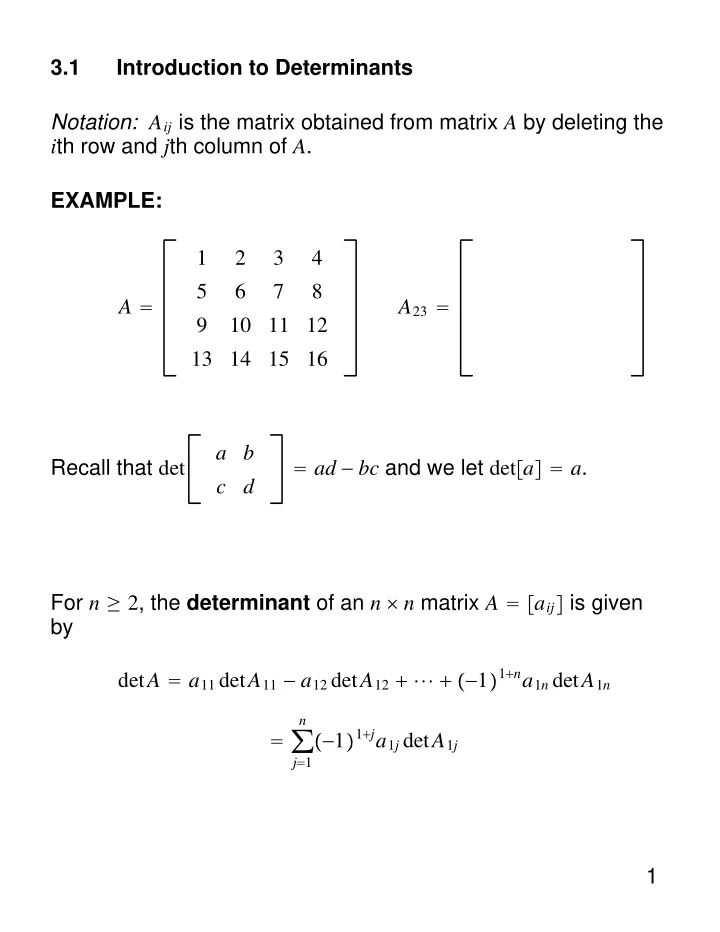
3.1 Introduction to Determinants Notation: Aij is the matrix obtained from matrix A by deleting the ith row and jth column of A. EXAMPLE: A = 1 2 3 4 5 6 7 8 9 10 11 12 13 14 15 16 A23 = Recall that det a b c d = ad − bc and we let deta = a. For n ≥ 2, the determinant of an n × n matrix A = aij is given by detA = a11 detA11 − a12 detA12 + ⋯ + −11+na1n detA1n = ∑
j=1 n
−11+ja1j detA1j 1
SLIDE 2
EXAMPLE: Compute the determinant of A = 1 2 3 −1 2 2 1 Solution detA = 1det −1 2 1 − 2det 3 2 2 1 + 0det 3 −1 2 = ______________________________ = ______ Common notation: det 3 2 2 1 = 3 2 2 1 . So 1 2 3 −1 2 2 1 = 1 −1 2 1 − 2 3 2 2 1 + 0 3 −1 2 The i,j-cofactor of A is the number Cij where Cij = −1i+j detAij. 1 2 3 −1 2 2 1 = 1C11 + 2C12 + 0C13 (cofactor expansion across row 1) 2
SLIDE 3
THEOREM 1 The determinant of an n × n matrix A can be computed by a cofactor expansion across any row or down any column: detA = ai1Ci1 + ai2Ci2 + ⋯ + ainCin (expansion across row i) detA = a1jC1j + a2jC2j + ⋯ + anjCnj (expansion down column j) Use a matrix of signs to determine −1i+j + − + ⋯ − + − ⋯ + − + ⋯ ⋮ ⋮ ⋮ ⋱ EXAMPLE: Compute the determinant of A = 1 2 3 −1 2 2 1 using cofactor expansion down column 3. Solution 1 2 3 −1 2 2 1 = 0 3 −1 2 − 2 1 2 2 0 + 1 1 2 3 −1 = 1. 3
SLIDE 4
EXAMPLE: Compute the determinant of A = 1 2 3 4 0 2 1 5 0 0 2 1 0 0 3 5 Solution 1 2 3 4 0 2 1 5 0 0 2 1 0 0 3 5 = 1 2 1 5 0 2 1 0 3 5 − 0 2 3 4 0 2 1 0 3 5 + 0 2 3 4 2 1 5 0 3 5 − 0 2 3 4 2 1 5 0 2 1 = 1 ⋅ 2 2 1 3 5 = 14 Method of cofactor expansion is not practical for large matrices - see Numerical Note on page 190. 4
SLIDE 5 Triangular Matrices: ∗ ∗ ⋯ ∗ ∗ ∗ ⋯ ∗ ∗ ⋱ ∗ ∗ ∗ ∗ ∗ ∗ ∗ ∗ ∗ ∗ ⋱ ∗ ∗ ⋯ ∗ ∗ ∗ ⋯ ∗ ∗ (upper triangular) (lower triangular) THEOREM 2: If A is a triangular matrix, then det A is the product
- f the main diagonal entries of A.
EXAMPLE: 2 3 4 5 0 1 2 3 0 0 −3 5 0 0 4 = _____________________ = − 24 5
SLIDE 6 3.2 Properties of Determinants THEOREM 3 Let A be a square matrix.
- a. If a multiple of one row of A is added to another row of A
to produce a matrix B, then detA = detB.
- b. If two rows of A are interchanged to produce B, then
detB = −detA.
- c. If one row of A is multiplied by k to produce B, then
detB = k ⋅ detA. EXAMPLE: Compute 1 2 3 4 0 5 0 2 7 6 10 2 9 7 11 . Solution 1 2 3 4 0 5 0 2 7 6 10 2 9 7 11 = 5 1 3 4 2 6 10 2 7 11 = 5 1 3 4 0 0 2 2 7 11 = 5 1 3 4 0 0 2 0 1 3 = −5 1 3 4 0 1 3 0 0 2 = _________ = ____. 6
SLIDE 7
Theorem 3(c) indicates that ∗ ∗ ∗ −2k 5k 4k ∗ ∗ ∗ = k ∗ ∗ ∗ −2 5 4 ∗ ∗ ∗ . EXAMPLE: Compute 2 4 6 5 6 7 7 6 10 Solution 2 4 6 5 6 7 7 6 10 = 2 1 2 3 5 6 7 7 6 10 = 2 1 2 3 0 −4 −8 0 −8 −11 = 2−4 1 2 3 1 2 0 −8 −11 = 2−4 1 2 3 0 1 2 0 0 5 = 2−4115 = − 40 7
SLIDE 8
EXAMPLE: Compute 2 3 1 4 7 3 7 9 −2 4 1 2 4 using a combination of row reduction and cofactor expansion. Solution 2 3 1 4 7 3 7 9 −2 4 1 2 4 = −2 2 3 1 4 7 3 1 2 4 = −2 2 3 1 0 1 1 1 2 4 = 2 2 3 1 1 2 4 0 1 1 = −2 1 2 4 2 3 1 0 1 1 = −2 1 2 4 0 −1 −7 1 1 = −2 1 2 4 0 −1 −7 −6 = −21−1−6 = − 12. 8
SLIDE 9
Suppose A has been reduced to U = ■ ∗ ∗ ⋯ ∗ ■ ∗ ⋯ ∗ ■ ⋯ ∗ ⋱ ⋮ ■ by row replacements and row interchanges, then detA = −1r product of pivots in U when A is invertible when A is not invertible THEOREM 4 A square matrix is invertible if and only if detA ≠ 0. THEOREM 5 If A is an n × n matrix, then detAT = detA. Partial proof (2 × 2 case) det a b c d = ad − bc and det a b c d
T
= det a c b d = ad − bc ⇒ det a b c d = det a c b d . 9
SLIDE 10
(3 × 3 case) det a b c d e f g h i = a e f h i − b d f g i + c d e g h det a d g b e h c f i = a e h f i − b d g f i + c d g e h ⇒ det a b c d e f g h i = det a d g b e h c f i . Implications of Theorem 5? Theorem 3 still holds if the word row is replaced with ___________________. 10
SLIDE 11
THEOREM 6 (Multiplicative Property) For n × n matrices A and B, detAB = detAdetB. EXAMPLE: Compute detA3 if detA = 5. Solution: detA3 = detAAA = detAdetAdetA = ______________ = ________. EXAMPLE: For n × n matrices A and B, show that A is singular if detB ≠ 0 and detAB = 0. Solution: Since detAdetB = detAB = 0 and detB ≠ 0, then detA = 0. Therefore A is singular. 11