SLIDE 1
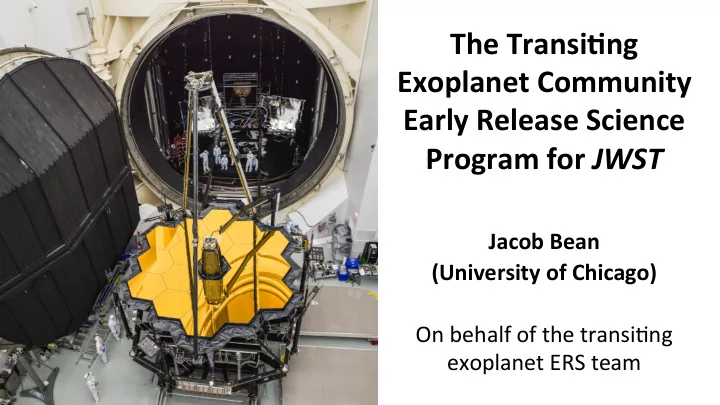
The Transi*ng Exoplanet Community Early Release Science Program for JWST
Jacob Bean (University of Chicago) On behalf of the transi/ng exoplanet ERS team
SLIDE 2
SLIDE 3
SLIDE 4
SLIDE 5
SLIDE 6
Thanks to the many hundreds of people who con*nue to work towards JWST mission success!
SLIDE 7 JWST offers myriad instrument setup choices
Stevenson+ 2016
Complica*ons:
- entrance apertures
- pixel sampling
- bright limits
- spectral contamina/on
- throughput varia/ons
- spa/al profile varia/ons
- detector gaps
- read paAerns
- data limits
- observatory opera/ons
SLIDE 8 JWST data reduc*on will be complex
NIRISS + SOSS lab data
Wavelength (μm) Light curve modeling spectral extrac/on
SLIDE 9 Figure adapted from Knutson+ 2012
Robust correc*on of instrument systema*cs is essen*al
1 x 10⁻³ Spitzer/IRAC 4.5μm HD 189733b thermal phase curve
SLIDE 10 Figure adapted from Knutson+ 2012
1 x 10⁻³ Spitzer/IRAC 4.5μm HD 189733b thermal phase curve 2 x 10⁻²
Robust correc*on of instrument systema*cs is essen*al
SLIDE 11 Goals of the transi*ng exoplanet community ERS program
- Determine the spectrophotometric /me-series performance of the key
instrument modes on /mescales relevant to transits for a representa/ve range of target star brightnesses.
- Jump-start the process of developing remedia/on strategies for
instrument-specific systema/c noise.
- Provide the community a comprehensive suite of transi/ng exoplanet
data to fully demonstrate JWST’s scien/fic capabili/es in this area.
For more informa/on see: Program 1377 informa/on at STScI website Bean+ 2018, PASP in revision, arXiv:1803.04985 hAps://ers-transit.github.io
SLIDE 12
Community
Currently 112 team members: 58% observers, 33% theorists 54% US, 46% EU + Canada 23% women overall 44% women in leadership roles
We welcome new team members!
community guidance
SLIDE 13
ERS Program 1377: 80 hours of JWST *me!
six observa2ons, three planets, four instruments, three transi2ng planet geometries
SLIDE 14
- 1. Panchroma*c transmission spectrum of a hot Jupiter
(NIRISS + NIRSpec + NIRCam: 0.6 – 5.0 μm, ~40 hrs)
What is the chemical composi/on of a hot Jupiter? WASP-79b: M=0.9 Mjup, R=2 Rjup, T=1750 K, J=9.3
HST data from Showalter+ in prep see poster #45
SLIDE 15
- 2. Mid-infrared phase curve of a short-period hot Jupiter
(MIRI LRS: 5 – 12 μm, ~30 hrs)
WASP-43b: M=2 Mjup, R=1 Rjup, T=1450 K, J=10.0 How does energy transport and 3D chemistry operate under extreme irradia/on? dayside
For more see Venot+ in prep
SLIDE 16
- 3. Thermal emission of a hot Jupiter orbi*ng a bright star
(NIRISS: 0.8 – 2.7 μm, ~10 hrs)
WASP-18b: M=10 Mjup, R=1.2 Rjup, T=2400 K, J=8.4 What is the chemistry, thermal structure, and energy budget of an ultra-hot Jupiter?
SLIDE 17
Target Selec*on
Start of JWST science assuming a March 30 launch primary targets
SLIDE 18
These workshops will be open to the en*re community, regardless of Co-I/Collaborator status on the proposal.
SLIDE 19 Slide courtesy Zach Berta-Thompson
SLIDE 20 Slide courtesy Zach Berta-Thompson
SLIDE 21
Timeline
SLIDE 22 Timeline
TESS 2 year mission complete
Figure from Rob Zellem See also: Kempton+ 2018 (arXiv:1805.03671)
SLIDE 23
ERS Program 1377 Transi/ng Planets Time: 80 hrs ERS Program 1386 Direct Imaging Time: 52 hrs
(see Hinkley talk tomorrow morning)
SLIDE 24
ERS Program 1377 Transi/ng Planets Time: 80 hrs ERS Program 1386 Direct Imaging Time: 52 hrs 27% of the allocated ERS /me went to exoplanets!