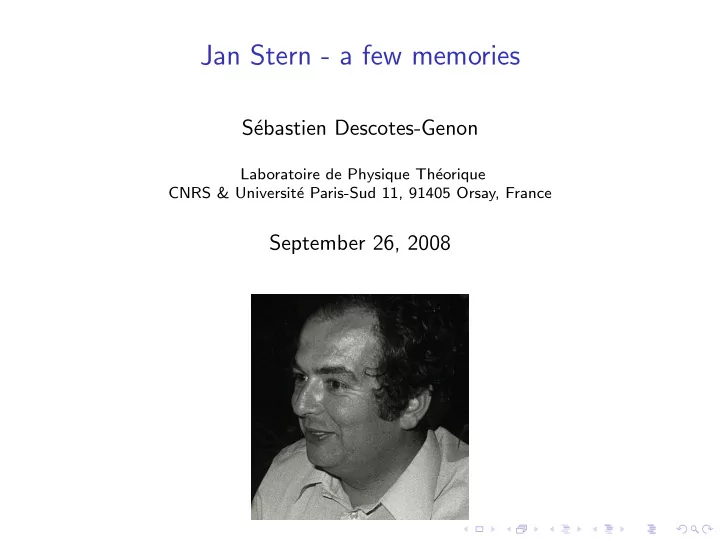
SLIDE 1
Jan Stern - a few memories
S´ ebastien Descotes-Genon
Laboratoire de Physique Th´ eorique CNRS & Universit´ e Paris-Sud 11, 91405 Orsay, France
September 26, 2008
SLIDE 2 My first encounter with Jan
◮ Spring 1997 : looking for a PhD
advisor and subject
◮ ”Masses and properties of light
quarks in QCD” ?
◮ Came to IPN Orsay (getting lost
◮ One-hour discussion ◮ . . . and I began my PhD in summer
SLIDE 3 My first encounter with Jan
◮ Spring 1997 : looking for a PhD
advisor and subject
◮ ”Masses and properties of light
quarks in QCD” ?
◮ Came to IPN Orsay (getting lost
◮ One-hour discussion ◮ . . . and I began my PhD in summer
It took me some time to get the full measure of the character (much longer than my PhD, for sure) Thanks to Marc Knecht, Bachir Moussallam, Heiri Leutwyler, Jiri Jersak, and in particular to Hagop Sazdjian
SLIDE 4 From Prague to Orsay
◮ Born in 1942 in Prague
(difficult times for his family)
◮ Studies at Technical University of Prague
◮ 1964 : Engineer in Nuclear Physics ◮ 1965 : PhD in Theoretical Physics
◮ 1967 : Stays in Dubna ◮ 1968 : Leaves for CERN and Bern, meets Leutwyler ◮ 1969 : Invited in Orsay, then recruited by CNRS ◮ A few visits to Bern, Ann Arbor. . .
= ⇒A very strong formation in group theory and a specific sensitivity to symmetries, a salient feature of Jan’s work
SLIDE 5 Jan in Prague and Dubna (1) : Light-cone dynamics
At that time, many data on hadrons and competing ideas dispersion relations, S-matrix, Regge theory, symmetries, quark model. . . Internal symmetries like isospin, SU(3) successful in quantum mechanics. Could it be extended to relativistic systems ? Qa(q) ∼
q· xja 0(x)
x0 = 0
◮ Symmetries embedded in current algebra [ja, jb] defines [Qa, Qb] ◮ Coleman : 1 part|Qa(q)|more part = 0 ◮ Equal-time charge can create particules from |0 ◮ Applications of current algebra often relied on secondary assumptions
to get rid of multi-hadron states (p → ∞)
SLIDE 6 Jan in Prague and Dubna (2) : Light-cone dynamics
In 1967, Jan highlights role of light-like charges ˜ Qa(q) ∼
µ(x)
n · x = 0 where n2 = 0 (e.g. n = (1, 0, 0, 1)) so that n · x = 0 is a plane tangent to light-cone
◮ ˜
Qa(q)|1 part >= |1 part >
◮ Postulating light-like current algebra
[ ˜ Qa(q1), ˜ Qb(q2)] = if abc ˜ Qc(q1 + q2) allows one to rederive results of current algebra without fuzzy assumptions (e.g., sum rules)
◮ Strong constraints on the high-energy behaviour of correlators
= ⇒Light-cone interesting to combine internal and Poincar´ e symmetries and to understand general features of quantum field theories
SLIDE 7 Jan in Bern : from the light cone to light quarks
With H. Leutwyler (a great friend and opponent, with whom he discussed. . . in French)
◮ In 1970, QFT and current algebra on the light cone,
applied to recent data on DIS (and by others to light-cone sum rules, distribution amplitudes, mended
◮ Try to constrain the 3 dynamical operators embedding
strong interactions in the light-cone formulation Meeting with Gell-Mann (highly esteemed by Jan)
SLIDE 8 Jan in Bern : from the light cone to light quarks
With H. Leutwyler (a great friend and opponent, with whom he discussed. . . in French)
◮ In 1970, QFT and current algebra on the light cone,
applied to recent data on DIS (and by others to light-cone sum rules, distribution amplitudes, mended
◮ Try to constrain the 3 dynamical operators embedding
strong interactions in the light-cone formulation Meeting with Gell-Mann (highly esteemed by Jan) Some time to get convinced that QCD right theory of strong interactions (too many arguments from perturbation theory, not enough general QFT) Bern : Times of excitement and fun (great memories for Jan)
SLIDE 9
Jan in Orsay (1) : different directions
With the advent of QCD, and his own installation in Orsay Jan explored several directions
◮ Structure of gauge theories and gauge fields [Craigie, Floratos] ◮ Chiral symmetry breaking in supersymmetric theories [Knecht] ◮ Gauge fields with arbitrary spins in connection with string theory
[Ouvry]
◮ . . . and getting into Chiral Perturbation Theory
[Sazdjian, Moussallam, Fuchs, Knecht, Girlanda]
SLIDE 10
Jan in Orsay (2) : ππ scattering
◮ Reluctant wrt to ChPT because of its perturbative nature ◮ Growing interest in ChPT once formulated as an effective theory
through symmetries
◮ Basic ideas OK, but shouldn’t we test its phenomological relevance ?
Possibility of a small quark condensate and Generalized ChPT
◮ ππ scattering as a relevant probe of chiral symmetry breaking, and in
particular of quark condensate for mu,d → 0
◮ Discussed at length with Bern, in and off Eurodaphne and Euridice
meetings = ⇒Structure of ππ amplitude, Kℓ4 and τ → 3π decays, lattice. . .
SLIDE 11
Jan in Orsay (2) : ππ scattering
◮ Reluctant wrt to ChPT because of its perturbative nature ◮ Growing interest in ChPT once formulated as an effective theory
through symmetries
◮ Basic ideas OK, but shouldn’t we test its phenomological relevance ?
Possibility of a small quark condensate and Generalized ChPT
◮ ππ scattering as a relevant probe of chiral symmetry breaking, and in
particular of quark condensate for mu,d → 0
◮ Discussed at length with Bern, in and off Eurodaphne and Euridice
meetings = ⇒Structure of ππ amplitude, Kℓ4 and τ → 3π decays, lattice. . . Kℓ4 decays
◮ For a long time, only ”high-statistics” Geneva-Saclay experiment ◮ 2000 : results from E865 (Brookhaven) ◮ 2007 : results from NA48/2
SLIDE 12
Scattering lengths after E865 data
Two different fits of Kℓ4 data supplemented with
◮ info on pion scalar radius [Colangelo, Gasser, Leutwyler] ◮ data in I = 2, ℓ = 0 channel [Fuchs, Girlanda, Stern]
SLIDE 13
Scattering lengths after NA48 (preliminary) data
Two different fits of Kℓ4 data supplemented with
◮ info on pion scalar radius [Colangelo, Gasser, Leutwyler] ◮ data in I = 2, ℓ = 0 channel [Fuchs, Girlanda, Stern]
SLIDE 14
Jan in Orsay (3) : Role of the strange quark
◮ Difference between Nf = 2 and Nf = 3 chiral symmetry breaking ? ◮ Effect of strange quark loops in the vacuum ◮ Significant suppression of quark condensate Σ(3) [mu,d,s → 0] with
respect to Σ(2) [mu,d → 0 and ms physical]
◮ . . . related to peculiar dynamics of light scalars ◮ . . . and making harder to use Nf = 3 chiral perturbation theory
SLIDE 15
Jan in Orsay (3) : Role of the strange quark
◮ Difference between Nf = 2 and Nf = 3 chiral symmetry breaking ? ◮ Effect of strange quark loops in the vacuum ◮ Significant suppression of quark condensate Σ(3) [mu,d,s → 0] with
respect to Σ(2) [mu,d → 0 and ms physical]
◮ . . . related to peculiar dynamics of light scalars ◮ . . . and making harder to use Nf = 3 chiral perturbation theory
Lattice with 2+1 dynamical flavours hints at such a scenario now
◮ MILC @ LATTICE 07 : Σ(2)/Σ(3) ≃ 1.52(17)(+38 −15) ◮ UKQCD-RBC @ Capri08 : Difficulties to fit 2+1 data with Nf = 3
ChPT, use only Nf = 2
◮ PACS-CS @ LATTICE 08 : Large NLO contributions in Nf = 3 ChPT
due to ms
SLIDE 16
Sachrajda [Capri08]
SLIDE 17
Impact of isospin-breaking
Jan puzzled by Kℓ4 data from NA48/2, indicating a low condensate Σ(2) by that time, he expected Σ(2) large and Σ(3) small = ⇒Role of isospin breaking [Gasser, Colangelo, Rusetsky, Kubis, Knecht] [Colangelo, Kaon 2007] Without isospin corrections With an estimate of isospin corr Agreement with Jan’s idea of different Nf = 2 and Nf = 3 patterns ?
SLIDE 18
Jan in Orsay (4) : EFT of electroweak symmetry breaking
Over the last ten years, Jan turned to electroweak symmetry breaking
◮ Many different attempts to build a consistent EFT of electroweak
symmetry breaking without explicit Higgs
◮ Naturalness : which symmetries can suppress the operators arising in
EFT and not observed ?
◮ Symmetry group Snat consisting of elementary sector (SM fermions and
gauge fields) and composite sector (Goldstone bosons for W and Z)
◮ Broken into SUW (2) ⊗ UY (1) by spurions connecting the two sectors ◮ These spurions provide power counting for size of deviations from SM
= ⇒In the expansion of the EFT, first non-SM effects correspond to V+A contributions to W -quark interaction [Hirn]
SLIDE 19
Jan in Orsay (5) : Right-handed currents
Are weak right-handed currents really ruled out experimentally ? [Passemar, Oertel, Bernard] Few places where high accuracy can be reached
◮ Kℓ3 decay (πK information and
Callan Treiman th) [unconfirmed hopes from NA48]
◮ Hadronic τ decays ◮ π0 → 2γ ◮ ππ scattering ◮ Inelastic ν scattering ◮ W semi-inclusive decays. . .
What about heavy quarks ? Departures from SM in the same framework ?
SLIDE 20
Jan Stern
◮ A deep physicist with a relevant and
long-lasting impact
◮ Somebody to learn many things from ◮ A challenger of common views with a
great intuition
◮ . . . who invited (and sometimes
provoked) others to go further
◮ A passionate man
Our community owes him a lot. We miss him.