
SLIDE 1
JANUARY 2020 REGIONAL CALLS
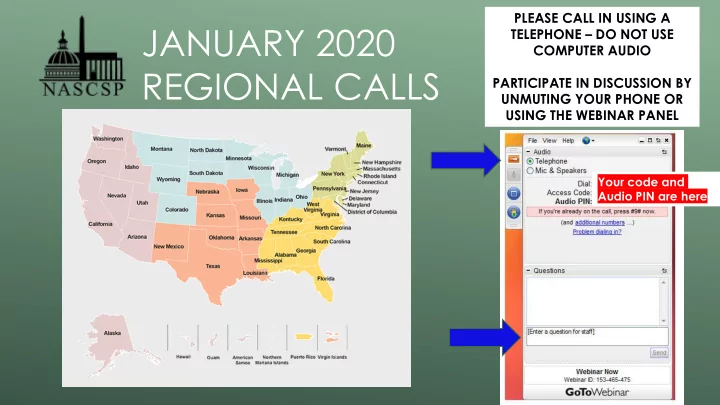
PLEASE CALL IN USING A TELEPHONE – DO NOT USE COMPUTER AUDIO PARTICIPATE IN DISCUSSION BY UNMUTING YOUR PHONE OR USING THE WEBINAR PANEL
Your code and Audio PIN are here
JANUARY 2020 TELEPHONE DO NOT USE COMPUTER AUDIO REGIONAL CALLS - - PowerPoint PPT Presentation
PLEASE CALL IN USING A JANUARY 2020 TELEPHONE DO NOT USE COMPUTER AUDIO REGIONAL CALLS PARTICIPATE IN DISCUSSION BY UNMUTING YOUR PHONE OR USING THE WEBINAR PANEL Your code and Audio PIN are here Agenda Legislative Update DOE
PLEASE CALL IN USING A TELEPHONE – DO NOT USE COMPUTER AUDIO PARTICIPATE IN DISCUSSION BY UNMUTING YOUR PHONE OR USING THE WEBINAR PANEL
Your code and Audio PIN are here
Legislative Update DOE Updates & 2020 Planning Winter Conference Preparations Open Discussion
Congress released a spending package late December made up of
"minibus" bills which finalize 2020 funding amounts
House and Senate passed, Trump signed into law on December 20th
WAP- $308.5 million
This is an increase of $51.5 million over FY 2019 $3.5 million is specifically reserved for Training and Technical Assistance
at DOE Headquarters; this is an increase of $500,000 over FY 2019.
State Energy Program (SEP)- $62.5 million This is an increase of $7.5 million over FY 2019.
Read the full text of the Energy and Water bill here.
Community Services Block Grant (CSBG)- $740 million This is an increase of $15 million over FY 2019. Low-Income Home Energy Assistance Program (LIHEAP)- $3.74
billion
This is an increase of $50 million over FY 2019. Head Start- $10.6 billion This is a increase of $550 million over FY 2019. Read the full text of the Labor-HHS bill here.
House and Senate energy committees each
passed a version of reauthorization
Vote before full House & Senate won’t happen
this year. Sometime next year.
NASCSP planning strategy for 2020
116th Congress lasts until Jan. 2021
Both bills could move forward next year
without being reintroduced
CLEAN Future Act
Outline/Discussion draft released last week by Rep. Paul
Tonko, Rep. Frank Pallone, & Rep. Bobby Rush
100% clean economy by 2050
Aims to eliminate carbon emissions from power
, transportation, and manufacturing
“The CLEAN Future Act incorporates several additional
measures to reduce building emissions, including reauthorizing and expanding the Weatherization Assistance Program; improving energy efficiency in public buildings, including through the use of energy savings performance contracts and a newly established Federal Smart Building Program; reauthorizing and modernizing the Energy Efficiency and Conservation Block Grant Program to promote the use of alternative fuels, including electricity; establishing a smart energy and water efficiency management grant program; and improving energy efficiency in public schools, federally-owned data centers, and buildings owned by nonprofit organizations.”
“The CLEAN Future Act also expands access to clean energy
throughout the United States. The bill establishes loan and technical assistance grant programs within DOE to deploy distributed energy systems that increase the use of clean energy, improve grid resiliency and reliability, and enhance demand-side management. In addition, the Act creates a loan and grant program to install solar panels in low-income communities; introduces a long-term power purchase agreement (PPA) model for zero-emissions technologies; establishes a PPA pilot program for advanced nuclear technology; provides incentives for efficiency improvements at hydroelectric facilities; improves the hydroelectric licensing process; and reauthorizes the Low-Income Home Energy Assistance Act of 1981 (LIHEAP).”
“The transition to a clean economy will require a skilled
and diverse clean energy workforce. To that end, the CLEAN Future Act incorporates the Blue Collar to Green Collar Jobs Development Act of 2019, introduced by Rep. Bobby Rush (D-IL). Among other measures, the bill establishes the Office of Economic Impact, Diversity, and Employment within DOE and directs the Secretary of Energy to establish and implement an energy workforce development program. It further requires the Secretary of Energy to provide direct financial and technical assistance to educational institutions, local workforce development boards, state workforce development boards, non-profit
programs.”
Interviews held for Project
Officer positions
Alex Fitzsimmons to attend
Winter Conference
DOE may make grants available to local weatherization agencies…to expand the weatherization assistance program for residential buildings to include materials, benefits, and renewable and domestic energy technologies not covered by the program…
42 U.S.C. Chapter 81 §6872. Authorization of appropriations
$275 Million Trigger – up to 2% of funds Past Projects: Heat pump water heaters, solar hot water systems, solar
photovoltaics, in-home energy monitors, community-based social marketing, geothermal heating and cooling, clothes washers, bulk purchasing networks
2017 ORNL Assessment
Reminder email sent Monday 1/13 with Assessment Tool
Due Dates: February 10, 2020 and May 1, 2020
Budget – Use WPN 19-2 Allocations
Carryover is allowed into 2020 (See WAP Memo 55)
PAGE glitch – Section V
.4 Climatic Conditions missing
Will be corrected, in interim follow section titles in PAGE
Available on Member Portal WAP Monitoring Tools page
Is your State/Territory planning new initiatives or innovative projects for 2020 or beyond (new technologies like solar and air source heat pumps, multi-family weatherization, pilot projects, etc.)? If yes please briefly describe. Do you plan to utilize the leveraging budget cost category in 2020?
What percentage of total funds (DOE + LIHEAP + Other) did your state/territory allocate to T&TA in 2019?
Of that T&TA percentage, what amount was allocated to local WAP
agencies (vs. used by the Grantee)?
Do you plan to adjust these percentages in 2020?
Does your state use T&TA funds for activities other than monitoring or T&TA provided to Grantee and Subgrantee staff (e.g., program evaluations, client education, pilot studies, research)? If yes, please briefly describe those activities.
Dates & Location: February 24-28, 2020 at the
Crystal Gateway Marriott, Arlington, VA
Registration & Draft Agendas now available DOE WAP Memo 57: Allowable use of TTA Pre-Conference Offerings Monday & Tuesday
WAP Orientation (2 days) Pre-orientation webinar February 13, 2pm EST Legal Considerations for State Administrators (Tuesday)
Wednesday Thursday Friday General Sessions
WAP Sessions
Peer Exchange in WAP
and National Partner Update (NEADA) Other Vendors – CAP Solar
Wrap up and raffle Evening Board Meeting with NEADA & NEUAC Networking Reception n/a – adjourn at Noon
Wednesday February 26, 1:00 – 3:00 pm
Tentative Topics:
ACSI Work Group Summary & Discussion NASCSP Strategic Plan: Our Goals for 2020 – 2023 Other topics?
Appropriations, SERC and HUD coordination Update on deferrals research Radon and vermiculite study updates WAP monitoring guidance (WPN 16-4) Clarification on what constitutes a DOE completion Other topics or questions?
NASCSP is moving to a bi-monthly Regional Call
January 14th & 16th March 10th & 12th May 12th & 14th July 14th & 16th September 8th & 10th November 10th & 12th
Bruce Hagen, WAP Program Chair bahagen@nd.gov Eric Behna, Policy and Communications Manager ebehna@nascsp.org | 202-370-3662 Amy Klusmeier, WAP Director aklusmeier@nascsp.org | 202-370-3661