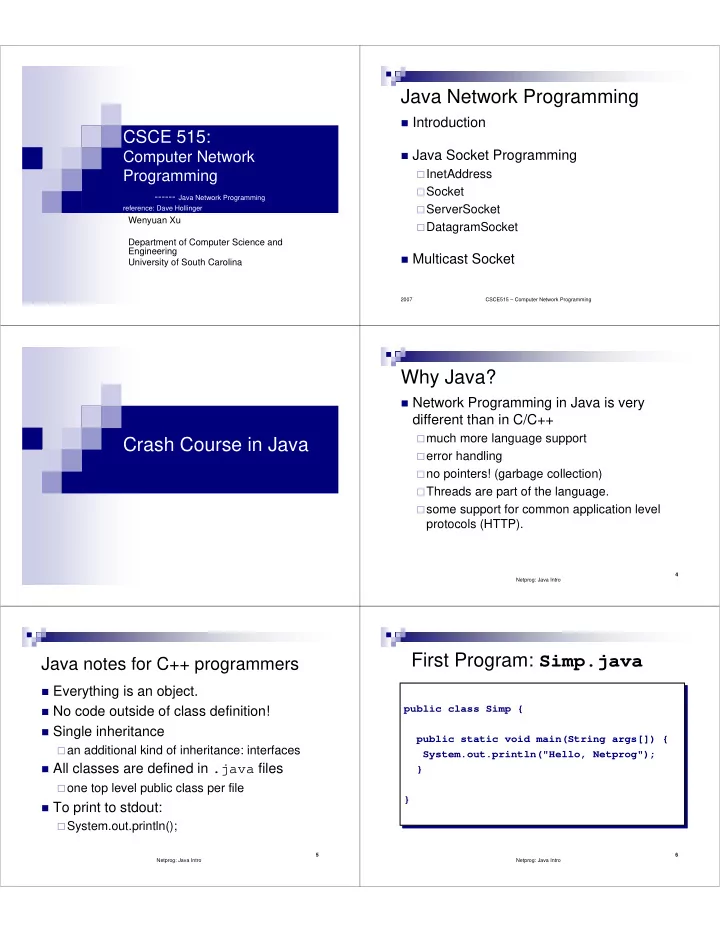
Java Network Programming Introduction CSCE 515: Java Socket - - PDF document

java network programming
SMART_READER_LITE
LIVE PREVIEW

Java Network Programming Introduction CSCE 515: Java Socket - - PDF document

Java Network Programming Introduction CSCE 515: Java Socket Programming Computer Network Programming InetAddress Socket ------ Java Network Programming ServerSocket reference: Dave Hollinger Wenyuan Xu DatagramSocket


slide-1
SLIDE 1

CSCE 515:

Computer Network Programming

  • ----- Java Network Programming

reference: Dave Hollinger

Wenyuan Xu Department of Computer Science and Engineering University of South Carolina

Java Network Programming

Introduction Java Socket Programming

InetAddress Socket ServerSocket DatagramSocket

Multicast Socket

CSCE515 – Computer Network Programming 2007

Crash Course in Java Why Java?

Network Programming in Java is very

different than in C/C++

much more language support error handling no pointers! (garbage collection) Threads are part of the language. some support for common application level

protocols (HTTP).

Netprog: Java Intro 4

Java notes for C++ programmers

Everything is an object. No code outside of class definition! Single inheritance

an additional kind of inheritance: interfaces

All classes are defined in .java files

  • ne top level public class per file

To print to stdout:

System.out.println();

Netprog: Java Intro 5

First Program: Simp.java

public class Simp { public static void main(String args[]) { System.out.println("Hello, Netprog"); } } public class Simp { public static void main(String args[]) { System.out.println("Hello, Netprog"); } }

Netprog: Java Intro 6

slide-2
SLIDE 2

Compiling and Running

Netprog: Java Intro 7

Simp.java javac Simp.java java Simp Simp.class

compile run bytecode source code

Java bytecode and interpreter

bytecode is an intermediate representation

  • f the program (class).

The Java interpreter starts up a new

“Virtual Machine”.

The VM starts executing the users class

by running it’s main() method.

Netprog: Java Intro 8

Java Data Types

Primitive Data Types:

boolean

true or false

char

unicode! (16 bits)

byte

signed 8 bit integer

short

signed 16 bit integer

int

signed 32 bit integer

long

signed 64 bit integer

float,double

IEEE 754 floating point

Netprog: Java Intro 9

not an int!

Other Data Types

Reference types (composite)

classes arrays

strings are supported by a built-in class

named String

Not an array of chars!

string literals are supported by the

language (as a special case).

Netprog: Java Intro 10

Classes and Objects

“All Java statements appear within

methods, and all methods are defined within classes”.

Java classes are very similar to C++

classes (same concepts).

Instead of a “standard library”, Java

provides a lot of Class implementations.

Netprog: Java Intro 11

Defining a Class

One top level public class per .java file.

typically end up with many .java files for a

single program.

One (at least) has a static public main()

method.

Class name must match the file name!

compiler/interpreter use class names to figure

  • ut what file name is.

Netprog: Java Intro 12

slide-3
SLIDE 3

Sample Class

(from Java in a Nutshell)

public class Point { public double x,y; public Point(double x, double y) { this.x = x; this.y=y; } public double distanceFromOrigin(){ return Math.sqrt(x*x+y*y); } }

Netprog: Java Intro 13

Objects and new

You can declare a variable that can hold an

  • bject:

Point p;

but this doesn’t create the object! You have to use new:

Point p = new Point(3.1,2.4);

there are other ways to create objects…

Netprog: Java Intro 14

Using objects

Just like C++:

  • bject.method()
  • bject.field

BUT, never like this (no pointers!)

  • bject->method()
  • bject->field

Netprog: Java Intro 15

Reference Types

Objects and Arrays are reference types Primitive types are stored as values. Reference type variables are stored as

references (pointers that we can’t mess with).

There are significant differences!

Netprog: Java Intro 16

Primitive vs. Reference Types

int x=3; int y=x; Point p = new Point(2.3,4.2); Point t = p;

Netprog: Java Intro 17

There are two copies of the value 3 in memory There is only one Point object in memory!

Passing arguments to methods

Primitive types: the method gets a copy of

the value. Changes won’t show up in the caller.

Reference types: the method gets a copy

  • f the reference, the method accesses the

same object!

Netprog: Java Intro 18

slide-4
SLIDE 4

Packages

You can organize a bunch of classes into

a package.

defines a namespace that contains all the

classes.

You need to use some java packages in

your programs

java.lang java.io, java.util

Netprog: Java Intro 19

Importing classes and packages

Instead of #include, you use import You don’t have to import anything, but

then you need to know the complete name (not just the class, the package).

if you import java.io.File you can use

File objects.

If not – you need to use java.io.File

  • bjects.

Netprog: Java Intro 20

Exceptions

Terminology:

throw an exception: signal that some

condition (possibly an error) has occurred.

catch an exception: deal with the error (or

whatever).

In Java, exception handling is necessary

(forced by the compiler)!

Netprog: Java Intro 21

Try/Catch/Finally

try { // some code that can throw // an exception } catch (ExceptionType1 e1) { // code to handle the exception } catch (ExceptionType2 e2) { // code to handle the exception } finally { // code to run after the stuff in try // can handle other exception types }

Netprog: Java Intro 22

Exceptions and Network Programming

Exceptions take care of handling errors

instead of returning an error, some method

calls will throw an exception.

A little hard to get used to, but forces the

programmer to be aware of what errors can occur and to deal with them.

Netprog: Java Intro 23

Socket Programming

slide-5
SLIDE 5

Netprog: Java Sockets 25

Java Sockets Programming

The package java.net provides support for

sockets programming (and more).

Typically you import everything defined in

this package with: import java.net.*;

Classes

InetAddress Socket ServerSocket DatagramSocket DatagramPacket

Netprog: Java Sockets 26

java.net.InetAddress class

static methods you can use to create new

InetAddress objects.

public static InetAdress getByName(String host) public static InetAdress getLocalHost() public static InetAdress[] getAllByName(String hostName)

InetAddress x = InetAddress.getByName( “cse.sc.edu”);

Netprog: Java Sockets 27

Sample Code: Lookup.java

Uses InetAddress class to lookup

hostnames found on command line.

java Lookup www.yahoo.com

www.yahoo.com:209.191.93.52

Netprog: Java Sockets 28 Netprog: Java Sockets 29

try { InetAddress a = InetAddress.getByName(hostname); System.out.println(hostname + ":" + a.getHostAddress()); } catch (UnknownHostException e) { System.out.println("No address found for " + hostname); } try { InetAddress a = InetAddress.getByName(hostname); System.out.println(hostname + ":" + a.getHostAddress()); } catch (UnknownHostException e) { System.out.println("No address found for " + hostname); }

Sample Code: getLocalhost.java

Uses InetAddress class to lookup

localhost

java getLocalhost

broad/129.252.130.139

Netprog: Java Sockets 30

slide-6
SLIDE 6

getLocalhost()

Netprog: Java Sockets 31

try { InetAddress address = InetAddress.getLocalHost(); System.out.println(address); } catch (UnknownHostException e) { System.out.println("Could not find this computer's address."); } } try { InetAddress address = InetAddress.getLocalHost(); System.out.println(address); } catch (UnknownHostException e) { System.out.println("Could not find this computer's address."); } }

CSCE515 – Computer Network Programming 2007

try { InetAddress[] addresses = InetAddress.getAllByName("www.microsoft.com"); for (int i = 0; i < addresses.length; i++) { System.out.println(addresses[i]); } } catch (UnknownHostException e) { System.out.println("Could not find www.microsoft.com"); } try { InetAddress[] addresses = InetAddress.getAllByName("www.microsoft.com"); for (int i = 0; i < addresses.length; i++) { System.out.println(addresses[i]); } } catch (UnknownHostException e) { System.out.println("Could not find www.microsoft.com"); }

getAllByName() How to open a socket?

Socket class: corresponds to active TCP sockets

  • nly!

client sockets socket returned by accept();

Passive sockets are supported by a different

class: ServerSocket

UDP sockets are supported by DatagramSocket

Netprog: Java Sockets 33

Client Socket Constructors

Constructor creates a TCP connection to a

named TCP server.

There are a number of constructors:

Socket(InetAddress server, int port); Socket(InetAddress server, int port, InetAddress local, int localport); Socket(String hostname, int port);

Netprog: Java Sockets 34

Client Socket Constructors

Socket(String hostname, int port);

Netprog: Java Sockets 35

Socket MyClient; try { MyClient = new Socket(“www.yahoo.com", 80); } catch (UnKnowHostException e) { System.out.println(e); } catch (IOException e) { System.out.println(e); } Socket MyClient; try { MyClient = new Socket(“www.yahoo.com", 80); } catch (UnKnowHostException e) { System.out.println(e); } catch (IOException e) { System.out.println(e); }

Client Socket Constructors

Socket(InetAddress server, int port);

Netprog: Java Sockets 36

InetAddress myServerAddr; Socket MyClient; try { myServerAddr = InetAddress.getByName(“www.yahoo.com”); MyClient = new Socket(myServerAddr, 80); } catch (UnKnowHostException e) { System.out.println(e); } catch (IOException e) { System.out.println(e); } InetAddress myServerAddr; Socket MyClient; try { myServerAddr = InetAddress.getByName(“www.yahoo.com”); MyClient = new Socket(myServerAddr, 80); } catch (UnKnowHostException e) { System.out.println(e); } catch (IOException e) { System.out.println(e); }

slide-7
SLIDE 7

Socket Methods

void close(); InetAddress getInetAddress(); getpeername InetAddress getLocalAddress(); getsockname InputStream getInputStream(); OutputStream getOutputStream(); Lots more (setting/getting socket options,

partial close, etc.)

Netprog: Java Sockets 37

Socket I/O

Socket I/O is based on the Java I/O

support (in the package java.io).

InputStream and OutputStream are

abstract classes

common operations defined for all kinds of

InputStreams, OutputStreams…

Netprog: Java Sockets 38

InputStream Basics

// reads some number of bytes and // puts in buffer array b int read(byte[] b); // reads up to len bytes int read(byte[] b, int off, int len); Both methods can throw IOException. Both return –1 on EOF.

Netprog: Java Sockets 39

OutputStream Basics

// writes b.length bytes void write(byte[] b); // writes len bytes starting // at offset off void write(byte[] b, int off, int len); Both methods can throw IOException.

Netprog: Java Sockets 40

Output stream example

CSCE515 – Computer Network Programming 2007

InetAddress myServerAddr; Socket MyClient; DataOutputStream output; try { …

  • utput = new

DataOutputStream(MyClient.getOutputStream());

  • utput.writeBytes(“hello”);
  • utput.writeBytes("DATA\n");

} catch (IOException e) { System.out.println(e); } InetAddress myServerAddr; Socket MyClient; DataOutputStream output; try { …

  • utput = new

DataOutputStream(MyClient.getOutputStream());

  • utput.writeBytes(“hello”);
  • utput.writeBytes("DATA\n");

} catch (IOException e) { System.out.println(e); }

Sample Client

smtpClient.java Simple client code to send an email via an smtp

server

Client:

Open a socket. Open an input and output stream to the socket. Read from and write to the socket according to the server's

protocol.

Clean up.

CSCE515 – Computer Network Programming

slide-8
SLIDE 8

ServerSocket Class –Servers (TCP Passive Socket)

Constructors: ServerSocket(int port); ServerSocket(int port, int backlog); ServerSocket(int port, int backlog, InetAddress bindAddr);

Netprog: Java Sockets 43

ServerSocket Constructors

ServerSocket(int port, int backlog);

Netprog: Java Sockets 44

ServerSocket MyService; try { MyService = new ServerSocket(PortNumber, 90); } catch (IOException e) { System.out.println(e); } ServerSocket MyService; try { MyService = new ServerSocket(PortNumber, 90); } catch (IOException e) { System.out.println(e); }

ServerSocket Methods

Socket accept(); void close(); InetAddress getInetAddress(); int getLocalPort();

throw IOException, SecurityException

Netprog: Java Sockets 45

Sample Echo Server

TCPEchoServer.java Server:

1.

Create a ServerSocket

  • 2. accept incoming request, get a Socket

3.

Open an input and output stream to the Socket.

4.

Read from and write to the Socket according to the server's protocol.

5.

Close the Socket

6.

Return to step 2

Netprog: Java Sockets 46

UDP Sockets

DatagramSocket class DatagramPacket class needed to specify

the payload (incoming or outgoing).

Netprog: Java Sockets 47

DatagramSocket Constructors

DatagramSocket(); DatagramSocket(int port); DatagramSocket(int port, InetAddress a);

All can throw SocketException or SecurityException. When should each constructors be used?

Netprog: Java Sockets 48

slide-9
SLIDE 9

Client UDP Socket constructor

CSCE515 – Computer Network Programming 2007

try { DatagramSocket client = new DatagramSocket(); //send packets…. } catch (SocketException e) { System.out.println(e); } try { DatagramSocket client = new DatagramSocket(); //send packets…. } catch (SocketException e) { System.out.println(e); }

UDP port scanner

CSCE515 – Computer Network Programming 2007

for (int port = 1024; port<=65535; port++){ try { DatagramSocket server = new DatagramSocket(port); server.close(); } catch (SocketException e) { System.out.println(“there is a server on port”+port+ “.”); } } for (int port = 1024; port<=65535; port++){ try { DatagramSocket server = new DatagramSocket(port); server.close(); } catch (SocketException e) { System.out.println(“there is a server on port”+port+ “.”); } }

DatagramSocket Methods

void receive(DatagramPacket p); void send(DatagramPacket p); void connect (int port, InetAddress); void close();

Lots more!

Netprog: Java Sockets 51

ssize_t sendto( int sockfd, const void *buff, size_t nbytes, int flags, const struct sockaddr* to, socklen_t addrlen);

DatagramPacket

Contain the payload (a byte array). Can also be used to specify the

destination address (when not using connected mode UDP).

Netprog: Java Sockets 52

DatagramPacket Constructors

For receiving: DatagramPacket( byte[] buf, int len); For sending: DatagramPacket( byte[] buf, int len InetAddress a, int port);

Netprog: Java Sockets 53

DatagramPacket methods

byte[] getData(); void setData(byte[] buf); void setAddress(InetAddress a); void setPort(int port); InetAddress getAddress(); int getPort();

Netprog: Java Sockets 54

destination address could be either address (depends on context)

slide-10
SLIDE 10

Sample UDP code

UDPEchoServer.java Simple UDP Echo server. Test using nc as the client (netcat): > nc –u hostname port

Netprog: Java Sockets 55

Multicast

CSCE515 – Computer Network Programming

Multicasting

Unicast

A flow from one source to one destination IP packets contain destination IP address

Broadcast

A flow from one source to all destinations IP packets contain broadcast address 255.255.255.255

  • Multicast

A flow from one source transmits to a Group of destinations IP packets contain a class D address for destination Ranges from 224.0.0.0 to 239.255.255.255 (256K addresses)

CSCE515 – Computer Network Programming

Multicast vs. Multiple Unicast

CSCE515 – Computer Network Programming

Advantages of Multicasting

Advantages:

Lower overhead at the source

Source sends only one packet

Bandwidth is conserved on shared links

Only one copy of each packet is sent on each link

Requirements:

Group address management

– Network/router participation

Packet duplication at routing nodes

  • Disadvantages

Security Business models No Incentives for deployment

CSCE515 – Computer Network Programming

Multicast Addressing

224.0.0.0 -- 239.255.255.255 The set of hosts listening to a particular multicast address is called a host group Multicast packets, at least for now, are sent only as UDP packets (WHY?) Some of the addresses 224.0.0.0 to 224.0.0.15 are reserved for well-known groups 239.0.0.0 to 239.255.255.255 are for local/administratively scoped applications Like any IP address, a multicast address can have a hostname, e.g. 224.0.0.2 -- all-routers.mcast.net (All routers on the local subnet)

CSCE515 – Computer Network Programming

1 1 1 0 multicast group ID Class D 28

slide-11
SLIDE 11

Mapping to Ethernet Addresses

Ethernet has a 48-bit address field

It has its own multicast address range 01.00.5e.00.00.00 through 01.00.5e.7f.ff.ff

Lower order 23 bits can be used for multicast addresses

IP multicast address has 28 bits for specifying a group address Thus, only the lower order 23 bits of IP multicast address are

copied into the Ethernet address

CSCE515 – Computer Network Programming

Link-Layer Multicast Addresses

Ranges from 01:00:5E:00:00:00 to 01:00:5E:7F:FF:FF

Map low-order 23 bits of class D address to lower order 23 bits

  • f ethernet multicast address space

Upper 5 bits of multicast group ID are ignored in the mapping,

thus mapping is not unique

For point-to-point links: no mapping needed.

CSCE515 – Computer Network Programming

Multicast service model

Uses the notion of host groups

Sender sends to a group address Any receiver who has joined this group gets this packets

Implications?

No limits on number or location of receivers Best effort delivery (same as in unicast)

  • Dynamic membership

Host can join/leave at will (no synchronization required among

group members)

Scope control

Can limit the distribution using TTL

CSCE515 – Computer Network Programming

Components of the IP Multicast Architecture

CSCE515 – Computer Network Programming

Multicast Routers

Biggest restriction on multicasting:

Availability of special multicast routers

Check whether your routers support

multicasting:

wyxu@broad % ping all-routers.mcast.net all-routers.mcast.net is alive

CSCE515 – Computer Network Programming

IGMP

Internet Group Management Protocol (IGMP) Allows a router to know which of its directly connected

hosts belongs to which multicast group

IGMP is required to support TRPB, RPM, CBT and PIM

protocols

CSCE515 – Computer Network Programming

slide-12
SLIDE 12

IGMPv1 Message Format

IGMP is part of the IP layer IGMP messages are transmitted in IP

packets

67

15 16 31 8 bytes

checksum group address (class D IP address) unused

IGMP type(1-2) IGMP version

3 4 7 8

IGMP Host Queries

Routers uses IGMP “query” messages to periodically

query hosts on their subnets and learn if they are members of any multicast group

Queries are addressed to all hosts group (224.0.0.1) and carry

an IP TTL of 1 (no more than once a minute)

Hosts who are members of multicast groups respond with one

IGMP “report” message for each group they are a member of

To improve efficiency, hosts wait a random amount of time

before responding

– During this waiting time, hosts listen to other host responses – If another host reports membership in the same group, then the first host

aborts its report

CSCE515 – Computer Network Programming

IGMP Host Queries

CSCE515 – Computer Network Programming

IGMP Host Queries

CSCE515 – Computer Network Programming

IGMP Host Queries

CSCE515 – Computer Network Programming

Communicating with a Multicast Group

Typical four key operations

Join a multicast group Send data to the members of the group Receive data from the group Leave the multicast group

To receive data from a multicast group, you

have to join the group

To send data, you don’t have to join the group

CSCE515 – Computer Network Programming

slide-13
SLIDE 13

Class MulticastSocket

Extend class DatagramSocket and add

support for IP multicast

Multiple MulticastSockets can listen to

same port on same machine

Constructors

MulticastSocket() MulticastSocket(int port) MulticastSocket(SocketAddress bindAddress)

Class MulticastSocket

try { MulticastSocket ms = new MulticastSocket(); //send some datagrams } catch (SocketException e) { System.out.println(e); } try { MulticastSocket ms = new MulticastSocket(); //send some datagrams } catch (SocketException e) { System.out.println(e); }

75

Class MulticastSocket

Methods

void joinGroup(InetAddress group) throws IOException void leaveGroup(InetAddress group) throws IOException void setTimeToLive(int ttl) throws IOException void setTTL(byte ttl) throws IOException int getTimeToLive() throws IOException byte getTTL() throws IOException void send(DatagramPacket packet, byte ttl) throws IOException void setInterface(InetAddress address) throws SocketException InetAddress getInterface() throws SocketException void receive(DatagramPacket p)

Exceptions

IOException SecurityException

76

Sending Multicast Packets

// byte[] data // InetAddress multicastGroup // int multicastPort MulticastSocket socket = new MulticastSocket(); DatagramPacket packet = new DatagramPacket (data, data.length, multicastGroup, multicastPort); socket.send(packet, (byte) 64); socket.close();

77

Receiving Multicast Packets

MulticastSocket socket = new MulticastSocket(multicastPort); Socket.joinGroup(multicastGroup); byte buffer[] = new byte[65508]; DatagramPacket packet = new DatagramPacket(); socket.receive(packet); InetAddress fromAddress = packet.getAddress(); int fromPort = packet.getPort(); int length = packet.getLength(); byte[] data = packet.getData(); // … socket.leaveGroup(multicastGroup); socket.close();

Sample MulticastSocket code

MulticastSender.java MulticastSniffer.java Receiver: Broad % java MulticastSniffer all- systems.mcast.net 4000 Sender: Broad % java MulticastSender all- systems.mcast.net 4000

Netprog: Java Sockets 78

slide-14
SLIDE 14

79

A Peer-to-Peer Multicast Chat System

Each client multicasts its message to other

clients

No server is involved; all clients

communicate as peers

Open a chat frame and start a thread that

listens for incoming packets

Threads

  • Subclassing thread
  • public class MyThread extends Thread{}
  • public void run(){..}
  • public static void main(String[] args) {
  • new Mythread.start();}