JJC - Campus Lake Lake pictures taken by Virginia Piekarski, 2006 - - PowerPoint PPT Presentation
jjc campus lake
SMART_READER_LITE
LIVE PREVIEW

JJC - Campus Lake Lake pictures taken by Virginia Piekarski, 2006 - - PowerPoint PPT Presentation

JJC - Campus Lake Lake pictures taken by Virginia Piekarski, 2006 JJC Lake Rehabilitation & Management Project The Joliet Junior College Lake is a central aesthetic feature of the main campus. The 5.8 acre lake has a 362 acre


slide-1
SLIDE 1

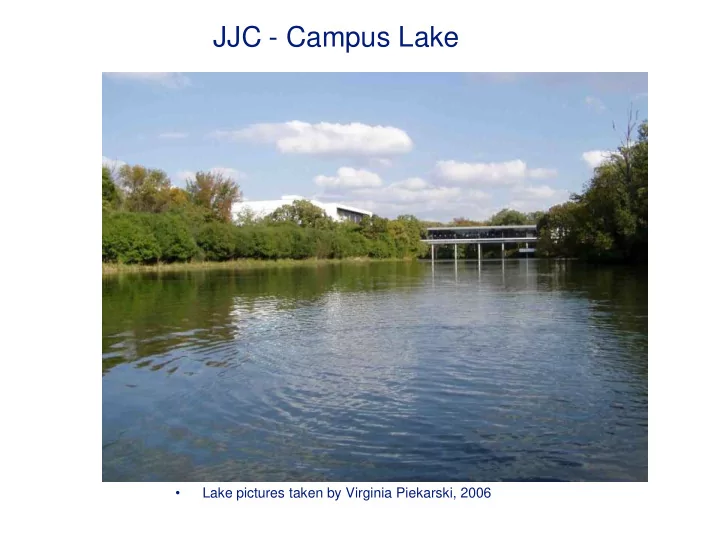
JJC - Campus Lake

  • Lake pictures taken by Virginia Piekarski, 2006
slide-2
SLIDE 2

JJC Lake Rehabilitation & Management Project The Joliet Junior College Lake is a central aesthetic feature of the main campus. The 5.8 acre lake has a 362 acre watershed which includes the college campus; parking lots; wooded, farm and open fields; and residential and commercial

  • developments. The JJC Lake is eutrophic; this

condition causes water quality degradation.

slide-3
SLIDE 3

A grant-funded rehabilitation project is underway to restore the natural beauty and ecological health of the JJC

  • Lake. Fertilizers, pesticides and herbicides from

surrounding lawns and agricultural fields flow into the lake through storm water runoff. Nutrient-rich sediments accumulate, causing an explosion of plant and algal

  • growth. This depletes oxygen levels, which leads to fish
  • kills. The accumulation of sediment has also reduced the

lake’s water-holding capacity by 20 percent. The rehabilitation efforts will address these issues with the goal of restoring the quality, health and natural beauty of the lake.

slide-4
SLIDE 4

West View from Bridge, August 2006

slide-5
SLIDE 5

East View, August 2006

slide-6
SLIDE 6

Aquatic Vegetation Flourishes in Nutrient Rich Water

slide-7
SLIDE 7

Excessive Aquatic Vegetation Depletes Dissolved Oxygen which Results in Fish Kills

slide-8
SLIDE 8
slide-9
SLIDE 9

Drainage patterns, Joliet Junior College, 1215 Houbolt Road

N

slide-10
SLIDE 10
  • Lake Project Highlights:
  • 6,300 cubic yards of sediment will be dredged from the lake

and distributed on the college’s agricultural fields; after dewatering, the nutrient-rich sediment will be spread over the Ag field

  • Best management practices (BMP’s) will be established and

implemented to reduce non-point source pollution and ensure the long-term health of the lake

  • Separators and Wetland Swale will be installed to filter runoff

water from the parking lots

  • Bioswales and a Bio-Filter Cell will be installed to filter runoff

water from agricultural fields, grass fields and residential areas before it enters the lake

  • Native plant species will be planted along the shoreline to

prevent soil erosion

slide-11
SLIDE 11
slide-12
SLIDE 12

JJC Lake Rehabilitation & Management Project

BioSwale BioFilter Cell Dewatering Pond Wetland Swale Separators #1 Snout #2 FloGard #3 Vortex No Dredge Zone

slide-13
SLIDE 13
  • Benefits:
  • Unsightly floating debris, odor problems and sediment buildup

will be reduced

  • A clean, healthy habitat for fish, wildlife and native plant

species will be restored

  • Approximately two feet will be added to the depth of the lake
  • n average, restoring the lake’s water-holding capacity
  • Education and research opportunities will be increased
  • This campus asset will continue to provide an outdoor

laboratory for JJC faculty & students

slide-14
SLIDE 14

The Lake Dredging Project and Installation of BMP’s are scheduled for the Fall 2009. To learn how you can help restore the JJC Lake Watershed, refer to the JJC Lake Fact Sheet. Funding for this project provided, in part, by the Illinois Environmental Protection Agency through Section 319 of the Clean Water Act.