SLIDE 1
SLIDE 2
John Ruskin The writer and art critic inspired the philosophy of the Arts and Crafts Movement. Ruskin saw mass- produced goods as “cheap and nasty.” His philosophy was that beautiful things were valuable and industrialization stifles creativity.
SLIDE 3 William Morris became the leader
Crafts Movement — an artist and textile designer, he rejected the poor quality mass productions of the Industrial Revolution.
SLIDE 4
William Morris Born into wealth, he had his architect friend Philip Webb build The Red House for him and his wife.
SLIDE 5 William Morris He was disappointed in the poor quality
furniture at the time so he began to design his
He is best known for his intricately detailed patterns and designs for fabrics and textiles.
SLIDE 6
William Morris He spent several years designing the furniture, tapestries and stained glass windows for Red House.
SLIDE 7
William Morris Established his first art-decorating firm in 1861 devoted to craftsmanship and quality.
SLIDE 8
William Morris designed from a love of nature and an admiration for art from the 15th century.
SLIDE 9
William Morris was deeply concerned over problems associated with factories and industrialization.
SLIDE 10
A socialist, Morris believed that when artists and craftsmen combine to make beautiful objects … workers would find joy in their work again.
SLIDE 11
Morris was appalled by the proliferation of signboards and posters all across the rural countryside and false claims on packages and ads.
SLIDE 12
Morris founded the Society for Checking the Abuses of Public Advertising to regulate their claims.
SLIDE 13 Morris founded the Society for Protection
in 1877. It is the
preservation society, dedicated to the
and restoration. He was outspoken against remodels and modernizations.
SLIDE 14
Arthur Mackmurdo was a young architect and designer when he met Morris. He too, disapproved of industrialized production.
SLIDE 15
Arthur Mackmurdo His flowing designs established a link to the Art Nouveau movement a decade before its conception.
SLIDE 16
SLIDE 17
The Century Guild was founded by Mackmurdo and included writer Herbert Horne and designer/illustrator Selwyn Image.
SLIDE 18 The Century Guild Hobby Horse was produced with painstaking care; this periodical introduced the Arts and Crafts movement to all
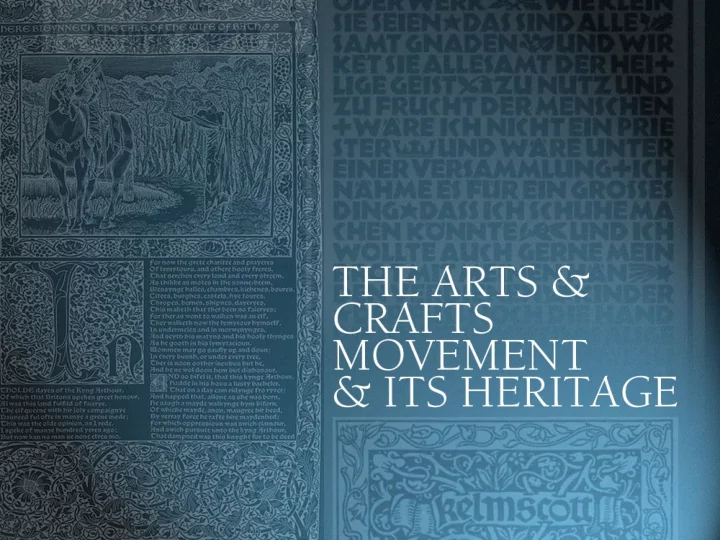
SLIDE 19 Kelmscott Press Inspired by incunabula book design, William Morris starts his
press.
SLIDE 20
William Morris designs three new typefaces for his books based on 15th century incunabula types.
SLIDE 21
Golden Morris designed this type using the Venetian roman typefaces of the Renaissance era.
SLIDE 22 Morris delved into the study
design, instead using his Golden roman type.
SLIDE 23
Kelmscott Press Morris’s first book, The Story of the Glittering Plain, was published in 1894.
SLIDE 24
Troy Based on studies Peter Schoeffer’s Gothic types, Morris developed a new gothic typeface Troy and used it in his first book.
SLIDE 25
The Works of Geoffrey Chaucer was Morris’ masterpiece of book design, printed in 1896. It used the Troy typeface.
SLIDE 26
The Works of Geoffrey Chaucer featured 87 woodcuts, 14 large borders and 18 smaller frames around the illustrations.
SLIDE 27
Morris designed over 200 initial letters and words in The Works of Geoffrey Chaucer. He used a smaller version of his Troy type and called it Chaucer.
SLIDE 28
The Private Press Movement These independent print houses were mainly concerned with high standards of design, materials and workmanship. Their books were considered works of art. Kelmscott Press Essex House Press Doves Press
SLIDE 29
The Doves Press Bible, 1903 Considered a masterpiece for its purity of design and craftsmanship. Essex House Press
SLIDE 30
The Doves Press Bible, 1903 Bookbinder T.J. Cobden-Sanderson and printer Emery Walker shared the view that “the whole duty of Typography is to communicate to the imagination, without loss by the way, the thought or image intended to be conveyed by the Author.”
SLIDE 31 The Doves Press Bible, 1903 The book’s design was spare and obsessively focussed on pure typography. Dove’s type was based
Old Style roman type of Nicolas Jenson.
SLIDE 32
A book-design renaissance: France Lucian and Esther Pissarro, 1903 Ishtar’s Descent to the Nether World
SLIDE 33
A book-design renaissance: Netherlands Jan van Krimpen, 1920 Deidre and the sons of Usnach
SLIDE 34 A book-design renaissance: Netherlands
1929 Hand and soul
SLIDE 35
A book-design renaissance: Germany Rudoph Koch, 1922-23, was a master calligrapher and designer of gothic fonts.
SLIDE 36
A book-design renaissance: He created this unexpected new design, the rough- hewn and chunky Neuland in 1922.
SLIDE 37
A book-design renaissance: America Frederic Goudy, 1911 A freelance designer, Goudy designed a total of 122 typefaces, many based on Venetian and French Renaissance type designs
SLIDE 38
A book-design renaissance: America Bruce Rogers graduated from college in the 1890s, where he was a campus artist. He worked as a newspaper illustrator, magazine designer and joined the Riverside Press in 1896 as book designer.
SLIDE 39
A book-design renaissance: America In 1912 Rogers left The Riverside Press to freelance — creating a typeface for for the New York Museum of Art and consulting for several university presses.
SLIDE 40
A book-design renaissance: America Bruce Rogers, 1915 The Centaur is one of Rogers’ most elegant book designs. Inspired by Morris, he created the typeface Centaur and illustrated the initials in the French Renaissance style.
SLIDE 41 A book-design renaissance: America Rogers had
design judgment. He determined the usefulness of a design element or decoration by whether the page was better served with
SLIDE 42