Journalists in Russia and their attitude to protests? Dmitrii - - PowerPoint PPT Presentation

journalists in russia and their attitude to protests
SMART_READER_LITE
LIVE PREVIEW

Journalists in Russia and their attitude to protests? Dmitrii - - PowerPoint PPT Presentation

Journalists in Russia and their attitude to protests? Dmitrii Gavra (St-Petersburg), Dmitry Strovsky (Ekaterinburg) Leicester, JAMCR conference, July, 2016 Political protest: cores Collective action aimed at changing the system of


slide-1
SLIDE 1

Journalists in Russia and their attitude to protests?

Dmitrii Gavra (St-Petersburg), Dmitry Strovsky (Ekaterinburg) Leicester, JAMCR conference, July, 2016

slide-2
SLIDE 2

Political protest: cores

  • Collective action aimed at

changing the system of representatives and\or executive power, the policy of the state or the relations between citizens and the state in general (Jenkins , Klandermans, 1995)

  • Purpose: to achieve collective

goals and claims (Tharrow, 2012)

slide-3
SLIDE 3

Myths about protests in modern Russia

  • No tradition;
  • Week, fragile,

fragmented;

  • Based on liberal ideas;
  • Demands for

democracy, civil rights, press freedom, etc.

slide-4
SLIDE 4

Five stages of protest movement in modern Russia (1990 – 2015)

} 1 stage – 1990 – 1991 } Mass democratic

demonstrations and social movements against the Communist party reign.

} Most numerous public

actions in the history of modern Russia.

slide-5
SLIDE 5

The second stage (1992 – 1993)

} Political protests of the

communist opposition against President Yeltsin with mass political mobilization in October 1993.

slide-6
SLIDE 6

The third stage (1994 -2004)

} The growth of the

workers strike movement

} “Putin’s consensus”

slide-7
SLIDE 7

The fourth period (2005 -2010)

} Rebirth and growth of

political protests

} Mass protests of

pensioners against Putin’s monetization social reforms – 2005

} Protest of car owners

2007-2010

} Ecological protests 2007 –

2010

} Protest in the Russian

regions against local authorities

slide-8
SLIDE 8

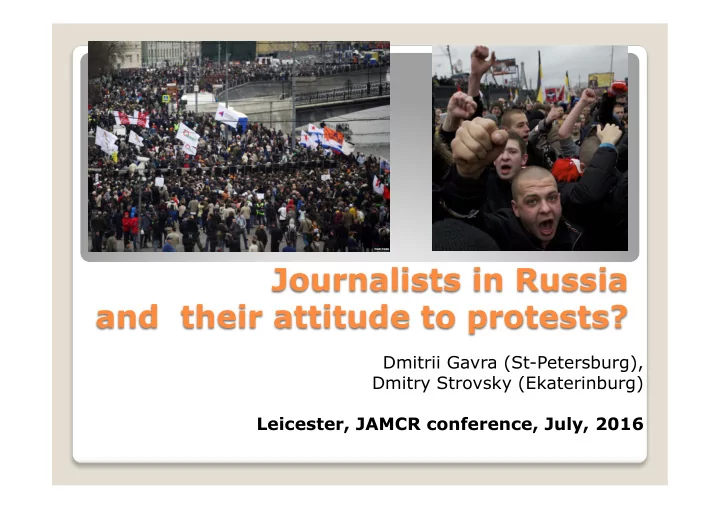
Finally, the fifth period since 2011

} Following the

parliamentary elections (2011), Russia protested against electoral fraud.

} over 30,000 citizens

pledged virtual support for the opposition on Facebook.

slide-9
SLIDE 9

Finally, the fifth period since 2011

} Young urban professionals

marched alongside pensioners and intellectuals, and the ideological spectrum ranged from liberal and communist to nationalist and monarchist.

} Official police estimates

suggested 25,000 had joined the demonstrations, while various opposition leaders claimed the crowds reached up to 150,000

slide-10
SLIDE 10

Structure of the Russian political protest

Protest

Workers strikes Russian nationalists protest Ecological protest

Protest of systemic and non-systemic political opposition

Protest of different social groups

slide-11
SLIDE 11

A#tude of Russian journalists to protests:

53,5

Posi)ve Nega)ve

46,5

slide-12
SLIDE 12

New media journalist are more likely to support protest

10 20 30 40 50 60

Tradi)onal media journalists New media journalists

40 53

slide-13
SLIDE 13

Capital and provincial journalists: different in their aFtude to protest

68.5 41.5 39 21.5 20 40 60 80 Moscow St-Petersburg Petrozavodsk Ekaterinburg

Posi5ve to protest

Posi)ve to protest

slide-14
SLIDE 14

Structural model of the Russian journalists positive attitude motivation to political protest

Oppositional political values shared with protesters Personal liking of the protest leaders and common protesters Distrust and negative attitude to acting political regime Positive attitude to the civil right of legal protest without support to protesters Protest positive

slide-15
SLIDE 15

Why do journalists support protests?

Factor 3. Distrust and negative attitude to acting political regime Roman, 42 yr., TV-correspondent

  • The protests help to destroy state oligarchy which is greedy

about getting profits only for itself.

  • The authorities do not worry about social problems,

and the protests remind them: you are bastards, you have to know your place!

  • We as people are being cheated with these Russian

powers.

slide-16
SLIDE 16

Why do journalists support protests

Factor 4. Positive attitude to the civil right of legal

protest without particular support to protesters

  • Igor’ , 27 yr., reviewer of Internet Gazette
  • It is normal to have and transmit comments from

all those who are involved in one or another

  • situation. Journalistic reports stimulate our

authorities to conceive what goes on around them. It is important to know the opinions of all sides.

slide-17
SLIDE 17

Why do journalists support protests?

Factor 2. Personal liking of the protest leaders and

protesters themselves

  • Anna, 28 yr., radio correspondent

The people from opposition are great because they come out onto the streets. They can say about what other people are silent, and this is important because lately it is not habitual in our country to speak about what is not liked.

slide-18
SLIDE 18

Structural model of the Russian journalists who are negative to political protests Distrust to the protest leaders

Fear of instability, political turbulence Positive attitude to the actual political regime

slide-19
SLIDE 19

Why do journalists neglect protests?

1.

Protests shake the boat and make the whole state mechanism totally or, at least, partly unmanageable; Darya, 40 yr.., editor in chief of the glossy magazine: As an individual of an old formation, I think that it is not worth shaking the boat. I have a very ambiguous attitude to the protests in Russia.

slide-20
SLIDE 20
  • 2. Mistrust to the leaders of opposition as personally

feeble who simultaneously tend to reach their own purposes;

Anton, 32 yr., newspaper correspondent: The ideas of opposition seem to be good, but their leaders are powerless and do not set concrete programs and purposes. Besides, they discredit each other. Therefore people do not support the opposition Pavel, 25 yr., Internet journal Many of those who protest, do this for money. I have many friends working for security bodies and they know that those who participate in protests get the money in the lobbies. I am prone to believe them. Dmitry, 26 yr.., Internet portal I support protests but do not feel interesting to take part in them. I cannot influence the powers and some people from the opposition look arrogant and selfish to real people’s needs

slide-21
SLIDE 21

3. The leaders of the protest movement think only

  • f themselves

Kirill, 26 yr., Internet newspaper They are stupid and cannot work consistently and hard. It is correct that these people are bullied. It is always as a historical process continues. If it is going ro be a civic war, it is not awful because later will be better. Maria, 28 yr., Internet website Journalists often provoke situations and are eager to draw attention only. All journalists are involved in money work. Valeriy, 45 yr., radio correspondent Those who come out onto the streets want satisfy their ego, first of all. They are not real fighters and seem to be untrusted. Many of them dream about destroying the system without bringing something positive to it.

slide-22
SLIDE 22
  • 1. Novaya gazeta,

weekly, since 1 April 1993, with the circulation 284 thousand copies

Opposition and liberally oriented media in Russia

In 2010 the newspaper received Freedom of Speech Medal от Roosevelt Study Center

slide-23
SLIDE 23
  • 2. Meduza Project, since July 2014

Galina Timchenko, editor-in-chief, a former director

  • f the closed Information portal Lenta.ru:

“We choose the most important news and prepare the best texts on what is happening in both Russia and the world”