Judy Paterson, Joel Laity and John Moala University of Auckland - - PowerPoint PPT Presentation

judy paterson joel laity and john moala university of
SMART_READER_LITE
LIVE PREVIEW

Judy Paterson, Joel Laity and John Moala University of Auckland - - PowerPoint PPT Presentation

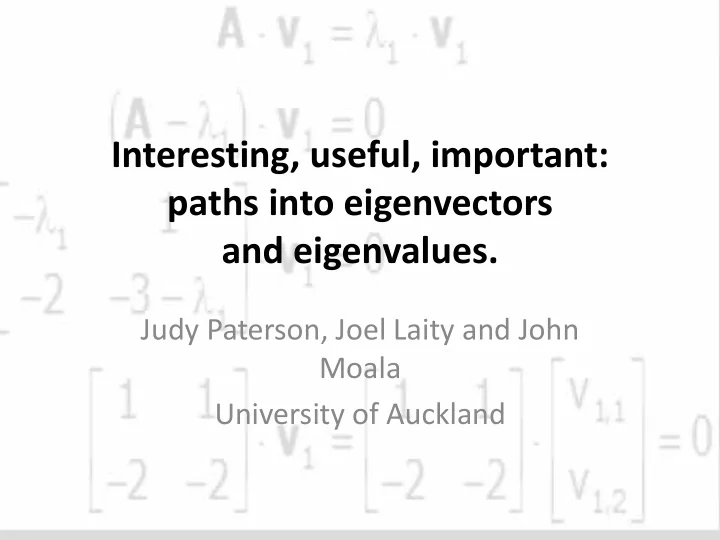
Interesting, useful, important: paths into eigenvectors and eigenvalues. Judy Paterson, Joel Laity and John Moala University of Auckland Route map Introductory remarks Starting point interviews, participants, co- researchers


slide-1
SLIDE 1

Interesting, useful, important: paths into eigenvectors and eigenvalues.

Judy Paterson, Joel Laity and John Moala University of Auckland

slide-2
SLIDE 2

Route map

  • Introductory remarks
  • Starting point –interviews, participants, co-

researchers

  • Interesting: what motivates students
  • Research connections
slide-3
SLIDE 3
  • A very early influence on my research
slide-4
SLIDE 4

“And if anyone knows anything about anything," said Bear to himself, "it's Owl who knows something about something," he said, "or my name's not Winnie-the- Pooh," he said. "Which it is," he added. "So there you are.” Before beginning a hunt, it is wise to ask someone what you are looking for before you begin looking for it. You can't stay in your corner of the Forest waiting for

  • thers to come to you. You have to go to them

sometimes.

Milne, A.A. (1928) The house at Pooh corner. Methuen and Co., Ltd. London

slide-5
SLIDE 5

The interview

  • Imagine that you are in the following situation:
  • You are teaching one stream or section of a general

first year course in calculus and linear algebra for students who intend to major in maths. I would like you to explain to me how you might introduce eigenvectors and eigenvalues in this context. I am interested in the reasons you take the approach or approaches you choose.

slide-6
SLIDE 6

Participants and co-researchers

  • 23 research mathematicians who lecture

– 5 English speaking countries – some bilingual – Wide range of research areas, ages – 4 women – 2 had never taught these concepts

  • 2 summer scholarship students who looked at

the data in detail.

slide-7
SLIDE 7

Overview from John’s report

  • “Listening to professional mathematicians

discuss: how they order and filter the information that they present, what they believe motivates students to learn mathematics, what they consider to be the major impediments to meaningful learning of certain mathematical concepts, and how they teach the concepts differently to different types of students, was enlightening.”

slide-8
SLIDE 8

Which way to go??

slide-9
SLIDE 9
  • From Joel’s report
  • When lecturers discussed how they would introduce

eigenvectors and eigenvalues it became apparent that many of them had put a lot of thought into two aspects in particular. The first of these was the question of how the subject should be motivated. Most of the lecturers were unhappy to simply state the definition of an eigenvector and eigenvalue and instead wanted the students to have some idea of why these are interesting, useful or important concepts before they started learning about them. This was particularly interesting because the way lecturers would motivate eigenvectors and eigenvalues was so diverse. Some lecturers used real world applications to pique their students' interest while others would motivate eigenvectors and eigenvalues from an algebraic or geometric perspective.

slide-10
SLIDE 10

Why they are interesting, useful or important concepts.

– Interesting or useful – real world

–Interesting – Algebraically –Useful – later –Important – big picture

slide-11
SLIDE 11

What you see in the course description isn’t exactly what you actually get

Meat and Potatoes – with added spice

  • One interviewee explained how he and a fellow

lecturer, teaching at different institutions, were supposedly teaching the same course (based on the fact that their syllabi were identical) only to discover, through various discussions about what the content

  • f this common syllabus meant to each of them, that

they were teaching two different courses.

slide-12
SLIDE 12

The overview mathematicians see

slide-13
SLIDE 13

Paths

  • Examples

– of a matrix and different vectors

  • Algebraically
  • Geometrically
  • Demonstrate mathematically ‘how it’s done’ in
  • rder to use them in an application
  • Use of technology

– To visualise – real world

  • Arise naturally

– Engineering – Applied mathematics

slide-14
SLIDE 14

Algebraic example 1

Mostly math majors - still start with examples, but they get the whole nine yards: definition, theorem, proof. Start with 3 by 3 matrix, apply to a vector, it looks random, there’s no obvious pattern to what it is doing. Then I pull

  • ut the eigenvectors and say, “Look if you apply it to these

vectors, something amazing happens – it stays on the same line, it just gets multiplied by a scalar.” And this year somebody put up his hand and said, “Where did you get those vectors from?” Once you find these ‘special vectors’ you get great insight into these transformations. Lovely thing to teach, rich applications.

slide-15
SLIDE 15

Algebraic example 2

I have this line which I use, which I think doesn’t always go down well, but I kind of have the vectors, I picture them as little kind of, you know, little creatures in space, and this matrix is going to come along and hit them. Hit them and move them somewhere else. And the matrix does the same as the number 3 does. So really they have a special relationship to each other with this vector, special for that matrix. And so that’s how I try to explain the basic concept of an eigenvector

slide-16
SLIDE 16

More general

  • I would probably go for invariance of certain

subspaces under a mapping. That might be useful.

slide-17
SLIDE 17

The ideas we study in Linear Algebra will be useful in

  • ther more advanced branches of Mathematics and

students should be made aware of this. In particular eigenvectors and eigenvalues is a phenomenon that will be encountered by them later in context of infinite-dimensional and, in particular, functional vector spaces, used for solving differential equations and represent quantum states in Mathematical

  • Physics. We can give them an idea of what is to

come by showing the operator of differentiation and explaining that when we learn to treat functions as vectors, then the exponent will be an eigenvector. For example, the function eλx is an eigenvector of the differential operator with eigenvalue λ since

slide-18
SLIDE 18

Shift to geometry

If I think back to how I first taught them I would have taught them by characteristic equations. So in a full algebraic sense. And at one stage I remember going to a lecture where someone had a nice graphical representation of eigenvectors, and that definitely was, if I think back, that was instrumental in changing the way that I would try and teach

  • them. So I would absolutely focus on the

multiplying by the matrix is the same as multiplying by scalar. And then I would look for some problems where that literally happened.

slide-19
SLIDE 19

Some years ago I (belatedly) made the link between eigenvectors as an algebraic phenomenon, and eigenvectors as vectors that preserve their direction when their parent matrix is regarded as a geometric

  • transformation. I realised the potential to present a

pedagogically powerful image for students’ understanding of what might otherwise be an abstract algebraic notion.

slide-20
SLIDE 20

Geometrical example

Eigenvectors and eigenvalues are geometric objects, okay. There’s a geometry about eigenvectors and eigenvalues. You take simple cases in two and three dimensions, you have matrices that act on vectors in the plane or in space. You can talk about rotations, you can talk about reflections, and you can then ask about how matrices act

  • n those vectors. The class as a whole get the same

vectors, what did your matrices do to these vectors. And then you share pictures of it and of course some of them turn out to be eigenvectors and some of them turn out not to be.

slide-21
SLIDE 21

Using technology- to visualise

  • I came from a very traditional undergraduate education,

which was very abstract. Algebra for me was - you have these maps and the homomorphism does this and so on. So that to me was linear algebra. And I came here and there was all these matrices, just a whole book full of matrices, and I thought what’s that got to do with

  • anything. It didn’t even look like linear algebra to me. So I

really had to stop and think, okay what, how am I going to, what’s going on here ….

  • Eigenvectors and eigenvalues, well, that’s a really

important concept. I would take 10 or 15 minutes, and I have a visual in mind that I use, an animation, one of the few computer animations that I use in class. I don’t really like technology when I teach, but that’s one of the places where I say no, no, this is really important. And if you get this you are going to get a lot of what we have been doing, so I really take time on that one.

slide-22
SLIDE 22

Using technology - Real World

The example I use is the Leslie Age Distribution Model, which you can attach meaning to the axes. It’s a biology example yeah. So you divide a population into age

  • groups. So I had some actual data for a seal population
  • ff the coast of Nova Scotia on a pilot, so I just used the

actual data, because why not.

slide-23
SLIDE 23

Arise naturally - Engineering

I think it came along naturally in, when we were trying to solve systems of differential equations. We have that application in mind. We have several differential equations and we want to solve them simultaneously, which leads to an equation that turns out to need eigenvectors. Then you’ve got your motivation of perhaps why this is a useful

  • concept. So this is how it happened.
slide-24
SLIDE 24

Arise naturally – Applied Mathematics

When you’re looking at phase plane plots or direction fields… Okay, so you have this

  • bservation that certain types of solutions are

straight line solutions, and then when you see what that means for the matrix and the vector, together to get a number times a vector and then you say well we have a special name for this kind of relationship, this is an eigenvector and an eigenvalue.

slide-25
SLIDE 25

Need to know how, then use

Believe me you will find this very useful – just get your mind around the computation first.

slide-26
SLIDE 26

Suggestions for reasons for choice

  • Clearly a function of who is being taught

– they are math majors so ….

  • Own example space

– I like – I don’t

  • neat
  • Own experience

– very abstract – I used to but now

slide-27
SLIDE 27

Questions to ask the data I have and in the future.

  • Would be Interesting to examine impact on

students – or to ask mathematicians a bit more about how they were introduced to the ideas that now fascinate them. Do Introductions matter?

  • Are eigenvectors and eigenvalues threshold

concepts?

  • Do we see the same degree of variation in the

presentation of other concepts?

  • Great gestures in the data – one participant

already part of a project focussed on that at SFU.

slide-28
SLIDE 28

What have we found in the literature

  • Very little on the teaching choices made by mathematicians

as they first introduce concepts undergraduate mathematics.

  • We view these choices as a particular example of the

decisions teachers make all the time while teaching .

  • We can examine the choices and decisions against findings

from research on

– personal example spaces – examples – concern about students’ understanding of definitions – mathematical knowledge for teaching – APOS theory – advanced mathematical thinking – visualisation – threshold concepts.

slide-29
SLIDE 29
  • Thanks for following me along the paths.
slide-30
SLIDE 30

From John Butcher

  • Eigenvalues and eigenvectors are at the centre of

science and the diversity of approaches reflects this.

slide-31
SLIDE 31
slide-32
SLIDE 32
slide-33
SLIDE 33
slide-34
SLIDE 34
slide-35
SLIDE 35
  • Eigenvectors and eigenvalues illuminate …..
slide-36
SLIDE 36