Juvenile Chinook Salmon Monitoring on the Mainstem Trinity River, - - PowerPoint PPT Presentation

juvenile chinook salmon monitoring on the mainstem
SMART_READER_LITE
LIVE PREVIEW

Juvenile Chinook Salmon Monitoring on the Mainstem Trinity River, - - PowerPoint PPT Presentation

Juvenile Chinook Salmon Monitoring on the Mainstem Trinity River, California USFWS Arcata Fish and Wildlife Office Yurok Tribal Fisheries Program Hoopa Valley Tribal Fisheries Department Outline History Why Monitor


slide-1
SLIDE 1

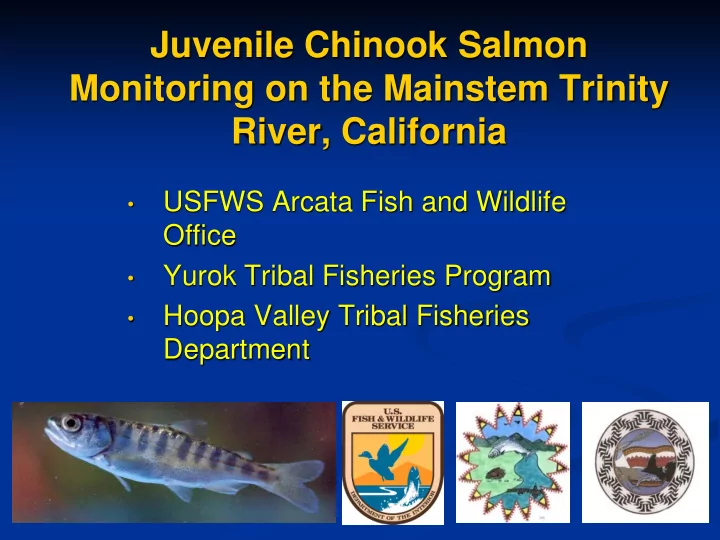
Juvenile Chinook Salmon Monitoring on the Mainstem Trinity River, California

  • USFWS Arcata Fish and Wildlife

Office

  • Yurok Tribal Fisheries Program
  • Hoopa Valley Tribal Fisheries

Department

slide-2
SLIDE 2

Outline

 History  Why Monitor Juvenile Salmon

Outmigration?

 How Data are Currently Presented  Preliminary Analytical Results  Other Uses of Data  Questions for TAMWG

slide-3
SLIDE 3

X

Willow Creek Trap Site

X

Pear Tree Trap Site

slide-4
SLIDE 4

 Willow Creek

  • 1989-2016

 Junction City

  • 1992-2004

 Pear Tree

  • 2003-2016

 Outmigrant Review

  • 2009 – Need for More Mark-Recapture for Population Estimates

 2003--Move to Pear Tree from Junction City to estimate

Chinook Salmon production in upper 40 Miles

 Willow Creek -- estimate Chinook Salmon migration timing

and production of Trinity River basin

slide-5
SLIDE 5

Implementing Outmigrant Review Recommendations

 Trap Earlier -> Catch more of ‘Spring

Chinook’ emigration period (Dec-Mar)

 Use Hatchery Fish for Mark-Recapture

  • Implemented Freeze

Branding in 2009

  • 130,000 Hatchery

Chinook Salmon

  • Unique mark for

each release group/site

  • Up to 8 unique

marks per week

slide-6
SLIDE 6

Partners

 USFWS

 Operated Willow Creek Site

 1989-2002  2003-2010 Jointly With Yurok Tribal Fisheries (YTFP)

 Oversee Population Estimation

 Coordinate with YTFP and Hoopa Tribal Fisheries

Department  Yurok Tribe

 Willow Creek Site Operations

 Hoopa Valley Tribe

 Pear Tree Site Operations

slide-7
SLIDE 7

Why Monitor Juvenile Salmon

 Integrated Assessment Plan

 Objective 3: Restore and maintain natural

production of anadromous fish populations. Sub-objective 3.2: Increase freshwater production of anadromous fish.

 Abundance of Juvenile Chinook Salmon is

Key Metric for assessing Objective 3 & 3.2

 Juveniles vs Adults

 Juvenile should be a more direct measure of

restoration/management actions

slide-8
SLIDE 8

How Data Are Currently Presented

 Reports

AFWO website:

 https://www.fws.gov/arcata/fisheries/reportsDisplay.html

Population Estimates Fork Length Summaries Condition Factor Much More

slide-9
SLIDE 9

Population Estimates

50,000 100,000 150,000 200,000 250,000 300,000 350,000 400,000 450,000

Weekly Population Estimate Week of Year (Start date) Natural Hatchery

WCRST 2015

slide-10
SLIDE 10

Population Estimates

50,000 100,000 150,000 200,000 250,000 300,000 350,000 400,000 450,000

Weekly Population Estimate Week of Year (Start date) Natural Hatchery

PTRST 2015

slide-11
SLIDE 11

Fork Length Summaries

20 40 60 80 100 120 140 160 180 200 220 1 3 5 7 9 11 13 15 17 19 21 23 25 27 29 31 33 35 37 39

Week of the Year

PTRST 2015 Chinook Salmon

Age-0 Age-1

Mean fork length (mm)

slide-12
SLIDE 12

Condition Index – Fulton’s Condition Factor (K)

slide-13
SLIDE 13

Lots of Data (1 appendix of 15)

Week Starting Week

  • f

Year Mean Daily Discharge m3/s Trap Days Sampled Weekly Chinook Salmon Catch Weekly Chinook Salmon Index Hatchery Natural Catch Total Hatchery Natural Index Total NC AD Age-1 Age-0 Age-1 NC AD Age-1 Age-0 Age-1

1/8/15

2 16.7 3 4 4,518 4,522 51 57,401 57,452

1/15/2015

3 23.4 5 3 10,257 10,260 32 109,304 109,336

1/22/2015

4 17.0 5 13,864 4 13,868 128,369 37 128,406

1/30/2015

5 18.7 5 13,781 1 13,782 140,487 10 140,497

2/5/2015

6 124.6 2 1,885 1,885 351,715 351,715

2/12/2015

7 41.2 4 5,526 5,526 161,841 161,841

2/19/2015

8 24.5 5 2,741 2 2,743 37,335 27 37,362

2/26/2015

9 19.4 5 1,801 1,801 19,852 19,852

3/5/2015

10 17.0 5 4 735 2 741 29 7,352 14 7,395

3/12/2015

11 17.0 5 509 2 511 5,006 20 5,026

3/19/2015

12 16.1 5 6 531 537 52 4,690 4,742

3/26/2015

13 16.7 5 903 2 905 8,210 18 8,228

4/2/2015

14 14.8 5 2,206 3 2,209 18,698 25 18,723

4/9/2015

15 15.3 5 2,500 7 2,507 21,567 60 21,627

4/16/2015

16 15.1 5 1,786 2 1,788 16,605 19 16,624

4/23/2015

17 19.7 5 1,674 1 1,675 20,160 12 20,172

4/30/2015

18 123.5

  • 5/7/2015

19 119.2 4 332 332 30,396 30,396

5/14/2015

20 62.0 5 458 458 15,711 15,711

5/21/2015

21 59.7 4 156 156 5,863 5,863

5/28/2015

22 46.2 5 662 199 292 1,153 15,245 4,582 6,719 26,546

6/4/2015

23 34.0 5 2,858 859 78 3,795 47,329 14,225 1,291 62,845

6/11/2015

24 22.2 5 1,707 560 2,267 20,272 6,650 26,922

6/18/2015

25 19.1 5 1,527 459 95 2,081 15,132 4,548 941 20,621

6/25/2015

26 15.3 5 1,486 481 1,967 12,103 3,918 16,021

7/2/2015

27 12.6 3 506 152 287 945 10,833 3,256 6,154 20,243

7/9/2015

28 13.8 5 343 104 447 8,999 2,728 11,727

7/16/2015

29 13.0 5 203 61 19 283 5,507 1,655 518 7,680

7/23/2015

30 12.7 5 47 14 12 73 1,437 432 384 2,253

7/30/2015

31 12.6 5 26 10 36 356 137 493

8/6/2015

32 12.6 4 9 5 14 276 153 429

8/13/2015

33 27.8 3 6 2 8 509 170 679

8/20/2015

34 28.3 4 2 2 37 37

8/27/2015

35 31.7 1

Totals

147 9,380 2,906 17 66,948 26 79,277 137,998 42,454 164 1,176,606 242 1,357,464
slide-14
SLIDE 14

Other Species

 Coho Salmon / steelhead

 No Population Estimates  Flow Based Abundance Index  Length/Weight

 Green Sturgeon  Lamprey  Brown Trout  Others

slide-15
SLIDE 15

Database Management

 Standardized Outmigrant Database for

entire Klamath Basin

 Ensures data is comparable across sampling

sites

 Graphing Features  Custom Queries

slide-16
SLIDE 16

Preliminary Analytical Results

 Four Modes of Restoration

  • 1. Flow Management from Lewiston Dam
  • 2. Construct Channel Rehabilitation Sites
  • 3. Augmentation of Spawning gravels
  • 4. Control of fine sediments
slide-17
SLIDE 17

Willow Creek Population Time Series

 1989-2014  Mark-Recapture Population Estimates for

Juvenile Chinook Salmon

 Separate Estimates for Wild and

Hatchery Fish

slide-18
SLIDE 18

25 Years of Data – Wild Juvenile Chinook Salmon

1 2 3 4 5 6

Millions Year

Population Estimates ‘ROD Flows’

slide-19
SLIDE 19

Extreme Years – Low Population Size

5 10 15 20 25

1 1 2 3 4 5 6 7 8 9 10 11 12 Thousands of Acre Feet Month

High Flow During Critical Incubation Period

= Scour / Displacement / Decreased Initial Feeding Success (High Turbitidy)

slide-20
SLIDE 20

Population vs Jan-Feb Peak Discharge

  • 1.5
  • 1
  • 0.5

0.5 1 1.5 2 2.5 3

  • 1.5
  • 1
  • 0.5

0.5 1 1.5 2 2.5 3 3.5 Total Population Estimates Standardized Residuals Jan-Feb Peak Daily Discharge Standardized Residuals

slide-21
SLIDE 21

Record Of Decision Flows

5 10 15 20 25

1 1 2 3 4 5 6 7 8 9 10 11 12

Thousands of Acre Feet Month

Increased Flows during Juvenile Rearing / Outmigration Period

slide-22
SLIDE 22

Pre-ROD Flows

5 10 15 20 25

1 1 2 3 4 5 6 7 8 9 10 11 12

Thousands of Acre Feet Month

Pre-Rod flows during study period, 1989-2003

slide-23
SLIDE 23

ROD Flows

5 10 15 20 25 1 1 2 3 4 5 6 7 8 9 10 11 12 Thousands of Acre Feet Month

slide-24
SLIDE 24

Statistical Equation

 Juvenile Abundance – Function of:

 Adult Population Size  High Flow / No High Flow

 Jan/Feb Peak Daily Discharge (JFPQ) >> Average

 Volume of Rearing Habitat

 Size of the ‘Fish Tank’  Sum of April/May Discharge in Acre Feet (AMAF)

 Juvenile Abundance ~ Adult + JFPQ + AMAF

slide-25
SLIDE 25

Linear Model

Estimate

  • Std. Error

T-value Pr > |t| sig Intercept 1.833 e+06 3.759 e+05 4.878 0.000078 *** JFPQ

  • 1.753 e+06

3.837 e+05

  • 4.569

0.00015 *** AMVOL 5.165 e+05 1.934 e+05 2.671 0.01396 * Adult 1.763 e+01 9.561 e+00 1.844 0.07868 . P-Value 0.0002737 Adj R-sq 0.5124

  • Coefficient of Jan February Peak is Negative
  • Coefficient of April/May Volume is Positive
  • Coefficient of Adult Population is Positive
slide-26
SLIDE 26

Emigration Timing

 Measured at Willow Creek Trap Site  Species Specific Temperature Targets at

Willow Creek – Flow Study

 Goal: get 80% of Population Past Willow

Creek by the Target Dates

 Run Timing 80% = RT80

slide-27
SLIDE 27

0.2 0.4 0.6 0.8 1

16-Apr 23-Apr 30-Apr 7-May 14-May 21-May 28-May 4-Jun 11-Jun 18-Jun 25-Jun 2-Jul 9-Jul 16-Jul 23-Jul 30-Jul 6-Aug 13-Aug 20-Aug 27-Aug

Cumulative Abundance From 2001 to 2015

2001 2002 2003 2004 2005 2006 (ext. wet) 2007 2008 2009 2010 2011 2012 2013 2014 (crit dry) 2015

CRIT.DRY DRY NORMAL WET

  • EX. WET
slide-28
SLIDE 28

0.2 0.4 0.6 0.8 1

16-Apr 30-Apr 14-May 28-May 11-Jun 25-Jun 9-Jul 23-Jul 6-Aug 20-Aug

Cumulative Emigration Dry Year Emigration

2001 2007 2009 2014 (crit dry) 2015 Dry year RT80 range from June 9 to June 29

slide-29
SLIDE 29

0.2 0.4 0.6 0.8 1 16-Apr 30-Apr 14-May 28-May 11-Jun 25-Jun 9-Jul 23-Jul 6-Aug 20-Aug

Cumulative Emigration

Normal Year Emigration

2002 2005 2008 2010 2012 Normal year RT80 range from June 20 to July 17

slide-30
SLIDE 30

0.2 0.4 0.6 0.8 1 16-Apr 30-Apr 14-May 28-May 11-Jun 25-Jun 9-Jul 23-Jul 6-Aug 20-Aug

Cumulative Emigration

Wet Year Emigration

2003 2004 2006 (ext. wet) 2011 Wet year RT80 range from July 4 to July 24

slide-31
SLIDE 31

RT80 vs Temperature

y = -0.1111x + 299.36 R² = 0.8191

150 160 170 180 190 200 210

900 950 1000 1050 1100 1150 1200 1250 1300

Date of RT80 vs. ATUs at NF Helena Day of Year (RT80)

Total Accumulated Thermal Units on RT80 date

slide-32
SLIDE 32

Other Uses of Outmigrant Data

 Salmon Production Model (SSS), a

component of the Decision Support System (DSS)

 Weekly Population Estimates

 Pear Tree  Willow Creek

 Size Data (fish lengths)

 Pear Tree Primarily (current SSS model is for

upper 40)

 Willow Creek

 Emigration Timing

 Both Pear Tree and Willow Creek

slide-33
SLIDE 33

Summary

 25 Years of Population Estimates  Negative Effect of January February High

Flows

 Positive Effect of April/May Discharge

Volume

 Wet Years Extend Emigration Period  Timing and Magnitude of Water

Management is Very Important

slide-34
SLIDE 34

Questions for TAMWG

 How can data delivery be improved?  What else would you like to see?  Would regular meetings with TAMWG help?

slide-35
SLIDE 35