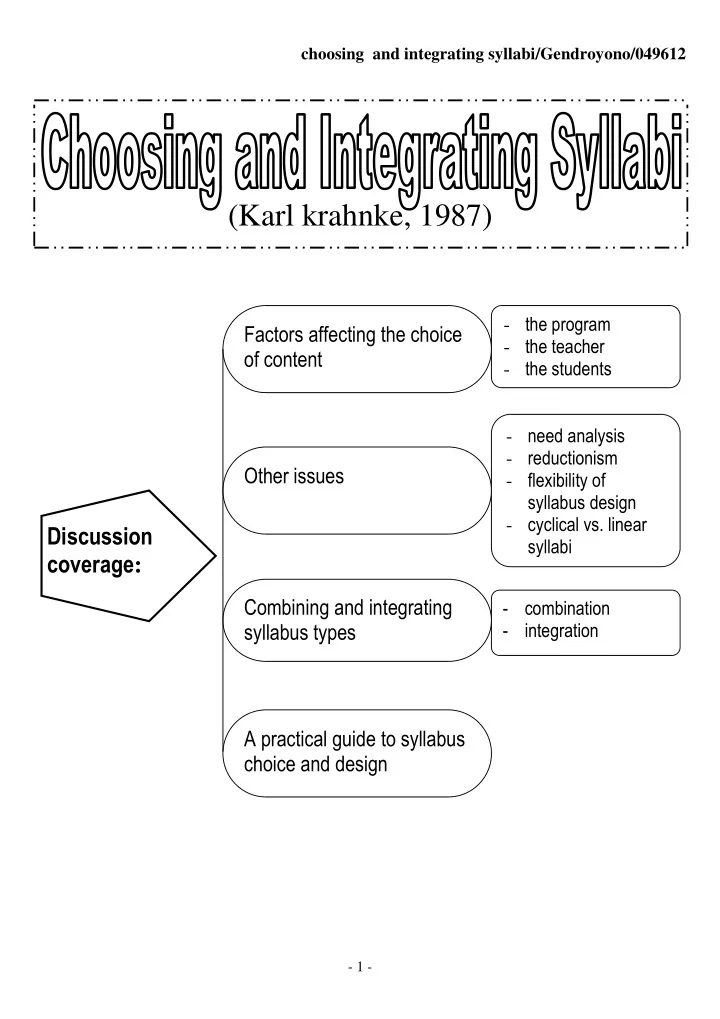
(Karl krahnke, 1987) - the program Factors affecting the choice - - - PDF document

karl krahnke 1987
SMART_READER_LITE
LIVE PREVIEW

(Karl krahnke, 1987) - the program Factors affecting the choice - - - PDF document

choosing and integrating syllabi/Gendroyono/049612 (Karl krahnke, 1987) - the program Factors affecting the choice - the teacher of content - the students - need analysis - reductionism Other issues - flexibility of syllabus design - cyclical


slide-1
SLIDE 1

choosing and integrating syllabi/Gendroyono/049612

  • 1 -

(Karl krahnke, 1987)

Factors affecting the choice

  • f content

Other issues Combining and integrating syllabus types A practical guide to syllabus choice and design

  • the program
  • the teacher
  • the students
  • need analysis
  • reductionism
  • flexibility of

syllabus design

  • cyclical vs. linear

syllabi

Discussion coverage:

  • combination
  • integration
slide-2
SLIDE 2

choosing and integrating syllabi/Gendroyono/049612

  • 2 -

Program factors

Goals and objectives Instructional resources Accountability and measurement

  • The type of knowledge or

behavior desired as an outcome

  • f the instruction.
  • The relationship of the goals

instruction to the content of instruction has not always been direct.

  • For almost all instructional

programs, it is clear that some combination of types of instructional content will be needed to address the complex goals of the program.

  • Include elements such as time,

textbooks, and other materials, visuals, realia, and out-of- classroom resources such as TV programs, etc.

  • Of these resources, textbooks

certainly play the greatest role in the determination of syllabus.

  • The resources instructor can

devise resources and modify activities so that available resources can be used.

  • The need to make the

instruction accountable to authorities or measurable by external measures – usually tests.

  • The influence of test on the

content of instruction is a well-known phenomenon.

  • Teachers and instructional

programs often teach toward a particular kind of knowledge if it is going to be tested, even though the knowledge may not be what the students really need.

Which the types of content to include or exclude? Whether to combine various types of syllabus content or to rely on a single type. Whether to use one type as basic and to organize others around it, or to sequence each type more or less independently of the other.

Questions in designing basic syllabus

slide-3
SLIDE 3

choosing and integrating syllabi/Gendroyono/049612

  • 3 -

Teacher factors

Teachers tend to teach what they know. Teacher’s ability The teacher’s belief system or

  • rientation

Teacher’s experiences as students

The conservative position on the relationship between a teacher’s beliefs and abilities and the choice of instructional content is to expect that teachers be relatively willing and able to undertake the type of instruction chosen before they undertake it; otherwise they will use content with which they are more comfortable at best and, at worst, flounder.

Student factors

The goals of the students Student’s prior knowledge Student’s expectations Student’s experiences Student’s social and personality types The number of students in a given class

Other issues

Needs analysis Cyclical vs. linear syllabi Flexibility of syllabus design Reductionism

slide-4
SLIDE 4

choosing and integrating syllabi/Gendroyono/049612

  • 4 -
  • The linguistic and communicative material that students will need is determined, and the

teaching syllabus is developed accordingly.

  • This is rather difficult to perform for several reasons.
  • First is economic (time, financial resources, expertise): A good NA requires the skills of a

trained linguist as well as other professionals.

  • Second, NA is often not practically feasible (requiring extensive time investment)
  • Last, NA may reveal that students’ needs are so broad that a useful selection of content is

difficult to make.

Needs analysis

  • A reductionist approach attempts to define the least that should be taught to meet some real
  • r imagined need.
  • Reductionism in syllabus design is a temptation because of the apparent success with which

limited amounts of language can be taught and learned.

  • Reductionist approaches to syllabus design do more harm than good, considering what

students really need in order to succeed with a second language.

  • The most practical alternative to reductionist syllabi is instructional content that provides

learners with the broadest possible range of abilities and knowledge.

Reductionism

  • A narrowly defined syllabus allows little room for modification by teacher or students: they do

what the syllabus predetermines for the classroom.

  • In contrast, a loosely defined syllabus allows for more flexibility, modification, and innovation
  • n the part of the teachers and students.
  • The type of syllabus also affects the degree of definition. Structural, functional, situational:

narrowly defined syllabus. Skill, task, content-based: loosely defined syllabus.

Flexibility of syllabus design

  • In a linear syllabus, material is dealt with once, presumably mastered by the students, and

never directly taken up again.

  • This is the concept of mastery learning, by which a series of small, discrete steps is taught

and learned, and all add up to the overall behavior desired.

  • New definition of language learning: language learning is not just cumulative, it is an

integrative process (Corder, 1973)

  • This view argues for a cyclical pattern that allows language material to be dealt with

repeatedly as the syllabus progresses, usually with a greater degree of complexity each time it is encountered.

Cyclical vs. linear syllabi

slide-5
SLIDE 5

choosing and integrating syllabi/Gendroyono/049612

  • 5 -

COMBINING AND INTEGRATING SYLLABUS TYPES

  • Combination is the inclusion of more than one type of syllabus with little attempt to

relate the content types to each other.

  • Combination frequently occurs in language teaching when various communicative
  • r “fluency” activities (i.e., skills, tasks) are added on to a structural, functional, or

situational syllabus.

  • While integration is when some attempt is made to inter-relate content items.
  • Example: after a structural lesson on the subjunctive, students were asked to

prepare stories on the theme, “what I would do if I were rich,” the two types of instruction would be integrated.

  • Instruction that reinforces and relates various syllabus and content types is

probably more effective than instruction that is divided into discrete compartments.

  • On the other hand, when specific knowledge and behavioral outcomes are desired,

discrete combinations may be preferable to fully integrated syllabi.

slide-6
SLIDE 6

choosing and integrating syllabi/Gendroyono/049612

  • 6 -

.

A practical guide to syllabus choice and design

Ten step in preparing a practical language teaching syllabus (Dubin & Olshtain, 1986; Steiner, 1975)

  • 1. Determine, to the extent possible, what outcomes are desired for the students in the

instructional program. That, as exactly and realistically as possible, defines what the students should be able to do as a result of the instruction.

  • 2. Rank the syllabus types presented here as to their likelihood of leading to the
  • utcomes desired. Several rankings may be necessary if outcomes are complex.
  • 3. Evaluate available resources in expertise (for teaching, needs analysis, material

choice and production, etc.), in materials, and in training for teachers.

  • 4. Rank the syllabi relative to available resources. That is, determine what syllabus

types would be the easiest to implement given available resources.

  • 5. Compare the lists made under Nos. 2 and 4. Making as few adjustments to the

earlier list as possible, produce a new ranking based on the resources constraints.

  • 6. Repeat the process, taking into account the constraint contributed by teacher and

student factors described earlier.

  • 7. Determine a final ranking, taking into account all the information produced by the

earlier steps.

  • 8. designate one or two syllabus types as dominant and one or two as secondary
  • 9. Review the question of combination or integration of syllabus type and determine

how combination will be achieved and in what proportion.

  • 10. Translate decisions into actual teaching units