Ketamine Cystitis Dr Peggy CHU Tuen Mun Hospital Ketamine (C 13 H - PDF document
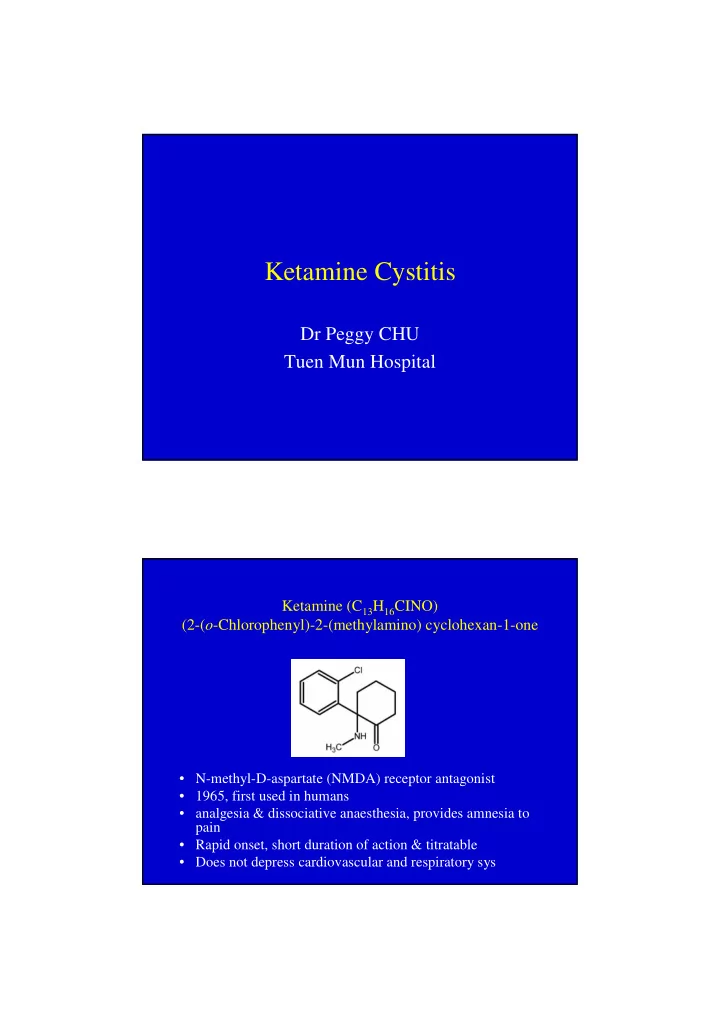
Ketamine Cystitis Dr Peggy CHU Tuen Mun Hospital Ketamine (C 13 H 16 CINO) (2-( o -Chlorophenyl)-2-(methylamino) cyclohexan-1-one N-methyl-D-aspartate (NMDA) receptor antagonist 1965, first used in humans analgesia &
Ketamine Cystitis Dr Peggy CHU Tuen Mun Hospital Ketamine (C 13 H 16 CINO) (2-( o -Chlorophenyl)-2-(methylamino) cyclohexan-1-one • N-methyl-D-aspartate (NMDA) receptor antagonist • 1965, first used in humans • analgesia & dissociative anaesthesia, provides amnesia to pain • Rapid onset, short duration of action & titratable • Does not depress cardiovascular and respiratory sys
Ketamine • onset – 3 – 5 min (IMI) – 60 s (IVI) • duration of action – 20 – 30 min (IMI) – 10 – 15 min (IVI) • N-dealkylated in liver, metabolized and excreted in urine (>90%) Hong Kong Statistics Central Registry of Drug Abuse 58 th Report
HK’s first 10 cases of ketamine cystitis Hong Kong Med J 2007; 13: 311 – 3 Introduction Hong Kong Med J 2007; 13: 311 – 3
Patients • TMH • Sep 2006 - Jun 2010 • 113 patients • M: F = 90: 43 • mean age 25.6 yrs (14 – 42) • years of ketamine abuse: 3/12 to 11 years • referred by A&E, GP, psychiatrist • C/O: LUTS+ve Lower Urinary Tract Symptomatology • frequency, urgency, dysuria, urge incontinence, painful haematuria • urine culture –ve • no response to multiple courses of oral antibiotics
Urodynamic evaluation • 56/113 • Cystometric capacity 14 – 600 ml – 42/56 � 150 ml – 30/56 � 100 ml • 6/56 bilateral vur
Urodynamic Urodynamic • uni/bilateral vur
Cystoscopic Findings • 65/113 had cystoscopy • 25/65 – various degrees of mucosal inflammation – glomerulations Cystoscopic findings A B
Cystoscopic findings Upper Urinary Tract • blood creatinine • +/- hydronephrosis • papillary necrosis • ureteric stricture
Blood Creatinine • 10/113 – Creatinine 126 - 1069 – 2 required PCN
Upper Tract Radiology • all have renal USG – 30% bilateral hydronephrosis – 10% unilateral hydronephrosis Upper Tract Radiology • 2 bilat PCN x ARF
Upper Tract Radiology • all have renal USG – 4/113 sonographic evidence papillary necrosis Upper Tract Radiology • CT scan – acute papillary necrosis – Paraaortic lymphadenopathy – thickened ureteric wall suggestive of marked ongoing transmural inflammatory changes
Aetiology • ? ketamine • ? cutting agent (?impurites) Evidence for ketamine • HK only pure ketamine identified in the “ketamine” provided by patient & government lab • Canada
Pathophysiology ? chronic submucosal inflammatory response resulting from chemical cystitis ? microvascular changes ? autoimmune (raised ESR & C3/4) ? bacteriuria Treatment × Antibiotics × Antimuscarinic agent (oxybutynin, detrusitol) × Hyaluronic acid (oral elmeron /intravesical cystistat) √ ? Cystoplasty √ √ √ ABSTINENCE
Guidelines (before Jun 2008) ≤ 25 g within discretion of sentencer 25 – 400 g 2 - 4 yrs’ imprisonment 400 - 800 g 4 - 8 yrs ≥ 800 g ≥ 8 yrs Guideline (after Jun 2008) ≤ 1 g within discretion of sentencer 1 - 10 g 2 - 4 yrs’ imprisonment 10 - 50 g 4 - 6 yrs 50 - 300 g 6 - 9 yrs 300 - 600 g 9 - 12 yrs 600 - 1000 g 12 - 14 yrs ≥ 1000 g ≥ 14 yrs
Asia • China Asia Taiwan Am J Addict 2008; 17(5):453
Asia Taiwan Am J Addict 2008; 17(5):453 Canada Urology 2007; 69(5): 810-2
Europe • UK : 1 st reported case from Guy’s Hospital BMJ 2008; 336: 898 Europe • UK: echoed by urologists from Bristol BMJ 2008; 336: 973
New Problems with ketamine abuse PUF score
Neurogenic Bladder arising from ketamine abuse ketamine cystitis social problem medical problem
Thank You
Recommend
More recommend
Explore More Topics
Stay informed with curated content and fresh updates.