Key Topics and New Frontiers Navigating Fees, Exclusivity, Approval - - PowerPoint PPT Presentation

key topics and new frontiers
SMART_READER_LITE
LIVE PREVIEW

Key Topics and New Frontiers Navigating Fees, Exclusivity, Approval - - PowerPoint PPT Presentation

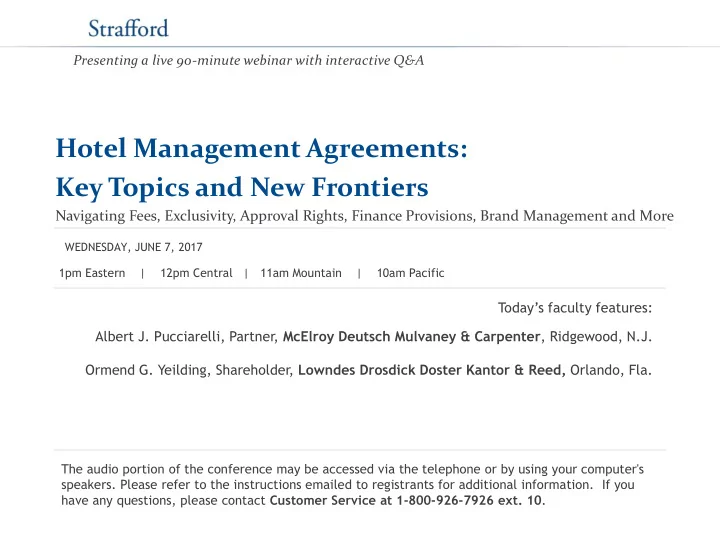
Presenting a live 90-minute webinar with interactive Q&A Hotel Management Agreements: Key Topics and New Frontiers Navigating Fees, Exclusivity, Approval Rights, Finance Provisions, Brand Management and More WEDNESDAY, JUNE 7, 2017 1pm


slide-1
SLIDE 1

The audio portion of the conference may be accessed via the telephone or by using your computer's

  • speakers. Please refer to the instructions emailed to registrants for additional information. If you

have any questions, please contact Customer Service at 1-800-926-7926 ext. 10.

Presenting a live 90-minute webinar with interactive Q&A

Hotel Management Agreements: Key Topics and New Frontiers

Navigating Fees, Exclusivity, Approval Rights, Finance Provisions, Brand Management and More

Today’s faculty features:

1pm Eastern | 12pm Central | 11am Mountain | 10am Pacific WEDNESDAY, JUNE 7, 2017

Albert J. Pucciarelli, Partner, McElroy Deutsch Mulvaney & Carpenter, Ridgewood, N.J. Ormend G. Yeilding, Shareholder, Lowndes Drosdick Doster Kantor & Reed, Orlando, Fla.

slide-2
SLIDE 2

Tips for Optimal Quality

Sound Quality If you are listening via your computer speakers, please note that the quality

  • f your sound will vary depending on the speed and quality of your internet

connection. If the sound quality is not satisfactory, you may listen via the phone: dial 1-866-873-1442 and enter your PIN when prompted. Otherwise, please send us a chat or e-mail sound@straffordpub.com immediately so we can address the problem. If you dialed in and have any difficulties during the call, press *0 for assistance. Viewing Quality To maximize your screen, press the F11 key on your keyboard. To exit full screen, press the F11 key again.

FOR LIVE EVENT ONLY

slide-3
SLIDE 3

Continuing Education Credits

In order for us to process your continuing education credit, you must confirm your participation in this webinar by completing and submitting the Attendance Affirmation/Evaluation after the webinar. A link to the Attendance Affirmation/Evaluation will be in the thank you email that you will receive immediately following the program. For additional information about continuing education, call us at 1-800-926-7926

  • ext. 35.

FOR LIVE EVENT ONLY

slide-4
SLIDE 4

Program Materials

If you have not printed the conference materials for this program, please complete the following steps:

  • Click on the ^ symbol next to “Conference Materials” in the middle of the left-

hand column on your screen.

  • Click on the tab labeled “Handouts” that appears, and there you will see a

PDF of the slides for today's program.

  • Double click on the PDF and a separate page will open.
  • Print the slides by clicking on the printer icon.

FOR LIVE EVENT ONLY

slide-5
SLIDE 5
  • I. BRAND MANAGEMENT

AGREEMENTS AND NEW HOTEL DEVELOPMENTS

Ormend G. Yeilding, Esq., Shareholder Hospitality & Leisure Practice Group

  • rmend.yeilding@lowndes-law.com
slide-6
SLIDE 6

Issue:

  • In hotel development deals, lenders will not fund a

construction loan until the brand management agreement is in place. But how does a management agreement work with respect to a hotel that does not yet exist?

  • This issue is resolved in a separate document – either as a

stand-alone agreement or as an addendum to the management agreement – that governs the obligations of Manager and Owner between the closing of construction financing and opening of the hotel. This document is usually called a “Technical Services and Pre-Opening Agreement [or Addendum].”

6

Brand Management Agreements and New Hotel Developments

slide-7
SLIDE 7

The Technical Services and Pre-Opening Agreement [or Addendum] or “TSA” As the title implies, the agreement is comprised of two main sections:

  • 1. Technical Services: this section governs the construction

phase and details the types of plans and specifications for the new hotel that must be submitted by Owner to Manager for approval, and sets forth the deadlines for construction milestones between Owner and Manager.

  • 2. Pre-Opening – this part of the TSA governs the 6 to 12

months prior to hotel opening, setting forth the actions that Manager will take (at Owner’s expense) to get the Hotel

  • perationally ready for opening, such as hiring staff, pre-

selling rooms, etc.

7

Brand Management Agreements and New Hotel Developments

slide-8
SLIDE 8

Technical Services in More Detail What the Manager Wants in the TSA:

  • Owner’s obligation to provide submittals to Manager for

review for compliance with brand standards at every stage of the hotel design through final construction plans.

  • Manager to have approval rights over the major project

consultants, such as the architect, engineer, general contractor and interior designer.

  • Owner’s obligation to build the hotel in accordance with the

Manager-approved plans on a timely schedule, with deadlines for commencement of construction, substantial completion and opening.

  • Fee from Owner to compensate Manager for its review of

plans.

8

Brand Management Agreements and New Hotel Developments

slide-9
SLIDE 9

Technical Services in More Detail What the Owner Wants in the TSA:

  • Specific limit on time to review – such as 15 to 45 days

depending upon type of submittal.

  • Specific Standard of Review – since construction can take

from 18 to 36 months, want to “lock down” the specific applicable brand standards in place at the time of the TSA, so that Owner doesn’t have to revise plans to accommodate changing standards.

  • “One Bite at the Apple”: once Manager has approved plans,

the plans are then “deemed” to be in compliance with brand standards (even if they technically are not in compliance). Owner needs to be able to rely on Manager’s approval.

9

Brand Management Agreements and New Hotel Developments

slide-10
SLIDE 10

Pre-Opening in More Detail What Manager Wants:

  • Needs notice from Owner as to date that is one year prior to

projected opening, so that Manager can begin hiring employees for and marketing the hotel.

  • Owner funding of all pre-opening expenses, and payment of a

pre-opening fee for these services to Manager (otherwise Manager does not begin earning regular management fees until hotel is open and generating revenues).

  • Manager to have final say when the hotel is authorized to
  • pen under the Manager’s brand.

10

Brand Management Agreements and New Hotel Developments

slide-11
SLIDE 11

Pre-Opening in More Detail What Owner Wants:

  • All pre-opening expenses to be subject to a budget agreed

to by Owner and Manager, and reasonable approval rights

  • ver material variances from the budget.
  • Manager to be subject to a “reasonableness” standard for

authorizing hotel opening (punch-list items can be completed after opening).

  • Clearly defined dispute resolution process – since normal

litigation claims are not practical in a construction process, consider establishing a committee of “decision makers” from each of Owner and Manager who are empowered in the TSA to hear disputes about approval of plans, authorizations, etc., on a timely basis.

11

Brand Management Agreements and New Hotel Developments

slide-12
SLIDE 12

Hotel Management Agreements: Top Ten Topics for 2016 and Beyond – CLE Webinar – April 14, 2016

  • II. FEES:

BALANCING INCENTIVES

Albert J. Pucciarelli, Esq., Partner Chairman, Hotel and Resorts Practice Group apucciarelli@mdmc-law.com

slide-13
SLIDE 13

Albert J. Pucciarelli, Esq., Partner Chairman, Hotel and Resorts Practice Group

REVENUE BASED-

  • Base Fee – Typical: 3% of Gross Revenue
  • Marketing Fee – Typical – 1% of Gross Revenue
  • Negotiable? Maybe a ramp up in early years of a

new hotel

  • For an existing hotel, Owner may seek a fee that is

a higher percentage, but only a percentage of Gross Revenue in excess of previously achieved levels; this will be resisted by the big brands

13

slide-14
SLIDE 14

Albert J. Pucciarelli, Esq., Partner Chairman, Hotel and Resorts Practice Group

INCENTIVE FEE – Rewards not just volume (Gross Revenue) but operating efficiency.

Typical: 10% of Gross Operating Profit – i.e., Gross Revenue MINUS Operating Expenses – i.e., just those expenses that are within the control of the Manager and therefore include routine departmental expenses, but do not include the traditional “below-the-line” items:

  • FF&E Reserve (negotiable)
  • Capital Expenditures
  • Property Insurance
  • Property Taxes
  • Debt Service
  • Depreciation
  • Distributions/Dividends
  • Owner’s Income Taxes

14

slide-15
SLIDE 15

Albert J. Pucciarelli, Esq., Partner Chairman, Hotel and Resorts Practice Group

Alternatively, the incentive fee may be a percentage of Income Before Fixed Charges* or Income Before Fixed Charges MINUS the FF&E Reserve or Net Operating Income† or even Net Income.‡

_____________________________________________________

*Income Before Fixed Charges = Gross Operating Profit MINUS Base Fee. † Net Operating Income = Gross Operating Profit MINUS Base Fee, Insurance Premiums, Property Taxes and Ground Rent. ‡ Net Income = Net Operating Income MINUS Replacement Reserves, Income Taxes and Depreciation.

15

slide-16
SLIDE 16

Albert J. Pucciarelli, Esq., Partner Chairman, Hotel and Resorts Practice Group

SOME VARIATIONS ON INCENTIVE FEE FORMULAE:

  • Earned as a percentage of Gross Operating profit but only paid to the

extent of Net Operating Income in excess of Owner’s Priority which is typically a percentage of project cost increased by subsequent capital expenditures; Earned but not paid fees accumulate and may or may not bear interest and are paid to the extent of excess NOI after current Incentive Fees are paid.

  • Or a higher percentage – say 25% - of Net Operating Income (all expenses

before the replacement reserves, debt service, depreciation and income taxes).

  • Or for an existing hotel, a higher percentage, but only of Gross Operating

Profit in excess of a previously achieved level.

  • There are many variations that are the ‘stuff’ of hard negotiation.

16

slide-17
SLIDE 17

Albert J. Pucciarelli, Esq., Partner Chairman, Hotel and Resorts Practice Group

OTHER CHARGES/FEES:

Central Service Charges – e.g., reservation charges (typically $X per reservation), reward programs (typically a percentage of Room Revenue generated by the reward-program member who is a guest at the hotel), employee training charges, brand marketing charges and more - be sure to limit these to the extent possible to cost recovery and make them apply in the same manner as they apply to all other hotels in the chain. Voluntary (Optional) Programs – such as optional purchasing programs, technical services for improvements, quality audits and more.

17

slide-18
SLIDE 18

Albert J. Pucciarelli, Esq., Partner Chairman, Hotel and Resorts Practice Group

CREDIT ENHANCEMENTS: Assistance from the Manager to Fund the Project to Build or Acquire the Hotel Some examples –

  • Equity Participation
  • Subordinated/Mezzanine Loan
  • Key Money
  • Fee Subordination (e.g., Incentive Fee with an Owner’s

Priority)

  • Debt Service Guaranty
  • Contribution of Technical (and Other) Services

18

slide-19
SLIDE 19
  • III. KEY MONEY

The Brand’s Gift to Owner of Golden Handcuffs (kidding!*)

Ormend G. Yeilding, Esq., Shareholder Hospitality & Leisure Practice Group

  • rmend.yeilding@lowndes-law.com

*sort of

slide-20
SLIDE 20

What is Key Money?

  • Key Money is special financing provided by

the Manager to Owner in exchange for a long term management contract, usually for a newly-built hotel or for an existing hotel being renovated and reflagged under the Manager’s system.

  • Key Money is popular with Owner’s because,

theoretically, Key Money does not have to be repaid . . . but there are strings attached…

20

Key Money

slide-21
SLIDE 21

General Terms:

  • The amount of Key Money available depends upon the size of the

hotel and length of the management agreement. This could range from $500,000 to $15,000,000.

  • Key Money is paid after the hotel opens (it is not paid at the time of

construction financing)

  • Structured as an unsecured loan bearing 0% interest that is partially

forgiven each year during the initial term of the management

  • agreement. For example, if Manager provides $1,000,000 in Key

Money for a management agreement with a 20 year initial term, 1/20th of that amount ($50,000) is forgiven each year that the management agreement remains in place.

  • If the management agreement terminates for any reason during the

initial term, the then-unforgiven balance of the Key Money is immediately due and payable to Manager.

21

Key Money

slide-22
SLIDE 22

What’s the Catch?

  • When a Manager agrees to provide Key Money, the Manager

usually becomes less flexible in negotiating other provisions of the management agreement (such as with respect to term, fees, performance termination, etc.)

  • An outstanding Key Money obligation can complicate a later sale of

the Hotel. Brand management agreements must be assigned at Closing to the buyer. The seller, who received the key money, wants buyer to assume the contingent repayment obligation at closing since seller will have no control over whether the management agreement terminates after the sale. The buyer does not want to assume the repayment obligation because the buyer never received the benefit of the Key Money. This is usually resolved with Buyer assuming the obligation at closing, but receiving a comprehensive estoppel from Manager stating the unforgiven balance of Key Money, and that there exist no defaults under the Management Agreement.

22

Key Money

slide-23
SLIDE 23

What’s the Catch? (cont’d)

  • Key Money can also complicate financing. Sometimes

lenders may require Key Money to be escrowed and spent only on specific improvements to the hotel

  • collateral. Lenders may also require a complete release

from Manager from any liability to pay the unforgiven Key Money obligation to Manager in the event the management agreement terminates following a

  • foreclosure. Manager may not be willing to provide this

release.

  • In these respects, Key Money can be described as both

the “cheapest” and “most expensive” financing an Owner can get.

23

Key Money

slide-24
SLIDE 24
  • IV. THE PERFOMANCE TEST:

MAKE IT MEANINGFUL!

Albert J. Pucciarelli, Esq., Partner Chairman, Hotel and Resorts Practice Group apucciarelli@mdmc-law.com

slide-25
SLIDE 25

Albert J. Pucciarelli, Esq., Partner Chairman, Hotel and Resorts Practice Group

WHAT IS A TYPICAL TEST?

  • Currently Brand management companies must fail two tests

before facing termination, a profit threshold test and a REVPAR

  • test. The REVPAR test is a comparison of the hotel’s revenue

performance against a “competitive set” of similar hotels in the

  • market. Under the traditional test, to face termination, the

Management Company must not only fail to perform, but perform poorly in relation to other hotels. Many have criticized the traditional test as having resulted in very few terminations during the recent severe recession. Brands would argue that the traditional test performed exactly as designed, since performance declined due to macroeconomic factors outside of the management companies’ control.

25

slide-26
SLIDE 26

Albert J. Pucciarelli, Esq., Partner Chairman, Hotel and Resorts Practice Group

A TYPICAL PERFORMANCE TEST - CONTINUED

  • If in any consecutive two-year period (a)

budgeted GR [or GOP] is less than 90% of budgeted GR [or GOP] AND (b) the hotel does not achieve at least 90% of the RevPAR of the Competitive Set, and such failure is not the result of Force Majeure….

26

slide-27
SLIDE 27

Albert J. Pucciarelli, Esq., Partner Chairman, Hotel and Resorts Practice Group

WHAT IS A MEANINGFUL TEST?

A test that is measured as a function of Net Income – the Owner’s bottom line. At the end of the day, the hotel is in a sense a joint venture between owner and manager, and test that is passed even while the

  • wner has a net operating loss or is not achieving its planned income

level may mean that the owner has the wrong brand or manager, or has built or acquired the wrong hotel for the market. In any case, a manager remaining in place and taking fees while the owner is losing money seems a bad venture, ultimately that will inure to the detriment

  • f both parties.

27

slide-28
SLIDE 28

Albert J. Pucciarelli, Esq., Partner Chairman, Hotel and Resorts Practice Group

OWNER’S RESPONSE

  • Replace two consecutive years with any two of

three consecutive years...

  • Increase the percentages, making the RevPAR

test greater than 100%...

  • Change “and” to “or”.

28

slide-29
SLIDE 29

Albert J. Pucciarelli, Esq., Partner Chairman, Hotel and Resorts Practice Group

ANOTHER ALTERNATIVE TEST

One innovation may be to institute a “Performance Relief” concept, whereby management fees and certain other management related expenses are automatically reduced during a sustained period of REVPAR declines below a certain threshold, so that Owners’ and brand management companies’ interests are aligned even during a recession.

29

slide-30
SLIDE 30

Albert J. Pucciarelli, Esq., Partner Chairman, Hotel and Resorts Practice Group

TIMING OF THE TEST: COMMENCEMENT

MANGER’S POSITION – a “black-out period” – i.e, the test commences only after the hotel has achieved “stabilization” under the new manager. In the case of a new hotel, the test may not take effect until years three, four or five from opening. In the case of an existing hotel, the black-out period should be shorter – perhaps one year. OWNER’S POSITION – no “black-out period” or at least one that is as brief as possible so that the test commences as soon as the new manager is in control.

30

slide-31
SLIDE 31

Albert J. Pucciarelli, Esq., Partner Chairman, Hotel and Resorts Practice Group

TIMING OF THE TEST: THE YEARS TO MEASURE

MANGER’S POSITION – the test must be failed for two consecutive years. OWNER’S POSITION – the test has been failed if a failure

  • ccurs in any two of three consecutive years.

31

slide-32
SLIDE 32

Albert J. Pucciarelli, Esq., Partner Chairman, Hotel and Resorts Practice Group

CURE: WHAT TO CURE AND EFFECT OF THE CURE

MANGER’S POSITION – the cure payment is the least amount necessary to render a passing grade – so, for example, if the budgeted in test year 1 was $50,000 short, the cure payment is $50,000 and that negates the result for the two years in question. OWNER’S POSITION – the cure payment cures only the year in

  • question. In the example above, year 2 would remain as a failed

year, possibly to be counted as year one of the next two-year period that remains countable as a failed year.

32

slide-33
SLIDE 33

Albert J. Pucciarelli, Esq., Partner Chairman, Hotel and Resorts Practice Group

LIMITATION ON CURE RIGHTS

MANAGER’S POSITION: unlimited cure opportunities. OWNER’S POSITION: only two in the term; also, if Manager has a unilateral renewal right (insisted upon by some management companies), any failure of the performance test during the initial term negates that right.

33

slide-34
SLIDE 34

THE COMPETITIVE SET

  • Should be truly representative of the competition in the

market

  • Should be updated periodically by agreement of the parties to

include new market entrants; if they cannot agree, this is a good place to use “expert determination”.

  • It is reasonable to expect your hotel to beat the competitive

set if you have chosen the right brand.

34

Albert J. Pucciarelli, Esq., Partner Chairman, Hotel and Resorts Practice Group

slide-35
SLIDE 35
  • V. LENDER HOT BUTTONS

REGARDING BRAND MANAGEMENT AGREEMENTS

Ormend G. Yeilding, Esq., Shareholder Hospitality & Leisure Practice Group

  • rmend.yeilding@lowndes-law.com
slide-36
SLIDE 36

Main Issue:

  • The Lender considers the hotel brand and its operation as

key components in underwriting the loan to Owner. But the

  • wner of the Brand and the operator of the hotel are not

borrowers under the loan.

  • This issue is resolved by a combination of Owner covenants

in the loan agreement regarding the Manager and the management agreement, and by an SNDA, which is a three party agreement between Owner, Lender and Manager governing the rights of each.

  • Key point: Owners need to make sure the management

agreement comports with the requirements of the loan agreements, and vice versa.

36

Lender Hot Buttons Regarding Brand Management Agreements

slide-37
SLIDE 37

Loan Agreement provisions regarding or relevant to the Manager and Management Agreement:

  • Owner collaterally assigns its right, title and interest in and to the

Management Agreement (this may require Manager consent, provided in the SNDA).

  • Owner will not make any material amendments to the

Management Agreement (such as to fees, term, etc.) without Lender’s prior consent.

  • Owner will not terminate the Management Agreement without

Lender’s prior written consent.

  • Owner will not enter into any space lease or material supply

contract over a certain threshold without Lender’s prior written consent – but note that the Management Agreement authorizes Manager to enter into leases/contracts in Owner’s name up to a certain threshold – Owner needs to make sure these don’t conflict.

37

Lender Hot Buttons Regarding Brand Management Agreements

slide-38
SLIDE 38

Loan Agreement provisions regarding or relevant to the Manager and Management Agreement (cont’d):

  • Owner to provide monthly, quarterly and annual financial reports

regarding the performance of the Hotel. But note that Owner relies on Manager to provide financial reports in the management agreement – Owner needs to confirm that the types of financial reports to be provided by Manager, and when Manager will provide such reports, in the management agreement will enable Owner to comply with the loan agreement.

  • Both the loan agreement and the management agreement will

require a reserve for FF&E and routine capital

  • expenditures. Owner needs to make sure that the reserve under

the management agreement will suffice for the loan agreement, and that the reserve provisions of the management agreement are compatible with Owner’s obligations under the loan agreement

38

Lender Hot Buttons Regarding Brand Management Agreements

slide-39
SLIDE 39

Subordination, Non-Disturbance and Attornment Agreements (SNDAs):

  • Signed by Owner, Lender and Manager
  • Subordination – Manager agrees to subordinate its interest

in the hotel to Lender’s mortgage.

  • Non-Disturbance – Lender agrees to continue to honor the

management agreement following a foreclosure.

  • Attornment – Manager agrees to consider the Lender the

“Owner” under the management agreement following foreclosure.

39

Lender Hot Buttons Regarding Brand Management Agreements

slide-40
SLIDE 40

Common SNDA Issues:

  • The modern SNDA took shape in the context of

commercial leases for loans involving office buildings, shopping centers, and the like. As the hotel industry has transitioned over the past few decades with brands being “asset light” and preferring long term management agreements to owning their own hotels, commercial lending looked to the commercial lease SNDA as a model for the new hotel management agreement structure.

  • This makes sense, in that modern brand management

agreements resemble leases in that they are long-term contracts granting the manager a possessory interest in the hotel and right to operate the business.

40

Lender Hot Buttons Regarding Brand Management Agreements

slide-41
SLIDE 41

Common SNDA Issues: (cont’d)

  • BUT – management agreements differ from leases

in many important ways that implicates the

  • SNDA. First, Manager is not responsible for
  • perating losses of the business. Second,

revenues of the hotel under the management agreement are gross revenues needed to pay

  • perating expenses on a daily expenses, whereas

rent provides the revenue under a commercial

  • lease. Third, the brand management agreement

provides affirmative obligations on the Owner beyond what a lease requires of a landlord. These differences have many implications for the Manager SNDA.

41

Lender Hot Buttons Regarding Brand Management Agreements

slide-42
SLIDE 42

Key SNDA Issues for Resolution:

  • Cash Management: Lockbox of all revenues, or just NOI paid to Owner?
  • Lender will require right to see financial statements, and covenant from Manager

not to amend without consent. Owner needs to confirm Lender is not demanding more rights in SNDA than Lender has in loan agreements.

  • Subordination of fees: Base Fee vs Incentive Fee
  • Lender cure rights of Owner defaults
  • What does “Non-Disturbance” mean? After foreclosure, does Lender have to pay

amounts owed by Owner to Manager?

  • “Non-Disturbance” – does this extend to Lender having to sign a new management

agreement if original terminated in bankruptcy?

  • Lender needs confirmation that lender is an approved “assignee” in a foreclosure

situation, and that foreclosure will not trigger any ROFR or ROFO.

42

Lender Hot Buttons Regarding Brand Management Agreements

slide-43
SLIDE 43

Hotel Management Agreements: Top Ten Topics for 2016 and Beyond – CLE Webinar – April 14, 2016

  • VI. OWNER APPROVAL RIGHTS:

YOU SIMPLY CANNOT TURN OVER THE KEYS AND WALK AWAY.

Albert J. Pucciarelli, Esq., Partner Chairman, Hotel and Resorts Practice Group apucciarelli@mdmc-law.com

slide-44
SLIDE 44

Albert J. Pucciarelli, Esq., Partner Chairman, Hotel and Resorts Practice Group

OWNER APPROVAL RIGHTS GENERALLY

  • The nature of an owner’s approval rights in the case of a managed hotel

will vary depending upon the owner’s own real estate management expertise and whether or not the owner has an “asset manager” – either an individual, an internal department or an asset management company.

  • The major brands will insist on a high degree of control over the
  • perational aspects of the hotel – from rates, to menus to life safety

standards – an in a sense, it is this expertise that the owner is paying for.

  • Even so, an owner should be involved in certain key aspects of the hotel’s
  • peration, and most certainly will have to be responsible for those P&L

items that fall below the GOP line – such as property taxes, property insurance, ground lease obligations, if any, property taxes, debt service and capex.

44

slide-45
SLIDE 45

Albert J. Pucciarelli, Esq., Partner Chairman, Hotel and Resorts Practice Group

THE ANNUAL PLAN

This is an owner’s most significant on-going, operational involvement

  • Review and approve the annual plan
  • More than just the budget for the next FY – also a personnel plan, a

marketing plan, a plan for the use of the FF&E reserve, a capex plan…

  • Items in dispute may be submitted to an “expert” or applied from last

year’s budget, adjusted by a CPI number

  • Carve-outs from owner’s approval right may include utilities, central

service charges by the brand and costs to comply with brand standards (CAVEAT), life safety and legal requirements

  • Owner should require periodic forecasts vs. budget and a revised budget

in mid-year, subject to owner’s approval, where the original budget and forecast have parted company.

45

slide-46
SLIDE 46

Albert J. Pucciarelli, Esq., Partner Chairman, Hotel and Resorts Practice Group

THE EXECUTIVE COMMITTEE

In the US, all hotel employees are likely to be employees of the management company and outside the US, they will be employees of the owner, although certain key personnel will be “secunded” by (on assignment from) the management company In either case, the owner should have the right to approve the selection by the management company of “key personnel” – and have their resumes and other data, such as background searches, available to the owner and an opportunity to interview these persons “key personnel” = General Manager, Director of Marketing and Sales, Controller An owner is not likely to have the power to fire ANY employees, but should at least have a complaint opportunity with a written response as to corrective action.

46

slide-47
SLIDE 47

Albert J. Pucciarelli, Esq., Partner Chairman, Hotel and Resorts Practice Group

CERTAIN AGREEMENTS

  • Commercial space agreements, such as shop

leases, parking lot management agreements and roof-top antennas, or at least those that have a term in excess of one year or cannot be terminated without penalty on 30 days notice.

  • Collective bargaining and employment

agreements.

  • No management involvement in CCRs,

easements or secured loans.

47

slide-48
SLIDE 48

Albert J. Pucciarelli, Esq., Partner Chairman, Hotel and Resorts Practice Group

LITIGATION

  • Commencement and settling of non-routine

claims, proceedings and lawsuits

  • Choice of counsel for all or at least non-

routine lawsuits

  • Property tax appeals and settlements

48

slide-49
SLIDE 49

A WORD ABOUT THOSE CONFUSING AGENCY CASES!

  • The previously “settled” common law rules.
  • The Maryland Statute anti-dote.
  • And now recent New York cases have

“unsettled” the whole thing.

  • What is needed? A line of cases that leaves

the parties to their deal as embodied in their carefully drafted, well-negotiated HMA.

49

slide-50
SLIDE 50

Thank You

50

Albert J. Pucciarelli, Esq., Partner Chairman, Hotel and Resorts Practice Group apucciarelli@mdmc-law.com Ormend G. Yeilding, Esq., Partner Hospitality & Leisure Practice Group

  • rmend.yeilding@lowndes-law.com