SLIDE 1
SLIDE 2
KIDS TO KIDS: LET'S PREPARE A HEALTHY TRADITIONAL MEAL
ABSTRACT
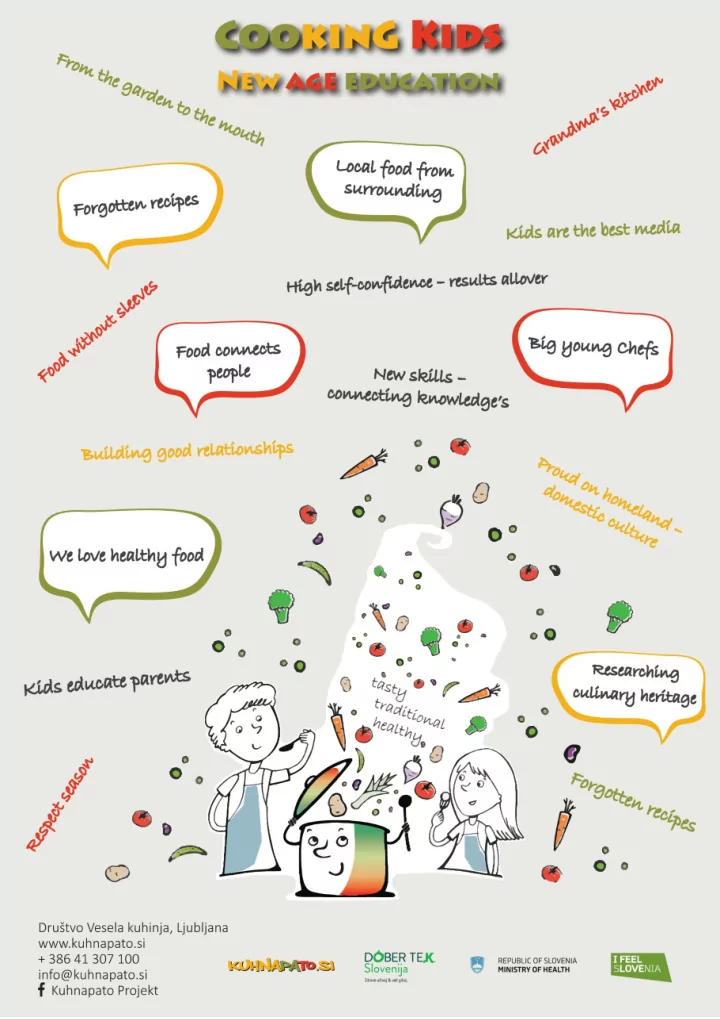
Exploring the culinary (nutritional) cultural heritage is one of the essential activities of preserving the identity of a nation or population, and represent the basis for regulating a healthy diet today. The dishes and food preparation processes of our ancestors are a part of a cultural and social happenings that describes the way of life in a geographically diversity of the Country or State. We present you a new age education project that has been going on for nine years in the whole country of Slovenia, and whose main actors are Elementary School pupils. Their task is to explore the forgotten culinary heritage of their region with cultural background and to adapt the dishes to today’s body needs. They are motivated to use healthy, seasonal ingredients from the surroundings (short chains) and to learn about the reasons of using that in the kitchen (what to eat when and why), to cook at home and minimize food waste. The main project mission is to encouraging children to a healthy and sustainable - responsible way of life. At the National level, the project is important for the main areas: Health, Local food, Education, Employment, Tourism and Social ties. At the global level, it has an impact on climate changes and an overall awareness of the world's population. Project is supported by Ministry of Health and is a part of the National program “Dober tek Slovenija”. In September, 2018, the European Commission - DG SANTE identified the project as one of the 10 Best Practices in the field of healthy and a sustainable lifestyle in relation to food.
SLIDE 3
In order to avoid the fact that local or regional typical dishes are becoming just written (or even just oral) memories with the extinction of the older generations sink into oblivion, is our wish to turn the wheel in favor of the quality of life for us, young people and to revive respect and awareness of food produced at home. We need to research our history as far back as we can find useful documents about daily life and culinary habits that have contributed to local culture as a whole. It is necessary to know the roots, that we can build the future. Based on intergenerational communication, children get information that is not accessible to ethnologists. Knowledge of our grandmothers is an important skill that we must not lose. On the other hand the overweight of children was nine years ago, when the project started, one of the biggest chronic diseases among young people in Slovenia. Slovenia is a country that has undergone major socio-political and economic changes in the last 20 years, which has greatly influenced the way of life, the eating habits of children and their physical
- development. Because of general poverty in the past, the psychological problem was in overeating with greasy and
sweet dishes. Because children are being so absorbed in the global world of information, they did not even payed attention to what they "throw" into the mouth, and what was happening around them. Parents, however, often did not use the right actions for the children to break this circle. One of the reasons was also in their education (of parents). Children were becoming more and more obese, unconscious and depressed. Therefore, obesity not only impairs quality of life, but also increases public and personal health expenditures. Eating disorders are going in the other direction, namely malnutrition. Problems of the existing situation in the past:
- adolescent insufficient respect of food from basic seasonal ingredients
- ignorance of basic healthy ingredients and their use
- malfunctions of children's tastes of healthy dishes (especially vegetable)
- great and easy accessibility of "wrapped" dishes available in shops and fast food establishments and their
desirability according to artificial additives
- insufficient emphasis on the visual effect of dishes in schools
- too much "absence" of parents in raising children to get respect for healthy food
- poor motivation of young people (from all sides) for changes tastes and mind
All this leads to:
- overweight
- body fatigue
- consequently, poorer wellbeing
- apathy and bad self-esteem
- illness, failure in life
- lead to bad companies
- sitting on roads, in restaurants or in front of computers and
- avoiding physical activity
- 2. MAIN OBJECTIVES
Our main goal is to prepare the children for a safe and responsible way of life, while in their peak capacity for learning crucial life skills. Adults engage in debates with children and provide useful information, while children with their acquired knowledge can creatively participate not only in everyday lives of adults but also by implementing innovative contents into daily healthy meals of all generations. It is necessary to make the children understandable for causes and consequences of enjoying healthy food and:
- get the basic ingredients closer to children as a necessary part of the meal
- make healthy meals "cute" and tasty
- encourage children to consume large quantities of vegetables and fruits¸ to eat food full of vitamins and
minerals
SLIDE 4
- use locally from the surrounding area – without “traveled many kilometers”
- to know what, when and why to eat
- extend the horizon of children's knowledge of local food (way of production, innovative uses, consequences
- r causes of eating)
- attract recognized chefs as an example in preparing food
- consider (at least partially) world culinary trends
- educate and motivate school nutrition leaders and school chefs to listen to children's - perception of food and
feeding, and to put more aesthetics in school meals.
- motivate the leadership of the schools to listen and support the more modern approaches to preparing food
(from recipes to performance).
- use the right motivational methods: to put children in the role of "cook" in carrying out their own meal, to
entrust them with an important task.
- with media support to reach children's interest
- to put them in the role of the "ambassadors" of their institutions, thus reaching the full generation's voice
- with inter-peer stimulus, impact on own and all other generations
- with additional - outside of school activities, help to understand the whole process
- to influence on the decisions of the future profession (which is undoubtedly formed in elementary school)
- to promote joy to work; to achieve better self-image, higher success, better competence of children
- create consumers who will require locally produced healthy foods; revive respect and awareness of food
produced at home At the National level, the project is important for the main areas:
- Health
- Local food
- Education
- Employment
- Tourism
- Social ties
In addition, some important facts to note:
- reducing food waste
- the importance of climate change
- strengthening overall responsibility to the environment and ourselves
- changing lifestyles
- 3. CONCEPTUAL FRAMEWORK
In addition to concern for the preservation of natural and cultural heritage, project includes the efforts of preserving the culinary characteristics of the region of the fundamental motives of humanity. Aggression of globalism was (or is steel) extremely strong and is reflected in the attitudes of the young generation to local food "without sleeves" and, consequently, the general culture of eating. Project is based on activities related with practice, upgraded psychological and motivational concepts, established on several years of experience working with elementary school pupils in Slovenia. Enabling children to master skills in an attractive way: understanding the linking of knowledge of different school subjects, research, organization, cooperation and respect, along with manual skills, as a part of lifelong learning. The authenticity of flavors and spontaneity of children, but at the same time cooking at the highest level, is surprising all audiences, wherever they are occurring. Cooking kids are ambassadors for their own schools. The project has grown into a movement for: encouraging youth to become aware and to respect their own nutritional cultural history, the use and familiarity of local food, to create a desire to upgrade knowledge about the production or processing of local food, promoting the cultivation of autochthonous varieties. Also knowledge of food preparation procedures from the past and adaptations to today' needs. The project connects different segments of knowledge, skills, or abilities.
SLIDE 5 The project connects the best professionals of gastronomy, history – ethnologists, nutritionists and related local food
- producers. We educate people who prepare food for children for better understand the child's feeding and more
modern approaches. With additional - outside of school activities we achieve an understanding of the entire process.
3.1. MAIN ACTIVITIES
- seminar with practical workshop for mentors, school nutrition planners and school kitchen managers is
- rganized
- competitive regional performances for the public
- project promotions at culinary and diplomatic events
SLIDE 6
- kids to kids - cook traditional meals in school kitchens for entire school and optional kindergartens
- public awareness through the media
- book publishing
Based on the recipes, procedures and stories written by our nutritional cultural heritage, and which children have placed between us through intergenerational communication, a book is published after each annual project.
SLIDE 7 3.2. TARGET POPULATION
Basic target group are children between 8 and 15 years: Based on research prior to the start of the project in Slovenia and experiences through the 8 years of the project's operation, is confirmed that children of the age of elementary school are in the most acceptable period of acceptance of essential information. If contents given to them are passed in an attractive way, they use it with enthusiasm, maintain it in the end and inform their own generation with them. Elementary school pupils with appropriate motivation act as mentors to the younger ones and thus represent the most efficient transfer of knowledge, incentives and values. To reach their attention, we need to work with a thoughtful combination of formal and non-formal learning approaches. Their enthusiasm is one of exceptionally effective medium for appealing to the generation of the elderly. Next target group are teachers of household like mentors of groups of children and school Chefs: The target group
- f teachers, with relatively rigorous teaching systems and on the other hand, attractive activities beyond the regular
part of the lesson that they find useful for upgrading the curriculum, is motivated to work and distribute information. With modern motivational and educational processes for teachers, we achieve an increased level of the learning system and consequently, learning success. Target group of participating experts: Depending on the actuality of contents and techniques or methods of work, we attract organizations and experts from the fields of the project, those interested in contributing to the connection of the environment, visibility, while participating in a higher level of quality of information and possibilities for improving the processes. By being directly or indirectly involved or just observing appearances, they are motivated to be responsible for the distributing of essential information for life. They help to raise the quality of education, social cohesion and strengthening of values. They create new innovative jobs, thus motivating children to a variety of career choices.
3.3. STAKEHOLDER INVOLVEMENT
There is a high level of interest from local food producers and local communities, which support schools with healthy local food. Thus, it is encouraged to increase the production of domestic ingredients, to raise new varieties and autochthonous plants, to promote production and to create modern production approaches. Interest is also by the food industry based on effective marketing space. Future consumers are raised who already make changes about buying food. Sponsors support children and teachers with knowledge of modern and healthy production of products without additives. State institutions are interested, particular the Ministry of Health and the National Institute of Public Health. With an example of good practice, we effectively address different target groups and influence the increase in general health. These institutions help us with co-financing and effective promotion, which is the reason for high visibility of the project with its mission in the whole country.
3.3. METHODOLOGY
- 1. Research
- 2. Performances: cooking and offering
Cooking competitions Cooking actions in schools Performances
- 3. Training of mentors (teachers): experts to teachers
- 4. Practical approach to work – workshops for children
- 5. Methods of analysis
SLIDE 8 3.3. STRENGTHENING THE SOCIAL COMPETENCES
They are also at the forefront social competences as an essential component of the prosperity of coexistence between diverse groups. Most modern approaches of motivation, where the methodology of transferring knowledge and skills is placed to the forefront: children to children, in a coherent, acceptable way, achieves long-term acceptance by youth. A formal, non-formal learning approach motivates both, children and teachers, who perceive the same kind of advantages and integrate them into the regular learning process. This leads to better learning achievement in general, satisfaction and genuine cooperation between teachers and children, which further enhances the joy of learning and work, self-initiative and friendly level of cooperation in heterogeneous groups, mutual assistance and organizational
- skills. The content that explores the cultural culinary heritage is the basis for accepting, understanding the cultural
background of other groups, strengthening the favorable social environment, cooperation of the local, regional surroundings... It encourages the cooperation, the support of local communities and the recognition of the regions with its organizations. Updated learning approaches based on modern motivational elements update the entire learning process and give motivation to educate youth outside the school walls. Thus, it gives greater competences to teachers and leads to a permanent desire to upgrade learning approaches according to modern trends.
- 4. FINDINGS BASED ON ANALYSIS
Due to its topicality in various fields, the project attracted an extraordinary number of participants from the beginning, which increased from year to year. The interest of children for participating is remarkable and growing. Therefore, the teachers (during the first period of the project) in preparing for the competition included a larger number of children (the competition group had four cooks). Entering school kitchens and carrying out project activities at least once a month enables schools to include a much larger number of children. NUMBER OF DIRECTLY PARTICIPATING KIDS NUMBER OF HEALTHY MEALS MADE BY KIDS OR KID'S HELP in s. year 50400 60800 85500 2000 860 1200 590 520 3400 2500 1120 2011/12 2012/13 2013/14 2014/15 2015/16 2016/17* 2017/18* 2018/19* * entry of children into school kitchens
SLIDE 9
These are exceptional motivational measures for the whole school nutrition-organizing group. Children encourage school nutrition planners to integrate more vegetables into school meals with the fact that food is also eaten. increased quantity of vegetables in school meals compared to school year 2012/13 2015/16 2016/17* 2017/18* 2018/19* 61% 48% 36% 22% * entry of children into school kitchens Source: mentors of participating schools in a given period sample: 60 schools Gradually, a participating school creates a movement that encourages the use of healthier ingredients and food preparation procedures even in daily lunches (outside project activities) and snacks. All this is maintained in the long run and encourages children for healthy lifestyle. The changes listed below are becoming a trend that is also spreading to the homes and the environment. replacing fruit juices with water and fresh fruit compared to school year 2012/13 2015/16 2016/17* 2017/18* 2018/19* 43% 31% 8% 17% * entry of children into school kitchens Source: mentors of participating schools in a given period sample: 60 schools
SLIDE 10
replacement of white bread with buckwheat, rye, whole grain, corn compared to school year 2012/13 2015/16 2016/17* 2017/18* 2018/19* 39% 27% 5% 11% * entry of children into school kitchens Source: mentors of participating schools in a given period sample: 60 schools replacement of potatoes and pasta with cereals - porridge or polenta compared to school year 2012/13 2015/16 2016/17* 2017/18* 2018/19* 57% 33% 8% 16% * entry of children into school kitchens Source: mentors of participating schools in a given period sample: 60 schools the amount of fried foods in oil compared to school year 2012/13 2015/16 2016/17* 2017/18* 2018/19*
SLIDE 11 42% 30% 18% 9% * entry of children into school kitchens Source: mentors of participating schools in a given period sample: 60 schools With child-friendly motivation procedures, changes are made in the long run. The amount of discarded foods
- decreases. Since all these tendencies work slowly, with the necessary permanent incentives, less food waste is
perceived in the course of project activities, but gradually also on a daily basis. WASTE OF FOOD in the days of the program - cooked by kids school lunches - cooked by school chefs 2016/17* 2017/18* 2018/19* Source: mentors of participating schools in a given period sample: 60 schools Primary School children are an extremely critical population because they express their opinions directly and change their habits only with complete trust. Therefore, we are proud that children trust the activities – our work and are prepared to change one of the most important habits for a healthy and responsible life in the future.
SLIDE 12 changes in the eating habits of the participating kids 2015/16 2018/19* Source: mentors of participating schools in a given period sample: 60 schools
4.1 NOT MESURABLE RESULTS
- changing the awareness of school cooking staff and nutritionists is rising steeply
- exceptional inter-disciplinary motivation, promotion of values related to nutrition and health
- exceptional motivation for the population of Slovenia of all ages
- healthy eating to better results in all areas
- children's motivation influences better self-image, consequently health
- interest in the typical dishes of other regions, use - consequently strengthening national awareness and
respect for the environment
- interventions by seasonal ingredients - lifestyle
- vegetable dishes are becoming a trend
- high competence of children and, consequently, higher employment
- creation of new jobs with modern ideas about the production or use of local ingredients
- growing empathy and understanding of different groups of children
- 5. REFERENCES
As the beginners of reviving traditional, almost forgotten Slovenian dishes, we proudly presented the Slovenian culinary heritage:
- 2015: in cooperation with the Embassy of the Republic of Slovenia in Washington, at a Symposium of Culinary
Diplomacy (Make food not war) with the presence of the former Director of the White House Protocol
- 2015: in cooperation with the Permanent Representation of Slovenia to the EU, in order to celebrate the
Slovenian National Day, we organized a reception at the Brussels Town Hall for more than 800 diplomats; and for the same reason, in cooperation with the Slovenian Embassy in London, a reception at the Europe House in London
- 2016: in cooperation with the Embassy of the Republic of Slovenia in Washington, at the European Union
Representation in Washington, with the intention of Slovenia's initiative to become the World Bee Day on May 20, we prepared traditional honey breakfast for invited diplomats
- 2017: in collaboration with the Embassy of the Republic of Slovenia in Washington, DCPC and DC Central
Kitchen, we organized Slovenian meals on 113 Public Schools in Washington (50,000 children). May 10, the Mayor of Washington DC declared as Slovenian Food Day. This year also the honorary patron of the project was Prime Minister of the Republic of Slovenia, Dr. Miro Cerar.
- 2017: in cooperation with the Slovenian Embassy in Paris, we presented the project as the most innovative
culinary product from Slovenia at the event »Planète de goût«
- the project is part of the presentation strategy of Slovenia for the Gastronomic Region of Europe 2021
- integration into the annual project of the European Year of Cultural Heritage
- 2018: the European Commission - DG SANTE identified the project between 10 Best Practices in EU on the
field of healthy and sustainable lifestyle in relation to food