Kim Mueller , S. Gourdji, V. Yadav , A.E. Andrews, M. Trudeau, G. - - PowerPoint PPT Presentation

kim mueller s gourdji v yadav a e andrews m trudeau g
SMART_READER_LITE
LIVE PREVIEW

Kim Mueller , S. Gourdji, V. Yadav , A.E. Andrews, M. Trudeau, G. - - PowerPoint PPT Presentation

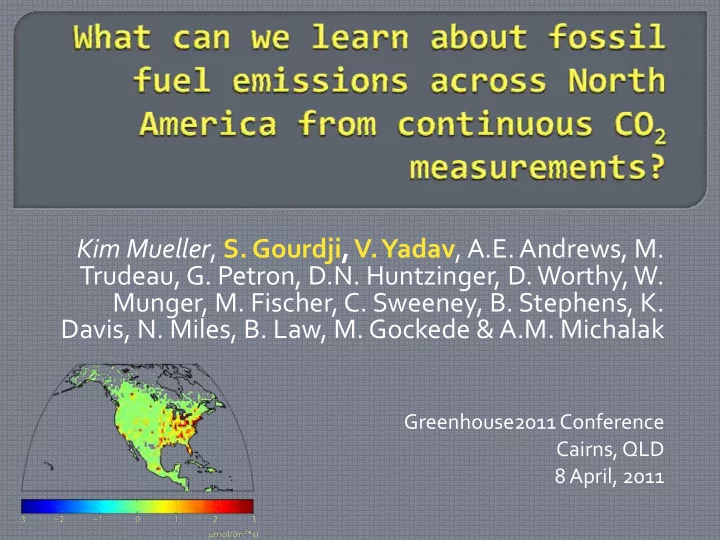
Kim Mueller , S. Gourdji, V. Yadav , A.E. Andrews, M. Trudeau, G. Petron, D.N. Huntzinger, D. Worthy, W. Munger, M. Fischer, C. Sweeney, B. Stephens, K. Davis, N. Miles, B. Law, M. Gockede & A.M. Michalak Greenhouse2011 Conference Cairns, QLD 8


slide-1
SLIDE 1

Kim Mueller, S. Gourdji, V. Yadav, A.E. Andrews, M. Trudeau, G. Petron, D.N. Huntzinger, D. Worthy, W. Munger, M. Fischer, C. Sweeney, B. Stephens, K. Davis, N. Miles, B. Law, M. Gockede & A.M. Michalak

Greenhouse2011 Conference Cairns, QLD 8 April, 2011

slide-2
SLIDE 2

Carbon accounting is important for science, politics,

business, and the public at large

  • National databases: Australia – National Carbon Accounting System
  • Global databases: Carbon Dioxide Information Analysis Center

(CDIAC) (Marland, 2010)

There is a need to understand the accuracy of fossil fuel

emission estimates

2

The development of reliable emissions inventories through time and by country/region is neither straightforward or quick. This will be a long‐ term effort, perhaps on order of 5‐10 years, and will require considerable care to ensure scientific credibility and reliability in terms of the quality

  • f the data.

Will Steffen, 2003 Executive Director, International Geosphere‐Biosphere Programme

slide-3
SLIDE 3

Independent verification of fossil fuel emission

inventories important for:

  • top‐down estimates (aka inversions) of biospheric fluxes [Science]
  • monitoring emission reduction commitments [Policy]

uncertainties in emission databases can be up to 15‐20%

Different means of assessing the accuracy of inventories:

  • developed countries can monitor individual point sources (US‐EPA)
  • top‐down initiatives to assess CO2 pollution from large cities (Mega‐

cities project)

  • use carbon isotopes (C14) or carbon monoxide measurements to

isolate fossil fuel emissions to larger areas

3

Need to assess emissions inventories from the perspective of atmospheric observations without using expensive measurements or complicated methods:

1. Help with constraining other natural sources and sinks 2. Have the potential to validate emissions where direct monitoring is difficult

slide-4
SLIDE 4

Sites that continuously measure atmospheric CO2

slide-5
SLIDE 5

5

Fossil fuel signal small in magnitude relative to biospheric during height

  • f growing season

Question: Is the fossil fuel signal

detectable across the entire continent? Throughout the year?

Question: Can the biospheric and

anthropogenic signals be independently identified? Use a Geostatistical Inversion to try and answer these questions …

slide-6
SLIDE 6

[CO2]

  • 1. CO2 Concentration

Measurements (mass)

  • 2. Transport Model
  • 3. Flux Estimates

(mass/time)

Adapted from

  • Y. Shiga (Umich)

TOTAL FLUX = fossil fuel + biospheric fluxes

slide-7
SLIDE 7

Geostatistical inverse modeling objective function:

  • H (35,000×8,000,000)

= Transport information,

  • s (8,000,000 ×1)

= Estimated flux,

  • y (35,000 ×1)

= Concentration measurements

  • X (8,000,000 ×60)

= Auxiliary variables

  • β (60 ×1)

= Estimated regression coefficients

  • R (35,000 ×35,000)

= Model data mismatch covariance

  • Q (8,000,000 ×8,000,000) = Spatio‐temporal covariance matrix

1 1 ,

1 1 ( ) ( ) ( ) ( ) 2 2

T T

L

− −

= − − + − −

s β

y Hs R y Hs s Xβ Q s Xβ

7

Reproducing the measurements Minimize the sum of the squared residuals

slide-8
SLIDE 8

Geostatistical Inversion acts similar to a multi‐linear regression s = βo +βanthro(Emissions) + βbio (Environ. Data) + error

^ ^ ^ ^ ^ ^

slide-9
SLIDE 9

Use 1° x 1° merged dataset for

entire continent

  • Vulcan 2.0 for continental United

States (Gurney et al., 2009)

  • Night Lights/ CDIAC fossil fuel

inventory for Canada & Mexico (Oda & Maksyutov, 2010) – Available for Australasia

Vulcan scaled from 2002 to 2004 using total

emissions for continental U.S.

slide-10
SLIDE 10

U.S. Energy Information Administration data Compiled by US-EPA

slide-11
SLIDE 11

Total Flux Error

Total Flux (biospheric component only, pre-subtract fossil fuels from observations)

Error Total Flux

A pr i l Jul y

slide-12
SLIDE 12

Is the fossil fuel emission signal independent of the

biospheric fluxes?

  • Can calculate a posteriori correlation between β’s (i.e. ρ) to

assess this

Canopy cond. Evapo‐ trans. Precip. Specific humidity Snow cover 16‐day lag precip Northeast ‐0.02 0.03 ‐0.04 0.00 0.11 ‐0.11 Southeast 0.00 0.02 ‐0.01 ‐0.19 0.02 ‐0.08 Midwest ‐0.16 0.06 ‐0.02 0.06 0.11 ‐0.05 South‐central 0.03 0.04 0.06 ‐0.29 0.08 0.01 Central plains ‐0.18 0.11 ‐0.01 0.03 0.18 ‐0.07 North Central 0.06 ‐0.03 0.01 0.01 0.08 0.02 California & Southwest ‐0.02 0.06 0.05 ‐0.04 0.13 ‐0.03 Pacific Northwest 0.07 ‐0.07 0.02 0.01 0.08 ‐0.23 Canada 0.02 ‐0.01 ‐0.04 0.04 0.06 ‐0.11

slide-13
SLIDE 13

β (2004) β (2008) Northeast 1.18 0.92 Southeast 0.65 1.90 Midwest 1.08 1.35 South central 1.24 1.26 Central plains 2.38 1.70 North central n/a 0.56 California & southwest n/a 1.55 Pacific northwest n/a n/a Alaska n/a n/a Canada 0.61 1.28 Mexico n/a n/a 13

Sampling bias may be inflating β’s on fossil fuels…

slide-14
SLIDE 14

Region Jan Feb Mar Apr May Jun Jul Aug Sep Oct Nov Dec Northeast U.S. X X X X X X Southeast U.S. X Midwest U.S. X X X X X X South‐central U.S. X X X X X X Central plains U.S. X X X X X X X North‐central U.S. X California & southwest U.S. Pacific Northwest X X Alaska Canada X X Mexico X X

Selected fossil fuel variables (in addition to biospheric): 2004

Region Jan Feb Mar Apr May Jun Jul Aug Sep Oct Nov Dec Northeast U.S. X X X X X X Southeast U.S. X X X X X X X X Midwest U.S. X X X X X X X X X X X South‐central U.S. X X X X X Central plains U.S. X X X X X X North‐central U.S. X California & southwest U.S. X X X X Pacific Northwest X Alaska X Canada Mexico

Selected fossil fuel variables (in addition to biospheric): 2008

14

slide-15
SLIDE 15

Q: from atmospheric CO2 measurements in a geostatistical inversion, can we independently identify:

  • the biospheric and anthropogenic signals?

Yes

  • the fossil fuel signal for different seasons & regions?

New towers in 2008 help to isolate emissions in more regions relative to 2004 Still difficult during growing season, except for Midwest in 2008 due to denser measurement network

15

slide-16
SLIDE 16

Before using atmospheric CO2 to validate fossil fuel

inventories or learning more about how to use them for top‐down budgeting , need for:

  • Year‐specific emission datasets (i.e. an “operational” Vulcan for

the entire continent or globe)

  • Denser measurement network and additional sites in under‐

constrained areas and sites away from urban centers

16 OCO2 Simulated Track for 27th January, 2006

  • D. Hammerling (Umich)
slide-17
SLIDE 17

WRF‐STILT: AER, Inc. (Janusz Eluszkiewicz, Thomas Nehrkorn,

John Henderson), John Lin, DeyongWen

Data providers: Bill Irving, Andrea Denny Funders: NASA (ROSES NACP) Research group at University of Michigan: Abhishek Chatterjee,

Dorit Hammerling, Deborah Huntzinger, Dan Obenour, & Yuntao Zhou

kimlm@umich.edu sgourdji@umich.edu