L k ( a , b ) = a i b i k i = 1 1 dimensional i = 1 L 1 - - PDF document

l k a b a i b i k i 1 1 dimensional i 1 l 1 a b a b what
SMART_READER_LITE
LIVE PREVIEW

L k ( a , b ) = a i b i k i = 1 1 dimensional i = 1 L 1 - - PDF document

9/28/08 The properties of a metric D(a,b) the distance between a and b Non-negativity: D(a,b)>=0 Reflexivity: D(a,b)=0 if and only if a=b Symmetry: D(a,b)=D(b,a) Triangle inequality: D(a,b)+D(b,c)>=D(a,c) 4.6 METRICS AND


slide-1
SLIDE 1

9/28/08 1

4.6 METRICS AND NEAREST- NEIGHBOR CLASSIFICATION

Li Yu, Hongda Mao & Joan Wang

The properties of a metric

D(a,b) – the distance between a and b

 Non-negativity: D(a,b)>=0  Reflexivity: D(a,b)=0 if and only if a=b  Symmetry: D(a,b)=D(b,a)  Triangle inequality: D(a,b)+D(b,c)>=D(a,c)

Example: Minkowski Metric (Lk norm)

 The distance between a and b in d dimensions  What if k=1 (L1 norm)  What if k=2 (L2 norm)

Lk(a,b) = ai − bi

k i=1 d

k

L1 Norm

 d-dimensional  1 dimensional

L1(a,b)=|a-b|

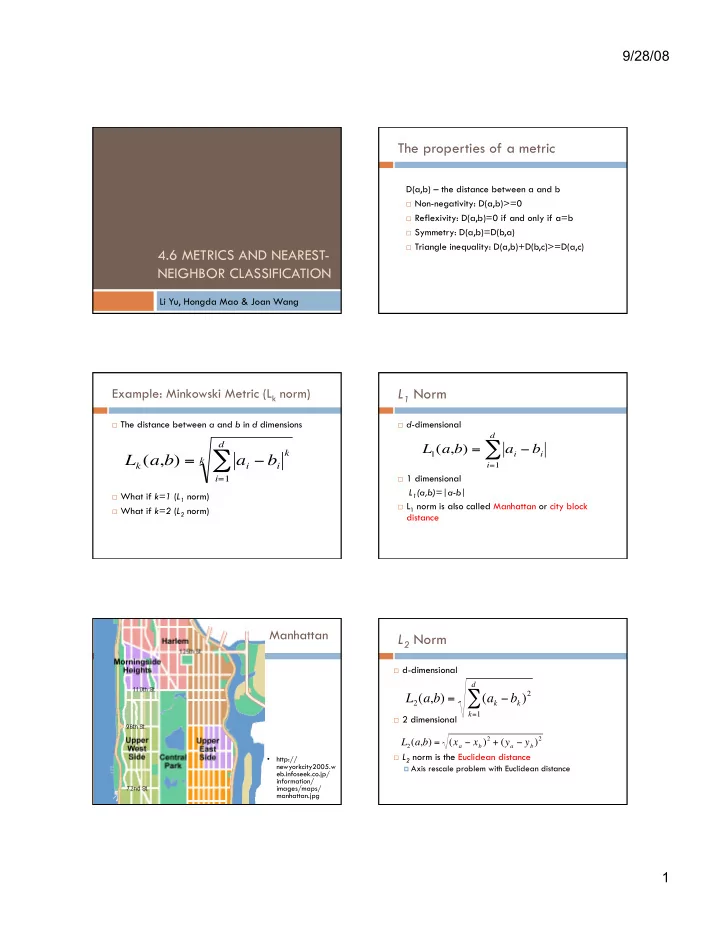
 L1 norm is also called Manhattan or city block

distance

L1(a,b) = ai − bi

i=1 d

Manhattan

  • http://

newyorkcity2005.w eb.infoseek.co.jp/ information/ images/maps/ manhattan.jpg

L2 Norm

 d-dimensional  2 dimensional  L2 norm is the Euclidean distance  Axis rescale problem with Euclidean distance

L2(a,b) = (xa − xb)2 + (ya − yb)2

L2(a,b) = (ak − bk)2

k=1 d

slide-2
SLIDE 2

9/28/08 2

Another example in taxonomy: Tanimoto Metric

  • The distance between two sets S1 and S2

Where n1 – number of elements in S1 n2 – number of elements in S2 n12 – number of elements in both S1 and S2

DTanimoto(S1,S2) = n1 + n2 − 2n12 n1 + n2 − n12

Tanimoto Coefficient

  • The similarity between two “fingerprints” S1 and S2

Where n1 – number of features in S1 n2 – number of features in S2 n12 – number of common features

  • Widely used in biology and chemistry to compare species/molecules
  • “fingerprints” could be coded molecular structure [1], gas

chromatograms[2], etc

T = n12 n1 + n2 − n12

[1] D. Flower, “On the Properties of Bit String-Based Measures of Chemical Similarity”, Journal of chemical information and computer sciences, 1998. [2] P. Dunlog, “Chemometric analysis of gas chromatographic data of oils from Eucalyptus species”, Chemometrics and Intelligent Laboratory Systems, 1995.

Drawbacks of using a particular metric

 There may be drawbacks inherent in the uncritical use of a particular metric in nearest-neighbor classifiers.  Example:

  • 1.Consider a 100-dimensional pattern x’ representing a 10x10 pixel

grayscale image of a handwritten 5.

  • 2.Computing the Euclidean distance from x’ to the pattern

representing an image that is shifted horizontally but otherwise Identical .

  • 4.Making a comparison between the two Euclidean distances
  • 3.Computing the Euclidean distance from x’ to an unshifted 8.
slide-3
SLIDE 3

9/28/08 3

Discussions

  • Like the horizontal transformation, other transformations, such as overall

rotation or scale of the image, would not be well accommodated by Euclidean distance in this manner.

  • Such drawbacks are especially pronounced if we demand that our classifier

be simultaneously invariant to several transformations, such as horizontal translation, vertical translation, overall scale, rotation, line thickness, and so

  • n.
  • One remedy:

Preprocess the images by shifting their centers to coalign, then have the same bounding box, and so forth.

  • Sensitivity to outlying pixels or to noise
  • Ideally, during classification we would like to first transform the

patterns to be as similar to one another and only then compute their similarity, for instance by the Euclidean distance. However, the computational complexity of such transformations make this ideal unattainable.  Example  Merely rotating a k x k image by a known amount and interpolating to a new grid is O(k2).  We don’t the proper rotation angle ahead of time and must search through several values, each value requiring a distance calculation to test whether the optimal setting has been found.  Searching for the optimal set of parameters for several transformation for each stored prototype during classification, the computational burden is prohibitive.

Tangent distance

 Construction of the classifier:

  • Perform each of the transformations on the

prototype x’

  • Construct a tangent vector TVi for each transformation:

TVi can be expressed as a 1 X d vector We can construct a r X d matrix T: Here r is the number of transformations d is the number of dimensions  The general approach in tangent distance classifiers is to use a novel measure of distance and a linear approximation to the arbitrary transforms.

Linearized approximation to Combination of transforms

  • The small red number in each image is the Euclidean

distance between the tangent approximation and the image generated by the unapproximated transformations.

Tangent Distance

 Computing a test point x to a particular stored prototype x’. The tangent distance from x’ to x is:

  • “ one-sided” tangent distance,

Only one pattern is transformed.

  • “two-sided” tangent distance,

Both of the two patterns are transformed. Although it can improve the accuracy, it brings a large added computational burden.

Finding the minimum distance

According to the gradient Descent method, we can start with an arbitrary a and take a step in the direction of the negative gradient, updating our parameter vector as:

  • The Euclidean distance:
  • Computing the gradient with respect to the vector of parameters a,

The projections onto the tangent vectors- as
slide-4
SLIDE 4

9/28/08 4

Gradient descent methods [3][4]

Gradient descent is an optimization algorithm. To find a local minimum of a function using gradient descent, one takes steps proportional to the negative of the gradient of the function at the current point. [3] H. Mao, et al, “Neighbor-Constrained Active Contour without edges”, CVPR workshop, 2008. [4] C. Li et al, “Level set evolution without re-initialization: a new variational formulation”, CVPR , 2005.

4.7 FUZZY CLASSIFICATION What is fuzzy classification

Using informal knowledge about problem domain for classification

  • Example:

– Adult salmon is oblong and light in color – Sea bass is stouter and dark

  • Goal:

– Convert objectively measurable parameters to

“category membership” function

– Then use this function for classification

Categories V.S. Classes

 Categories here do not refer to final classes  Categories refer to ranges of feature values  e.g. lightness is divided into five “categories”  Dark  Medium-dark  Medium  Medium-light  Light

Conjunction Rule

 With multiple “category memberships”, we need a

conjunction rule to produce a single discriminate function for classification

 Many possible ways of merging

e.g. for two membership functions ux and uy

µx(x)•µy(y)

Example: Classifying Remote Sensing Images [5]

  • Three membership

functions: soil, water, vegetation

  • Then summed up to

form the discriminant function

  • [5] F. Wang, “Fuzzy

classification of remote sensing images”, IEEE transactions on Geoscience and Remote Sensing, 1990.

slide-5
SLIDE 5

9/28/08 5

Category membership functions V.S. probabilities

 Category membership functions do not represent

probabilities

 e.g. half teaspoon of sugar placed in tea  Implying sweetness is 0.5  Not probability of sweetness is 50%

Limitations of fuzzy methods

  • Cumbersome to use in

– high dimensions – Complex problems

  • Amount of information designer can bring is limited
  • Lack normalization thus poorly suited to changing cost

matrices

  • Training data not utilized (but there are attempts [5])
  • Main contribution: Converting knowledge in linguistic

form to discriminant functions

4.9 APPROXIMATIONS BY SERIES EXPANSIONS

Drawbacks of Nonparametric Methods

 All of the samples must be stored  The designer have extensive knowledge of the

problem

 Example:

Modified Parzen-window procedure

 Basic idea: approximate the window function by a

finite series expansion that is acceptably accurate in the region of interest.

 Split the dependence upon x and xi

Modified Parzen-window procedure

Then from Eq. 11 we have

slide-6
SLIDE 6

9/28/08 6

Taylor series

 There are many types of series expansions can be

used.

 Taylor series is a representation of a function as an

infinite sum of terms calculated from the values of its derivatives at a single point.

Taylor series

 Exponential function ex near x = 0  Take m = 2 for simplicity

Taylor series

 This simple expansion condenses the information in n

samples into the values, b0, b1, and b2.

Evaluation of Error

 We have

The quality of the approximation is controlled by the remainder term

Evaluation of Error

 Now we have the max error evaluation  Stirling’s approximation

Stirling’s approximation

 Roughly, this means that these quantities

approximate each other for all sufficiently large integers n.

slide-7
SLIDE 7

9/28/08 7

Limitations

 In a polynomial expansion we might find the terms associated with an xi far

from x contributing most (rather than least) to the expansion.

 The error becomes small only when m > e(r/h)2. It needs for many terms if

the window size h is small relative to the distance r from x to the most distant

  • sample. Attractive when the large window.