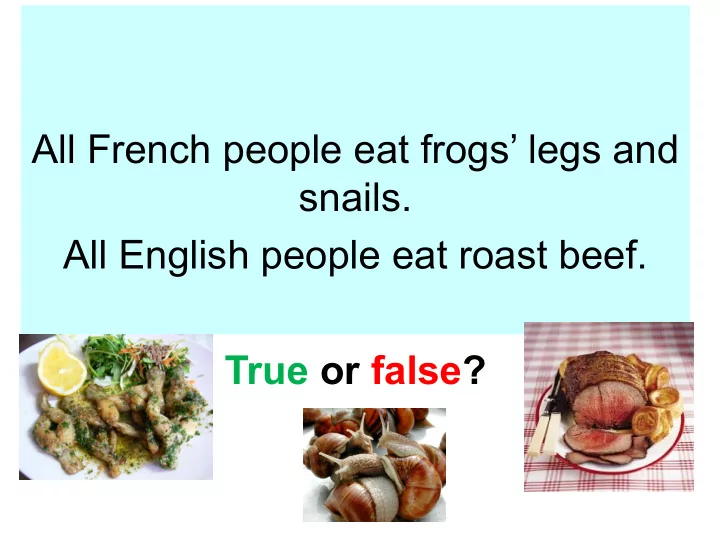
La nourriture franaise All French people eat frogs legs and snails. - - PowerPoint PPT Presentation

la nourriture fran aise
SMART_READER_LITE
LIVE PREVIEW

La nourriture franaise All French people eat frogs legs and snails. - - PowerPoint PPT Presentation

La nourriture franaise All French people eat frogs legs and snails. All English people eat roast beef. True or false? GRAMMAR POP! tre to be Je suis I am Tu es You (singular) are Il/ elle/ on est He/ she/ one is Nous


slide-1
SLIDE 1

La nourriture française

All French people eat frogs’ legs and snails. All English people eat roast beef. True or false?

slide-2
SLIDE 2

GRAMMAR POP! Être – to be Je suis – I am Tu es – You (singular) are Il/ elle/ on est – He/ she/ one is Nous sommes –We are Vous êtes – You (plural) are Ils/ elles sont – They are

slide-3
SLIDE 3

Learning intentions:

  • You will recall the names of typical French dishes.
  • You will understand how to agree adjectives in French.
  • You will apply this knowledge to give your opinion of French dishes.

Success criteria:

  • I can recall the names of typical French dishes (level 1)
  • I can say which dishes I like and dislike (level 3)
  • I can make adjectives agree with the noun in French
  • I can give a reason why I like or don’t like a dish (level 4)

Les mots clés: noun masculine feminine adjective agreement

slide-4
SLIDE 4

Les fruits de mer

Learning intentions: You will recall the names of typical French dishes.

Les moules-frites (f) Les crevettes (f) Les huîtres (f)

slide-5
SLIDE 5

Les plats principaux

Learning intentions: You will recall the names of typical French dishes.

Le steak-frites Le magret de canard La salade niçoise

slide-6
SLIDE 6

Le fromage!

Learning intentions: You will recall the names of typical French dishes.

Le camembert Le brie Le roquefort Le fromage de chèvre

slide-7
SLIDE 7

Les desserts!

Learning intentions: You will recall the names of typical French dishes.

Les crêpes La tarte tatin La crème brûlée

slide-8
SLIDE 8

parce que/ car…

 

délicieux dégoûtant sucré salé épicé fort

Learning intentions: You will recall the names of typical French dishes.

Les mots clés: noun masculine feminine adjective agreement

slide-9
SLIDE 9

Les adjectifs

Masculine singular (le) Feminine singular (la) Masculine plural (les) Feminine plural (les) sweet sucré sucrés salty salé salée salées spicy épicé épicés strong fort forts fortes disgusting dégoûtant dégoûtante dégoûtantes good bon bonne bons delicious délicieux délicieuse délicieux

Learning intentions: You will recall the names of typical French dishes. You will understand how to agree adjectives in French.

slide-10
SLIDE 10

Learning intentions: You will recall the names of typical French dishes. You will understand how to agree adjectives in French. You will apply this knowledge to give their opinion of French dishes.

Task : Translate into English 1) J’adore les crêpes parce qu’elles sont délicieuses. 2) Je n’aime pas le roquefort car il est trop fort. 3) J’aime la salade niçoise parce qu’elle est délicieuse. 4) I love tarte tatin because it’s very good! 5) I like mussels with chips because they are delicious!

Les mots clés: noun masculine feminine adjective agreement

slide-11
SLIDE 11

Learning intentions: You will recall the names of typical French dishes. You will understand how to agree adjectives in French. You will apply this knowledge to give their opinion of French dishes.

Task : À toi! (Over to you!) Qu’est-ce que tu aimes manger? (What do you like to eat?) Pourquoi?

Les mots clés: noun masculine feminine adjective agreement

slide-12
SLIDE 12

1) Je n’aime pas les huîtres parce qu’elles sont trop salées et gluantes. 2) I love crème brûlée because it’s delicious. 3) Which letter do we add to an adjective when describing a feminine noun? 4) Which letter do we add to an adjective when describing a masculine plural noun? 5) How do we know if a word is masculine or feminine? 6) Which letter do we add to an adjective when describing a feminine plural noun? 7) I hate niçoise salad because it’s disgusting. 8) Je déteste le roquefort parce qu’il est trop fort. 9) I don’t like tarte tatin because it’s too sweet.