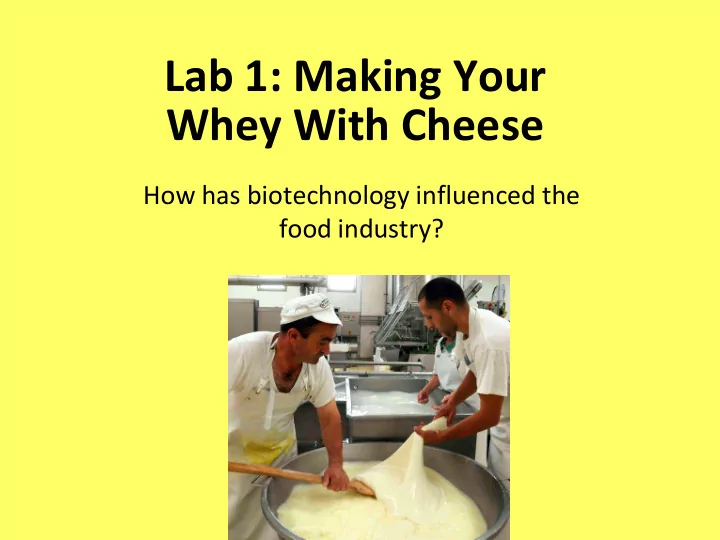
Lab 1: Making Your Whey With Cheese How has biotechnology - - PowerPoint PPT Presentation

lab 1 making your whey with cheese
SMART_READER_LITE
LIVE PREVIEW

Lab 1: Making Your Whey With Cheese How has biotechnology - - PowerPoint PPT Presentation

Lab 1: Making Your Whey With Cheese How has biotechnology influenced the food industry? History of Cheese Making Closely associated with the domestication of milk producing animals, such as sheep (8,000 to 10,000 years ago) Evidence


slide-1
SLIDE 1

How has biotechnology influenced the food industry?

Lab 1: Making Your Whey With Cheese

slide-2
SLIDE 2

History of Cheese Making

  • Closely associated with the domestication
  • f milk producing animals, such as sheep

(8,000 to 10,000 years ago)

  • Evidence found in Egyptian tomb murals

(4,000)

  • Widespread by the Roman Empire (25BC to

410 AD)

slide-3
SLIDE 3
slide-4
SLIDE 4

Bacteria and Cheese

  • Different cultures of bacteria are used to

produce the many different flavors of cheese

slide-5
SLIDE 5

The Science Behind Cheese

  • Bacteria produce enzymes that convert

lactose (milk) to lactic acid.

  • Lactic acid causes the milk protein, casein,

to denature and fall out of solution.

  • Other enzymes, called proteases, also act
  • n casein proteins further.
  • Denatured casein proteins are called curds

– used to make cheese.

slide-6
SLIDE 6
slide-7
SLIDE 7

Curdling Methods

1. Leave It To Chance Method – bacteria in the air 2. Bacterial Culture Method – buttermilk cultures 3. We Need a Cow Stomach Method – rennin enzyme 4. Genetically Trick a Fungus Method – chymosin recombinant enzyme

slide-8
SLIDE 8

Leave It To Chance Method

(milk + milk)

slide-9
SLIDE 9

Bacterial Culture Method

(milk + buttermilk)

slide-10
SLIDE 10

We Need a Cow Stomach Method

(milk + rennin)

slide-11
SLIDE 11

Genetically Trick a Fungus Method

(milk + chymosin)

slide-12
SLIDE 12

Genetic Engineering

slide-13
SLIDE 13

Lab Objectives

  • To determine which curdling agent produces

cheese the fastest.

  • To determine which curdling agent produces the

most cheese.

  • To examine numerical data to support

predictions.

  • To examine variables that can lead to invalid

experiments.

slide-14
SLIDE 14

Record the following in your lab notebook:

  • 1. Title of the lab.
  • 2. Describe the objectives of the lab.
  • 3. Identify the independent and dependent

variable.

Lab Notebook

slide-15
SLIDE 15

Record the following in your lab notebook:

  • 4. Predict which curdling agent will produce the

largest volume of cheese in the shortest amount

  • f time. This is your hypothesis and should be

written using the format provided. Explain your hypothesis.

  • 5. Draw diagrams of the four test tubes. Include

the contents and amounts of each reagent in your diagrams.

Lab Notebook

slide-16
SLIDE 16

Label with group initials and number:

Test Tubes

slide-17
SLIDE 17

Data Table 1

slide-18
SLIDE 18

Data Table 2

slide-19
SLIDE 19

Data Analysis