Labor market discrimination of internal migrants: An experimental - - PowerPoint PPT Presentation

labor market discrimination of internal migrants an
SMART_READER_LITE
LIVE PREVIEW

Labor market discrimination of internal migrants: An experimental - - PowerPoint PPT Presentation

Labor market discrimination of internal migrants: An experimental study Jan Priebe GIGA Hamburg UNU-WIDER: Transforming economies for better jobs Bangkok, 11-13 September 2019 Structure of the talk Motivation & preview of


slide-1
SLIDE 1

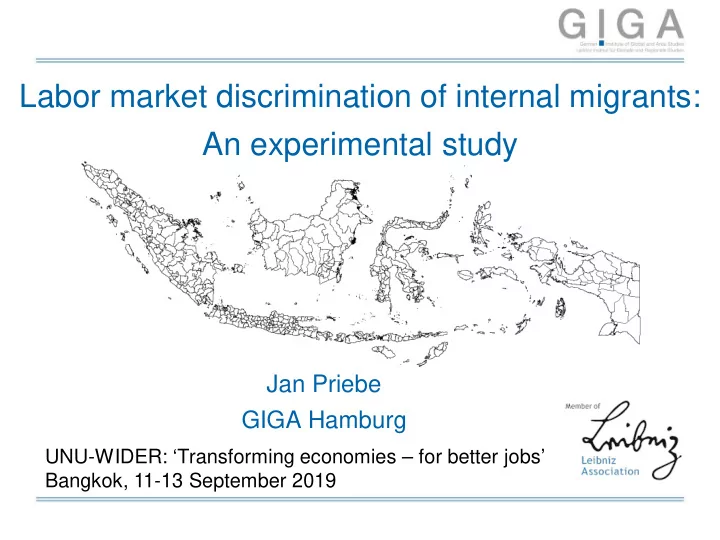
Labor market discrimination of internal migrants: An experimental study

UNU-WIDER: ‘Transforming economies – for better jobs’ Bangkok, 11-13 September 2019

Jan Priebe GIGA Hamburg

slide-2
SLIDE 2

Structure of the talk

2

  • Motivation & preview of results
  • Indonesian context
  • Experimental design
  • Results
  • Policy conclusions
slide-3
SLIDE 3

Motivation & preview of results

3

Stylized facts about tertiary/higher education

  • Strong increase in global enrollment figures
  • 33 million (in 1970) vs. 221 million (in 2016)
  • Half of all students are enrolled in Asia alone these days
  • Strong increase in the number of colleges
  • Particularly strong increase in private colleges
  • Wider geographical spread of colleges within countries
  • ‘Massification’ of college education
  • Establishment of many lower quality institutions
slide-4
SLIDE 4

Motivation & preview of results

4

Returns to college education

  • High tuition fees (except public colleges), but
  • Returns to college education increased over time
  • Returns are larger in developing countries
  • Returns can differ by college selectivity and by discrimination
  • Labor market discrimination based on gender, religion, ethnicity,

  • But: Scarcity of causal evidence on
  • (Mechanisms behind) labor market discrimination
  • Disentangling signaling vs. sorting vs. learning vs. peer effects vs.

network effects

  • Heterogeneous returns to college education
slide-5
SLIDE 5

Motivation & preview of results

5

Returns to college education & labor market discrimination

  • Non-experimental studies
  • Race:
  • Blacks in the US (Loury and Garmant, 1995); Andrews (2016)
  • Hispanics in the US (Dale and Krueger, 2014)
  • Wealth:
  • Wealthy elite: Zimmerman (2019) for Chile
  • Poor: Saavedra (2009) for Columbia
  • Experimental studies: Correspondence studies
  • Race: Blacks in the US: Gaddis (2014)
  • Immigrants to Canada: Oreopolous (2011)
slide-6
SLIDE 6

Motivation & preview of results

6

Overview on experiment

  • Location: Greater Jakarta (Indonesia)
  • Method: Correspondence experiment
  • with 13,500 CVs sent to 2,700 job vacancies
  • 5 CV types per job vacancy
  • Differences by internal migrant status
  • Differences by college selectivity
slide-7
SLIDE 7

Motivation & preview of results

7

Preview of results

  • College quality increases interview callbacks
  • + 2.9pp for public colleges + additional 3.9pp for elite colleges
  • Internal migrants receive less callbacks
  • Internal migrants from better colleges see less discrimination
  • Suggestive evidence for statistical discrimination
  • Others
  • Follow-up calls with employers hints to statistical discrimination
  • Suggestive evidence for taste-based discrimination against

blacks

  • No discrimination by gender and religion
slide-8
SLIDE 8

Motivation & preview of results

8

Contribution to the literature

  • College selectivity and discrimination
  • Causal evidence for interaction between college selectivity and

discriminatory practices

  • Internal migration
  • Causal evidence on extent and nature of discrimination against

internal migrants in labor markets

  • Correspondence studies
  • Few conducted in developing countries
  • No study on discrimination regarding religion and gender in a

majority Muslim country

slide-9
SLIDE 9

Indonesian context: General

9

  • 4th most populous country in the world (about 270 million)
  • >140 million on the island of Java alone
  • Religion:
  • 87.2% Muslims, 9.9% Christians, 1,7% Hindu, 0,9% Buddhists
  • Greater Jakarta: Political, economic, and financial center
  • About 35 million people
  • Province and district creation: Along ethno-religious lines
  • Documented cleavages
  • Java vs. outer islands
  • Religious
  • Ethnic-religious (e.g. Chinese, Papuans)
slide-10
SLIDE 10

Indonesian context:

10

Consequences of cleavages:

  • Violent conflict (Barren et al., 2009; Bazzi and Gudgeon, 2016; Pierskalla

and Sacks, 2017)

  • Splitting and creation of (sub-) districts (Pierskalla, 2016)
  • Political coalitions and campaigns (Bünte, 2010)
  • Interpersonal trust (Gaduh, 2012)
  • Trade relationships (Schmetzer, 2011; Studwell, 2007)
  • Success of business negotiations (Irawanto et al., 2011)
  • Javanese manners (politeness, calmness, modesty, face saving, etc.) are

highly appreciated

  • Marriage market (Bazzi et al., 2017)
slide-11
SLIDE 11

Indonesian context: Higher education (I)

11

General overview: from kindergarten to senior high school

  • 50 million pupils/students
  • 4 million teachers
  • 250,000 education facilities
  • About 6 million pupil graduate from senior high school (SMA) annually

Quality of high school education (teacher + student learning

  • utcomes)
  • Rural vs. urban gap
  • Richer vs. poorer provinces
  • Java vs. non-Java
slide-12
SLIDE 12

12

slide-13
SLIDE 13

Indonesian context: Higher education (II)

13

  • 3,000 institutions of higher education with 6.5 million students
  • 4 main types of institutions:
  • Academies and polytechnic schools provide vocational training
  • Institutes and universities provide academic education (4.5 million students)
  • 547 accredited colleges (institutes/universities) in 2015
  • 73 public and 473 private ones
  • Public colleges:
  • No tuitions + admission based on national university entrance exam + highly

competitive

  • Elite colleges: All on Java + public
slide-14
SLIDE 14

14

slide-15
SLIDE 15

15

slide-16
SLIDE 16

Experiment (I): General

16

  • Location: Greater Jakarta (“Jabodetabek”)
  • Job requirements
  • Entry level positions with bachelor degree
  • Bachelor degree in Accounting, Business, Economics, and Management
  • About 30% of all undergraduate degrees in Indonesia
  • List of job
  • Source: 2 largest national job websites (jobstreet, jobsdb)
  • Selection process: 2,700 unique jobs + maximum of 1 job per company
  • Contacting
  • Sending of application: Email with personalized cover text + resume attachment
  • Callback rates: Contact for interview via email or phone (call, sms)
slide-17
SLIDE 17

Experiment (II):

17

Basic features:

  • Birthdate and place of birth
  • Senior high school: Name + location + GPA
  • College: Name + location + GPA
  • Other: Hobbies, sports, extracurricular activities, language skills
  • Contact details: Email, cell phone
  • Contact address:
  • Javanese (always Javanese)
  • Non-Javanese (internal migrants): 75% on Java
  • Names: 12 (6 male + 6 female; 8 Muslim + 4 neutral)
slide-18
SLIDE 18

Experiment (III)

18

Main types

  • Type 1: Javanese + elite college degree
  • Type 2: Javanese + non-elite Javanese college degree
  • Type 3: Internal migrant + elite college degree
  • Type 4: Internal migrant + non-elite Javanese college degree
  • Type 5: Internal migrant + non-elite non-Javanese college degree
slide-19
SLIDE 19

Main results (I)

19

slide-20
SLIDE 20

Main results (II)

20

slide-21
SLIDE 21

Robustness checks

21

  • Alternative callback definition: Explicit interview invitations
  • Within vacancy spill-over effects
  • With and without vacancy fixed effects
slide-22
SLIDE 22

Extensions (I)

22

  • Channels for statistical discrimination
  • Travel distance: Costs + probability to appear at interview
  • Yes, explains part of the results
  • Cultural distance:
  • Yes, explains part of the results
  • College quality:
  • Yes, explains part of the results
  • Channels for taste-based discrimination
  • Papuan effect for jobs with high customer contact
  • Others: No discrimination by religion or against women
slide-23
SLIDE 23

Extension II: Follow-up phone survey

23

slide-24
SLIDE 24

Conclusions

24

Findings

  • Evidence of statistical discrimination against internal migrants
  • Less discrimination if colleges are attended that are (I) better and (II) on Java
  • Some evidence for taste-based discrimination (skin color)
  • No evidence for discrimination along religion and gender lines

Policy conclusions

  • Reduce geographic differences in education quality
  • Stipulate that locational identifiers (birth place,...) are not on CVs
  • Increase use of long-distance interview/recruitment processes
slide-25
SLIDE 25

Appendix: Alternative callback definition

25

slide-26
SLIDE 26

Appendix: Within vacancy spillover effects

26

slide-27
SLIDE 27

Appendix: College quality

27

slide-28
SLIDE 28

Appendix: Travel costs and cultural distance

28

slide-29
SLIDE 29

Appendix: Taste-based discrimination

29

slide-30
SLIDE 30

Appendix: Gender and religion

30