Last time 6.891 Computer Vision and Applications Interesting - - PDF document

last time 6 891
SMART_READER_LITE
LIVE PREVIEW

Last time 6.891 Computer Vision and Applications Interesting - - PDF document

Last time 6.891 Computer Vision and Applications Interesting points, correspondence, affine patch tracking Prof. Trevor. Darrell Scale and rotation invariant descriptors [Lowe] Lecture 7: Features and Geometry Affine invariant features


slide-1
SLIDE 1

1

1

6.891

Computer Vision and Applications

  • Prof. Trevor. Darrell

Lecture 7: Features and Geometry

– Affine invariant features – Epipolar geometry – Essential matrix

Readings: Mikolajczyk and Schmid; F&P Ch 10

2

Last time

Interesting points, correspondence, affine patch tracking Scale and rotation invariant descriptors [Lowe]

3

Images as Vectors

Left Right

L

w

R

w

m m L

w

L

w

row 1 row 2 row 3

m m m

“Unwrap” image to form vector, using raster scan order

Each window is a vector in an m2 dimensional vector space. Normalization makes them unit length.

4

Image Metrics

L

w ) (d wR

2 ) , ( ) , ( 2 SSD

) ( )] , ( ˆ ) , ( ˆ [ ) ( d w w v d u I v u I d C

R L y x W v u R L

m

− = − − =

(Normalized) Sum of Squared Differences Normalized Correlation

θ cos ) ( ) , ( ˆ ) , ( ˆ ) (

) , ( ) , ( NC

= ⋅ = − =

d w w v d u I v u I d C

R L y x W v u R L

m

) ( max arg ) ( min arg

2 *

d w w d w w d

R L d R L d

⋅ = − =

5

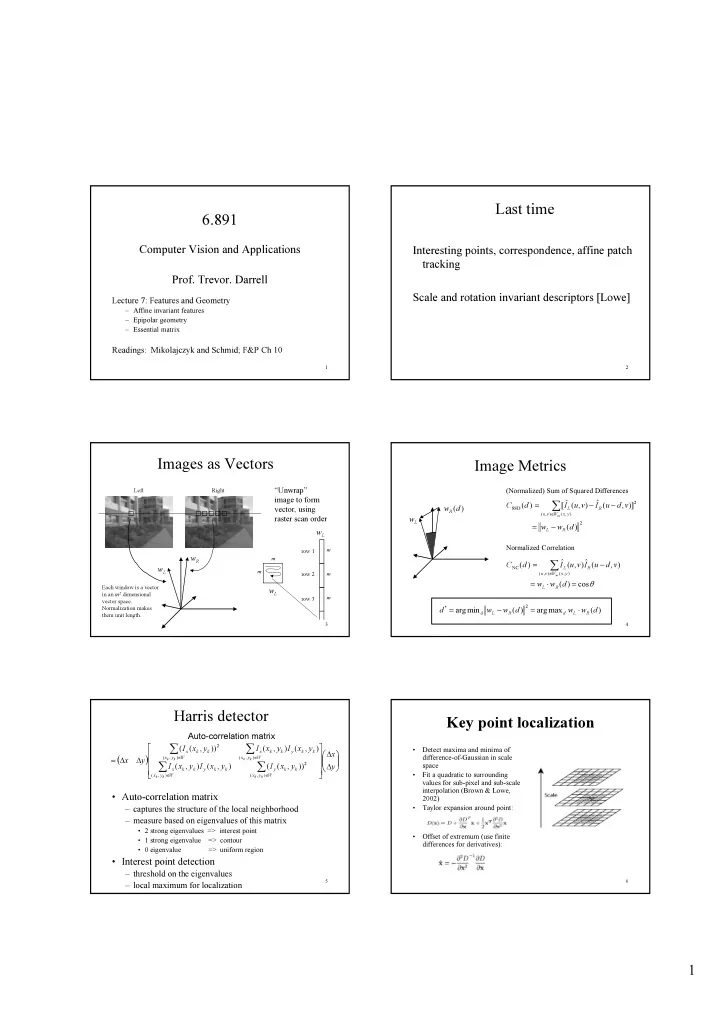
Harris detector

( )

        ∆ ∆           ∆ ∆ =

∑ ∑ ∑ ∑

∈ ∈ ∈ ∈

y x y x I y x I y x I y x I y x I y x I y x

W y x k k y W y x k k y k k x W y x k k y k k x W y x k k x

k k k k k k k k

) , ( 2 ) , ( ) , ( ) , ( 2

)) , ( ( ) , ( ) , ( ) , ( ) , ( )) , ( ( Auto-correlation matrix

  • Auto-correlation matrix

– captures the structure of the local neighborhood – measure based on eigenvalues of this matrix

  • 2 strong eigenvalues => interest point
  • 1 strong eigenvalue => contour
  • 0 eigenvalue => uniform region
  • Interest point detection

– threshold on the eigenvalues – local maximum for localization

6

Key point localization

  • Detect maxima and minima of

difference-of-Gaussian in scale space

  • Fit a quadratic to surrounding

values for sub-pixel and sub-scale interpolation (Brown & Lowe, 2002)

  • Taylor expansion around point:
  • Offset of extremum (use finite

differences for derivatives):

B l u r
slide-2
SLIDE 2

2

7

Select canonical orientation

  • Create histogram of local

gradient directions computed at selected scale

  • Assign canonical orientation

at peak of smoothed histogram

  • Each key specifies stable 2D

coordinates (x, y, scale,

  • rientation)

8

SIFT vector formation

  • Thresholded image gradients are sampled over 16x16

array of locations in scale space

  • Create array of orientation histograms
  • 8 orientations x 4x4 histogram array = 128 dimensions

9

Today

Affine Invariant Interest points [Schmid] Evaluation of interest points and descriptors [Schmid] Epipolar geometry and the Essential Matrix

10

Affine invariance of interest points Cordelia Schmid CVPR’03 Tutorial

11

Scale invariant Harris points

  • Multi-scale extraction of Harris interest points
  • Selection of points at characteristic scale in scale space

Laplacian Chacteristic scale :

  • maximum in scale space
  • scale invariant

12

Scale invariant interest points

invariant points + associated regions [Mikolajczyk & Schmid’01]

multi-scale Harris points selection of points at the characteristic scale with Laplacian

slide-3
SLIDE 3

3

13

Viewpoint changes

  • Locally approximated by an affine transformation

A

detected scale invariant region projected region

14

State of the art

  • Affine invariant regions (Tuytelaars et al.’00)

– ellipses fitted to intensity maxima – parallelogram formed by interest points and edges

15

State of the art

  • Theory for affine invariant neighborhood

(Lindeberg’94)

x x A →

x x

2 1 −

L

M x x

2 1 −

R

M ) x ( ) x (

2 1 2 1 L L R R

M R M = ) , x (

L L L

M Σ = µ Isotropic neighborhoods related by rotation ) , x (

R R R

M Σ = µ

16

State of the art

  • Localization & scale influence affine

neighhorbood

=> affine invariant Harris points (Mikolajczyk & Schmid’02)

  • Iterative estimation of these parameters
  • 1. localization – local maximum of the Harris measure
  • 2. scale – automatic scale selection with the Laplacian
  • 3. affine neighborhood – normalization with second

moment matrix

Repeat estimation until convergence

17

  • Iterative estimation of localization, scale, neighborhood

Initial points

Affine invariant Harris points

18

  • Iterative estimation of localization, scale, neighborhood

Iteration #1

Affine invariant Harris points

slide-4
SLIDE 4

4

19

  • Iterative estimation of localization, scale, neighborhood

Iteration #2

Affine invariant Harris points

20

  • Iterative estimation of localization, scale, neighborhood

Iteration #3, #4, ...

Affine invariant Harris points

21

Affine invariant Harris points

  • Initialization with multi-scale interest points
  • Iterative modification of location, scale and neighborhood

22

Affine invariant Harris points

Harris-Laplace Harris-Laplace + affine regions affine Harris

23

affine Harris detector affine Laplace detector

Affine invariant neighborhhood

24

Image retrieval

> 5000 images change in viewing angle

slide-5
SLIDE 5

5

25

Matches

22 correct matches

26

Image retrieval

> 5000 images change in viewing angle + scale change

27

Matches

33 correct matches

28

3D Recognition

29

3D Recognition

3D object modeling and recognition using affine-invariant patches and multi-view spatial constraints,

  • F. Rothganger, S. Lazebnik, C. Schmid, J. Ponce,

CVPR 2003

30

Evaluation of interest points and descriptors

Cordelia Schmid CVPR’03 Tutorial

slide-6
SLIDE 6

6

31

Introduction

  • Quantitative evaluation of interest point detectors

– points / regions at the same relative location => repeatability rate

  • Quantitative evaluation of descriptors

– distinctiveness => detection rate with respect to false positives

32

Quantitative evaluation of detectors

  • Repeatability rate : percentage of corresponding points
  • Two points are corresponding if
  • 1. The location error is less than 1.5 pixel
  • 2. The intersection error is less than 20%

homography

33

Comparison of different detectors

[Comparing and Evaluating Interest Points, Schmid, Mohr & Bauckhage, ICCV 98]

repeatability - image rotation

34

Comparison of different detectors

[Comparing and Evaluating Interest Points, Schmid, Mohr & Bauckhage, ICCV 98]

repeatability – perspective transformation

35

Harris detector + scale changes

36

Harris detector – adaptation to scale

slide-7
SLIDE 7

7

37

Evaluation of scale invariant detectors

repeatability – scale changes

38

Evaluation of affine invariant detectors

40 60 70

repeatability – perspective transformation

39

Quantitative evaluation of descriptors

  • Evaluation of different local features

– SIFT, steerable filters, differential invariants, moment invariants, cross-correlation

  • Measure : distinctiveness

– receiver operating characteristics of detection rate with respect to false positives – detection rate = correct matches / possible matches – false positives = false matches / (database points * query points)

[A performance evaluation of local descriptors, Mikolajczyk & Schmid, CVPR’03]

40

Experimental evaluation

41

Scale change (factor 2.5)

Harris-Laplace DoG

42

Viewpoint change (60 degrees)

Harris-Affine (Harris-Laplace)

slide-8
SLIDE 8

8

43

Descriptors - conclusion

  • SIFT + steerable perform best
  • Performance of the descriptor independent
  • f the detector
  • Errors due to imprecision in region

estimation, localization

44

Today

Affine Invariant Interest points [Schmid] Evaluation of interest points and descriptors [Schmid] Epipolar geometry and the Essential Matrix

45

Multi-view geometry and 3-D

We have 2 eyes, yet we see 3-D! Using multiple views allows inference of hidden dimension.

46

3-D: The hidden dimension…

47

Multiple views to the rescue!

48

How to see in 3-D

(Using geometry…)

  • Find features
  • Triangulate & reconstruct depth
slide-9
SLIDE 9

9

49

Multi-view geometry

Relate

50

Multi-view geometry

Relate

  • 3-D points

51

Multi-view geometry

Relate

  • 3-D points
  • Camera centers

52

Multi-view geometry

Relate

  • 3-D points
  • Camera centers
  • Camera orientation

53

Multi-view geometry

Relate

  • 3-D points
  • Camera centers
  • Camera orientation
  • Camera intrinsics

54

Multi-view geometry

Relate

  • 3-D points
  • Camera centers
  • Camera orientation
  • Camera intrinsics
slide-10
SLIDE 10

10

55

Stereo constraints

Given p in left image, where can corresponding point p’ be? Could be anywhere! Might not be same scene!

p’?

p

56

Stereo constraints

Given p in left image, where can p’ be?

p’?

p

57

Stereo constraints

Given p in left image, where can p’ be?

p

DEMO

p’?

58

Epipolar line

?

p

59

Epipolar constraint

All epipolar lines contain epipole, the image of other camera center.

60

From geometry to algebra…

O O’ P p p’

slide-11
SLIDE 11

11

61

From geometry to algebra…

The epipolar constraint: these vectors are coplanar:

O O’ P p p’

62

c1 c2 p p,p’ are image coordinates of P in c1 and c2… c2 is related to c1 by rotation R and translation t

t R

= 0

p’

O O’ P p p’

63

Matrix form

Linear constraint, should be able to express as matrix equation… = 0

64

Review: matrix form of cross- product

The vector cross product also acts on two vectors and returns a third vector. Geometrically, this new vector is constructed such that its projection onto either of the two input vectors is zero.

          − − − = ×

x y y x z x x z y z z y

b a b a b a b a b a b a b a r r

65

Review: matrix form of cross- product

= ] [

x

a b a b a

x

r r r ] [ = ×

66

Matrix form

b a b a

x

r r r ] [ = × ' ] [ = ℜp t p

x T

= 0

ℜ = ] [ x t ε

slide-12
SLIDE 12

12

67

The Essential Matrix

Matrix that relates image of point in one camera to a second camera, given translation and rotation. Assumes intrinsic parameters are known.

b a b a

x

r r r ] [ = ×

ℜ = ] [ x t ε

68

The Essential Matrix

is the epipolar line corresponding to p’ in the left camera.

' p

ε

' p

ε

= + + c bv au

T

v u p ) 1 , , ( =

T

c b a l ) , , ( = = ⋅ p l

' = ⋅p p

ε

69

Today

Affine Invariant Interest points [Schmid] Evaluation of interest points and descriptors [Schmid] Epipolar geometry and the Essential Matrix