last time %xmm1: [6, 8, 10, 12] Result will be: %xmm1: [5, 6, 7, - - PowerPoint PPT Presentation

last time
SMART_READER_LITE
LIVE PREVIEW

last time %xmm1: [6, 8, 10, 12] Result will be: %xmm1: [5, 6, 7, - - PowerPoint PPT Presentation

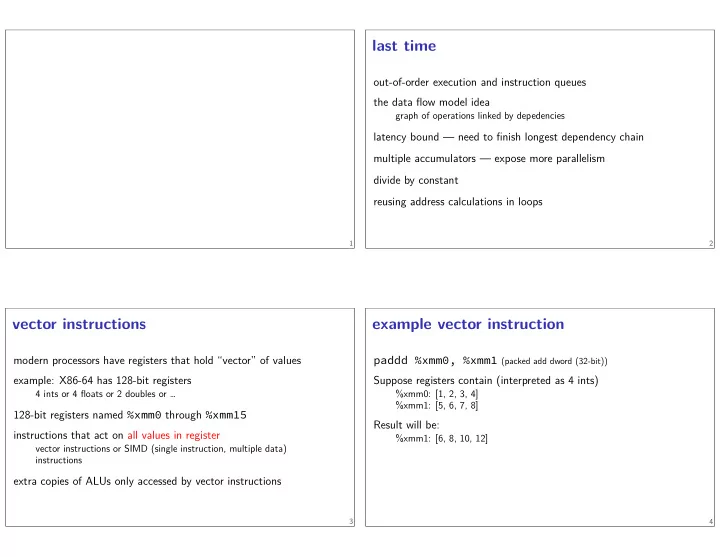
1 last time %xmm1: [6, 8, 10, 12] Result will be: %xmm1: [5, 6, 7, 8] %xmm0: [1, 2, 3, 4] Suppose registers contain (interpreted as 4 ints) paddd %xmm0, %xmm1 (packed add dword (32-bit)) example vector instruction 3 extra copies of ALUs


slide-1
SLIDE 1

1

last time

  • ut-of-order execution and instruction queues

the data fmow model idea

graph of operations linked by depedencies

latency bound — need to fjnish longest dependency chain multiple accumulators — expose more parallelism divide by constant reusing address calculations in loops

2

vector instructions

modern processors have registers that hold “vector” of values example: X86-64 has 128-bit registers

4 ints or 4 fmoats or 2 doubles or …

128-bit registers named %xmm0 through %xmm15 instructions that act on all values in register

vector instructions or SIMD (single instruction, multiple data) instructions

extra copies of ALUs only accessed by vector instructions

3

example vector instruction

paddd %xmm0, %xmm1 (packed add dword (32-bit)) Suppose registers contain (interpreted as 4 ints)

%xmm0: [1, 2, 3, 4] %xmm1: [5, 6, 7, 8]

Result will be:

%xmm1: [6, 8, 10, 12]

4

slide-2
SLIDE 2

vector instructions

void add(int * restrict a, int * restrict b) { for (int i = 0; i < 128; ++i) a[i] += b[i]; } add: xorl %eax, %eax // init. loop counter the_loop: movdqu (%rdi,%rax), %xmm0 // load 4 from A movdqu (%rsi,%rax), %xmm1 // load 4 from B paddd %xmm1, %xmm0 // add 4 elements! movups %xmm0, (%rdi,%rax) // store 4 in A addq $16, %rax // +4 ints = +16 cmpq $512, %rax // 512 = 4 * 128 jne the_loop rep ret

5

vector add picture

A[0] B[0] A[1] B[1] A[2] B[2] A[3] B[3] A[4] B[4] A[5] B[5] A[6] B[6] A[7] B[7] A[8] B[8] A[9] B[9] … …

movdqu %xmm0 movdqu %xmm1 paddd %xmm0

A[4] + B[4] A[5] + B[5] A[6] + B[6] A[7] + B[7]

6

wiggles on prior graphs

200 400 600 800 1000 N 0.0 0.1 0.2 0.3 0.4 0.5

cycles per multiply/add [optimized loop] unblocked blocked

variance from this optimization 8 elements in vector, so multiples of 8 easier

7

  • ne view of vector functional units

ALU (lane 1) (stage 1) ALU (lane 1) (stage 2) ALU (lane1) (stage 3) ALU (lane 2) (stage 1) ALU (lane 2) (stage 2) ALU (lane 2) (stage 3) ALU (lane 3) (stage 1) ALU (lane 3) (stage 2) ALU (lane 3) (stage 3) ALU (lane 4) (stage 1) ALU (lane 4) (stage 2) ALU (lane 4) (stage 3) input values (one/cycle)

  • utput values

(one/cycle) vector ALU

8

slide-3
SLIDE 3

why vector instructions?

lots of logic not dedicated to computation

instruction queue reorder bufger instruction fetch branch prediction …

adding vector instructions — little extra control logic …but a lot more computational capacity

9

vector instructions and compilers

compilers can sometimes fjgure out how to use vector instructions

(and have gotten much, much better at it over the past decade)

but easily messsed up:

by aliasing by conditionals by some operation with no vector instruction …

10

fjckle compiler vectorization (1)

GCC 7.2 and Clang 5.0 generate vector instructions for this:

#define N 1024 void foo(unsigned int *A, unsigned int *B) { for (int k = 0; k < N; ++k) for (int i = 0; i < N; ++i) for (int j = 0; j < N; ++j) B[i * N + j] += A[i * N + k] * A[k * N + j]; }

but not:

#define N 1024 void foo(unsigned int *A, unsigned int *B) { for (int i = 0; i < N; ++i) for (int j = 0; j < N; ++j) for (int k = 0; k < N; ++k) B[i * N + j] += A[i * N + k] * A[j * N + k]; }

11

fjckle compiler vectorization (2)

Clang 5.0.0 generates vector instructions for this:

void foo(int N, unsigned int *A, unsigned int *B) { for (int k = 0; k < N; ++k) for (int i = 0; i < N; ++i) for (int j = 0; j < N; ++j) B[i * N + j] += A[i * N + k] * A[k * N + j]; }

but not: (probably bug?)

void foo(long N, unsigned int *A, unsigned int *B) { for (long k = 0; k < N; ++k) for (long i = 0; i < N; ++i) for (long j = 0; j < N; ++j) B[i * N + j] += A[i * N + k] * A[k * N + j]; }

12

slide-4
SLIDE 4

vector intrinsics

if compiler doesn’t work… could write vector instruction assembly by hand second option: “intrinsic functions” C functions that compile to particular instructions

13

vector intrinsics: add example

void vectorized_add(int *a, int *b) { for (int i = 0; i < 128; i += 4) { // "si128" --> 128 bit integer // a_values = {a[i], a[i+1], a[i+2], a[i+3]} __m128i a_values = _mm_loadu_si128((__m128i*) &a[i]); // b_values = {b[i], b[i+1], b[i+2], b[i+3]} __m128i b_values = _mm_loadu_si128((__m128i*) &b[i]); // add four 32-bit integers // sums = {a[i] + b[i], a[i+1] + b[i+1], ....} __m128i sums = _mm_add_epi32(a_values, b_values); // {a[i], a[i+1], a[i+2], a[i+3]} = sums _mm_storeu_si128((__m128i*) &a[i], sums); } }

special type __m128i — “128 bits of integers”

  • ther types: __m128 (fmoats), __m128d (doubles)

functions to store/load si128 means “128-bit integer value” u for “unaligned” (otherwise, pointer address must be multiple of 16) function to add epi32 means “4 32-bit integers”

14

vector intrinsics: add example

void vectorized_add(int *a, int *b) { for (int i = 0; i < 128; i += 4) { // "si128" --> 128 bit integer // a_values = {a[i], a[i+1], a[i+2], a[i+3]} __m128i a_values = _mm_loadu_si128((__m128i*) &a[i]); // b_values = {b[i], b[i+1], b[i+2], b[i+3]} __m128i b_values = _mm_loadu_si128((__m128i*) &b[i]); // add four 32-bit integers // sums = {a[i] + b[i], a[i+1] + b[i+1], ....} __m128i sums = _mm_add_epi32(a_values, b_values); // {a[i], a[i+1], a[i+2], a[i+3]} = sums _mm_storeu_si128((__m128i*) &a[i], sums); } }

special type __m128i — “128 bits of integers”

  • ther types: __m128 (fmoats), __m128d (doubles)

functions to store/load si128 means “128-bit integer value” u for “unaligned” (otherwise, pointer address must be multiple of 16) function to add epi32 means “4 32-bit integers”

14

vector intrinsics: add example

void vectorized_add(int *a, int *b) { for (int i = 0; i < 128; i += 4) { // "si128" --> 128 bit integer // a_values = {a[i], a[i+1], a[i+2], a[i+3]} __m128i a_values = _mm_loadu_si128((__m128i*) &a[i]); // b_values = {b[i], b[i+1], b[i+2], b[i+3]} __m128i b_values = _mm_loadu_si128((__m128i*) &b[i]); // add four 32-bit integers // sums = {a[i] + b[i], a[i+1] + b[i+1], ....} __m128i sums = _mm_add_epi32(a_values, b_values); // {a[i], a[i+1], a[i+2], a[i+3]} = sums _mm_storeu_si128((__m128i*) &a[i], sums); } }

special type __m128i — “128 bits of integers”

  • ther types: __m128 (fmoats), __m128d (doubles)

functions to store/load si128 means “128-bit integer value” u for “unaligned” (otherwise, pointer address must be multiple of 16) function to add epi32 means “4 32-bit integers”

14

slide-5
SLIDE 5

vector intrinsics: add example

void vectorized_add(int *a, int *b) { for (int i = 0; i < 128; i += 4) { // "si128" --> 128 bit integer // a_values = {a[i], a[i+1], a[i+2], a[i+3]} __m128i a_values = _mm_loadu_si128((__m128i*) &a[i]); // b_values = {b[i], b[i+1], b[i+2], b[i+3]} __m128i b_values = _mm_loadu_si128((__m128i*) &b[i]); // add four 32-bit integers // sums = {a[i] + b[i], a[i+1] + b[i+1], ....} __m128i sums = _mm_add_epi32(a_values, b_values); // {a[i], a[i+1], a[i+2], a[i+3]} = sums _mm_storeu_si128((__m128i*) &a[i], sums); } }

special type __m128i — “128 bits of integers”

  • ther types: __m128 (fmoats), __m128d (doubles)

functions to store/load si128 means “128-bit integer value” u for “unaligned” (otherwise, pointer address must be multiple of 16) function to add epi32 means “4 32-bit integers”

14

vector intrinsics: difgerent size

void vectorized_add_64bit(long *a, long *b) { for (int i = 0; i < 128; i += 2) { // a_values = {a[i], a[i+1]} (2 x 64 bits) __m128i a_values = _mm_loadu_si128((__m128i*) &a[i]); // b_values = {b[i], b[i+1]} (2 x 64 bits) __m128i b_values = _mm_loadu_si128((__m128i*) &b[i]); // add two 64-bit integers: paddq %xmm0, %xmm1 // sums = {a[i] + b[i], a[i+1] + b[i+1]} __m128i sums = _mm_add_epi64(a_values, b_values); // {a[i], a[i+1]} = sums _mm_storeu_si128((__m128i*) &a[i], sums); } }

15

vector intrinsics: difgerent size

void vectorized_add_64bit(long *a, long *b) { for (int i = 0; i < 128; i += 2) { // a_values = {a[i], a[i+1]} (2 x 64 bits) __m128i a_values = _mm_loadu_si128((__m128i*) &a[i]); // b_values = {b[i], b[i+1]} (2 x 64 bits) __m128i b_values = _mm_loadu_si128((__m128i*) &b[i]); // add two 64-bit integers: paddq %xmm0, %xmm1 // sums = {a[i] + b[i], a[i+1] + b[i+1]} __m128i sums = _mm_add_epi64(a_values, b_values); // {a[i], a[i+1]} = sums _mm_storeu_si128((__m128i*) &a[i], sums); } }

15

recall: square

void square(unsigned int *A, unsigned int *B) { for (int k = 0; k < N; ++k) for (int i = 0; i < N; ++i) for (int j = 0; j < N; ++j) B[i * N + j] += A[i * N + k] * A[k * N + j]; }

16

slide-6
SLIDE 6

square unrolled

void square(unsigned int *A, unsigned int *B) { for (int k = 0; k < N; ++k) { for (int i = 0; i < N; ++i) for (int j = 0; j < N; j += 4) { /* goal: vectorize this */ B[i * N + j + 0] += A[i * N + k] * A[k * N + j + 0]; B[i * N + j + 1] += A[i * N + k] * A[k * N + j + 1]; B[i * N + j + 2] += A[i * N + k] * A[k * N + j + 2]; B[i * N + j + 3] += A[i * N + k] * A[k * N + j + 3]; } }

17

handy intrinsic functions for square

_mm_set1_epi32 — load four copies of a 32-bit value into a 128-bit value

instructions generated vary; one example: movq + pshufd

_mm_mullo_epi32 — multiply four pairs of 32-bit values, give lowest 32-bits of results

generates pmulld

18

vectorizing square

/* goal: vectorize this */ B[i * N + j + 0] += A[i * N + k] * A[k * N + j + 0]; B[i * N + j + 1] += A[i * N + k] * A[k * N + j + 1]; B[i * N + j + 2] += A[i * N + k] * A[k * N + j + 2]; B[i * N + j + 3] += A[i * N + k] * A[k * N + j + 3];

19

vectorizing square

/* goal: vectorize this */ B[i * N + j + 0] += A[i * N + k] * A[k * N + j + 0]; B[i * N + j + 1] += A[i * N + k] * A[k * N + j + 1]; B[i * N + j + 2] += A[i * N + k] * A[k * N + j + 2]; B[i * N + j + 3] += A[i * N + k] * A[k * N + j + 3]; // load four elements from B Bij = _mm_loadu_si128(&B[i * N + j + 0]); ... // manipulate vector here // store four elements into B _mm_storeu_si128((__m128i*) &B[i * N + j + 0], Bij);

19

slide-7
SLIDE 7

vectorizing square

/* goal: vectorize this */ B[i * N + j + 0] += A[i * N + k] * A[k * N + j + 0]; B[i * N + j + 1] += A[i * N + k] * A[k * N + j + 1]; B[i * N + j + 2] += A[i * N + k] * A[k * N + j + 2]; B[i * N + j + 3] += A[i * N + k] * A[k * N + j + 3]; // load four elements from A Akj = _mm_loadu_si128(&A[k * N + j + 0]); ... // multiply each by A[i * N + k] here

19

vectorizing square

/* goal: vectorize this */ B[i * N + j + 0] += A[i * N + k] * A[k * N + j + 0]; B[i * N + j + 1] += A[i * N + k] * A[k * N + j + 1]; B[i * N + j + 2] += A[i * N + k] * A[k * N + j + 2]; B[i * N + j + 3] += A[i * N + k] * A[k * N + j + 3]; // load four elements starting with A[k * n + j] Akj = _mm_loadu_si128(&A[k * N + j + 0]); // load four copies of A[i * N + k] Aik = _mm_set1_epi32(A[i * N + k]); // multiply each pair multiply_results = _mm_mullo_epi32(Aik, Akj);

19

vectorizing square

/* goal: vectorize this */ B[i * N + j + 0] += A[i * N + k] * A[k * N + j + 0]; B[i * N + j + 1] += A[i * N + k] * A[k * N + j + 1]; B[i * N + j + 2] += A[i * N + k] * A[k * N + j + 2]; B[i * N + j + 3] += A[i * N + k] * A[k * N + j + 3]; Bij = _mm_add_epi32(Bij, multiply_results); // store back results _mm_storeu_si128(..., Bij);

19

square vectorized

__m128i Bij, Akj, Aik, Aik_times_Akj; // Bij = {Bi,j, Bi,j+1, Bi,j+2, Bi,j+3} Bij = _mm_loadu_si128((__m128i*) &B[i * N + j]); // Akj = {Ak,j, Ak,j+1, Ak,j+2, Ak,j+3} Akj = _mm_loadu_si128((__m128i*) &A[k * N + j]); // Aik = {Ai,k, Ai,k, Ai,k, Ai,k} Aik = _mm_set1_epi32(A[i * N + k]); // Aik_times_Akj = {Ai,k × Ak,j, Ai,k × Ak,j+1, Ai,k × Ak,j+2, Ai,k × Ak,j+3} Aik_times_Akj = _mm_mullo_epi32(Aij, Akj); // Bij= {Bi,j + Ai,k × Ak,j, Bi,j+1 + Ai,k × Ak,j+1, ...} Bij = _mm_add_epi32(Bij, Aik_times_Akj); // store Bij into B _mm_storeu_si128((__m128i*) &B[i * N + j], Bij);

20

slide-8
SLIDE 8

shuffmes/swizzles

/* x = 32-bit values: {10, 20, 30, 40} */ __m128i x = _mm_setr_epi32(10, 20, 30, 40); /* y = {20, 10, 40, 30} */ /* __MM_SHUFFLE macro lists indices to select in reverse order */ __m128i y = _mm_shuffle_epi32(x, _MM_SHUFFLE(2, 3, 0, 1)); /* x = 8-bit values: {10, 20, 30, 40, 50, ..., 160} */ __m128i x = _mm_setr_epi8(10, 20, 30, 40, 50, 60, 70, 80, 90, 100, 110, 120, 130, 140, 150, 160); /* y = {30, 30, 30, 30, 40, 40, 40, 40, 10, 10, 10, 10, 20, 20, 20, 20} */ __m128i y = _mm_shuffle_epi8(x, __mm_setr_epi8(2, 2, 2, 2, 3, 3, 3, 3, 0, 0, 0, 0, 1, 1, 1, 1));

21

more misc operations

many more variations/special cases of shuffmes combining values from difgerent vectors into one vector arithmetic within a vector extracting parts of vectors …

22

alternate vector interfaces

intrinsics functions/assembly aren’t the only way to write vector code e.g. GCC vector extensions: more like normal C code

types for each kind of vector write + instead of _mm_add_epi32

e.g. CUDA (GPUs): looks like writing multithreaded code, but each thread is vector “lane”

23

  • ther vector instructions

multiple extensions to the X86 instruction set for vector instructions this class: SSE, SSE2, SSE3, SSSE3, SSE4.1, SSE4.2

supported on lab machines 128-bit vectors

latest X86 processors: AVX, AVX2, AVX-512

256-bit and 512-bit vectors

also other ISAs have these: e.g. NEON on ARM, MSA on MIPS, AltiVec/VMX on POWER, …

24

slide-9
SLIDE 9
  • ther vector instructions features

SSE pretty limiting

  • ther vector instruction sets often more featureful:

(and require more sophisticated HW support)

better conditional handling better variable-length vectors ability to load/store non-contiguous values some of these features in some versions of AVX

25

smooth preview

smooth — take average of every 3x3 block of pixels in an image pixels: 4 one-byte values …but we need shorts to do computation of average

intermediate values > 255

vectors of 16 bit values → two pixels/vector regiser

26

adding pixels

red = pixel[0].red + pixel[1].red + ...; green = pixel[0].green + pixel[1].green + ...; blue = pixel[0].blue + pixel[1].blue + ...; alpha = pixel[0].blue + pixel[1].blue + ...; /* vector of 16-bit values, last 64-bits unused? */ combined_parts = _mm_add_epi16( _mm_add_epi16(pixel_zero_parts, pixel_one_parts), ...);

27

  • ptimizing real programs

spend efgort where it matters e.g. 90% of program time spent reading fjles, but optimize computation? e.g. 90% of program time spent in routine A, but optimize B?

28

slide-10
SLIDE 10

profjlers

fjrst step — tool to determine where you spend time tools exist to do this for programs example on Linux: perf

29

perf usage

sampling profjler

stops periodically, takes a look at what’s running

perf record OPTIONS program

example OPTIONS:

  • F 200 — record 200/second
  • -call-graph=dwarf — record stack traces

perf report or perf annotate

30

children/self

“children” — samples in function or things it called “self” — samples in function alone

31

demo

32

slide-11
SLIDE 11
  • ther profjling techniques

count number of times each function is called not sampling — exact counts, but higher overhead

might give less insight into amount of time

33

tuning optimizations

biggest factor: how fast is it actually setup a benchmark

make sure it’s realistic (right size? uses answer? etc.)

compare the alternatives

34 35

an infjnite loop

int main(void) { while (1) { /* waste CPU time */ } }

If I run this on a lab machine, can you still use it? …if the machine only has one core?

36

slide-12
SLIDE 12

timing nothing

long times[NUM_TIMINGS]; int main(void) { for (int i = 0; i < N; ++i) { long start, end; start = get_time(); /* do nothing */ end = get_time(); times[i] = end - start; }

  • utput_timings(times);

}

same instructions — same difgerence each time?

37

doing nothing on a busy system

200000 400000 600000 800000 1000000 sample # 101 102 103 104 105 106 107 108 time (ns)

time for empty loop body

38

doing nothing on a busy system

200000 400000 600000 800000 1000000 sample # 101 102 103 104 105 106 107 108 time (ns)

time for empty loop body

39

time multiplexing

loop.exe ssh.exe firefox.exe loop.exe ssh.exe

CPU: time

... call get_time // whatever get_time does movq %rax, %rbp

million cycle delay

call get_time // whatever get_time does subq %rbp, %rax ...

40

slide-13
SLIDE 13

time multiplexing

loop.exe ssh.exe firefox.exe loop.exe ssh.exe

CPU: time

... call get_time // whatever get_time does movq %rax, %rbp

million cycle delay

call get_time // whatever get_time does subq %rbp, %rax ...

40

time multiplexing

loop.exe ssh.exe firefox.exe loop.exe ssh.exe

CPU: time

... call get_time // whatever get_time does movq %rax, %rbp

million cycle delay

call get_time // whatever get_time does subq %rbp, %rax ...

40

time multiplexing really

loop.exe ssh.exe firefox.exe loop.exe ssh.exe

= operating system exception happens return from exception

41

time multiplexing really

loop.exe ssh.exe firefox.exe loop.exe ssh.exe

= operating system exception happens return from exception

41

slide-14
SLIDE 14

OS and time multiplexing

starts running instead of normal program

mechanism for this: exceptions (later)

saves old program counter, registers somewhere sets new registers, jumps to new program counter called context switch

saved information called context

42

context

all registers values

%rax %rbx, …, %rsp, …

condition codes program counter i.e. all visible state in your CPU except memory address space: map from program to real addresses

43

context switch pseudocode

context_switch(last, next): copy_preexception_pc last−>pc mov rax,last−>rax mov rcx, last−>rcx mov rdx, last−>rdx ... mov next−>rdx, rdx mov next−>rcx, rcx mov next−>rax, rax jmp next−>pc

44

contexts (A running)

%rax %rbx %rcx %rsp … SF ZF PC

in CPU Process A memory: code, stack, etc. Process B memory: code, stack, etc. OS memory:

%raxSF %rbxZF %rcxPC … …

in Memory

45

slide-15
SLIDE 15

contexts (B running)

%rax %rbx %rcx %rsp … SF ZF PC

in CPU Process A memory: code, stack, etc. Process B memory: code, stack, etc. OS memory:

%raxSF %rbxZF %rcxPC … …

in Memory

46