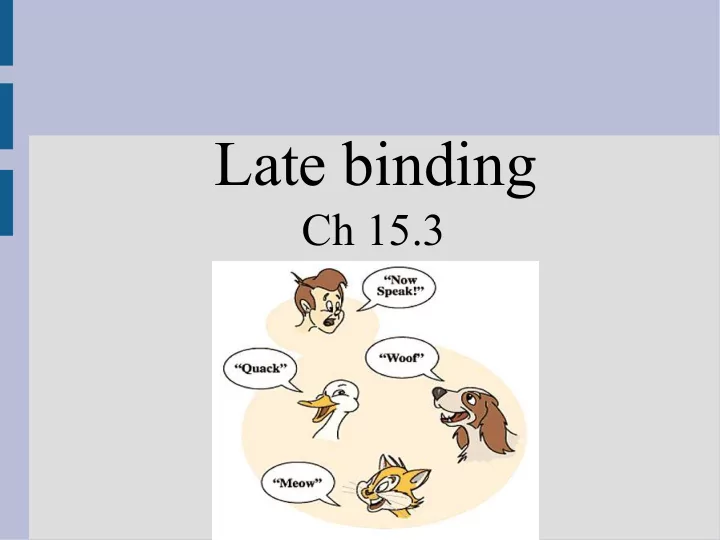
SLIDE 1
Late binding
Ch 15.3
SLIDE 2 Highlights
- Late binding for variables
SLIDE 3
Review: Derived classes
Today we will deal more with inheritance Mainly we will focus on how you can store a child class in a parent container (sort of) Questions we will answer: What is this line of code doing exactly? Are there other ways of doing this?
SLIDE 4 Early vs late binding
Static binding (or early) is when the computer determines what to use when you hit the compile button Dynamic binding (late) is when the computer figures out the most appropriate action when it is actually running the program Much of what we have done in the later parts
- f class is similar to late binding
SLIDE 5 Static binding
When you go to a fast-food-ish restaurant, you get one tray, regardless of what you order The key is before they knew what you were
- rdering, they determined you needed one tray
SLIDE 6
Dynamic binding
When you order a drink, they do not just give you a standard cup and say “fill to this line” Now, they have to react to what you want and give you the correct cup size (not a predetermined action, thus dynamic binding)
SLIDE 7
Static binding
Checking out at a grocery store, all items are scanned and added to the bill in the same way The same program on the computer runs for all items and just identifies their price
SLIDE 8 Dynamic binding
After you pay, you put the food into bags (paper/plastic/your own) What items go where depends on what you want to use and the item properties (weight, dampness, rigidness, etc.)
Both
SLIDE 9
All animals need to mate, so we could build a generic Animal class with a function mate() However, the gender roles in mate() are very different between species...
Static/dynamic binding
snack caring
SLIDE 10
Static/dynamic binding
Consider this code: You know the output even before the program runs (you know at compile time = static) While this code, you only know the output when the program runs (i.e. dynamic): (See: compleVsRun.cpp)
SLIDE 11
Static/dynamic binding
static = rigid/constant dynamic = flexible/adaptive
SLIDE 12 Static/dynamic binding
Static/dynamic binding is similar to how we
- riginally made arrays: (static/early binding)
To dynamic memory arrays: (dynamic/late)
SLIDE 13 Mini-quiz (ungraded)
What is in p at end of main()?
- 1. x=2
- 2. x=2, y=10
- 3. x=1, y=10
- 4. x=1
(Hint: what happens on this:)
SLIDE 14
= between parent/child
It is debatable how we should interpret line: In C++ (not some other languages), this just copies the parts of the parent class over Parent Child Parent
=
int x = 2 int x = 2 int y = 10 p c
SLIDE 15 Mini-quiz (ungraded)
What is at p now?
- 1. x=2
- 2. x=2, y=10
- 3. x=1, y=10
- 4. x=1
SLIDE 16
= between parent/child pointers
When the objects are pointers, lines line just changes the object being pointed to (but not any information inside either class) Parent Child Parent
=
int x = 1 int x = 2 int y = 10 p c Parent* Child* go go
SLIDE 17
Dynamic variable binding
If a Parent type is pointing to a Child instance, we cannot directly access them (variables cannot be “virtual”...) Instead, we have to tell it to act like a Child* by casting it: (bad practice as y public) (see: dynamicObject.cpp) (see: whatMyType.cpp)
SLIDE 18
Dynamic variable binding
If p points to a Parent instance, the below line is VERY BAD (but it might work... sorta...) You will be fooling around in some part of memory that is not really associated p (though you might not crash...) (see: badMemoryManagement.cpp) (see: memoryOops.cpp)