Law and regulatory issues Markus Peuhkuri 2005-04-26 Lecture - - PDF document

law and regulatory issues
SMART_READER_LITE
LIVE PREVIEW

Law and regulatory issues Markus Peuhkuri 2005-04-26 Lecture - - PDF document

Law and regulatory issues Markus Peuhkuri 2005-04-26 Lecture topics Legal issues Main focus on Finland (EU) IANAL, law is not a set of axioms however, law must be understood by common


slide-1
SLIDE 1

Law and regulatory issues

Markus Peuhkuri 2005-04-26

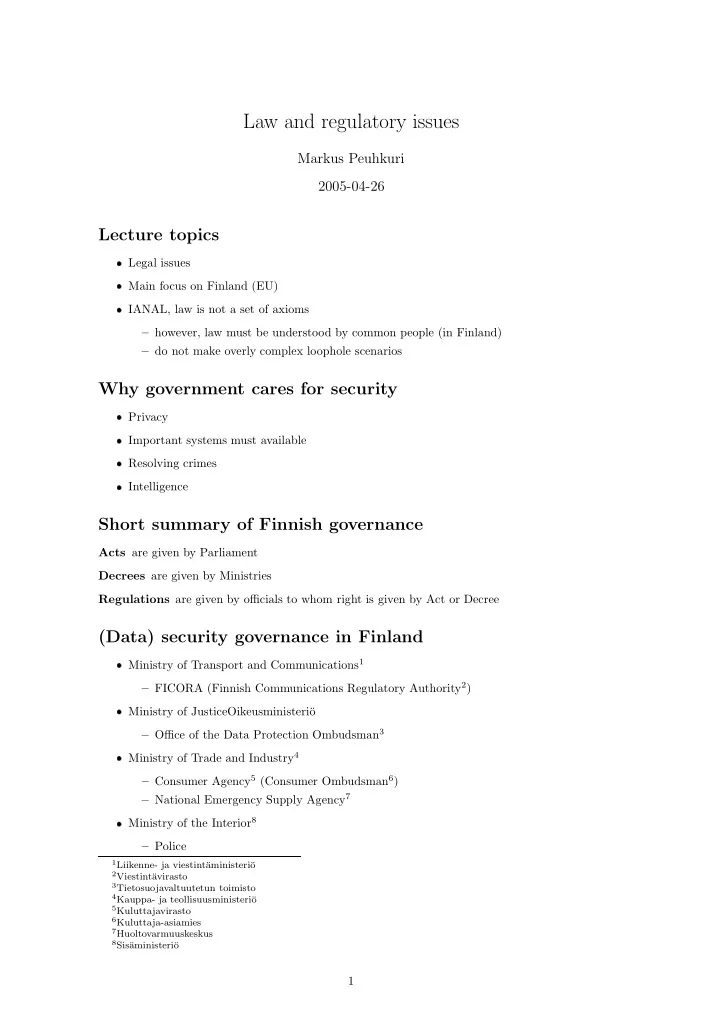
Lecture topics

  • Legal issues
  • Main focus on Finland (EU)
  • IANAL, law is not a set of axioms

– however, law must be understood by common people (in Finland) – do not make overly complex loophole scenarios

Why government cares for security

  • Privacy
  • Important systems must available
  • Resolving crimes
  • Intelligence

Short summary of Finnish governance

Acts are given by Parliament Decrees are given by Ministries Regulations are given by officials to whom right is given by Act or Decree

(Data) security governance in Finland

  • Ministry of Transport and Communications1

– FICORA (Finnish Communications Regulatory Authority2)

  • Ministry of JusticeOikeusministeri¨
  • – Office of the Data Protection Ombudsman3
  • Ministry of Trade and Industry4

– Consumer Agency5 (Consumer Ombudsman6) – National Emergency Supply Agency7

  • Ministry of the Interior8

– Police

1Liikenne- ja viestint¨

aministeri¨

  • 2Viestint¨

avirasto

3Tietosuojavaltuutetun toimisto 4Kauppa- ja teollisuusministeri¨

  • 5Kuluttajavirasto

6Kuluttaja-asiamies 7Huoltovarmuuskeskus 8Sis¨

aministeri¨

  • 1
slide-2
SLIDE 2

Privacy

  • Governed by multiple laws

– Act on the Protection of Privacy in Electronic Communication9 (516/2004) – Personal Data Act10 (523/1999) – Communications Market Act11 (393/2003)

  • A message that is not intended to public, is confidential regardless of medium

– unintended recipient may not disclose even existence of message – one may return to sender

Act on the Protection of Privacy in Electronic Communica- tion12 (516/2004)

  • Replaces Act on the Protection of Privacy and Data Security in Telecommunications

22.4.1999/565

  • Implements EC Directive on Privacy and Electronic Communications13 (2002/58/EC)
  • Definitions

message is a phone call, e-mail message, SMS message, voice message or any comparable message sent in communications network is any system using electromagnetic means to transport mes- sage public communications network is a network available to set of users without any prior restriction telecommunications operator network- or service provider network service provision of a communications network by a telecommunications opera- tor for providing communications service means the transmission, distribution or provision of messages value added service using identification data or location identification data associated to subscriber or user location data shows the geographic location subscriber a legal person or a natural person corporate or association subscriber user a natural person information security administrative and technical measures to protect data processing means collecting, saving, organising, using, transferring, disclosing, storing, modifying, combining, protecting, removing, destroying and other similar actions.

  • Covers

– public communication networks – networks attached to public networks – secrecy and privacy in internal (restricted) networks

9S¨

ahk¨

  • isen viestinn¨

an tietosuojalaki

10Henkil¨

  • tietolaki

11Viestint¨

amarkkinalaki

12s¨

ahk¨

  • isen viestinn¨

an tietosuojalaki

13s¨

ahk¨

  • isen viestinn¨

an tietosuojadirektiivi

2

slide-3
SLIDE 3

Act on the Protection of Privacy

  • Sets demand on

– network and service providers – value-add service providers – corporate subscribers – users of network

  • Handling of identification data

– any data that records existence or details of a message

  • Corporate subscriber

– organisation, that has users using services provided – may also be the other party in communications – usually a bystander – ultimately responsible even if outsourced

Who has right to handle identification data

  • To realise services

– even automatic handling for relaying is handling

  • To implement data security

– firewalls, virus scanners – must not infer with legal communication

  • For charging

– in most cases, no reason to reveal B-number ⇒ aggregate information sufficient

  • To improve technical implementation

– only aggregate or anonymous information

  • To resolve technical problems
  • To resolve misuse

– not to follow where a employee visits or what messages sends (unless identified as virus)

  • Communicating parities
  • If permission by one of communicating parties

How to handle identification data

  • Only when needed
  • Only as much as needed
  • Only those whose duties it belongs to
  • Handing information over only to those that have right
  • Service provider must have audit trail for two years
  • Professional discretion must be maintained

3

slide-4
SLIDE 4

Information security and privacy

  • Corporate subscriber must take case of identification data security
  • Threats on information security

– may take actions to protect system security – remove malicious payload – deny accepting message

  • Must not exaggerate actions

– no limit freedom of speech or privacy – must stop as soon as there is no immediate need – filtering should be done without accessing message content

Communications Market Act

Public communications networks and communications services and the communications networks and communications services connected to them shall be planned, built and maintained in such a manner that:

  • 1. the technical quality of telecommunications is of a high standard;
  • 2. the networks and services withstand normal, foreseeable climatic, mechanical, electromag-

netic and other external interference;

  • 3. they function as reliably as possible even in the exceptional circumstances referred to in

the Emergency Powers Act and in disruptive situations under normal circumstances;

  • 4. the protection of privacy, information security and other rights of users and other persons

are not endangered;

  • 5. the health and assets of users or other persons are not put at risk;
  • 6. the networks and services do not cause unreasonable electromagnetic or other interference;
  • 7. they function together and can, if necessary, be connected to another communications

network;

  • 8. terminal equipment meeting the requirements of the Radio Act can, if necessary, be con-

nected to them;

  • 9. they are, if necessary, compatible with a television receiver that meets the requirements of

this Act;

  • 10. their debiting is reliable and accurate;
  • 11. access to emergency services is secured as reliably as possible even in the event of network

disruptions;

  • 12. a telecommunications operator is also otherwise able to meet the obligations it has or those

imposed under this Act.

Information security

  • n

Communications provider (FI- CORA 47B 2004M)

  • Administrative security14

– organisational security (ISO 17799) – documentation

  • high-level principles

14Hallinnollinen tietoturvallisuus

4

slide-5
SLIDE 5
  • detailed information for day-to-day operation

– liabilities and resources – frequent evaluation and updating – security auditing – outsourcing

  • Personal security15

– background checks – avoiding dangerous positions: ones where there is no another person supervising other

  • r where one can cover her tracks.
  • Communication security16

– information of communication may not be disclosed to third parties – must have user identification / authentication / non-repudiation systems – able to limit or filter traffic

  • Equipment and software security17

– security threats must be controlled – no unnecessary services – backup systems and backup data

  • Documentation security18

– information classification – rights based on tasks, access control

  • Usage security19

– controlled risks – rights only for those who need those – bookkeeping who has right to where – no unauthorised use – security violations must be identified

Responsibilities in outsourcing

  • Provider ultimately responsible
  • What are roles:

– provider ⇔ outsourced – when contractor becomes provider?

15Henkil¨

  • st¨
  • turvallisuus

16Tietoliikenneturvallisuus 17Laitteisto- ja ohjelmistoturvallisuus 18Tietoaineistoturvallisuus 19K¨

aytt¨

  • turvallisuus

5

slide-6
SLIDE 6

Importance classification Ficora 27 E/2005 M20

  • It is not economical to protect all systems similarly
  • Classification based on impact
  • Important system21

– serious risks of unauthorised access – difficult to replace – disruption has an effect on 1/3 of numbering area (based on number of subscribers or by area) – disruption has an effect on more than 10000 customer of public broadcasting network

  • Very important system22

– high importance to service continuity or during state of emergency – relays significant proportion of important community traffic – disruption covers whole numbering area – disruption covers all public broadcasting network

  • Physical security, backup power

Examples of important systems

  • Important exchange in numbering area
  • Important exchange in long-distance network
  • Control room of mobile network
  • SMS exchange
  • Core network router
  • Authentication server
  • Name server
  • Server hotel
  • Broadcasting station for more than 10000 subscriber
  • System serving more than 100 voice subscriber: POTS, VoIP, mobile radio voice channels,

PBX connections

Examples of very important systems

  • Most important exchanges of long-distance network
  • Network management servers for very important systems
  • Mobile network exchange
  • Mobile network and IN databases
  • Root name servers
  • Internet exchanges
  • National DVB multiplex management system
  • System serving more than 500 voice subscriber: POTS, VoIP, mobile radio voice channels,

PBX connections

20Yleisen viestint¨

averkon t¨ arkeysluokittelu

21T¨

arke¨ a j¨ arjestelm¨ a

22Eritt¨

ain t¨ arke¨ a j¨ ajrestelm¨ a

6

slide-7
SLIDE 7

Decrees on email

  • Ficora 11/2004M
  • Prohibiting open relays

– must disconnect if one found

  • Consumer SMTP traffic through provider system

– inbound, outbound – provider may provide open access

  • must inform customer
  • must be able to react quickly
  • Malicious email traffic

– filtering of traffic – ability for emergency filtering – must disconnect host sending malicious traffic

  • Must monitor email system performance

– delay, system load – breaks by type – information about filtering – number of disconnected subscriber connections

  • Must have standard mailboxes: security, abuse, noc, postmaster

Authorised wiretapping

  • Prohibited in Finland before 1st June 199523
  • Wiretapping24

– listening or recording of message – for serious crimes; it is also allowed on some lesser crimes in which it is difficult to get evidence without wiretapping

  • Remote surveillance25

– identification information from messages, not content – location info – for crimes that maximum penalty is at least four years – crimes done though communication network – also information about all mobile devices around some place at certain time

  • Telecommunications operator must provide capacity for both
  • Requires court order; remote surveillance allowed by officer’s order in urgent situation.

Must notify court within 24 hours.

23Pakkokeinolaki 24Telekuuntelu 25Televalvonta

7

slide-8
SLIDE 8

State of emergency

  • How to protect communications in crisis

– logical and physical protection

  • Information warfare

– disrupting normal communications – spreading false information

  • Additional communications

– priority calls – emergency switching: non-priority calls are blocked

Reporting responsibility

  • Telecommunications provider must report to FICORA

– security violations

  • break-ins to provider systems
  • sensitive information disclosure
  • degenerated performance because of attack (DOS, SPAM)
  • malicious software in provider system
  • social engineering
  • unauthorised wiretapping equipment

– security threats

  • serious break-in attempts
  • anomalous traffic
  • new security problems in provider systems

– serious system malfunction or disruption

  • breaks longer than one hour affecting many subscribers
  • very important system malfunction more than 30 minutes
  • Customers must be informed

– customer education – information about implemented protection measures like email filtering

How about international issues

  • Which law should be enforced

– server location – user location – service provider location

  • Standpoint by country (note: extremely glib)

user privacy Northern Europe government rights Mediterranean Europe, Asia corporate rights USA – who owns your personal details: you or collector

  • War on terror adds law enforcement powers

8

slide-9
SLIDE 9

Summary

  • Laws and regulatory actions needed
  • Several aspects of security must be covered
  • Important to classify

– connections – equipment – documents – data sources – people to maintain security 9