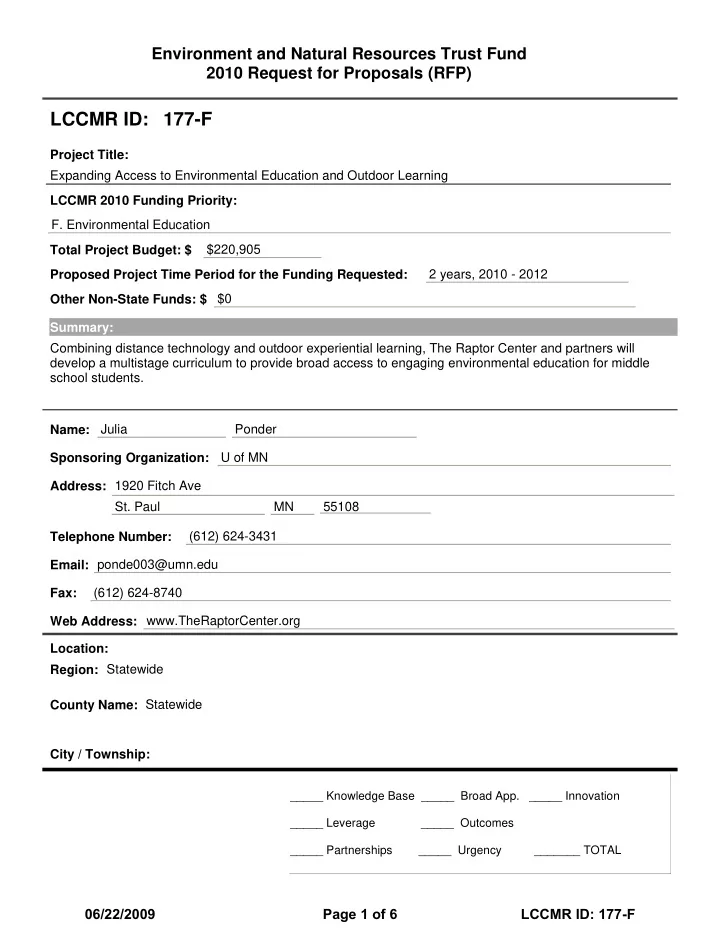
LCCMR ID: 177-F Project Title: Expanding Access to Environmental - - PDF document

lccmr id 177 f
SMART_READER_LITE
LIVE PREVIEW

LCCMR ID: 177-F Project Title: Expanding Access to Environmental - - PDF document

Environment and Natural Resources Trust Fund 2010 Request for Proposals (RFP) LCCMR ID: 177-F Project Title: Expanding Access to Environmental Education and Outdoor Learning LCCMR 2010 Funding Priority: F. Environmental Education Total


slide-1
SLIDE 1

Environment and Natural Resources Trust Fund 2010 Request for Proposals (RFP)

Expanding Access to Environmental Education and Outdoor Learning $220,905 2 years, 2010 - 2012 $0 Julia Ponder U of MN 1920 Fitch Ave

  • St. Paul

MN 55108 (612) 624-3431 (612) 624-8740 ponde003@umn.edu www.TheRaptorCenter.org Statewide Combining distance technology and outdoor experiential learning, The Raptor Center and partners will develop a multistage curriculum to provide broad access to engaging environmental education for middle school students. Project Title: Total Project Budget: $ Proposed Project Time Period for the Funding Requested: Other Non-State Funds: $ Name: Sponsoring Organization: Address: Telephone Number: Email: Fax: Web Address: County Name: City / Township: Region: Summary: Statewide

LCCMR ID: 177-F

LCCMR 2010 Funding Priority:

  • F. Environmental Education

Location:

_____ Knowledge Base _____ Broad App. _____ Innovation _____ Leverage _____ Outcomes _____ Partnerships _____ Urgency _______ TOTAL

06/22/2009 Page 1 of 6 LCCMR ID: 177-F

slide-2
SLIDE 2

MAIN PROPOSAL PROJECT TITLE: Expanding Access to Environmental Education and Outdoor Learning

  • I. PROJECT STATEMENT

Live animals provide a unique and compelling educational tool for delivering important messages about conservation, ecosystem interconnectedness, and the big picture of environmental sustainability. While live animal presentations on-site are effective as tools for delivering environmental education, they clearly present serious limitations. Programs are typically one - time experiences and are constrained by barriers

  • f geography and transportation. Most outstate Minnesota schools lack the opportunity to access

programming of the quality presented by this project’s collaborators. Additionally, while children are riveted by lessons involving live animals, we know that multiple interactions and hands-on experience can enhance learning even more. We need creative educational solutions for school districts and regions where programming is currently unavailable or not accessible. At the same time, we are interested in developing programs that allow for longer, more in-depth, and potentially more life-changing interactive relationships with young people than our existing programs typically permit. As acknowledged leaders in education about the natural world, The Raptor Center, the Minnesota Zoological Gardens, Wolf Ridge Environmental Learning Center and the Great Lakes Aquarium are eager to more fully embrace the challenge of expanding environmental literacy. We will develop a curriculum for 5th – 8th

  • II. DESCRIPTION OF PROJECT RESULTS

graders built on a hybrid model that uses technology to provide broad access to well- established Minnesota environmental education programs, combines that access with a local outdoor learning experience, and creates interactive discussions with scientists to enhance learning. Through this multi-stage process, students will learn skills designed to increase their awareness and knowledge of the natural world, develop a deeper understanding of how humans impact the natural world and identify ways that they can make a difference. We will create multimedia and experiential classroom tools to engage students in the natural world, as well as a professional development course for teachers to develop new skills for enhancing their teaching of environmental education. Teacher focus groups currently being conducted by The Raptor Center will be used to assure a usable product for classrooms results. Result 1: Developing Eco-Scientists curriculum Budget: $ This is a pilot program in the development of a multi-stage curriculum to engage students in outdoor learning and environmental science. Each partner on the team will bring specific content expertise, experience in the delivery of exceptional environmental education, and knowledge of conservation and the challenges of human impacted environmental change. The curriculum will have four components: _181,194_____

  • 1. A 45 minute multimedia program introducing a variety of outdoor ecosystems/habitats, the wildlife

that live there and the issues they face. Using live animals to captivate the students’ attention, this program will bring scientists into the classroom and set the foundation for introducing the students to

  • utdoor exploration and learning. Once developed, this program will be delivered through the

University of Minnesota’s Digital Campus and connected with the University’s College Readiness Consortium.

  • 2. Lesson plans for outdoor, experiential learning projects to help students build their skills in
  • bservation and description, promote inquiry and expand critical thinking and problem-solving skills.

These activities will promote outdoor exploration of a local ecosystem and engage students with their local outdoor environment. To develop these lesson plans, a workshop will be held to facilitate creative brainstorming and focused productivity among the project partners and teacher focus group

  • participants. Lesson plans will be housed on a common web site and will be freely available to

teachers and the general public.

06/22/2009 Page 2 of 6 LCCMR ID: 177-F

slide-3
SLIDE 3
  • 3. An on-line medium will be established for interaction between students and scientists during the

course of the students’ outdoor study.

  • 4. A final summary session with one of the partner organizations will bring the students face to face

with a scientist; this seminar will be delivered live on-site, off-site or over the internet, depending on classroom location and capacity. For outstate classrooms without adequate videoconferencing equipment, The Raptor Center will use UM Connect, a webcasting service accessible to any school with an internet connection. The seminar will reinforce learning about the human role in creating sustainable ecosystems. A key component of this session will be brainstorming with the students ways they might give back to improve the natural world The effectiveness of this multi-modal approach will be evaluated with pre and post assessment tools and used to inform future program expansion. Program deliverables will be adjusted to suit teacher needs as elicited through currently on-going focus groups. Deliverable Completion Date

  • 1. A 45 minute introductory multi-media program

Dec 1, 2011

  • 2. Classroom tools: lesson plans, pre and post assessment tools

Jul 1, 2011

  • 3. Interactive on-line resource site

Jul 1, 2011 Result 2: Professional Development for Teachers Budget: $ A professional development course for teachers on using live animals as a teaching resource will be

  • created. The goal will be to give teachers skills to support the environmental education concept. This

program will be delivered online in an independent study format through the University of Minnesota’s Digital Campus. Teachers passing the evaluation portion will receive continuing education credits through the University of Minnesota. _39,711_____ Deliverable Completion Date

  • 1. “Animals in the Classroom” – on-line professional development course

Dec 31, 2010

  • III. PROJECT STRATEGY
  • A. Project Team/Partners

The project team will be composed of experts in environmental education and curriculum development from four well-established non-profits in Minnesota. In addition, the University of Minnesota brings expertise in internet technologies, distance learning and education. Julia B. Ponder, The Raptor Center, University of Minnesota: Project coordinator Gail Buhl, The Raptor Center, University of Minnesota: Project manager Kim Skylander, Wolf Ridge Environmental Learning Center, Finland MN: Content expert, Site Coordinator Sarah Erickson, Great Lakes Aquarium, Duluth, MN: Content expert, Site Coordinator Gina Goralski, Minnesota Zoological Gardens, Apple Valley, MN: Content expert, Site Coordinator

  • B. Timeline Requirements

This project will be carried out over 18 months. The initial six months will be spent in data collection and assimilation from teacher focus groups. Filming for pre-taped sections will occur over a one year time period to encompass all seasons; lesson plans and other components will be done concurrently. Final production will require 6 months.

  • C. Long-Term Strategy

This program is the first stage of developing a comprehensive environmental outreach program using distance learning technologies. Distribution of the curriculum will be on a fee-for-service basis. In addition, funding will be sought from foundations for accessing underserved schools and students. Future module development will be based on evaluation of success of this program.

06/22/2009 Page 3 of 6 LCCMR ID: 177-F

slide-4
SLIDE 4

C:\Documents and Settings\dgriffit\My Documents\ML2010\RFP\2010 Proposals - JUNE FINALS\177-F - Ponder Julia 0409-2-169 - Budget

BUDGET ITEM (See list of Eligible & Non-Eligible Costs, p. 13) Personnel: Project manager - 0.5 FTE (UMN wages plus 32.7% benefits), 18 months Graduate student - 0.5 FTE (UMN wages plus 60% benefits), 18 months -research, filming, writing, curriculum building Contracts: Professional and technical input from MN Zoo, Wolf Ridge and Great Lakes Aquarium staff: content resource, filming time (10% time) University of Minnesota Digital Campus: instructional design, filming, web development/graphic design, editing/final production Videographer Equipment/Tools/Supplies: Video camcorder for live webcasting Document camera - displaying biofacts for webcasting Tripod for camcorder Lighting Installation cabling Videoconferencing equipment (Great Lakes Aquarium)- codec, camcorder, tripod, monitors, wiring Acquisition (Fee Title or Permanent Easements): Travel: Travel expenses within Minnesota for teacher focus groups, filming, and workshop Additional Budget Items: TOTAL PROJECT BUDGET REQUEST TO LCCMR SOURCE OF FUNDS AMOUNT Status Other Non-State $ Being Applied to Project During Project Period: Proposals will be submitted to foundations supporting environmental education for program testing and delivery: Hugh J Andersen Fdn, 3M Fdn, Carolyn Fdn. Ecolab Fdn, F.R. Bigelow Fdn

  • $

Pending Other State $ Being Applied to Project During Project Period:

  • $

Indicate: Secured or Pending In-kind Services During Project Period: Program oversight (Executive Director/Raptor Center - 3%FTE salary/fringe $3,873 Remaining $ from Current Trust Fund Appropriation (if applicable): N/A N/A Funding History: This is a pilot project, however funds for teacher focus groups currently informing the process have been provided by Hugh J Andersen Foundation and Next Generation Fund. 12,000 $

  • $

500 $ 500 $ 16,146 $ 4,500 $

  • $
  • $

58,720 $

  • V. OTHER FUNDS

Project Budget

  • IV. TOTAL PROJECT REQUEST BUDGET (2 years)

AMOUNT

  • $

26,624 $ 220,905 $ 31,446 $ 2,574 $ 294 $

  • $

1,621 $ 73,500 $ 4,480 $

06/22/2009 Page 4 of 6 LCCMR ID: 177-F

slide-5
SLIDE 5

Julia Ponder, DVM – Executive Director for The Raptor Center and College of Veterinary Medicine faculty member is the PI for this project and will provide project oversight and

  • coordination. For University of Minnesota submission protocol, she is listed as the project

manager and will be the primary contact for the proposal. Gail Buhl - Education Program Manager for The Raptor Center, will be the key personnel for this project. She brings extensive environmental education experience: Gail has a B.S. in Biology from the University of Minnesota. She has been working with and training a variety of animal species, but predominantly raptors since 1989. She has varied experience in writing, training, and presenting programs of all types. Gail has fully managed three very different programs at the Carpenter St. Croix Valley Nature Center in Hastings, Minnesota; the Minnesota Zoo World of Birds Show and Wolf Ridge Environmental Learning Center in Finland, Minnesota. At all three facilities she trained and managed volunteers, interns and staff on a daily basis. For these institutions she wrote Environmental Education curriculum for presentation to all ages especially in the area connecting people and birds. She has modified and created several supplemental activities to supplement ongoing curricula at The Raptor Center to increase student participation and learning of certain concepts. As an aside, she co-edited and authored the book, Wildlife in Education: A Guide for the Care and Use of Program Animals . Published in 2004 by the National Wildlife Rehabilitators Association (NWRA). And she has been an instructor for the Care and Management of Captive Raptors Workshops held at The Raptor Center since September 2005 to the present. Established in 1974, The Raptor Center at the University of Minnesota is a world renowned leader in raptor medicine and surgery. The Center has a threefold mission: to promote the health

  • f the ecosystem through the study of emerging issues; to train future leaders in avian medicine

and ecosystem health; and to increase stewardship of the environment through public

  • engagement. Key accomplishments of the organization include pioneering avian orthopedic

techniques and critical care, re-introduction of the peregrine falcon into the Midwest United States along with work on other endangered species such as the bald eagle and the California condor, treatment of over 17,000 raptors since 1974 and an outreach program that reaches 350,000 people each year. Additionally, over 300 veterinarians and veterinary students from over 27 different countries have come to study at The Raptor Center. The Center’s staff is well represented in the scientific literature on raptor medicine and care, and has published numerous books and chapters in these areas. Current areas of focus are the study of raptors as sentinels for emerging issues in ecosystem health, the development of an infrastructure for using data from wildlife hospitals for health monitoring of wild animal populations, clinical studies of new treatment protocols, expanded training capacity for veterinarians and the use of technology to enhance outreach methods to increase stewardship of the environment. As part of the University

  • f Minnesota’s College of Veterinary Medicine, the Center brings strong partnerships and

collaborations to the work it does. Although part of the university, The Raptor Center is a non- profit organization whose work is supported by community philanthropy and augmented by the efforts of over 300 volunteers

06/22/2009 Page 5 of 6 LCCMR ID: 177-F

slide-6
SLIDE 6

06/22/2009 Page 6 of 6 LCCMR ID: 177-F