LCS 11: Cognitive Science Aim to get data by end of this week - - PowerPoint PPT Presentation

lcs 11 cognitive science
SMART_READER_LITE
LIVE PREVIEW

LCS 11: Cognitive Science Aim to get data by end of this week - - PowerPoint PPT Presentation

Agenda Upcoming talks Pomona College Presentations LCS 11: Cognitive Science Aim to get data by end of this week Meetings next week Reading and the brain Group presentations May 1, 6 & 8 Aphasia Broca Jesse A. Harris


slide-1
SLIDE 1

Pomona College

LCS 11: Cognitive Science

Reading and the brain

Jesse A. Harris April 15, 2013

Jesse A. Harris: LCS 11: Cognitive Science, Reading and the brain 1

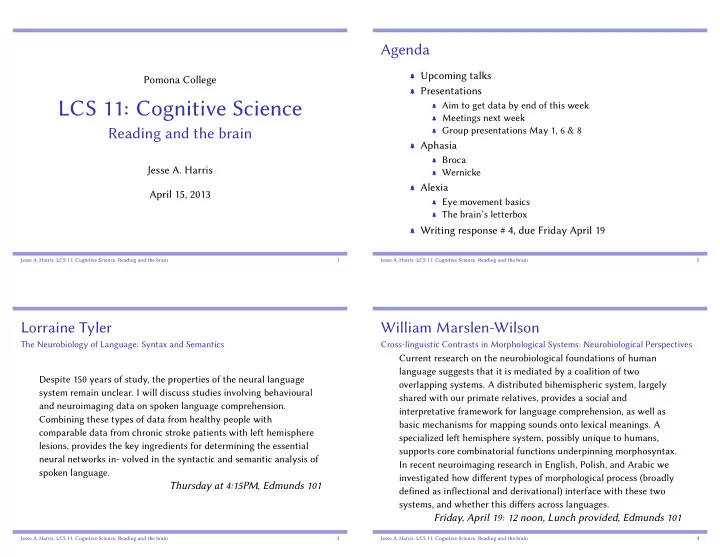
Agenda

֠ Upcoming talks ֠ Presentations

֠ Aim to get data by end of this week ֠ Meetings next week ֠ Group presentations May 1, 6 & 8

֠ Aphasia

֠ Broca ֠ Wernicke

֠ Alexia

֠ Eye movement basics ֠ The brain’s letterbox

֠ Writing response # 4, due Friday April 19

Jesse A. Harris: LCS 11: Cognitive Science, Reading and the brain 2

Lorraine Tyler

The Neurobiology of Language: Syntax and Semantics

Despite 150 years of study, the properties of the neural language system remain unclear. I will discuss studies involving behavioural and neuroimaging data on spoken language comprehension. Combining these types of data from healthy people with comparable data from chronic stroke patients with left hemisphere lesions, provides the key ingredients for determining the essential neural networks in- volved in the syntactic and semantic analysis of spoken language.

Thursday at 4:15PM, Edmunds 101

Jesse A. Harris: LCS 11: Cognitive Science, Reading and the brain 3

William Marslen-Wilson

Cross-linguistic Contrasts in Morphological Systems: Neurobiological Perspectives

Current research on the neurobiological foundations of human language suggests that it is mediated by a coalition of two

  • verlapping systems. A distributed bihemispheric system, largely

shared with our primate relatives, provides a social and interpretative framework for language comprehension, as well as basic mechanisms for mapping sounds onto lexical meanings. A specialized left hemisphere system, possibly unique to humans, supports core combinatorial functions underpinning morphosyntax. In recent neuroimaging research in English, Polish, and Arabic we investigated how different types of morphological process (broadly defined as inflectional and derivational) interface with these two systems, and whether this differs across languages.

Friday, April 19: 12 noon, Lunch provided, Edmunds 101

Jesse A. Harris: LCS 11: Cognitive Science, Reading and the brain 4

slide-2
SLIDE 2

Aphasia

Aphasia

Language disorder produced by brain damage Damage to specific areas associated with specific types of deficit.

  • 1. Broca’s (production)
  • 2. Wernicke’s (receptive)
  • 3. Conductive

Jesse A. Harris: LCS 11: Cognitive Science, Reading and the brain 5

Broca’s aphasia (1861)

◮ Leborgne (age 21; single word

word ‘Tam’) and Lelong (age 86; 5 words)

◮ Major speech production

difficulty

◮ Other cognitive functions spared ◮ At autopsy, found lesion in left

frontal lobe Paul Broca (1824–1880)

Jesse A. Harris: LCS 11: Cognitive Science, Reading and the brain 6

Broca’s aphasia

Example of a Broca’s aphasic: http://www.youtube.com/watch?v=f2IiMEbMnPM Consider watching this clip at home: http://www.youtube.com/watch?v=NUTpel04Nkc What do you notice about the patient’s speech?

Jesse A. Harris: LCS 11: Cognitive Science, Reading and the brain 7

Broca’s aphasia

◮ Speech is slow and labored ◮ Utterance are not complex ◮ Almost no “function words” like to, for, the, etc. ◮ Yet, words appear to be meaningful and on-topic ◮ In addition, awareness of deficit

Jesse A. Harris: LCS 11: Cognitive Science, Reading and the brain 8

slide-3
SLIDE 3

Wernicke’s aphasia (1875)

◮ Another type of aphasia, termed

“sensory aphasia”

◮ No signs of speech production

difficulty

◮ Lack of comprehension, both in

the utterance produced and reception of speech.

◮ At autopsy, found lesion in left

posterior temporal gyrus. Carl Wernicke (1848–1905)

Jesse A. Harris: LCS 11: Cognitive Science, Reading and the brain 9

Wernicke’s aphasia

Wernicke’s aphasia production http://www.youtube.com/watch?v=aVhYN7NTIKU Wernicke’s aphasia comprehension http://www.youtube.com/watch?v=dKTdMV6cOZw

Jesse A. Harris: LCS 11: Cognitive Science, Reading and the brain 10

Lesion sites

◮ Broca’s area: left temporal lobe, anterior to primary motor

cortex

◮ Wernicke’s area: Posterior portion of first temporal gyrus

Recap

Deficit Remaining capacity Lesion site Broca Production, agrammatism Comprehension, awareness Frontal lobe Wernicke Comprehension, Sensicality, Awareness Speech fluent Posterior temporal gyrus Table: Comparison of aphasia types

Jesse A. Harris: LCS 11: Cognitive Science, Reading and the brain 12

slide-4
SLIDE 4

Conduction aphasia

◮ Very rare type of aphasia ◮ Damage to the arcuate

fasciculus, a neural pathway thought to connect Wernicke’s area and Broca’s area (disputed)

◮ Both comprehension and

production seem relatively spared

◮ Difficulty repeating speech ◮ Make speech errors and try to

correct them, usually with much difficulty

Jesse A. Harris: LCS 11: Cognitive Science, Reading and the brain 13

Experiments on aphasic patients

Non-reversible sentences

Can utilize our world and semantic knowledge to infer the likely relations between words. (3) The book that the girl is reading is yellow

Reversible sentences

Relations between words cannot be determined without help from the syntax. (4) The horse that the bear is kicking is brown

Jesse A. Harris: LCS 11: Cognitive Science, Reading and the brain 14

Experiments on aphasic patients

Predictions

Broca’s If Broca’s aphasics only have a production deficit for syntactic processing, they should be able to understand complex sentences (just not produce them). Thus, they should be able to perform well on both reversible and non-reversible sentences. Wernicke’s Predicted to have across the board difficulty, due to global deficit in comprehension. Non-reversible Reversible Wernicke Chance Chance Broca Good Good Table: Expectations across different aphasic groups

Experiments on aphasic patients

◮ Caramazza and Zurif 1976 tested three different kinds of

aphasics, as well as a control

◮ Presented subjects with reversible and non-reversible

sentences

◮ From two pictures, asked to pick the appropriate

depiction of the sentence

Non-reversible Reversible Wernicke Chance Chance Broca Good Chance Table: Performance across different aphasic groups

slide-5
SLIDE 5

Experiments on aphasic patients

◮ Evidence that all comprehension capacity for Broca’s

aphasics is not spared.

◮ How might we make sense of this pattern? What might

aphasics be doing to process the comprehend non-reversible sentences that would fail when attempting to process reversible sentences?

Jesse A. Harris: LCS 11: Cognitive Science, Reading and the brain 17

Geschwind’s 1965 model of language processing

Jesse A. Harris: LCS 11: Cognitive Science, Reading and the brain 18

Reading

Reading processes involves by various factors, including

  • 1. Acuity limitations on the eye
  • 2. Rapid movements to overcome such limitations
  • 3. Decoding of orthographic forms into phonetic ones
  • 4. Access meaning and integration into sentential and

discourse context

Jesse A. Harris: LCS 11: Cognitive Science, Reading and the brain 19

The eye

Retina

Neural sheet at back of eye consisting of photoreceptors in various densities.

Fovea

High concentration of cones – photoreceptors responsible for visual acuity, constituting 15°

  • f visual field.

Jesse A. Harris: LCS 11: Cognitive Science, Reading and the brain 20

slide-6
SLIDE 6

Reading

Saccade

Ballistic eye movements that propel the eye to another fixation point.

Perceptual span

Asymmetric perceptual window during reading: 3–4 letters to left; 7–8 to right.

Jesse A. Harris: LCS 11: Cognitive Science, Reading and the brain 22

Reading Reading

slide-7
SLIDE 7

Alexia

Pure alexia

Recognize letters as letters, but incapable of naming or using them to recognize words.

◮ Other visual and verbal

capacities are largely spared.

◮ Able to recognize numbers! ◮ Damage to left occipto-temporal

area Joseph Jules Déjerine (1849–1917)

Jesse A. Harris: LCS 11: Cognitive Science, Reading and the brain 25

Dehaene, 2009: Fig 2.1 Dehaene, 2009: Fig 2.1 “Why should all human beings have this built-in facility for reading, when writing is a relatively recent cultural invention?” “How, then, did the visual word form area of the human brain arise?” Oliver Sacks (b. 1933)

Jesse A. Harris: LCS 11: Cognitive Science, Reading and the brain 28

slide-8
SLIDE 8

The brain constrains writing systems by accepting only a limited types of symbols, those shared with other, more ancestral forms of visual

  • processing. Thus, shared by all

humans – with natural, and universal, restrictions on

  • rthographies.

Stanislas Dehaene (b. 1965)

Jesse A. Harris: LCS 11: Cognitive Science, Reading and the brain 29

Writing response 4, due Friday, 19 April

In previous classes, we’ve discussed the role of biases in

  • cognition. According to Eagleman, biases are, to some extent,

what makes us smart by providing some order in perceptual

  • chaos. In the unit on language, we’ve seen examples of bias in

word leaning - for example, the whole object bias. In your response, please address the following three questions in 2-3 single spaced pages: (1) Can we say that biases encountered during language acquisition also make us smart? (2) How about restrictions that seem to be imposed by our particular native language - for example, whether we have an exact (cardinal) or relative number system? (3) How are such restrictions similar or different than biases in terms of their cognitive effect? Defend your position by using concrete examples of biases and restrictions from the readings to illustrate your point.